Difference between Feedback and Feed Forward control systems (original) (raw)
Last Updated : 10 Mar, 2026
Control systems play an essential role in regulating processes to ensure stability and productivity, primarily through the use of feedback and feedforward control mechanisms. **Feedback control systems respond to output deviations and provide precise corrections, but may be slower.
**Feedforward control systems act proactively to disturbances, offering quick responses but lacking error-correcting capabilities. Understanding the differences between these systems enhances decision-making when selecting the appropriate control method for specific processes.
**Feedback Control System?
A feedback control system is basically a control system where the output depends on the generated feedback signal. A feedback control system is responsible for processing the feedback signals, which further act as an input to the system. A feedback control system consists of different components, such as resistors, transistors, and other electrical components that perform the basic functioning. The feedback can further be divided into positive feedback and negative feedback.
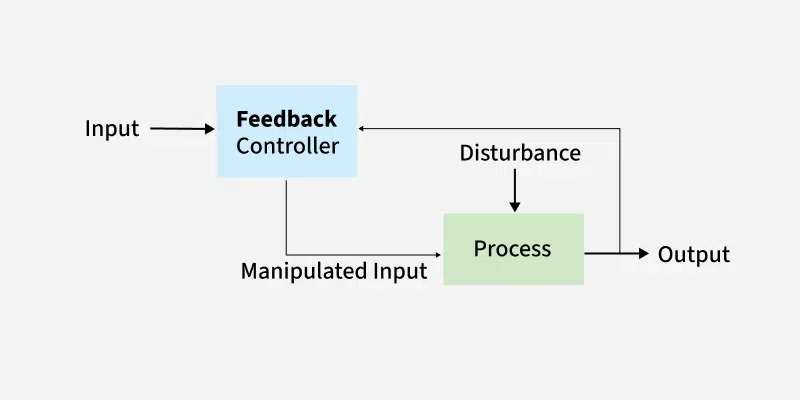
Feedback Control System
Advantages
- **Accurate Error Correction: Continuously monitors and rectifies output deviations, ensuring high precision.
- **Stability: Effective for maintaining accuracy and balancing variations in input or disturbances.
- **Adaptability: Adjusts to disturbance inputs and variations, ensuring consistent system performance.
- **Simplified Design: Feedback loops can be implemented without needing predictive modeling of disturbances.
- **Broad Applicability: Suitable for systems requiring precise adjustments, such as temperature control
Disadvantages
- **Slower Response Time: Reacts only after detecting an error, which may cause delays in dynamic systems.
- **Complexity: Designing feedback loops for complex systems can be challenging.
- **Potential for Oscillations: May cause instability unless carefully tuned.
- **Dependence on Measurement Accuracy: Requires precise measurement of output variables for effective error correction.
- **Error-Dependent: Struggles with large errors, potentially limiting corrective capability
**Feed Forward Control System
Feed forward control system is a system which passes the signal to some external load. It rejects the disturbances before they affect the controlled variable. It controls the major disturbances and is many times used with the combination of a feedback system. Feed forward systems are sensitive to modelling errors. It does direct measurement of the disturbances in the system. Feedback and feedforward control systems are two different types of control systems used in organizations to monitor and manage processes.
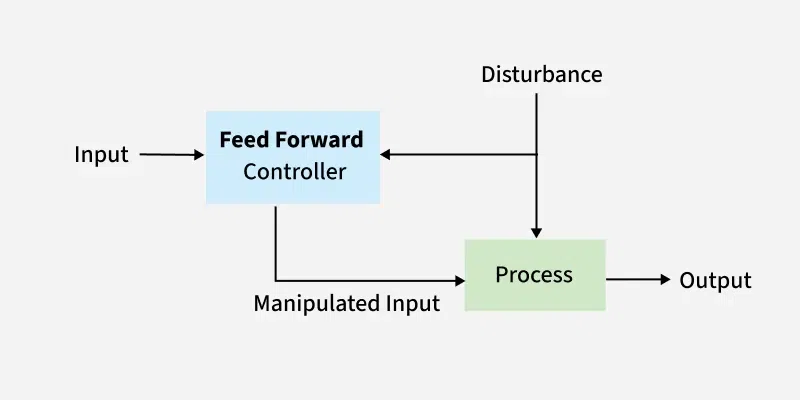
Feedforward Control System
Advantages of Feed Forward Control Systems
- **Faster Response: Preempts before an error takes place, it means that it responds faster.
- **Simple Design: Thus, no feedback loop simplifies the system design of the given problem.
- **Efficient for Predictable Systems: Most appropriate for those systems expected to undergo regular interferences or disruptiveness.
- **Smooth Operation: It helps maintain stability by adjusting inputs early, leading to smoother system performance.
- **Prevents Disturbances: By anticipating disturbances, feedforward systems can prevent them from affecting the output.
Disadvantages of Feed Forward Control Systems
- **No Error Correction: Should the unexpected disturbance happen the organization is unable to manage it once it happens.
- **Less Accurate: If the forecast of disturbances is wrong, then the system isn’t going to operate as planned.
- **Requires detailed system knowledge: Unlike feedback control, it requires modeling of the process and disturbance in order to function efficiently.
- **Sensitive to Changes: Feedforward systems are sensitive to changes in the environment or system that weren’t predicted.
- **Complexity: Designing a feedforward system can be more complex, as it requires understanding and modeling disturbances.
Feedback vs Feed Forward Control Systems
| Feedback Control System | Feed Forward Control System |
|---|---|
| In feedback system output depends on the generated feedback signal. | In feed forward system the signal is passed to some external load. |
| Measure of disturbances in the system is not needed by feedback system. | Measure of disturbances in the system is needed by feed forward system. |
| All the disturbances are detected in feedback system. | All the disturbances are not detected in feed forward system. |
| The loop in a feedback control system is a closed loop. | The loop in a feed forward control system is an open loop. |
| It focuses on the output of the system. | It focuses on the input of the system. |
| Can be more stable but may cause oscillations if not tuned properly. | Less stable if predictions are wrong; relies on accurate models. |
| Slower response, as it reacts after errors are detected. | Faster response, as it anticipates and adjusts in advance. |
| The variables are adjusted on the basis of errors. | The variables are adjusted on the basis of knowledge. |
| Used in systems where errors need to be corrected, such as temperature control, home heating, etc. | Used in systems where disturbances can be predicted, like in manufacturing processes or systems with known disturbances. |