Edge Triggering and Level Triggering (original) (raw)
Last Updated : 23 Jul, 2025
In digital circuits, two methods of triggering are possible, namely edge triggering and level triggering, which trigger the signal to switch from one state to the other. Both form part of digital electronics and help in increasing throughput and controlling the timing of operations in a given system.
What is Clock Pulse?
A clock pulse represents a series of periodic pulses that control the time of operations in digital circuits. Synchronization is used in conjunction with sequential circuits as a clock signal to control the changing of states at certain instances. It is possible to use clock pulses to control other triggered devices such as flip-flop and counters because these elements should change their state only within certain time, for instance at the rising or falling edge of the pulse.
What is Edge Triggering?
It is used wherever it is required to identify the transition in the state of the input signal from low to high or from high to low. It is commonly applied to synchronous circuits, including flip-flops and counters. More often, edge triggering is advantageous when high accuracy of timing is required.
In edge triggering, the rapid change in the input signal that is sampled by the circuit’s clock signal leads to a change in the signal. This edge, referred to as the trigger edge of the pulse, may be rising, that is, from a low state to high, or falling, that is, from high to low, depending on the circuit implementation. When the output signal crosses the trigger edge, the circuit changes the state of the output signal.
Advantages of Edge Triggering
- **Precise Timing: This simply ensures that the signal transition is correct and well timed due to timing needs such as flip-flops and counters.
- **Reliability: Offers less chances of errors occurring due to noise or variance in the signal that is being received.
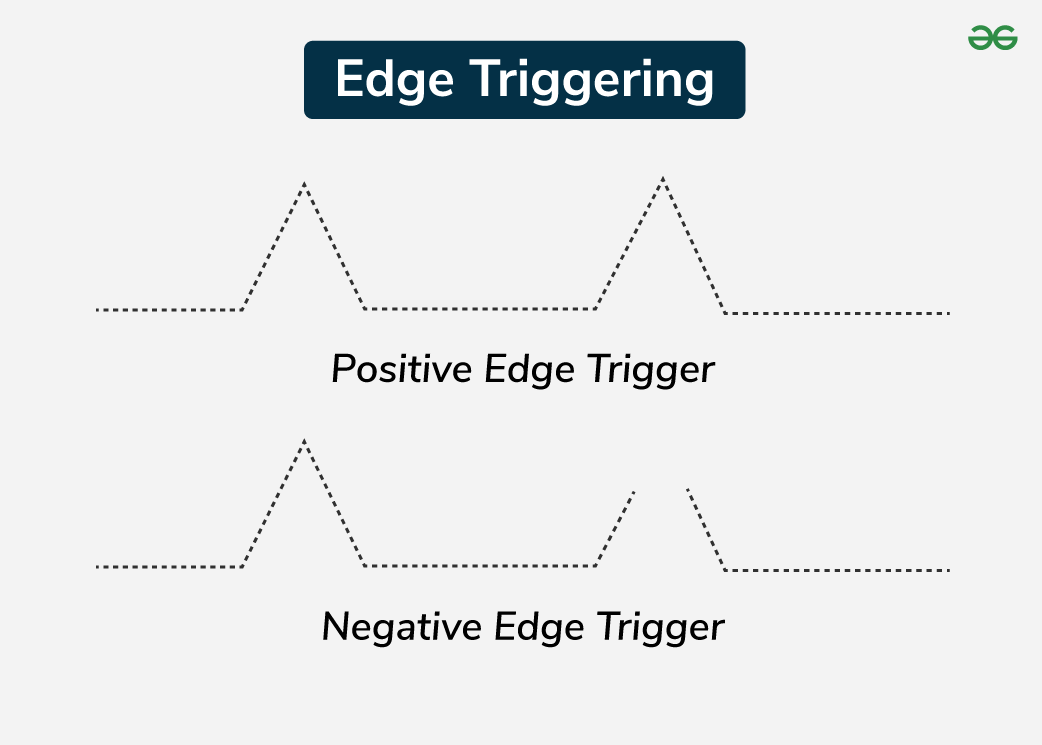
Edge Triggering
Disadvantages of Edge Triggering
- **Complex Design: Demands stricter clock management, which leads to the augmentation of the resulting circuit complexity.
- **High Sensitivity: May respond to unintended edges by noise, thus resulting in the possibility of an error in computation.
What is Level Triggering?
Level triggering, in contrast, is a kind of triggering that determines a signal at a certain level rather than the change of its state. It gives some output when it is required to know the value of the signal at some point in time and not just a change in state. Level triggering is commonly used in data acquisition and control systems because of the need for a constant level of input signal documentation.
Level triggering is continuously included that checks for the input signal, and the output is produced when the input signal is at the determined level and above. This level can be high or low depending on the design of this circuit type. The output signal depends on the triggered state until the input signal descends below the trigger level.
Advantages of Level Triggering
- **Continuous Monitoring: Optimum for applications where there is a need for determination of a signal level that is constant, including control systems and data acquisition.
- **Simpler Circuit Design: This is easier to implement as compared to the edge triggering circuits.
Disadvantages of Level Triggering
- **Less Precise: It offers less precise timing when compared to the edge triggering technique.
- **Longer Trigger Duration: As long as the signal remains on the trigger level, the output is in the triggered state, and that may not be required in some applications.

Level Triggering
**Differences between Edge Triggering and Level Triggering
| **Edge Triggering | **Level Triggering |
|---|---|
| Edge triggering is based on detecting a sharp edgein the input signal. | Level triggering is based on recognizing a specified signal level. |
| Edge triggering is frequently used in synchronous circuits,such as counters and flip-flops. | Level triggering is frequently employed in applications that call for continuous monitoring of an input signal, such as data acquisition and control system |
| Edge triggering is particularly helpful in applications that need precise timing. | Level triggering lacks the ability to regulate precise timing. |
| When edge triggering is used, the output signal is activated when the trigger edge is detected and changes to the opposing state. As long as the input signal is at or above the trigger level. | In level triggering, the output signal will remain in the triggered condition. |
Conclusion
Edge triggering and level triggering are very vital in digital circuits where they are both positively used and come with particular merits and demerits. That is why edge triggering is used in synchronous circuits, while level triggering is used in continuous monitoring. It is important to comprehend the differences between both of these triggering mechanisms when developing or operating digital circuits.