nbit Johnson Counter in Digital Logic (original) (raw)
Last Updated : 24 Apr, 2026
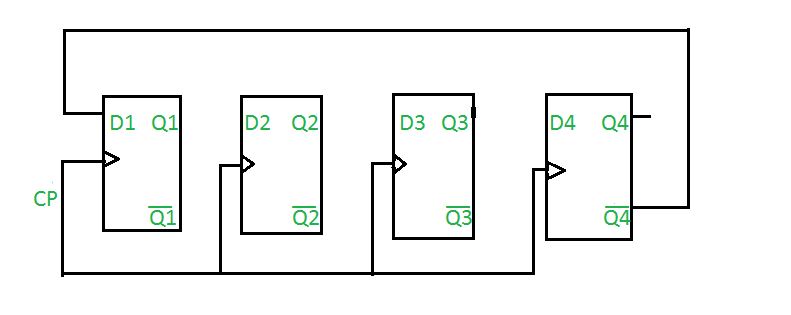
JA Johnson counter, also known as a twisted ring or creeping counter, is a synchronous shift register counter where the complemented output of the last flip-flop is fed into the input of the first. It uses _n flip-flops to generate _2n unique states, offering better state efficiency than regular ring counters.
- Requires _n flip-flops to generate _2n distinct states, making it more efficient than a ring counter.
- Commonly used for applications needing self-decodable outputs and efficient state utilization.
Total number of used and unused states in n-bit Johnson counter:
number of used states=2n
number of unused states=2n - 2*n**Example:
If n=4
4-bit Johnson counterInitially, suppose all flip-flops are reset.
**Truth Table
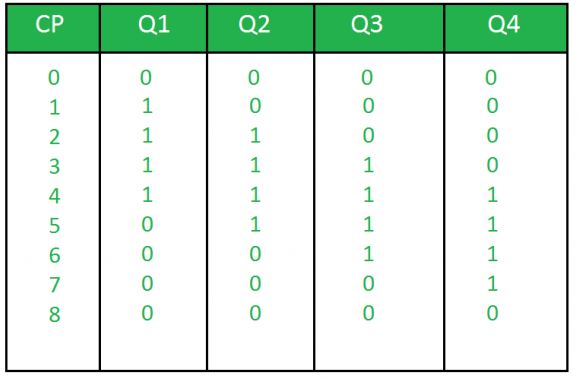
where, CP is clock pulse and Q1, Q2, Q3, Q4 are the states.
Question: Determine the total number of used and unused states in 4-bit Johnson counter.
Answer: Total number of used states= 2*n
= 2*4
= 8
Total number of unused states= 2n - 2*n
= 24-2*4
= 8
**Advantages
- The Johnson counter has same number of flip flop but it can count twice the number of states the ring counter can count.
- It can be implemented using D and JK flip flop.
- Johnson ring counter is used to count the data in a continuous loop.
- Johnson counter is a self-decoding circuit.
**Disadvantages
- Johnson counter doesn't count in a binary sequence.
- In Johnson counter more number of states remain unutilized than the number of states being utilized.
- The number of flip flops needed is one half the number of timing signals.
- It can be constructed for any number of timing sequence.
**Applications
- Johnson counter is used as a synchronous decade counter or divider circuit.
- It is used in hardware logic design to create complicated Finite states machine. ex: ASIC and FPGA design.
- The 3 stage Johnson counter is used as a 3 phase square wave generator which produces 1200 phase shift.
- It is used to divide the frequency of the clock signal by varying their feedback.
Ring Counter vs Johnson Counter
| Parameters | Ring Counter | Johnson Counter |
|---|---|---|
| Configuration | A ring counter employs the carry-in of the last flip-flop into the input of the first flip-flop without any manipulation. | In Johnson counter, the complement of output of the last flip-flop is applied to the input of the first flip-flop. |
| Number of Flip- Flops | 'n' flip-flops are required to count 'n' states. | 'n' flip-flops are required to count '2n' states. |
| Counting Sequence | It counts in a simple binary sequence often having one '1' and the rest '0's in each state. | It counts in a twisted sequence, where the output is a mixture of binary 1s and 0s. |
| Number of States | It can Generate 'n' unique states | It can Generate '2n' unique states |
| Unused states | None, because all the states are utilized | '2n-2n' states are unused |
| Self-Decoding Capability | Its not self-decoding since additional circuitry is needed | Its self-decoding makes it simpler for certain applications |
| Circuit Complexity | Since it does not require inversion feedback, thus the circuit is simple | Due to inversion, the circuit is slightly more complex |