Serial In Serial Out (SISO) Shift Register (original) (raw)
Last Updated : 24 Apr, 2026
In the realm of digital electronics, shift registers play a pivotal role in various applications, from data storage to signal processing. One commonly used type is the Serial-In Serial-Out (SISO) shift register. A Serial-In Serial-Out shift register is a sequential logic circuit that allows data to be shifted in and out one bit at a time in a serial manner. The input data is applied to the first flip-flop in the chain, and as the clock pulses, the data propagates through the flip-flops, ultimately appearing at the output.
- It consists of a cascade of flip-flops connected in series, forming a chain.
- The logic circuit provided below demonstrates a serial-in serial-out (SISO) shift register.
- It comprises four D flip-flops that are interconnected in a sequential manner.
- These flip-flops operate synchronously with one another, as they all receive the same clock signal.

4 Bit SISO Register
The synchronous nature of the flip-flops ensures that the shifting of data occurs in a coordinated manner. When the clock signal rises, the input data is sampled and stored in the first flip-flop. On subsequent clock pulses, the stored data propagates through the flip-flops, moving from one flip-flop to the next.
Each D flip-flop in the circuit has a Data (D) input, a Clock (CLK) input, and an output (Q). The D input represents the data to be loaded into the flip-flop, while the CLK input is connected to the common clock signal. The output (Q) of each flip-flop is connected to the D input of the next flip-flop, forming a cascade.
Working of SISO
A SISO (Single Input Single Output) shift register is a sequential circuit in which data is entered one bit at a time and shifted through flip-flops on each clock pulse, producing the output serially.
- Data is applied to the input.
- On every clock pulse, data shifts from one flip-flop to the next.
- After n clock pulses, the input bit appears at the output.
- Output is taken from the last flip-flop.
Overall, a SISO system means that there is one input signal processed to obtain a corresponding output signal; therefore, it is central to the notion of systems and signals.
T**ruth Table for SISO
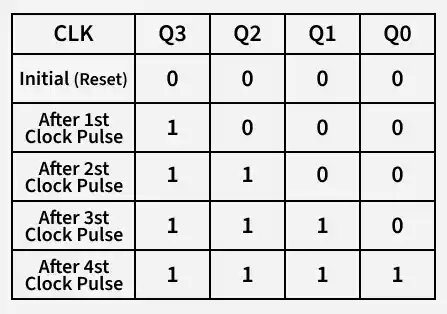
Truth Table
Waveform
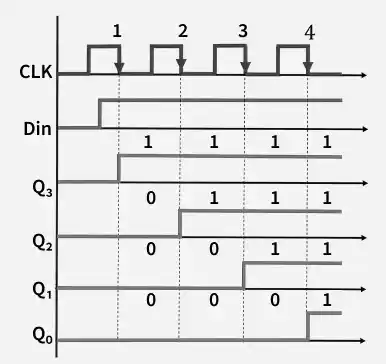
Waveform Representation
Functionality and Operation
The operation of a SISO shift register relies on two primary components: the flip-flops and the clock signal.
- **Flip-Flops: A flip-flop is a fundamental building block of sequential circuits. In the case of a SISO shift register, each flip-flop stores a single bit of data. The number of flip-flops determines the length or size of the shift register.
- **Clock Signal: The clock signal synchronizes the movement of data through the shift register. With each clock pulse, the data shifts from one flip-flop to the next. The clock signal ensures that the data propagates in a controlled and synchronized manner.
When the clock signal transitions from low to high (or high to low, depending on the specific implementation), the input data is sampled and stored in the first flip-flop. On subsequent clock pulses, the stored data moves through the chain of flip-flops. The output of the shift register is taken from the last flip-flop in the series.
Applications
- **Data Storage and Retrieval: SISO shift registers are often used to store and retrieve data in applications where serial transmission is more efficient or feasible. For instance, in communication systems, data is often transmitted serially, and a shift register allows for temporary storage before further processing.
- **Serial-to-Parallel Conversion: By using a SISO shift register in combination with additional circuitry, serial data can be converted into parallel form. This conversion is useful when interfacing between serial and parallel devices, such as microprocessors and peripheral devices.
- **Delay and Time-Sequence Generation: The cascaded nature of shift registers enables the generation of delayed versions of a signal or the generation of complex time sequences. By tapping into different stages of the shift register, various delayed versions of the input signal can be obtained.
- **Data Encryption and Decryption: Shift registers can be employed in cryptographic applications for data encryption and decryption. By utilizing feedback connections and appropriate logical operations, the shift register can act as a key generator or cipher unit.
- **Frequency Division and Counting: Serial-In Serial-Out shift registers are used in frequency division and counting applications. By connecting the output of a flip-flop back to the input, the shift register can function as a binary counter, dividing the input frequency by a factor of two with each clock pulse.
**Numerical
Assuming an initial state where all flip-flops are reset to 0, let's apply a series of input bits and observe the output as the data is shifted through the shift register. For simplicity, we'll use a clock signal with rising edges to trigger the shifting process.
Input data: 1011
Clock signal: 1 1 1 1
**Solution
Initially, all flip-flops are in the reset state (0), and the input data is 1011. As the clock signal rises, the first bit of the input (1) is sampled and stored in the first flip-flop. The remaining bits shift to the right, and the output reflects the state of the last flip-flop.
Clock 1: Input: 1 0 1 1; Output: 0 0 0 0
Clock 2: Input: 1 0 1 1; Output: 1 0 0 0
Clock 3: Input: 1 0 1 1; Output: 1 1 0 0
Clock 4: Input: 1 0 1 1; Output: 1 1 1 0
After four clock cycles, the input data has shifted through the shift register, and the final output is 1110.
It's important to note that the clock signal synchronizes the shifting process, ensuring that each bit moves to the next flip-flop at the rising edge of the clock pulse. The output of the shift register represents the last bit that has been shifted out of the register.
The above example demonstrates how a 4-bit SISO shift register operates, with the input data being sequentially shifted through the flip-flops, and the output reflecting the state of the last flip-flop.
The Serial-In Serial-Out shift register is a versatile component in the world of digital electronics, offering a simple yet effective way to shift and store data in a serial manner. Its applications span across various domains, including data storage, signal processing, encryption, and frequency division. Understanding the functionality and operation of SISO shift registers is fundamental for designing and implementing digital systems that require serial data manipulation and control.
Advantages
- **Simplicity : The SISO shift registers are simple to implement and understand since they contain only one input and one output. This keeps the design to be simple to be fabricated, hence widely used in many applications.
- **Space Efficiency : A SISO can store the required data using only a few storage elements as compared to that in a parallel shift register, which may require more storage devices. Thus, in a limited-space application, the SISO is in preference.
- **Economical : This is mainly because use of the above disadvantages of the parallel shift registers is more economical than the parallel shift register or preference of the SISO shift register to any other composite system for storing information.
- **Sequential Processing : SISO registers process data in a serial order, which can be very useful if the data has to be treated in some given order or sequence.
- **Compatibility : Serial communication systems predominantly use SISO shift registers, and they may conveniently use this technology when adapting to various communication protocols and standards.
Disadvantages
- **Slower Data Transmission : Due to processing data series ways, SISO shift registers may have lower data transfer rates than their parallel counterparts which transfer multiple bits at once. This is a disadvantage especially in cases where high-speed data processing is needed.
- **Limited Capability for Parallel Processing : The SISO Shift Registers process one bit at a time, thus restrict the ability to parallel processing. They are not suitable for applications where parallel processing is of the essence.
- **Complexity for Performing Multiple Operations : In case an application requires both sequential and parallel logic operations simultaneously on multi-bit inputs, this need may become impractical since several SISO will be required rather than a single one thus increasing complexity and making it less efficient than using a PIS register.
- **Data Synchronization Difficulties : As far as synchronization with respect to the synchronization input and output is concerned, it becomes difficult due to sequential nature of SISO shift registers in systems where such aspects are crucial.
- **High propagation delays : When using a SISO register, we will often see higher bureaucratic losses should we try transmitting data through it too fast because it just cannot do such things like an analog circuit would have been able to perform those actions.