2Satisfiability (2SAT) Problem (original) (raw)
2-Satisfiability (2-SAT) Problem
Last Updated : 23 Jul, 2025
Boolean Satisfiability Problem
Boolean Satisfiability or simply **SAT is the problem of determining if a Boolean formula is satisfiable or unsatisfiable.
- **Satisfiable : If the Boolean variables can be assigned values such that the formula turns out to be TRUE, then we say that the formula is satisfiable.
- **Unsatisfiable : If it is not possible to assign such values, then we say that the formula is unsatisfiable.
**Examples:
- F = A \wedge \bar{B} , is satisfiable, because A = TRUE and B = FALSE makes F = TRUE.
- G = A \wedge \bar{A} , is unsatisfiable, because:
| A | \bar{A} | G |
|---|---|---|
| TRUE | FALSE | FALSE |
| FALSE | TRUE | FALSE |
**Note : Boolean satisfiability problem is NP-complete (For proof, refer Cook's Theorem).
What is 2-SAT Problem
2-SAT is a special case of Boolean Satisfiability Problem and can be solved
in polynomial time.
To understand this better, first let us see what is Conjunctive Normal Form (CNF) or also known as Product of Sums (POS).
**CNF : CNF is a conjunction (AND) of clauses, where every clause is a disjunction (OR).
Now, 2-SAT limits the problem of SAT to only those Boolean formula which are expressed as a CNF with every clause having only **2 terms(also called **2-CNF).
**Example: F = (A_1 \vee B_1) \wedge (A_2 \vee B_2) \wedge (A_3 \vee B_3) \wedge ....... \wedge (A_m \vee B_m)
Thus, Problem of 2-Satisfiability can be stated as:
**Given CNF with each clause having only 2 terms, is it possible to assign such values to the variables so that the CNF is TRUE?
**Examples:
Input : F = (x1 \vee x2) \wedge (x2 \vee \bar{x1}) \wedge (\bar{x1} \vee \bar{x2})Output : The given expression is satisfiable. (for x1 = FALSE, x2 = TRUE)Input : F = (x1 \vee x2) \wedge (x2 \vee \bar{x1}) \wedge (x1 \vee \bar{x2}) \wedge (\bar{x1} \vee \bar{x2})Output : The given expression is unsatisfiable. (for all possible combinations of x1 and x2)
Approach for 2-SAT Problem
For the CNF value to come TRUE, value of every clause should be TRUE. Let one of the clause be (A \vee B) . **= TRUE
- If A = 0, B must be 1 i.e. (\bar{A} \Rightarrow B)
- If B = 0, A must be 1 i.e. (\bar{B} \Rightarrow A)
Thus,
(A \vee B) = TRUE is equivalent to (\bar{A} \Rightarrow B) \wedge (\bar{B} \Rightarrow A)
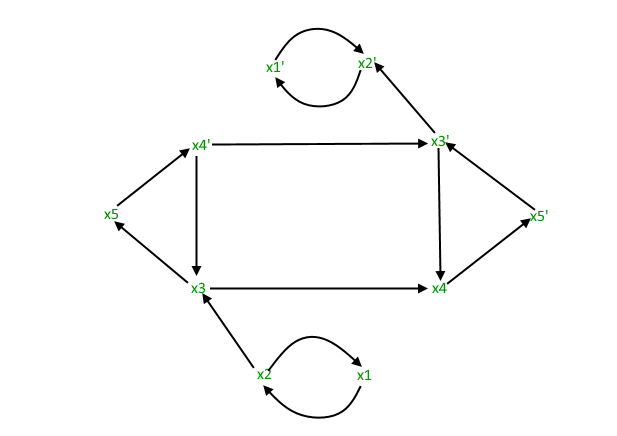
Now, we can express the CNF as an Implication. So, we create an Implication Graph which has 2 edges for every clause of the CNF.
(A \vee B) is expressed in Implication Graph as edge(\bar{A} \rightarrow B) \ & edge(\bar{B} \rightarrow A)
Thus, for a Boolean formula with ‘m’ clauses, we make an Implication Graph with:
- 2 edges for every clause i.e. ‘2m’ edges.
- 1 node for every Boolean variable involved in the Boolean formula.
Let’s see one example of Implication Graph.
**Note: The implication (if A then B) is equivalent to its contrapositive (if \bar{B} then \bar{A} ).
Now, consider the following cases:
**CASE 1: If edge(X \rightarrow \bar{X})exists in the graphThis means (X \Rightarrow \bar{X})If X = TRUE, \bar{X} = TRUE, which is a contradiction.But if X = FALSE, there are no implication constraints.Thus, X = FALSE
**CASE 2: If edge(\bar{X} \rightarrow X)exists in the graphThis means (\bar{X} \Rightarrow X)If \bar{X} = TRUE, X = TRUE, which is a contradiction.But if \bar{X} = FALSE, there are no implication constraints.Thus, \bar{X} = FALSE i.e. X = TRUE
**CASE 3: If edge(X \rightarrow \bar{X}) \& edge(\bar{X} \rightarrow X)both exist in the graphOne edge requires X to be TRUE and the other one requires X to be FALSE.Thus, there is no possible assignment in such a case.
**CONCLUSION:
If any two variables X and \bar{X} are on a cycle i.e. path(\bar{A} \rightarrow B) \& path({B} \rightarrow A) both exists, then the CNF is unsatisfiable. Otherwise, there is a possible assignment and the CNF is satisfiable.
Note here that, we use path due to the following property of implication:
If we have (A \Rightarrow B) \& (B \Rightarrow C), then A \Rightarrow C
Thus, if we have a path in the Implication Graph, that is pretty much same as having a direct edge.
**CONCLUSION FROM IMPLEMENTATION POINT OF VIEW:
If both X and \bar{X} lie in the same SCC (Strongly Connected Component), the CNF is unsatisfiable.
A Strongly Connected Component of a directed graph has nodes such that every node can be reach from every another node in that SCC.
Now, if X and \bar{X} lie on the same SCC, we will definitely have path(\bar{A} \rightarrow B) \& path({B} \rightarrow A) present and hence the conclusion.
Checking of the SCC can be done in O(E+V) using the Kosaraju’s Algorithm
**Implementation:
C++ `
// C++ implementation to find if the given // expression is satisfiable using the // Kosaraju's Algorithm #include <bits/stdc++.h> using namespace std;
const int MAX = 100000;
// data structures used to implement Kosaraju's // Algorithm. Please refer // https://www.geeksforgeeks.org/dsa/strongly-connected-components/ vector adj[MAX]; vector adjInv[MAX]; bool visited[MAX]; bool visitedInv[MAX]; stack s;
// this array will store the SCC that the // particular node belongs to int scc[MAX];
// counter maintains the number of the SCC int counter = 1;
// adds edges to form the original graph void addEdges(int a, int b) { adj[a].push_back(b); }
// add edges to form the inverse graph void addEdgesInverse(int a, int b) { adjInv[b].push_back(a); }
// for STEP 1 of Kosaraju's Algorithm void dfsFirst(int u) { if(visited[u]) return;
visited[u] = 1;

for (int i=0;i<adj[u].size();i++)
    dfsFirst(adj[u][i]);

s.push(u);
}
// for STEP 2 of Kosaraju's Algorithm void dfsSecond(int u) { if(visitedInv[u]) return;
visitedInv[u] = 1;

for (int i=0;i<adjInv[u].size();i++)
    dfsSecond(adjInv[u][i]);

scc[u] = counter;
}
// function to check 2-Satisfiability void is2Satisfiable(int n, int m, int a[], int b[]) { // adding edges to the graph for(int i=0;i<m;i++) { // variable x is mapped to x // variable -x is mapped to n+x = n-(-x)
    // for a[i] or b[i], addEdges -a[i] -> b[i]
    // AND -b[i] -> a[i]
    if (a[i]>0 && b[i]>0)
    {
        addEdges(a[i]+n, b[i]);
        addEdgesInverse(a[i]+n, b[i]);
        addEdges(b[i]+n, a[i]);
        addEdgesInverse(b[i]+n, a[i]);
    }

    else if (a[i]>0 && b[i]<0)
    {
        addEdges(a[i]+n, n-b[i]);
        addEdgesInverse(a[i]+n, n-b[i]);
        addEdges(-b[i], a[i]);
        addEdgesInverse(-b[i], a[i]);
    }

    else if (a[i]<0 && b[i]>0)
    {
        addEdges(-a[i], b[i]);
        addEdgesInverse(-a[i], b[i]);
        addEdges(b[i]+n, n-a[i]);
        addEdgesInverse(b[i]+n, n-a[i]);
    }

    else
    {
        addEdges(-a[i], n-b[i]);
        addEdgesInverse(-a[i], n-b[i]);
        addEdges(-b[i], n-a[i]);
        addEdgesInverse(-b[i], n-a[i]);
    }
}

// STEP 1 of Kosaraju's Algorithm which
// traverses the original graph
for (int i=1;i<=2*n;i++)
    if (!visited[i])
        dfsFirst(i);

// STEP 2 of Kosaraju's Algorithm which
// traverses the inverse graph. After this,
// array scc[] stores the corresponding value
while (!s.empty())
{
    int n = s.top();
    s.pop();

    if (!visitedInv[n])
    {
        dfsSecond(n);
        counter++;
    }
}

for (int i=1;i<=n;i++)
{
    // for any 2 variable x and -x lie in
    // same SCC
    if(scc[i]==scc[i+n])
    {
        cout << "The given expression "
             "is unsatisfiable." << endl;
        return;
    }
}

// no such variables x and -x exist which lie
// in same SCC
cout << "The given expression is satisfiable."
     << endl;
return;
}
// Driver function to test above functions int main() { // n is the number of variables // 2n is the total number of nodes // m is the number of clauses int n = 5, m = 7;
// each clause is of the form a or b
// for m clauses, we have a[m], b[m]
// representing a[i] or b[i]

// Note:
// 1 <= x <= N for an uncomplemented variable x
// -N <= x <= -1 for a complemented variable x
// -x is the complement of a variable x

// The CNF being handled is:
// '+' implies 'OR' and '*' implies 'AND'
// (x1+x2)*(x2’+x3)*(x1’+x2’)*(x3+x4)*(x3’+x5)*
// (x4’+x5’)*(x3’+x4)
int a[] = {1, -2, -1, 3, -3, -4, -3};
int b[] = {2, 3, -2, 4, 5, -5, 4};

// We have considered the same example for which
// Implication Graph was made
is2Satisfiable(n, m, a, b);

return 0;
}
Java
// Java implementation to find if the given // expression is satisfiable using the // Kosaraju's Algorithm import java.io.; import java.util.;
class GFG {
static final int MAX = 100000;

// Data structures used to implement Kosaraju's
// Algorithm. Please refer
// https://www.geeksforgeeks.org/dsa/strongly-connected-components/
@SuppressWarnings("unchecked")
static List<List<Integer> > adj = new ArrayList();

@SuppressWarnings("unchecked")
static List<List<Integer> > adjInv = new ArrayList();
static boolean[] visited = new boolean[MAX];
static boolean[] visitedInv = new boolean[MAX];
static Stack<Integer> s = new Stack<Integer>();

// This array will store the SCC that the
// particular node belongs to
static int[] scc = new int[MAX];

// counter maintains the number of the SCC
static int counter = 1;

// Adds edges to form the original graph void
static void addEdges(int a, int b)
{
    adj.get(a).add(b);
}

// Add edges to form the inverse graph
static void addEdgesInverse(int a, int b)
{
    adjInv.get(b).add(a);
}

// For STEP 1 of Kosaraju's Algorithm
static void dfsFirst(int u)
{
    if (visited[u])
        return;

    visited[u] = true;

    for (int i = 0; i < adj.get(u).size(); i++)
        dfsFirst(adj.get(u).get(i));

    s.push(u);
}

// For STEP 2 of Kosaraju's Algorithm
static void dfsSecond(int u)
{
    if (visitedInv[u])
        return;

    visitedInv[u] = true;

    for (int i = 0; i < adjInv.get(u).size(); i++)
        dfsSecond(adjInv.get(u).get(i));

    scc[u] = counter;
}

// Function to check 2-Satisfiability
static void is2Satisfiable(int n, int m, int a[],
                           int b[])
{

    // Adding edges to the graph
    for (int i = 0; i < m; i++) {

        // variable x is mapped to x
        // variable -x is mapped to n+x = n-(-x)

        // for a[i] or b[i], addEdges -a[i] -> b[i]
        // AND -b[i] -> a[i]
        if (a[i] > 0 && b[i] > 0) {
            addEdges(a[i] + n, b[i]);
            addEdgesInverse(a[i] + n, b[i]);
            addEdges(b[i] + n, a[i]);
            addEdgesInverse(b[i] + n, a[i]);
        }

        else if (a[i] > 0 && b[i] < 0) {
            addEdges(a[i] + n, n - b[i]);
            addEdgesInverse(a[i] + n, n - b[i]);
            addEdges(-b[i], a[i]);
            addEdgesInverse(-b[i], a[i]);
        }

        else if (a[i] < 0 && b[i] > 0) {
            addEdges(-a[i], b[i]);
            addEdgesInverse(-a[i], b[i]);
            addEdges(b[i] + n, n - a[i]);
            addEdgesInverse(b[i] + n, n - a[i]);
        }

        else {
            addEdges(-a[i], n - b[i]);
            addEdgesInverse(-a[i], n - b[i]);
            addEdges(-b[i], n - a[i]);
            addEdgesInverse(-b[i], n - a[i]);
        }
    }

    // STEP 1 of Kosaraju's Algorithm which
    // traverses the original graph
    for (int i = 1; i <= 2 * n; i++)
        if (!visited[i])
            dfsFirst(i);

    // STEP 2 of Kosaraju's Algorithm which
    // traverses the inverse graph. After this,
    // array scc[] stores the corresponding value
    while (!s.isEmpty()) {
        int top = s.peek();
        s.pop();

        if (!visitedInv[top]) {
            dfsSecond(top);
            counter++;
        }
    }

    for (int i = 1; i <= n; i++) {

        // For any 2 variable x and -x lie in
        // same SCC
        if (scc[i] == scc[i + n]) {
            System.out.println("The given expression"
                               + "is unsatisfiable.");
            return;
        }
    }

    // No such variables x and -x exist which lie
    // in same SCC
    System.out.println("The given expression "
                       + "is satisfiable.");
}

// Driver code
public static void main(String[] args)
{

    // n is the number of variables
    // 2n is the total number of nodes
    // m is the number of clauses
    int n = 5, m = 7;

    for (int i = 0; i < MAX; i++) {
        adj.add(new ArrayList<Integer>());
        adjInv.add(new ArrayList<Integer>());
    }

    // Each clause is of the form a or b
    // for m clauses, we have a[m], b[m]
    // representing a[i] or b[i]

    // Note:
    // 1 <= x <= N for an uncomplemented variable x
    // -N <= x <= -1 for a complemented variable x
    // -x is the complement of a variable x

    // The CNF being handled is:
    // '+' implies 'OR' and '*' implies 'AND'
    // (x1+x2)*(x2â??+x3)*(x1â??+x2â??)*(x3+x4)*(x3â??+x5)*
    // (x4â??+x5â??)*(x3â??+x4)
    int a[] = { 1, -2, -1, 3, -3, -4, -3 };
    int b[] = { 2, 3, -2, 4, 5, -5, 4 };

    // We have considered the same example
    // for which Implication Graph was made
    is2Satisfiable(n, m, a, b);
}
}
// This code is contributed by jithin
Python3
from collections import defaultdict
Constants
MAX = 100000
Data structures used to implement Kosaraju's Algorithm
adj = defaultdict(list) adj_inv = defaultdict(list) visited = [False] * (MAX + 1) visited_inv = [False] * (MAX + 1) s = [] scc = [0] * (MAX + 1) counter = 1
Function to add edges to form the original graph
def add_edges(a, b): adj[a].append(b)
Function to add edges to form the inverse graph
def add_edges_inverse(a, b): adj_inv[b].append(a)
STEP 1 of Kosaraju's Algorithm - DFS on the original graph
def dfs_first(u): if visited[u]: return
visited[u] = True

for neighbor in adj[u]:
    dfs_first(neighbor)

s.append(u)
STEP 2 of Kosaraju's Algorithm - DFS on the inverse graph
def dfs_second(u): if visited_inv[u]: return
visited_inv[u] = True

for neighbor in adj_inv[u]:
    dfs_second(neighbor)

scc[u] = counter
Function to check 2-Satisfiability
def is_2_satisfiable(n, m, a, b): global counter # Declare counter as a global variable
# Adding edges to the graph
for i in range(m):
    if a[i] > 0 and b[i] > 0:
        add_edges(a[i] + n, b[i])
        add_edges_inverse(a[i] + n, b[i])
        add_edges(b[i] + n, a[i])
        add_edges_inverse(b[i] + n, a[i])
    elif a[i] > 0 and b[i] < 0:
        add_edges(a[i] + n, n - b[i])
        add_edges_inverse(a[i] + n, n - b[i])
        add_edges(-b[i], a[i])
        add_edges_inverse(-b[i], a[i])
    elif a[i] < 0 and b[i] > 0:
        add_edges(-a[i], b[i])
        add_edges_inverse(-a[i], b[i])
        add_edges(b[i] + n, n - a[i])
        add_edges_inverse(b[i] + n, n - a[i])
    else:
        add_edges(-a[i], n - b[i])
        add_edges_inverse(-a[i], n - b[i])
        add_edges(-b[i], n - a[i])
        add_edges_inverse(-b[i], n - a[i])

# STEP 1 of Kosaraju's Algorithm - Traverse the original graph
for i in range(1, 2 * n + 1):
    if not visited[i]:
        dfs_first(i)

# STEP 2 of Kosaraju's Algorithm - Traverse the inverse graph
while s:
    node = s.pop()
    if not visited_inv[node]:
        dfs_second(node)
        counter += 1

# Check if there exist variables x and -x in the same SCC
for i in range(1, n + 1):
    if scc[i] == scc[i + n]:
        print("The given expression is unsatisfiable.")
        return

# No such variables x and -x exist in the same SCC
print("The given expression is satisfiable.")
Driver function to test the implementation
def main(): # Number of variables, number of clauses n, m = 5, 7
# Example CNF (x1+x2)*(x2’+x3)*(x1’+x2’)*(x3+x4)*(x3’+x5)*(x4’+x5’)*(x3’+x4)
a = [1, -2, -1, 3, -3, -4, -3]
b = [2, 3, -2, 4, 5, -5, 4]

is_2_satisfiable(n, m, a, b)
if name == "main": main()
C#
using System; using System.Collections.Generic;
class TwoSatisfiability { const int MAX = 100000;
// Data structures used to implement Kosaraju's
// Algorithm Please refer:
// https://www.geeksforgeeks.org/dsa/strongly-connected-components/
static List<int>[] adj = new List<int>[ MAX ];
static List<int>[] adjInv = new List<int>[ MAX ];
static bool[] visited = new bool[MAX];
static bool[] visitedInv = new bool[MAX];
static Stack<int> s = new Stack<int>();

// This array will store the SCC that the particular
// node belongs to
static int[] scc = new int[MAX];

// Counter maintains the number of the SCC
static int counter = 1;

// Adds edges to form the original graph
static void AddEdges(int a, int b) { adj[a].Add(b); }

// Adds edges to form the inverse graph
static void AddEdgesInverse(int a, int b)
{
    adjInv[b].Add(a);
}

// STEP 1 of Kosaraju's Algorithm
static void DfsFirst(int u)
{
    if (visited[u])
        return;

    visited[u] = true;

    foreach(var v in adj[u]) DfsFirst(v);

    s.Push(u);
}

// STEP 2 of Kosaraju's Algorithm
static void DfsSecond(int u)
{
    if (visitedInv[u])
        return;

    visitedInv[u] = true;

    foreach(var v in adjInv[u]) DfsSecond(v);

    scc[u] = counter;
}

// Function to check 2-Satisfiability
static void Is2Satisfiable(int n, int m, int[] a,
                           int[] b)
{
    // Initialize the arrays
    for (int i = 0; i < MAX; i++) {
        adj[i] = new List<int>();
        adjInv[i] = new List<int>();
    }

    // Adding edges to the graph
    for (int i = 0; i < m; i++) {
        if (a[i] > 0 && b[i] > 0) {
            AddEdges(a[i] + n, b[i]);
            AddEdgesInverse(a[i] + n, b[i]);
            AddEdges(b[i] + n, a[i]);
            AddEdgesInverse(b[i] + n, a[i]);
        }
        else if (a[i] > 0 && b[i] < 0) {
            AddEdges(a[i] + n, n - b[i]);
            AddEdgesInverse(a[i] + n, n - b[i]);
            AddEdges(-b[i], a[i]);
            AddEdgesInverse(-b[i], a[i]);
        }
        else if (a[i] < 0 && b[i] > 0) {
            AddEdges(-a[i], b[i]);
            AddEdgesInverse(-a[i], b[i]);
            AddEdges(b[i] + n, n - a[i]);
            AddEdgesInverse(b[i] + n, n - a[i]);
        }
        else {
            AddEdges(-a[i], n - b[i]);
            AddEdgesInverse(-a[i], n - b[i]);
            AddEdges(-b[i], n - a[i]);
            AddEdgesInverse(-b[i], n - a[i]);
        }
    }

    // STEP 1 of Kosaraju's Algorithm which traverses
    // the original graph
    for (int i = 1; i <= 2 * n; i++)
        if (!visited[i])
            DfsFirst(i);

    // STEP 2 of Kosaraju's Algorithm which traverses
    // the inverse graph. After this, array scc[] stores
    // the corresponding value
    while (s.Count > 0) {
        int node = s.Pop();

        if (!visitedInv[node]) {
            DfsSecond(node);
            counter++;
        }
    }

    for (int i = 1; i <= n; i++) {
        // For any 2 variables x and -x lie in the same
        // SCC
        if (scc[i] == scc[i + n]) {
            Console.WriteLine(
                "The given expression is unsatisfiable.");
            return;
        }
    }

    // No such variables x and -x exist which lie in the
    // same SCC
    Console.WriteLine(
        "The given expression is satisfiable.");
}

// Driver function to test above functions
static void Main()
{
    // n is the number of variables
    // 2n is the total number of nodes
    // m is the number of clauses
    int n = 5, m = 7;

    // Each clause is of the form a or b
    // For m clauses, we have a[m], b[m] representing
    // a[i] or b[i]

    // Note:
    // 1 <= x <= N for an uncomplemented variable x
    // -N <= x <= -1 for a complemented variable x
    // -x is the complement of a variable x

    // The CNF being handled is:
    // '+' implies 'OR' and '*' implies 'AND'
    // (x1+x2)*(x2’+x3)*(x1’+x2’)*(x3+x4)*(x3’+x5)*
    // (x4’+x5’)*(x3’+x4)
    int[] a = { 1, -2, -1, 3, -3, -4, -3 };
    int[] b = { 2, 3, -2, 4, 5, -5, 4 };

    // We have considered the same example for which
    // Implication Graph was made
    Is2Satisfiable(n, m, a, b);
}
}
JavaScript
// Data structures used to implement Kosaraju's Algorithm const MAX = 100000; const adj = new Array(MAX).fill(0).map(() => []); const adjInv = new Array(MAX).fill(0).map(() => []); const visited = new Array(MAX).fill(false); const visitedInv = new Array(MAX).fill(false); const s = [];
// This array will store the SCC that the particular node belongs to const scc = new Array(MAX).fill(0);
// Counter maintains the number of the SCC let counter = 1;
// Adds edges to form the original graph function addEdges(a, b) { adj[a].push(b); }
// Adds edges to form the inverse graph function addEdgesInverse(a, b) { adjInv[b].push(a); }
// Step 1 of Kosaraju's Algorithm function dfsFirst(u) { if (visited[u]) return; visited[u] = true;
for (let i = 0; i < adj[u].length; i++)
    dfsFirst(adj[u][i]);

s.push(u);
}
// Step 2 of Kosaraju's Algorithm function dfsSecond(u) { if (visitedInv[u]) return; visitedInv[u] = true;
for (let i = 0; i < adjInv[u].length; i++)
    dfsSecond(adjInv[u][i]);

scc[u] = counter;
}
// Function to check 2-Satisfiability function is2Satisfiable(n, m, a, b) { // Adding edges to the graph for (let i = 0; i < m; i++) { if (a[i] > 0 && b[i] > 0) { addEdges(a[i] + n, b[i]); addEdgesInverse(a[i] + n, b[i]); addEdges(b[i] + n, a[i]); addEdgesInverse(b[i] + n, a[i]); } else if (a[i] > 0 && b[i] < 0) { addEdges(a[i] + n, n - b[i]); addEdgesInverse(a[i] + n, n - b[i]); addEdges(-b[i], a[i]); addEdgesInverse(-b[i], a[i]); } else if (a[i] < 0 && b[i] > 0) { addEdges(-a[i], b[i]); addEdgesInverse(-a[i], b[i]); addEdges(b[i] + n, n - a[i]); addEdgesInverse(b[i] + n, n - a[i]); } else { addEdges(-a[i], n - b[i]); addEdgesInverse(-a[i], n - b[i]); addEdges(-b[i], n - a[i]); addEdgesInverse(-b[i], n - a[i]); } }
// Step 1 of Kosaraju's Algorithm which
// traverses the original graph
for (let i = 1; i <= 2 * n; i++)
    if (!visited[i])
        dfsFirst(i);

// Step 2 of Kosaraju's Algorithm which traverses
// the inverse graph
while (s.length > 0) {
    const node = s.pop();

    if (!visitedInv[node]) {
        dfsSecond(node);
        counter++;
    }
}

for (let i = 1; i <= n; i++) {
    if (scc[i] === scc[i + n]) {
        console.log("The given expression is unsatisfiable.");
        return;
    }
}

console.log("The given expression is satisfiable.");
}
// Driver function to test above functions // n is the number of variables // 2n is the total number of nodes // m is the number of clauses const n = 5, m = 7;
// Each clause is of the form a or b // For m clauses, we have a[m], b[m] // representing a[i] or b[i]
// Note: // 1 <= x <= N for an uncomplemented variable x // -N <= x <= -1 for a complemented variable x // -x is the complement of a variable x
// The CNF being handled is: // '+' implies 'OR' and '' implies 'AND' // (x1+x2)(x2’+x3)(x1’+x2’)(x3+x4)(x3’+x5) // (x4’+x5’)*(x3’+x4) const a = [1, -2, -1, 3, -3, -4, -3]; const b = [2, 3, -2, 4, 5, -5, 4];
// We have considered the same example for which // Implication Graph was made is2Satisfiable(n, m, a, b);
// This code is contributed by Yash Agarwal(yashagarwal2852002)
`
Output
The given expression is satisfiable.
**More Test Cases:
Input : n = 2, m = 3
a[] = {1, 2, -1}
b[] = {2, -1, -2}
Output : The given expression is satisfiable.
Input : n = 2, m = 4
a[] = {1, -1, 1, -1}
b[] = {2, 2, -2, -2}
Output : The given expression is unsatisfiable.
If you like GeeksforGeeks and would like to contribute, you can also write an article using write.geeksforgeeks.org or mail your article to review-team@geeksforgeeks.org. See your article appearing on the GeeksforGeeks main page and help other Geeks.