3coloring is NP Complete (original) (raw)
3-coloring is NP Complete
Last Updated : 15 Jul, 2025
**Prerequisite: NP-Completeness, Graph Coloring
**Graph K-coloring Problem : A K-coloring problem for undirected graphs is an assignment of colors to the nodes of the graph such that no two adjacent vertices have the same color, and **at most K colors are used to complete color the graph.
**Problem Statement : Given a graph **G(V, E) and an integer K = 3, the task is to determine if the graph can be colored using **at most 3 colors such that no two adjacent vertices are given the same color.
**Explanation:
An instance of the problem is an input specified to the problem. An instance of the **3-coloring problem is an undirected graph **G (V, E), and the task is to check whether there is a possible assignment of colors for each of the vertices **V using only 3 different colors with each neighbor colored differently. Since an NP-Complete problem is a problem which is both in **NP and **NP-hard, the proof for the statement that a problem is NP-Complete consists of two parts:
- The problem itself is in **NP class.
- All other problems in NP class can be polynomial-time reducible to that.(B is polynomial-time reducible to C is denoted as B ≤ PC)
If the **2nd condition is only satisfied then the problem is called **NP-Hard.
But it is not possible to reduce every NP problem into another NP problem to show its NP-Completeness all the time. Therefore, to show a problem is NP-Complete, then proof that the problem is in **NP and any **NP-Complete problem is reducible to that i.e., if B is NP-Complete and B≤PC then for C in NP, then C is NP-Complete. Thus, it can be concluded that the **Graph K-coloring Problem is NP-Complete using the following two propositions:
**3-coloring problem is in NP:
If any problem is in NP, then, given a certificate, which is a solution to the problem and an instance of the problem (A graph **G(V, E) and an assignment of the colors ****{c** 1 , c 2 , c 3 } where each vertex is assigned a color from this three colors ****{c** 1 , c 2 , c 3 }), then it can be verified (Check whether the solution given is correct or not) that the certificate in polynomial time. This can be done in the following way:
For each edge {u, v} in graph G verify that the color c(u) != c(v)
Hence, the assignment can be checked for correctness in the polynomial-time of the graph with respect to its edges O(V+E).
**3-coloring problem is NP-Hard:
In order to prove that the 3-coloring problem is NP-Hard, perform a reduction from a known NP-Hard problem to this problem. Carry out a reduction from which the 3-SAT problem can be reduced to the 3-coloring problem. Let us assume that the 3-SAT problem has a 3-SAT formula of m clauses on n variables denoted by **x 1 , x 2 , ..., x n. The graph can then be constructed from the formula in the following way:
- For every variable **x i Construct a vertex **v i In the graph and a vertex **v i’ denoting the negation of the variable **x i.
- For each clause c in m, add 5 vertices corresponding to values c1, c1, ..., c5.
- Three vertices of different colors are additionally added to denote the values True, False, and Base (T, F, B) respectively.
- Edges are added among these three additional vertices **T, F, B to form a triangle.
- Edges are added among the vertices **v i and **v i’ and Base (B) to form a triangle.
**The following constraints are true for graph G:
- For each of the pairs of vertices **v i and **v i’, either one is assigned a TRUE value and the other, FALSE.
- For each clause c in m clauses, at least one of the literal has to hold TRUE value for the value to be true.
A small OR- gadget graph therefore can be constructed for each of the clause **c = (u V v V w) in the formula by input nodes u, v, w, and connect output node of gadget to both False and Base special nodes.
Let us consider the formula **f = (u' V v V w') AND ****(u V v V w')**
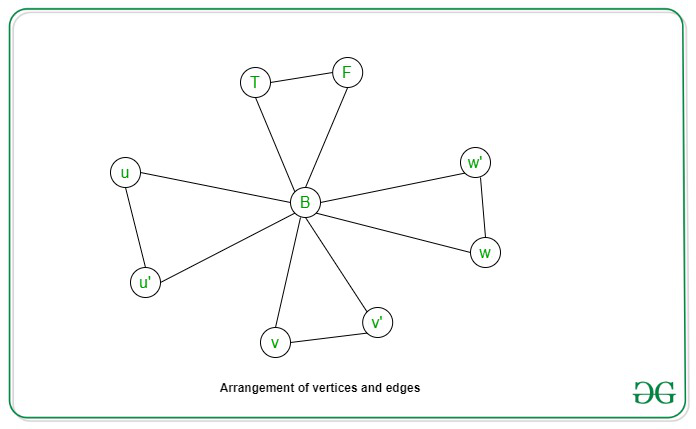
**Now the reduction can be proved by the following two propositions:
Let us assume that the 3-SAT formula has a satisfying assignment, then in every clause, at least one of the literals **x i has to be true, therefore, the corresponding **v i can be assigned to a TRUE color and **v i’ to FALSE. Now, extending this, for each clause the corresponding OR-gadget graph can be 3-colored. Hence, the graph can be 3-colored.
Let us consider that the graph G is 3-colorable, so if the vertex vi is assigned to the true color, correspondingly the variable xi is assigned to true. This will form a legal truth assignment. Also, for any clause **C j = (x V y V z), it cannot be that all the three literals x, y, z are False. Because in this case, the output of the OR-gadget graph for **C j has to be colored False. This is a contradiction because the output is connected to Base and False. Hence, there exists a satisfying assignment to the 3-SAT clause.
**Conclusion : Therefore, 3-coloring is an **NP-Complete problem.