All Topological Sorts of a Directed Acyclic Graph (original) (raw)
Last Updated : 19 May, 2023
Topological sorting for Directed Acyclic Graph (DAG) is a linear ordering of vertices such that for every directed edge uv, vertex u comes before v in the ordering. Topological Sorting for a graph is not possible if the graph is not a DAG.
Given a DAG, print all topological sorts of the graph.
For example, consider the below graph.
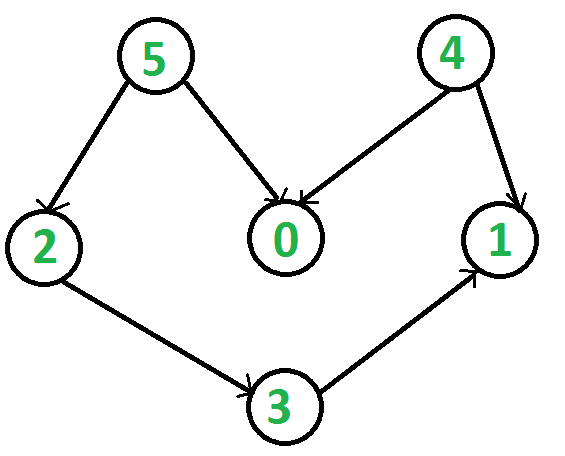
All topological sorts of the given graph are: 4 5 0 2 3 1 4 5 2 0 3 1 4 5 2 3 0 1 4 5 2 3 1 0 5 2 3 4 0 1 5 2 3 4 1 0 5 2 4 0 3 1 5 2 4 3 0 1 5 2 4 3 1 0 5 4 0 2 3 1 5 4 2 0 3 1 5 4 2 3 0 1 5 4 2 3 1 0
In a Directed acyclic graph many a times we can have vertices which are unrelated to each other because of which we can order them in many ways. These various topological sorting is important in many cases, for example if some relative weight is also available between the vertices, which is to minimize then we need to take care of relative ordering as well as their relative weight, which creates the need of checking through all possible topological ordering.
We can go through all possible ordering via backtracking , the algorithm step are as follows :
- Initialize all vertices as unvisited.
- Now choose vertex which is unvisited and has zero indegree and decrease indegree of all those vertices by 1 (corresponding to removing edges) now add this vertex to result and call the recursive function again and backtrack.
- After returning from function reset values of visited, result and indegree for enumeration of other possibilities.
Below is the implementation of the above steps.
C++ `
// C++ program to print all topological sorts of a graph #include <bits/stdc++.h> using namespace std;
class Graph { int V; // No. of vertices
// Pointer to an array containing adjacency list
list<int> *adj;

// Vector to store indegree of vertices
vector<int> indegree;

// A function used by alltopologicalSort
void alltopologicalSortUtil(vector<int>& res,
                            bool visited[]);
public: Graph(int V); // Constructor
// function to add an edge to graph
void addEdge(int v, int w);

// Prints all Topological Sorts
void alltopologicalSort();
};
// Constructor of graph Graph::Graph(int V) { this->V = V; adj = new list[V];
// Initialising all indegree with 0
for (int i = 0; i < V; i++)
    indegree.push_back(0);
}
// Utility function to add edge void Graph::addEdge(int v, int w) { adj[v].push_back(w); // Add w to v's list.
// increasing inner degree of w by 1
indegree[w]++;
}
// Main recursive function to print all possible // topological sorts void Graph::alltopologicalSortUtil(vector& res, bool visited[]) { // To indicate whether all topological are found // or not bool flag = false;
for (int i = 0; i < V; i++)
{
    //  If indegree is 0 and not yet visited then
    //  only choose that vertex
    if (indegree[i] == 0 && !visited[i])
    {
        //  reducing indegree of adjacent vertices
        list<int>:: iterator j;
        for (j = adj[i].begin(); j != adj[i].end(); j++)
            indegree[*j]--;

        //  including in result
        res.push_back(i);
        visited[i] = true;
        alltopologicalSortUtil(res, visited);

        // resetting visited, res and indegree for
        // backtracking
        visited[i] = false;
        res.erase(res.end() - 1);
        for (j = adj[i].begin(); j != adj[i].end(); j++)
            indegree[*j]++;

        flag = true;
    }
}

//  We reach here if all vertices are visited.
//  So we print the solution here
if (!flag)
{
    for (int i = 0; i < res.size(); i++)
        cout << res[i] << " ";
    cout << endl;
}
}
// The function does all Topological Sort. // It uses recursive alltopologicalSortUtil() void Graph::alltopologicalSort() { // Mark all the vertices as not visited bool *visited = new bool[V]; for (int i = 0; i < V; i++) visited[i] = false;
vector<int> res;
alltopologicalSortUtil(res, visited);
}
// Driver program to test above functions int main() { // Create a graph given in the above diagram Graph g(6); g.addEdge(5, 2); g.addEdge(5, 0); g.addEdge(4, 0); g.addEdge(4, 1); g.addEdge(2, 3); g.addEdge(3, 1);
cout << "All Topological sorts\n";

g.alltopologicalSort();

return 0;
}
Java
//Java program to print all topological sorts of a graph import java.util.*;
class Graph { int V; // No. of vertices
List<Integer> adjListArray[];

public Graph(int V) {

    this.V = V;

    @SuppressWarnings("unchecked")
    List<Integer> adjListArray[] = new LinkedList[V];

    this.adjListArray = adjListArray;

    for (int i = 0; i < V; i++) {
        adjListArray[i] = new LinkedList<>();
    }
}
// Utility function to add edge
public void addEdge(int src, int dest) {

    this.adjListArray[src].add(dest);

}

// Main recursive function to print all possible
// topological sorts
private void allTopologicalSortsUtil(boolean[] visited,
                    int[] indegree, ArrayList<Integer> stack) {
    // To indicate whether all topological are found
    // or not
    boolean flag = false;

    for (int i = 0; i < this.V; i++) {
        // If indegree is 0 and not yet visited then
        // only choose that vertex
        if (!visited[i] && indegree[i] == 0) {

            // including in result
            visited[i] = true;
            stack.add(i);
            for (int adjacent : this.adjListArray[i]) {
                indegree[adjacent]--;
            }
            allTopologicalSortsUtil(visited, indegree, stack);

            // resetting visited, res and indegree for
            // backtracking
            visited[i] = false;
            stack.remove(stack.size() - 1);
            for (int adjacent : this.adjListArray[i]) {
                indegree[adjacent]++;
            }

            flag = true;
        }
    }
    // We reach here if all vertices are visited.
    // So we print the solution here
    if (!flag) {
        stack.forEach(i -> System.out.print(i + " "));
        System.out.println();
    }

}

// The function does all Topological Sort.
// It uses recursive alltopologicalSortUtil()
public void allTopologicalSorts() {
    // Mark all the vertices as not visited
    boolean[] visited = new boolean[this.V];

    int[] indegree = new int[this.V];

    for (int i = 0; i < this.V; i++) {

        for (int var : this.adjListArray[i]) {
            indegree[var]++;
        }
    }

    ArrayList<Integer> stack = new ArrayList<>();

    allTopologicalSortsUtil(visited, indegree, stack);
}

// Driver code
public static void main(String[] args) {

    // Create a graph given in the above diagram
    Graph graph = new Graph(6);
    graph.addEdge(5, 2);
    graph.addEdge(5, 0);
    graph.addEdge(4, 0);
    graph.addEdge(4, 1);
    graph.addEdge(2, 3);
    graph.addEdge(3, 1);

    System.out.println("All Topological sorts");
    graph.allTopologicalSorts();
}
}
Python3
class to represent a graph object
class Graph:
# Constructor
def __init__(self, edges, N):

    # A List of Lists to represent an adjacency list
    self.adjList = [[] for _ in range(N)]

    # stores in-degree of a vertex
    # initialize in-degree of each vertex by 0
    self.indegree = [0] * N

    # add edges to the undirected graph
    for (src, dest) in edges:

        # add an edge from source to destination
        self.adjList[src].append(dest)

        # increment in-degree of destination vertex by 1
        self.indegree[dest] = self.indegree[dest] + 1
Recursive function to find
all topological orderings of a given DAG
def findAllTopologicalOrders(graph, path, discovered, N):
# do for every vertex
for v in range(N):

    # proceed only if in-degree of current node is 0 and
    # current node is not processed yet
    if graph.indegree[v] == 0 and not discovered[v]:

        # for every adjacent vertex u of v,
        # reduce in-degree of u by 1
        for u in graph.adjList[v]:
            graph.indegree[u] = graph.indegree[u] - 1

        # include current node in the path
        # and mark it as discovered
        path.append(v)
        discovered[v] = True

        # recur
        findAllTopologicalOrders(graph, path, discovered, N)

        # backtrack: reset in-degree
        # information for the current node
        for u in graph.adjList[v]:
            graph.indegree[u] = graph.indegree[u] + 1

        # backtrack: remove current node from the path and
        # mark it as undiscovered
        path.pop()
        discovered[v] = False

# print the topological order if
# all vertices are included in the path
if len(path) == N:
    print(path)
Print all topological orderings of a given DAG
def printAllTopologicalOrders(graph):
# get number of nodes in the graph
N = len(graph.adjList)

# create an auxiliary space to keep track of whether vertex is discovered
discovered = [False] * N

# list to store the topological order
path = []

# find all topological ordering and print them
findAllTopologicalOrders(graph, path, discovered, N)
Driver code
if name == 'main':
# List of graph edges as per above diagram
edges = [(5, 2), (5, 0), (4, 0), (4, 1), (2, 3), (3, 1)]

print("All Topological sorts")

# Number of nodes in the graph
N = 6

# create a graph from edges
graph = Graph(edges, N)

# print all topological ordering of the graph
printAllTopologicalOrders(graph)
This code is contributed by Priyadarshini Kumari
C#
using System; using System.Collections.Generic;
class Graph { int V; List[] adjListArray;
public Graph(int V)
{
    this.V = V;
    adjListArray = new List<int>[V];

    for (int i = 0; i < V; i++)
    {
        adjListArray[i] = new List<int>();
    }
}

public void addEdge(int src, int dest)
{
    this.adjListArray[src].Add(dest);
}

private void allTopologicalSortsUtil(bool[] visited, int[] indegree, List<int> stack)
{
    bool flag = false;

    for (int i = 0; i < this.V; i++)
    {
        if (!visited[i] && indegree[i] == 0)
        {
            visited[i] = true;
            stack.Add(i);
            foreach (int adjacent in this.adjListArray[i])
            {
                indegree[adjacent]--;
            }
            allTopologicalSortsUtil(visited, indegree, stack);

            visited[i] = false;
            stack.RemoveAt(stack.Count - 1);
            foreach (int adjacent in this.adjListArray[i])
            {
                indegree[adjacent]++;
            }

            flag = true;
        }
    }
    if (!flag)
    {
        stack.ForEach(i => Console.Write(i + " "));
        Console.WriteLine();
    }
}

public void allTopologicalSorts()
{
    bool[] visited = new bool[this.V];
    int[] indegree = new int[this.V];

    for (int i = 0; i < this.V; i++)
    {
        foreach (int var in this.adjListArray[i])
        {
            indegree[var]++;
        }
    }

    List<int> stack = new List<int>();

    allTopologicalSortsUtil(visited, indegree, stack);
}

static void Main(string[] args)
{
    Graph graph = new Graph(6);
    graph.addEdge(5, 2);
    graph.addEdge(5, 0);
    graph.addEdge(4, 0);
    graph.addEdge(4, 1);
    graph.addEdge(2, 3);
    graph.addEdge(3, 1);

    Console.WriteLine("All Topological sorts");
    graph.allTopologicalSorts();
}
}
JavaScript
`
Output
All Topological sorts 4 5 0 2 3 1 4 5 2 0 3 1 4 5 2 3 0 1 4 5 2 3 1 0 5 2 3 4 0 1 5 2 3 4 1 0 5 2 4 0 3 1 5 2 4 3 0 1 5 2 4 3 1 0 5 4 0 2 3 1 5 4 2 0 3 1 5 4 2 3 0 1 5 4 2 3 1 0
Time Complexity: O(V!), Here V is the number of vertices, V! is absolute worst case. (worst case example - any graph with no edges at all)
Auxiliary Space: O(V), for creating an additional array and recursive stack space.
This articles is contributed by Utkarsh Trivedi.