Building Heap from Array (original) (raw)
Last Updated : 18 Oct, 2025
Given an integer array **arr[], build a Max Heap from the given array.
A Max Heap is a complete binary tree where each parent node is greater than or equal to its children, ensuring the largest element is at the root.
**Examples:
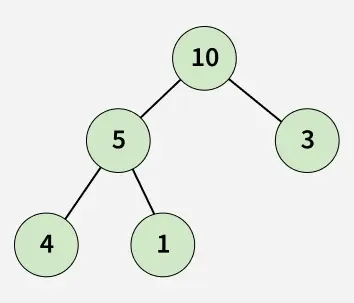
**Input: arr[] = [4, 10, 3, 5, 1]
**Output: Corresponding Max-Heap:
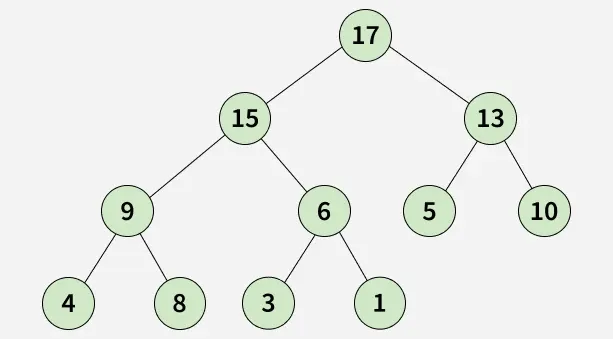
**Input: arr[] = [1, 3, 5, 4, 6, 13, 10, 9, 8, 15, 17]
**Output: Corresponding Max-Heap:
[Approach] Using Recursion - O(n) Time and O(log n) Space
To build a Max Heap from an array, treat the array as a complete binary tree and heapify nodes from the last non-leaf node up to the root in reverse level order. Leaf nodes already satisfy the heap property, so we start from the last non-leaf node, and for each subtree, we compare the parent with its children. Whenever a child node is greater than the parent, we swap them and continue heapifying that subtree to ensure the Max Heap property is maintained throughout.
**Note :
- Root is at index 0.
- Left child of node i -> 2*i + 1.
- Right child of node i -> 2*i + 2.
- Parent of node i -> (i-1)/2.
- Last non-leaf node -> parent of last node -> (n/2) - 1. C++ `
#include #include using namespace std;
// To heapify a subtree void heapify(vector&arr, int n, int i) { // Initialize largest as root int largest = i; int l = 2 * i + 1; int r = 2 * i + 2;
// If left child is larger than root
if (l < n && arr[l] > arr[largest])
    largest = l;

// If right child is larger than largest so far
if (r < n && arr[r] > arr[largest])
    largest = r;

// If largest is not root
if (largest != i) {
    swap(arr[i], arr[largest]);

    // Recursively heapify the affected sub-tree
    heapify(arr, n, largest);
}
}
// Function to build a Max-Heap from the given array void buildHeap(vector&arr) { int n=arr.size(); // Index of last non-leaf node
int startIdx = (n / 2) - 1;

// Perform reverse level order traversal
// from last non-leaf node and heapify
// each node
for (int i = startIdx; i >= 0; i--) {
    heapify(arr, n, i);
}
}
int main()
{
// Binary Tree Representation
// of input array
// 1
// /
// 3 5
// / \ /
// 4 6 13 10
// / \ /
// 9 8 15 17
vectorarr = {1, 3, 5, 4, 6, 13, 10, 9, 8, 15, 17};
// Function call
buildHeap(arr);
 for (int i = 0; i < arr.size(); ++i)
    cout << arr[i] << " ";
cout << "\n";

// Final Heap:
//              17
//            /    \
//          15      13
//         /  \     / \
//        9     6  5   10
//       / \   / \
//      4   8 3   1

return 0;
}
C
#include <stdio.h> #include <stdlib.h>
// To heapify a subtree void heapify(int arr[], int n, int i) { // Initialize largest as root int largest = i; int l = 2 * i + 1; int r = 2 * i + 2;
// If left child is larger than root
if (l < n && arr[l] > arr[largest])
    largest = l;

// If right child is larger than largest so far
if (r < n && arr[r] > arr[largest])
    largest = r;

// If largest is not root
if (largest != i) {
    int temp = arr[i];
    arr[i] = arr[largest];
    arr[largest] = temp;

    // Recursively heapify the affected sub-tree
    heapify(arr, n, largest);
}
}
// Function to build a Max-Heap from the given array void buildHeap(int arr[], int n) { // Index of last non-leaf node int startIdx = (n / 2) - 1;
// Perform reverse level order traversal
// from last non-leaf node and heapify
// each node
for (int i = startIdx; i >= 0; i--) {
    heapify(arr, n, i);
}
}
int main()
{
// Binary Tree Representation
// of input array
// 1
// /
// 3 5
// / \ /
// 4 6 13 10
// / \ /
// 9 8 15 17
int arr[] = {1, 3, 5, 4, 6, 13, 10, 9, 8, 15, 17};
int n = sizeof(arr) / sizeof(arr[0]);

// Function call
buildHeap(arr, n);
for (int i = 0; i < n; ++i)
    printf("%d ", arr[i]);
printf("\n");

// Final Heap:
//              17
//            /    \
//          15      13
//         /  \     / \
//        9     6  5   10
//       / \   / \
//      4   8 3   1

return 0;
}
Java
public class GfG {
// To heapify a subtree
static void heapify(int arr[], int n, int i)
{
    // Initialize largest as root
    int largest = i;
    int l = 2 * i + 1;
    int r = 2 * i + 2;

    // If left child is larger than root
    if (l < n && arr[l] > arr[largest])
        largest = l;

    // If right child is larger than largest so far
    if (r < n && arr[r] > arr[largest])
        largest = r;

    // If largest is not root
    if (largest != i) {
        int temp = arr[i];
        arr[i] = arr[largest];
        arr[largest] = temp;

        // Recursively heapify the affected sub-tree
        heapify(arr, n, largest);
    }
}

// Function to build a Max-Heap from the given array
static void buildHeap(int arr[])
{

    int n = arr.length;

    // Index of last non-leaf node
    int startIdx = (n / 2) - 1;

    // Perform reverse level order traversal
    // from last non-leaf node and heapify
    // each node
    for (int i = startIdx; i >= 0; i--) {
        heapify(arr, n, i);
    }
}

public static void main(String[] args)
{
    // Binary Tree Representation
    // of input array
    //             1
    //           /    \
    //         3        5
    //       /  \     /  \
    //     4      6  13  10
    //    / \    / \
    //   9   8  15 17
    int arr[] = {1, 3, 5, 4, 6, 13, 10, 9, 8, 15, 17};

    int n = arr.length;
    // Function call
    buildHeap(arr);
    for (int i = 0; i < n; ++i)
        System.out.print(arr[i] + " ");
    System.out.println();

    // Final Heap:
    //              17
    //            /    \
    //          15      13
    //         /  \     / \
    //        9     6  5   10
    //       / \   / \
    //      4   8 3   1
}
}
Python
To heapify a subtree
def heapify(arr, n, i):
# Initialize largest as root
largest = i
l = 2 * i + 1
r = 2 * i + 2

# If left child is larger than root
if l < n and arr[l] > arr[largest]:
    largest = l

# If right child is larger than largest so far
if r < n and arr[r] > arr[largest]:
    largest = r

# If largest is not root
if largest != i:
    arr[i], arr[largest] = arr[largest], arr[i]

    # Recursively heapify the affected sub-tree
    heapify(arr, n, largest)
Function to build a Max-Heap from the given array
def buildHeap(arr): n = len(arr)
# Index of last non-leaf node
startIdx = (n // 2) - 1

# Perform reverse level order traversal
# from last non-leaf node and heapify
# each node
for i in range(startIdx, -1, -1):
    heapify(arr, n, i)
if name == "main":
# Binary Tree Representation
# of input array
# 1
# /
# 3 5
# / \ /
# 4 6 13 10
# / \ /
# 9 8 15 17
arr = [1, 3, 5, 4, 6, 13, 10, 9, 8, 15, 17]
n = len(arr)
# Function call
buildHeap(arr)

for i in range(n):
    print(arr[i], end=" ")
print()

# Final Heap:
#              17
#            /    \
#          15      13
#         /  \     / \
#        9     6  5   10
#       / \   / \
#      4   8 3   1
C#
using System;
class GFG { // To heapify a subtree static void heapify(int[] arr, int n, int i) { // Initialize largest as root int largest = i; int l = 2 * i + 1; int r = 2 * i + 2;
    // If left child is larger than root
    if (l < n && arr[l] > arr[largest])
        largest = l;

    // If right child is larger than largest so far
    if (r < n && arr[r] > arr[largest])
        largest = r;

    // If largest is not root
    if (largest != i)
    {
        int temp = arr[i];
        arr[i] = arr[largest];
        arr[largest] = temp;

        // Recursively heapify the affected sub-tree
        heapify(arr, n, largest);
    }
}

// Function to build a Max-Heap from the given array
static void buildHeap(int[] arr)
{
    int n = arr.Length;

    // Index of last non-leaf node
    int startIdx = (n / 2) - 1;

    // Perform reverse level order traversal
    // from last non-leaf node and heapify
    // each node
    for (int i = startIdx; i >= 0; i--)
    {
        heapify(arr, n, i);
    }
}

static void Main()
{
    // Binary Tree Representation
    // of input array
    //             1
    //           /    \
    //         3        5
    //       /  \     /  \
    //     4      6  13  10
    //    / \    / \
    //   9   8  15 17
    int[] arr = { 1, 3, 5, 4, 6, 13, 10, 9, 8, 15, 17 };
    int n = arr.Length;

    // Function call
    buildHeap(arr);

    for (int i = 0; i < n; i++)
        Console.Write(arr[i] + " ");
    Console.WriteLine();

    // Final Heap:
    //              17
    //            /    \
    //          15      13
    //         /  \     / \
    //        9     6  5   10
    //       / \   / \
    //      4   8 3   1
}
}
JavaScript
// To heapify a subtree rooted function heapify(arr, n, i) { let largest = i; let l = 2 * i + 1; let r = 2 * i + 2;
// If left child is larger than root
if (l < n && arr[l] > arr[largest])
    largest = l;

// If right child is larger than largest so far
if (r < n && arr[r] > arr[largest])
    largest = r;

// If largest is not root
if (largest !== i) {
    [arr[i], arr[largest]] = [arr[largest], arr[i]];

    // Recursively heapify the affected sub-tree
    heapify(arr, n, largest);
}
}
// Function to build a Max-Heap from the given array function buildHeap(arr) { const n = arr.length;
// Index of last non-leaf node
let startIdx = Math.floor(n / 2) - 1;

// Perform reverse level order traversal
// from last non-leaf node and heapify
// each node
for (let i = startIdx; i >= 0; i--) {
    heapify(arr, n, i);
}
}
// Driver Code
// Binary Tree Representation of input array
// 1
// /
// 3 5
// / \ /
// 4 6 13 10
// / \ /
// 9 8 15 17
const arr = [1, 3, 5, 4, 6, 13, 10, 9, 8, 15, 17];
const n = arr.length;
// Build Max Heap buildHeap(arr);
for (let i = 0; i < n; i++) process.stdout.write(arr[i] + " "); console.log("\n");
// Final Heap Representation
// 17
// /
// 15 13
// / \ /
// 9 6 5 10
// / \ /
// 4 8 3 1
`
Output
17 15 13 9 6 5 10 4 8 3 1