Hashing with Chaining Implementation (original) (raw)
Last Updated : 1 Aug, 2025
In hashing there is a hash function that maps keys to some values. But these hashing functions may lead to a collision that is two or more keys are mapped to same value. **Chain hashing avoids collision. The idea is to make each cell of hash table point to a linked list of records that have same hash function value.
For a more detailed explanation and theoretical background on this approach, please refer to Hashing | Set 2 (Separate Chaining).
Let's create a hash function, such that our hash table has 'n' number of buckets.
To insert a node into the hash table, we first compute the hash index for the given key using a hash function:
**hashIndex = key % noOfBuckets.
This index determines the appropriate bucket where the node should be inserted.
**Example:
noOfBuckets = 7
keys to insert = [15, 11, 27, 8]
For each key:
- 15 % 7 = 1
- 11 % 7 = 4
- 27 % 7 = 6
- 8 % 7 = 1
**Insert: Move to the bucket corresponding to the above-calculated hash index and insert the new node at the end of the list.
**Delete: To delete a node from hash table, calculate the hash index for the key, move to the bucket corresponding to the calculated hash index, and search the list in the current bucket to find and remove the node with the given key (if found).
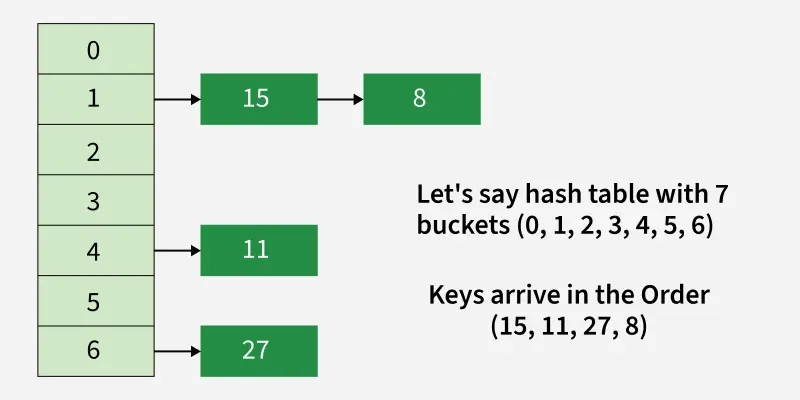
Table of Content
Simple Chaining
This method has not concept of rehashing. It only has a fixed size array i.e. fixed numbers of buckets.

C++ `
#include #include #include using namespace std;
class Hash { // Number of buckets int bucketCount; vector<vector> table;
public: // Constructor to initialize the hash // table with given bucket count Hash(int buckets) { bucketCount = buckets; table.resize(bucketCount); }
// Function to insert a key into hash table
void insert(int key) {
    // Get the hash index for the key
    int index = getHashIndex(key);

    // Insert the key into the corresponding bucket
    table[index].push_back(key);
}

// Function to delete a key from hash table
void remove(int key) {
    // Get the hash index for the key
    int index = getHashIndex(key);

    // Find and remove the key from the bucket
    auto it = find(table[index].begin(), table[index].end(), key);

    // Erase the key if found
    if (it != table[index].end()) {
        table[index].erase(it);
    }
}

// Function to display the hash table
void display() {
    for (int i = 0; i < bucketCount; i++) {
        cout << i;

        // Print all keys in current bucket
        for (int key : table[i]) {
            cout << " --> " << key;
        }

        cout << endl;
    }
}
private: // Simple hash function to map key to index int getHashIndex(int key) { return key % bucketCount; } };
int main() { vector keys = {7, 18, 12, 25};
Hash hashTable(7);

for (int key : keys) {
    hashTable.insert(key);
}

hashTable.remove(12);

hashTable.display();

return 0;
}
Java
import java.util.ArrayList; import java.util.List;
public class Hash { // Number of buckets private int bucketCount ;
// List of lists to store chains
private List<List<Integer>> table ;

// Constructor to initialize the hash
// table with given bucket count
public Hash(int buckets) {
    bucketCount = buckets ;
    table = new ArrayList<>() ;
    for (int i = 0; i < bucketCount; i++) {
        table.add(new ArrayList<>());
    }
}

// Function to insert a key into hash table
public void insert(int key) {
    // Get the hash index for the key
    int index = getHashIndex(key);

    // Insert the key into the corresponding bucket
    table.get(index).add(key);
}

// Function to delete a key from hash table
public void remove(int key) {
    // Get the hash index for the key
    int index = getHashIndex(key);

    // Find and remove the key from the bucket
    table.get(index).remove(Integer.valueOf(key));
}

// Function to display the hash table
public void display() {
    for (int i = 0; i < bucketCount; i++) {
        System.out.print(i);

        // Print all keys in current bucket
        for (int key : table.get(i)) {
            System.out.print(" --> " + key);
        }

        System.out.println();
    }
}

// Simple hash function to map key to index
private int getHashIndex(int key) {
    return key % bucketCount;
}

public static void main(String[] args) {
    int[] keys = {7, 18, 12, 25};

    Hash hashTable = new Hash(7);

    for (int key : keys) {
        hashTable.insert(key);
    }

    hashTable.remove(12);
    hashTable.display();
}
}
Python
class Hash: def init(self, buckets): # Number of buckets self.bucket_count = buckets
    # Create empty chains for each bucket
    self.table = [[] for _ in range(self.bucket_count)]

# Insert a key into hash table
def insert(self, key):
    # Compute hash index
    index = self.get_hash_index(key)

    # Append key to corresponding chain
    self.table[index].append(key)

# Remove a key from hash table
def remove(self, key):
    # Compute hash index
    index = self.get_hash_index(key)

    # Remove key if present in chain
    if key in self.table[index]:
        self.table[index].remove(key)

# Display contents of hash table
def display(self):
    for i in range(self.bucket_count):
        print(i, end="")

        # Print all keys in chain
        for key in self.table[i]:
            print(" -->", key, end="")

        print()

# Hash function
def get_hash_index(self, key):
    return key % self.bucket_count
if name == "main": keys = [7, 18, 12, 25]
hash_table = Hash(7)

for key in keys:
    hash_table.insert(key)

hash_table.remove(12)
hash_table.display()
C#
using System; using System.Collections.Generic;
public class Hash { // Number of buckets private int bucketCount; private List<List> table;
// Constructor to initialize the hash
// table with given bucket count
public Hash(int buckets) {
    bucketCount = buckets;
    table = new List<List<int>>(buckets);
    for (int i = 0; i < bucketCount; i++) {
        table.Add(new List<int>());
    }
}

// Function to insert a key into hash table
public void Insert(int key) {
    // Get the hash index for the key
    int index = GetHashIndex(key) ;

    table[index].Add(key) ;
}

// Function to delete a key from hash table
public void Remove(int key) {
    // Get the hash index for the key
    int index = GetHashIndex(key);

    // Remove the key from the bucket if it exists
    table[index].Remove(key);
}

// Function to display the hash table
public void Display() {
    for (int i = 0; i < bucketCount; i++) {
        Console.Write(i);

        // Print all keys in current bucket
        foreach (int key in table[i]) {
            Console.Write(" --> " + key);
        }

        Console.WriteLine();
    }
}

// Simple hash function to map key to index
private int GetHashIndex(int key) {
    return key % bucketCount;
}

public static void Main(string[] args) {
    int[] keys = { 7, 18, 12, 25 };

    Hash hashTable = new Hash(7);

    foreach (int key in keys) {
        hashTable.Insert(key);
    }

    hashTable.Remove(12);
    hashTable.Display();
}
}
JavaScript
class Hash { // Constructor to initialize the hash table with given bucket count constructor(buckets) { // Number of buckets this.bucketCount = buckets;
    // Array of arrays to store chains
    this.table = new Array(this.bucketCount).fill(null).map(() => []);
}

// Function to insert a key into hash table
insert(key) {
    // Get the hash index for the key
    const index = this.getHashIndex(key);

    // Insert the key into the corresponding bucket
    this.table[index].push(key);
}

// Function to delete a key from hash table
remove(key) {
    // Get the hash index for the key
    const index = this.getHashIndex(key);

    // Remove the key from the bucket if it exists
    const pos = this.table[index].indexOf(key);
    if (pos !== -1) {
        this.table[index].splice(pos, 1);
    }
}

// Function to display the hash table
display() {
    for (let i = 0; i < this.bucketCount; i++) {
        let output = i.toString();

        // Print all keys in current bucket
        for (const key of this.table[i]) {
            output += " --> " + key;
        }

        console.log(output);
    }
}

// Simple hash function to map key to index
getHashIndex(key) {
    return key % this.bucketCount;
}
}
// Driver Code const keys = [7, 18, 12, 25];
const hashTable = new Hash(7);
for (const key of keys) { hashTable.insert(key); }
hashTable.remove(12); hashTable.display();
`
Output
0 --> 7 1 2 3 4 --> 18 --> 25 5 6
**Time Complexity:
- **Search : O(1+(n/m))
- **Delete : O(1+(n/m))
where n = Total elements in hash table
m = Size of hash table - Here n/m is the **Load Factor.
- Load Factor (∝) must be as small as possible.
- If load factor increases, then possibility of collision increases.
- Load factor is trade of space and time .
- Assume , uniform distribution of keys,
- Expected chain length : O(∝)
- Expected time to search : O( 1 + ∝ )
- Expected time to insert/ delete : O( 1 + ∝ )
**Auxiliary Space: O(1), since no extra space has been taken.
Chaining with Rehashing
Let's discuss another method where there is no limitation on the number of buckets. The number of buckets increases when the load factor exceeds 0.5.
We will do rehashingwhen the value of load factor is greater than 0.5. In rehashing, we double the size of array and add all the values again to new array (doubled size array is new array) based on hash function. Hash function should also be change as it is depends on number of buckets. Therefore, hash function behaves differently from the previous one.
C++ `
#include #include #include using namespace std;
// HashTable class to handle insert, delete, // display, and rehash operations class Hash {
// Number of buckets
int bucketCount;

// Number of elements
int numOfElements;

// Vector of chains
vector<vector<int>> table;
public:
// Constructor to initialize the hash table
Hash(int buckets) {
    bucketCount = buckets;
    numOfElements = 0;
    table.resize(bucketCount);
}

// Insert a key into the hash table
void insert(int key) {
    while (getLoadFactor() > 0.5) {
        rehash();
    }
    int index = getHashIndex(key);
    table[index].push_back(key);
    numOfElements++;
}

// Remove a key from the hash table
void remove(int key) {
    int index = getHashIndex(key);
    auto it = find(table[index].begin(),
                    table[index].end(), key);
    if (it != table[index].end()) {
        table[index].erase(it);
        numOfElements--;
    }
}

// Display the current hash table
void display() {
    for (int i = 0; i < bucketCount; i++) {
        cout << i;
        for (int key : table[i]) {
            cout << " --> " << key;
        }
        cout << endl;
    }
}
private: // Hash function to map key to index int getHashIndex(int key) { return key % bucketCount; }
// Calculate load factor
float getLoadFactor() {
    return (float)numOfElements / bucketCount;
}

// Rehash the table by doubling the size
void rehash() {
    vector<vector<int>> oldTable = table;
    bucketCount *= 2;
    table.clear();
    table.resize(bucketCount);
    numOfElements = 0;
    for (const auto& bucket : oldTable) {
        for (int key : bucket) {
            insert(key);
        }
    }
}
};
int main() { vector keys = {15, 11, 27};
Hash hashTable(5);

for (int key : keys) {
    hashTable.insert(key);
}

hashTable.remove(11);
hashTable.display();

hashTable.insert(19);

cout << "\nAfter rehashing:\n";
hashTable.display();

return 0;
}
Java
import java.util.ArrayList; import java.util.List;
public class Hash { private int bucketCount;
private int numOfElements;

private List<List<Integer>> table;

// Constructor to initialize the table
public Hash(int buckets) {
    bucketCount = buckets;
    numOfElements = 0;
    table = new ArrayList<>();
    for (int i = 0; i < bucketCount; i++) {
        table.add(new ArrayList<>());
    }
}

// Insert a key into the hash table
public void insert(int key) {
    // If load factor exceeds 0.5, perform rehashing
    while (getLoadFactor() > 0.5) {
        rehash();
    }

    // Compute index for the key
    int index = getHashIndex(key);

    // Insert key into the corresponding bucket
    table.get(index).add(key);

    // Increase element count
    numOfElements++;
}

// Remove a key from the hash table
public void remove(int key) {
    // Get index of the key
    int index = getHashIndex(key);

    // Remove the key from its bucket if it exists
    table.get(index).remove((Integer) key);
    numOfElements--;
}

// Display all buckets and elements
public void display() {
    for (int i = 0; i < bucketCount; i++) {
        System.out.print(i);
        for (int key : table.get(i)) {
            System.out.print(" --> " + key);
        }
        System.out.println();
    }
}

// Hash function to map key to index
private int getHashIndex(int key) {
    return key % bucketCount;
}

// Calculate current load factor
private float getLoadFactor() {
    return (float) numOfElements / bucketCount;
}

// Rehash: double size and re-insert all elements
private void rehash() {
    List<List<Integer>> oldTable = table;
    bucketCount *= 2;
    table = new ArrayList<>();
    for (int i = 0; i < bucketCount; i++) {
        table.add(new ArrayList<>());
    }
    numOfElements = 0;
    for (List<Integer> bucket : oldTable) {
        for (int key : bucket) {
            insert(key);
        }
    }
}

public static void main(String[] args) {
    int[] keys = {15, 11, 27};

    Hash hashTable = new Hash(5);

    for (int key : keys) {
        hashTable.insert(key);
    }

    hashTable.remove(11);
    hashTable.display();
    hashTable.insert(19);

    System.out.println("\nAfter rehashing:");
    hashTable.display();
}
}
Python
class HashTable:
# Constructor to initialize buckets
def __init__(self, buckets):
    self.bucket_count = buckets
    self.num_of_elements = 0
    self.table = [[] for _ in range(buckets)]

# Insert a key into the table
def insert(self, key):
    # Rehash if load factor > 0.5
    while self.get_load_factor() > 0.5:
        self.rehash()

    # Get hash index
    index = self.get_hash_index(key)

    # Insert key in bucket
    self.table[index].append(key)
    self.num_of_elements += 1

# Remove a key from the table
def remove(self, key):
    index = self.get_hash_index(key)

    # If key exists, remove it
    if key in self.table[index]:
        self.table[index].remove(key)
        self.num_of_elements -= 1

# Display the hash table
def display(self):
    for i in range(self.bucket_count):
        print(i, end="")
        for key in self.table[i]:
            print(f" --> {key}", end="")
        print()

# Hash function
def get_hash_index(self, key):
    return key % self.bucket_count

# Load factor calculation
def get_load_factor(self):
    return self.num_of_elements / self.bucket_count

# Rehash the table by doubling size
def rehash(self):
    old_table = self.table
    self.bucket_count *= 2
    self.table = [[] for _ in range(self.bucket_count)]
    self.num_of_elements = 0

    # Re-insert keys into new table
    for bucket in old_table:
        for key in bucket:
            self.insert(key)
keys = [15, 11, 27] hashTable = HashTable(5)
for key in keys: hashTable.insert(key)
hashTable.remove(11)
hashTable.display()
hashTable.insert(19)
print("\nAfter rehashing:") hashTable.display()
C#
using System; using System.Collections.Generic;
class HashTable { // Number of buckets private int bucketCount;
// Number of elements
private int numOfElements;

// List of chains
private List<List<int>> table;

// Constructor to initialize
public HashTable(int buckets) {
    bucketCount = buckets;
    numOfElements = 0;
    table = new List<List<int>>(buckets);
    for (int i = 0; i < bucketCount; i++) {
        table.Add(new List<int>());
    }
}

// Insert a key
public void Insert(int key) {
    // Check load factor
    while (GetLoadFactor() > 0.5f) {
        Rehash();
    }

    // Get hash index
    int index = GetHashIndex(key);

    // Insert into bucket
    table[index].Add(key);
    numOfElements++;
}

// Remove a key
public void Remove(int key) {
    int index = GetHashIndex(key);
    if (table[index].Remove(key)) {
        numOfElements--;
    }
}

// Display all elements
public void Display() {
    for (int i = 0; i < bucketCount; i++) {
        Console.Write(i);
        foreach (int key in table[i]) {
            Console.Write(" --> " + key);
        }
        Console.WriteLine();
    }
}

// Hash function
private int GetHashIndex(int key) {
    return key % bucketCount;
}

// Load factor
private float GetLoadFactor() {
    return (float)numOfElements / bucketCount;
}

// Rehashing
private void Rehash() {
    var oldTable = table;
    bucketCount *= 2;
    table = new List<List<int>>(bucketCount);
    for (int i = 0; i < bucketCount; i++) {
        table.Add(new List<int>());
    }
    numOfElements = 0;

    // Re-insert elements
    foreach (var bucket in oldTable) {
        foreach (int key in bucket) {
            Insert(key);
        }
    }
}

public static void Main() {
    int[] keys = {15, 11, 27};
    HashTable hashTable = new HashTable(5);

    foreach (int key in keys) {
        hashTable.Insert(key);
    }

    hashTable.Remove(11);

    hashTable.Display();

    hashTable.Insert(19);
    Console.WriteLine("\nAfter rehashing:");
    hashTable.Display();
}
}
` JavaScript ``
class HashTable { // Constructor to initialize table constructor(buckets) { this.bucketCount = buckets; this.numOfElements = 0; this.table = Array.from({ length: buckets }, () => []); }
// Insert a key
insert(key) {
    // Rehash if needed
    while (this.getLoadFactor() > 0.5) {
        this.rehash();
    }

    // Get hash index
    const index = this.getHashIndex(key);

    // Insert key
    this.table[index].push(key);
    this.numOfElements++;
}

// Remove a key
remove(key) {
    const index = this.getHashIndex(key);
    const idx = this.table[index].indexOf(key);
    if (idx !== -1) {
        this.table[index].splice(idx, 1);
        this.numOfElements--;
    }
}

// Display table
display() {
    for (let i = 0; i < this.bucketCount; i++) {
        let output = `${i}`;
        for (let key of this.table[i]) {
            output += ` --> ${key}`;
        }
        console.log(output);
    }
}

// Hash function
getHashIndex(key) {
    return key % this.bucketCount;
}

// Load factor
getLoadFactor() {
    return this.numOfElements / this.bucketCount;
}

// Rehashing function
rehash() {
    const oldTable = this.table;
    this.bucketCount *= 2;
    this.table = Array.from({ length: this.bucketCount }, () => []);
    this.numOfElements = 0;

    // Re-insert all keys from old table
    for (let bucket of oldTable) {
        for (let key of bucket) {
            this.insert(key);
        }
    }
}
}
// Driver Code const keys = [15, 11, 27]; const hashTable = new HashTable(5); for (let key of keys) { hashTable.insert(key); } hashTable.remove(11); hashTable.display(); hashTable.insert(19); console.log("\nAfter rehashing:"); hashTable.display();
``
Output
0 --> 15 1 2 --> 27 3 4
After rehashing: 0 --> 15 1 2 --> 27 3 4 --> 19
**Complexity analysis of Insert:
- **Time Complexity: O(n), as we are checking the load factor each time and when it is greater than 0.5 we call rehashing function which takes O(n) time.
- **Auxiliary Space: O(n)
**Complexity analysis of Search:
- **Time Complexity: O(n)
- **Auxiliary Space: O(1)