Check if the given number is Ore number or not (original) (raw)
Last Updated : 11 Jul, 2025
Given a positive integer n, check if it is an Ore number or not. Print 'YES' if n is an ore number otherwise print 'NO'.
Ore Number: In mathematics, Ore numbers are positive integers whose divisors have an integer harmonic value. Ore numbers are often called harmonic divisor numbers. Ore numbers are named after Øystein Ore.
For example, 6 has four divisors namely 1, 2, 3, and 6.
The harmonic mean of the divisors is-
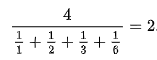
The harmonic mean of divisors of 6 is 2, an integer. So, 6 is an Ore number or harmonic divisor number.
First, a few Ore numbers or harmonic divisor numbers are:
1, 6, 28, 140, 270, 496, 672, 1638, 2970, 6200, 8128, 8190
Examples:
Input : N = 6 Output : Yes
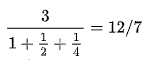
Input : N = 4 Output: No Explanation : Harmonic mean of divisors of 4 is not an Integer.
Prerequisite:
The idea is to generate all divisors of the given number and then check if the harmonic mean of the divisor is an Integer or not.
- Generate All Divisors of the given number - 'n'
- Calculate the Harmonic mean of the divisors of n
- Check if the Harmonic mean is an Integer or not
- If Yes, Then the number is an Ore Number otherwise Not
Below is the implementation of the above approach:
C++ `
// CPP program to check if the given number is // Ore number
#include <bits/stdc++.h> using namespace std;
vector arr;
// Function that returns harmonic mean void generateDivisors(int n) { // Note that this loop runs till square root for (int i = 1; i <= sqrt(n); i++) { if (n % i == 0) {
        // If divisors are equal, store 'i'
        if (n / i == i)
            arr.push_back(i);

        else // Otherwise store 'i' and 'n/i' both
        {
            arr.push_back(i);
            arr.push_back(n / i);
        }
    }
}
}
// Utility function to calculate harmonic // mean of the divisors double harmonicMean(int n) { generateDivisors(n);
// Declare sum variables and initialize
// with zero.

double sum = 0.0;

int len = arr.size();

// calculate denominator
for (int i = 0; i < len; i++)
    sum = sum + double(n / arr[i]);

sum = double(sum / n);

// Calculate harmonic mean and return

return double(arr.size() / sum);
}
// Function to check if a number is ore number bool isOreNumber(int n) { // Calculate Harmonic mean of divisors of n double mean = harmonicMean(n);
// Check if harmonic mean is an integer or not
if (mean - int(mean) == 0)
    return true;
else
    return false;
}
// Driver Code int main() { int n = 28;
if (isOreNumber(n))
    cout << "YES";
else
    cout << "NO";

return 0;
}
Java
// Java program to check if the given // number is Ore number
import java.util.*; class GFG {
static Vector<Integer> arr = new Vector<Integer>();

// Function that returns harmonic mean.
static void generateDivisors(int n)
{
    // Note that this loop runs till square root
    for (int i = 1; i <= Math.sqrt(n); i++) {
        if (n % i == 0) {

            // If divisors are equal, store 'i'
            if (n / i == i)
                arr.add(i);

            else // Otherwise store 'i' and 'n/i' both
            {
                arr.add(i);
                arr.add(n / i);
            }
        }
    }
}

// Utility function to calculate harmonic mean
// of the divisors
static double harmonicMean(int n)
{
    generateDivisors(n);

    // Declare sum variables and initialize
    // with zero.

    double sum = 0.0;

    int len = arr.size();

    // calculate denominator
    for (int i = 0; i < len; i++)
        sum = sum + n / arr.get(i);

    sum = sum / n;

    // Calculate harmonic mean and return

    return arr.size() / sum;
}

// Function to check if a number
// is Ore number
static boolean isOreNumber(int n)
{
    // Calculate Harmonic mean of divisors of n
    double mean = harmonicMean(n);

    // Check if Harmonic mean is an Integer or not
    if (mean - Math.floor(mean) == 0)
        return true;
    else
        return false;
}

// Driver Code
public static void main(String[] args)
{
    int n = 28;

    if (isOreNumber(n))
        System.out.println("YES");
    else
        System.out.println("NO");
}
}
Python3
Python3 program to check if the
given number is Ore number
arr = []
Function that returns harmonic mean
def generateDivisors(n):
# Note that this loop runs till square root
for i in range(1, int(n**(0.5)) + 1):
    if n % i == 0:

        # If divisors are equal, store 'i'
        if n // i == i:
            arr.append(i)

        # Otherwise store 'i' and 'n/i' both
        else:
            arr.append(i)
            arr.append(n // i)
Utility function to calculate harmonic
mean of the divisors
def harmonicMean(n):
generateDivisors(n)

# Declare sum variables and initialize
# with zero.
Sum = 0
length = len(arr)

# calculate denominator
for i in range(0, length):
    Sum = Sum + (n / arr[i])

Sum = Sum / n

# Calculate harmonic mean and return
return length / Sum
Function to check if a number
is ore number
def isOreNumber(n):
# Calculate Harmonic mean of
# divisors of n
mean = harmonicMean(n)

# Check if harmonic mean is an
# integer or not
if mean - int(mean) == 0:
    return True
else:
    return False
Driver Code
if name == "main":
n = 28

if isOreNumber(n) == True:
    print("YES")
else:
    print("NO")
This code is contributed
by Rituraj Jain
C#
// C# program to check if the given // number is Ore number using System; using System.Collections;
class GFG {
static ArrayList arr = new ArrayList();
// Function that returns harmonic mean. static void generateDivisors(int n) { // Note that this loop runs // till square root for (int i = 1; i <= Math.Sqrt(n); i++) { if (n % i == 0) {
        // If divisors are equal,
        // store 'i'
        if (n / i == i)
            arr.Add(i);

        else // Otherwise store 'i'
             // and 'n/i' both
        {
            arr.Add(i);
            arr.Add(n / i);
        }
    }
}
}
// Utility function to calculate // harmonic mean of the divisors static double harmonicMean(int n) { generateDivisors(n);
// Declare sum variables and
// initialize with zero.
double sum = 0.0;

int len = arr.Count;

// calculate denominator
for (int i = 0; i < len; i++)
    sum = sum + n / (int)arr[i];

sum = sum / n;

// Calculate harmonic mean
// and return
return arr.Count / sum;
}
// Function to check if a number // is Ore number static bool isOreNumber(int n) { // Calculate Harmonic mean of // divisors of n double mean = harmonicMean(n);
// Check if Harmonic mean is
// an Integer or not
if (mean - Math.Floor(mean) == 0)
    return true;
else
    return false;
}
// Driver Code public static void Main() { int n = 28;
if (isOreNumber(n))
    Console.WriteLine("YES");
else
    Console.WriteLine("NO");
} }
// This code is contributed by mits
JavaScript
`
Time Complexity: O(sqrt(n)), Where n is the given number.
Auxiliary Space: O(sqrt(n)), for storing the divisor of n in the array