Combinatorial Game Theory | Set 3 (Grundy Numbers/Numbers and Mex) (original) (raw)
Last Updated : 23 Jul, 2025
We have introduced Combinatorial Game Theory in Set 1 and discussed Game of Nim in Set 2.
Grundy Number is a number that defines a state of a game. We can define any impartial game (example : nim game) in terms of Grundy Number.
Grundy Numbers or Numbers determine how any Impartial Game (not only the Game of Nim) can be solved once we have calculated the Grundy Numbers associated with that game using Sprague-Grundy Theorem.
But before calculating Grundy Numbers, we need to learn about another term- Mex.
**What is Mex?
‘Minimum excludant’ a.k.a ‘Mex’ of a set of numbers is the smallest non-negative number not present in the set.
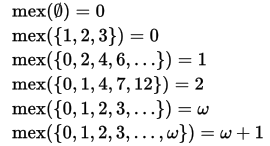
**How to calculate Grundy Numbers?
We use this definition- The Grundy Number/ number is equal to 0 for a game that is lost immediately by the first player and is equal to Mex of the numbers of all possible next positions for any other game.
Below are three example games and programs to calculate Grundy Number and Mex for each of them. Calculation of Grundy Numbers is done basically by a recursive function called as calculateGrundy() function which uses calculateMex() function as its sub-routine.
**Example 1
The game starts with a pile of n stones, and the player to move may take any positive number of stones. Calculate the Grundy Numbers for this game. The last player to move wins. Which player wins the game?
Since if the first player has 0 stones, he will lose immediately, so Grundy(0) = 0
If a player has 1 stones, then he can take all the stones and win. So the next possible position of the game (for the other player) is (0) stones
Hence, Grundy(1) = Mex(0) = 1 [According to the definition of Mex]
Similarly, If a player has 2 stones, then he can take only 1 stone or he can take all the stones and wins. So the next possible position of the game (for the other player) is (1, 0) stones respectively.
Hence, Grundy(2) = Mex(0, 1) = 2 [According to the definition of Mex]
Similarly, If a player has 'n' stones, then he can take only 1 stone, or he can take 2 stones........ or he can take all the stones and win. So the next possible position of the game (for the other player) is (n-1, n-2,....1) stones respectively.
Hence, Grundy(n) = Mex (0, 1, 2, ....n-1) = n [According to the definition of Mex]
We summarize the first the Grundy Value from 0 to 10 in the below table-

C++ `
/* A recursive C++ program to find Grundy Number for a game which is like a one-pile version of Nim. Game Description : The game starts with a pile of n stones, and the player to move may take any positive number of stones. The last player to move wins. Which player wins the game? */ #include<bits/stdc++.h> using namespace std;
// A Function to calculate Mex of all the values in // that set. int calculateMex(unordered_set Set) { int Mex = 0;
while (Set.find(Mex) != Set.end())
    Mex++;

return (Mex);
}
// A function to Compute Grundy Number of 'n' // Only this function varies according to the game int calculateGrundy(int n) { if (n == 0) return (0);
unordered_set<int> Set; // A Hash Table

for (int i=0; i<=n-1; i++)
        Set.insert(calculateGrundy(i));

return (calculateMex(Set));
}
// Driver program to test above functions int main() { int n = 10; printf("%d", calculateGrundy(n)); return (0); }
Java
// A recursive Java program to find Grundy
// Number for a game which is like a
// one-pile version of Nim. Game
// Description : The game starts
// with a pile of n stones, and the
// player to move may take any
// positive number of stones.
// The last player to move wins.
// Which player wins the game?
import java.util.*;
class GFG{
// A Function to calculate Mex of all // the values in that set. public static int calculateMex(Set Set) { int Mex = 0;
while (Set.contains(Mex))
    Mex++;

return (Mex);
}
// A function to Compute Grundy Number // of 'n'. Only this function varies // according to the game public static int calculateGrundy(int n) { if (n == 0) return (0);
// A Hash Table
Set<Integer> Set = new HashSet<Integer>();

for(int i = 0; i <= n - 1; i++)
    Set.add(calculateGrundy(i));

return (calculateMex(Set));
}
// Driver code public static void main(String[] args) { int n = 10;
System.out.print(calculateGrundy(n));} }
// This code is contributed by divyeshrabadiya07
Python3
''' A recursive Python3 program to find Grundy Number for a game which is like a one-pile version of Nim. Game Description : The game starts with a pile of n stones, and the player to move may take any positive number of stones. The last player to move wins. Which player wins the game? '''
A Function to calculate Mex of all the values in
that set.
def calculateMex(Set): Mex = 0
while (Mex in Set):
    Mex += 1

return (Mex)
A function to Compute Grundy Number of 'n'
Only this function varies according to the game
def calculateGrundy( n): if (n == 0): return (0)
Set = set() # A Hash Table

for i in range(n):
    Set.add(calculateGrundy(i));

return (calculateMex(Set))
Driver program to test above functions
n = 10; print(calculateGrundy(n))
This code is contributed by ANKITKUMAR34
C#
// A recursive C# program to find Grundy // Number for a game which is like a // one-pile version of Nim. Game // Description : The game starts // with a pile of n stones, and // the player to move may take // any positive number of stones. // The last player to move wins. // Which player wins the game? using System; using System.Collections; using System.Collections.Generic;
class GFG{
// A Function to calculate Mex of all // the values in that set. static int calculateMex(HashSet Set) { int Mex = 0;
while (Set.Contains(Mex))
    Mex++;

return (Mex);
}
// A function to Compute Grundy Number // of 'n'. Only this function varies // according to the game static int calculateGrundy(int n) { if (n == 0) return (0);
// A Hash Table
HashSet<int> Set = new HashSet<int>();

for(int i = 0; i <= n - 1; i++)
        Set.Add(calculateGrundy(i));

return (calculateMex(Set));
}
// Driver code public static void Main(string []arg) { int n = 10;
Console.Write(calculateGrundy(n)); } }
// This code is contributed by rutvik_56
JavaScript
`
**Output :
10
The above solution can be optimized using Dynamic Programming as there are overlapping subproblems.
**Example 2
The game starts with a pile of n stones, and the player to move may take any positive number of stones up to 3 only. The last player to move wins. Which player wins the game? This game is 1 pile version of Nim.
Since if the first player has 0 stones, he will lose immediately, so Grundy(0) = 0
If a player has 1 stones, then he can take all the stones and win. So the next possible position of the game (for the other player) is (0) stones
Hence, Grundy(1) = Mex(0) = 1 [According to the definition of Mex]
Similarly, if a player has 2 stones, then he can take only 1 stone or he can take 2 stones and win. So the next possible position of the game (for the other player) is (1, 0) stones respectively.
Hence, Grundy(2) = Mex(0, 1) = 2 [According to the definition of Mex]
Similarly, Grundy(3) = Mex(0, 1, 2) = 3 [According to the definition of Mex]
But what about 4 stones ?
If a player has 4 stones, then he can take 1 stone or he can take 2 stones or 3 stones, but he can’t take 4 stones (see the constraints of the game). So the next possible position of the game (for the other player) is (3, 2, 1) stones respectively.
Hence, Grundy(4) = Mex (1, 2, 3) = 0 [According to the definition of Mex]
So we can define Grundy Number of any n >= 4 recursively as-
Grundy(n) = Mex[Grundy (n-1), Grundy (n-2), Grundy (n-3)]
We summarize the first the Grundy Value from 0 to 10 in the below table-

C++ `
/* A recursive C++ program to find Grundy Number for a game which is one-pile version of Nim. Game Description : The game starts with a pile of n stones, and the player to move may take any positive number of stones up to 3 only. The last player to move wins. */ #include<bits/stdc++.h> using namespace std;
// A Function to calculate Mex of all the values in // that set.
// A function to Compute Grundy Number of 'n' // Only this function varies according to the game int calculateGrundy(int n) { if (n == 0) return (0); if (n == 1) return (1); if (n == 2) return (2); if (n == 3) return (3); else return (n%(3+1)); }
// Driver program to test above functions int main() { int n = 10; printf("%d", calculateGrundy(n)); return (0); }
Java
/* A recursive Java program to find Grundy Number for a game which is one-pile version of Nim. Game Description : The game starts with a pile of n stones, and the player to move may take any positive number of stones up to 3 only.The last player to move wins. / import java.util.;
class GFG {
// A function to Compute Grundy
// Number of 'n' Only this function
// varies according to the game
static int calculateGrundy(int n)
{
    if (n == 0)
        return 0;
    if (n == 1)
        return 1;
    if (n == 2)
        return 2;
    if (n == 3)
        return 3;
    else
        return (n%(3+1));
}

// Driver code
public static void main(String[] args)
{
    int n = 10;
    System.out.printf("%d", calculateGrundy(n));
}
} // This code is contributed by rahulnamdevrn27
Python3
A recursive Python3 program to find Grundy Number
for a game which is one-pile version of Nim.
Game Description : The game starts with a pile
of n stones, and the player to move may take
any positive number of stones up to 3 only.
The last player to move wins.
A function to Compute Grundy Number of 'n'
Only this function varies according to the game
def calculateGrundy(n):
if 0 <= n <= 3:
    return n

else:
    return (n%(3+1));
Driver program to test above functions
if name == "main":
n = 10
print(calculateGrundy(n))
This code is contributed by rahulnamdevrn27
C#
/* A recursive Java program to find Grundy Number for a game which is one-pile version of Nim. Game Description : The game starts with a pile of n stones, and the player to move may take any positive number of stones up to 3 only.The last player to move wins. */ using System; using System.Collections.Generic;
class GFG {
// A function to Compute Grundy Number of
// 'n' Only this function varies according
// to the game
static int calculateGrundy(int n)
{
    if (n == 0)
        return 0;
    if (n == 1)
        return 1;
    if (n == 2)
        return 2;
    if (n == 3)
        return 3;
    else
        return (n%(3+1));

}

// Driver code
public static void Main(String[] args)
{
    int n = 10;
    Console.Write(calculateGrundy(n));
}
} // This code is contributed by rahulnamdevrn27
JavaScript
`
**Output :
2
**Example 3
The game starts with a number- 'n' and the player to move divides the number- 'n' with 2, 3 or 6 and then takes the floor. If the integer becomes 0, it is removed. The last player to move wins. Which player wins the game?
We summarize the first the Grundy Value from 0 to 10 in the below table:

Think about how we generated this table.
C++ `
/* A recursive C++ program to find Grundy Number for a game. Game Description: The game starts with a number- 'n' and the player to move divides the number- 'n' with 2, 3 or 6 and then takes the floor. If the integer becomes 0, it is removed. The last player to move wins. */ #include<bits/stdc++.h> using namespace std;
// A Function to calculate Mex of all the values in // that set. int calculateMex(unordered_set Set) { int Mex = 0;
while (Set.find(Mex) != Set.end())
    Mex++;

return (Mex);
}
// A function to Compute Grundy Number of 'n' // Only this function varies according to the game int calculateGrundy (int n) { if (n == 0) return (0);
unordered_set<int> Set; // A Hash Table

Set.insert(calculateGrundy(n/2));
Set.insert(calculateGrundy(n/3));
Set.insert(calculateGrundy(n/6));

return (calculateMex(Set));
}
// Driver program to test above functions int main() { int n = 10; printf("%d", calculateGrundy (n)); return (0); }
Java
/* A recursive Java program to find Grundy Number for a game. Game Description : The game starts with a number- 'n' and the player to move divides the number- 'n' with 2, 3 or 6 and then takes the floor. If the integer becomes 0, it is removed. The last player to move wins. / import java.util.;
class GFG {
// A Function to calculate Mex of all the values in
// that set.
static int calculateMex(HashSet<Integer> Set)
{
    int Mex = 0;

    while (Set.contains(Mex))
    {
        Mex++;
    }

    return (Mex);
}

// A function to Compute Grundy Number of 'n'
// Only this function varies according to the game
static int calculateGrundy(int n)
{
    if (n == 0)
    {
        return (0);
    }

    HashSet<Integer> Set = new HashSet<Integer>(); // A Hash Table

    Set.add(calculateGrundy(n / 2));
    Set.add(calculateGrundy(n / 3));
    Set.add(calculateGrundy(n / 6));

    return (calculateMex(Set));
}

// Driver code
public static void main(String[] args)
{
    int n = 10;
    System.out.printf("%d", calculateGrundy(n));
}
}
// This code is contributed by PrinciRaj1992
Python3
A recursive Python3 program to
find Grundy Number for a game.
Game Description : The game starts with a number- 'n'
and the player to move divides the number- 'n' with 2, 3
or 6 and then take the floor. If the integer becomes 0,
it is removed. The last player to move wins.
A Function to calculate Mex
of all the values in that set.
def calculateMex(Set):
Mex = 0
while Mex in Set:
    Mex += 1

return Mex
A function to Compute Grundy Number of 'n'
Only this function varies according to the game
def calculateGrundy(n):
if n == 0:
    return 0

Set = set() # A Hash Table

Set.add(calculateGrundy(n // 2))
Set.add(calculateGrundy(n // 3))
Set.add(calculateGrundy(n // 6))

return (calculateMex(Set))
Driver program to test above functions
if name == "main":
n = 10
print(calculateGrundy(n))
This code is contributed by Rituraj Jain
C#
/* A recursive C# program to find Grundy Number for a game. Game Description: The game starts with a number- 'n' and the player to move divides the number- 'n' with 2, 3 or 6 and then takes the floor. If the integer becomes 0, it is removed. The last player to move wins. */ using System; using System.Collections.Generic;
class GFG {
// A Function to calculate Mex of
// all the values in that set.
static int calculateMex(HashSet<int> Set)
{
    int Mex = 0;

    while (Set.Contains(Mex))
    {
        Mex++;
    }

    return (Mex);
}

// A function to Compute Grundy Number of 'n'
// Only this function varies according to the game
static int calculateGrundy(int n)
{
    if (n == 0)
    {
        return (0);
    }

    // A Hash Table
    HashSet<int> Set = new HashSet<int>();

    Set.Add(calculateGrundy(n / 2));
    Set.Add(calculateGrundy(n / 3));
    Set.Add(calculateGrundy(n / 6));

    return (calculateMex(Set));
}

// Driver code
public static void Main()
{
    int n = 10;
    Console.WriteLine(calculateGrundy(n));
}
}
// This code is contributed by PrinciRaj1992
JavaScript
`
**Output :
0
The above solution can be optimized using Dynamic Programming as there are overlapping subproblems.
**References-
https://en.wikipedia.org/wiki/Mex_(mathematics)
https://en.wikipedia.org/wiki/Number
In the next post, we will be discussing solutions to Impartial Games using Grundy Numbers or Numbers.