Commonly Asked Data Structure Interview Questions on Linked List (original) (raw)
Last Updated : 6 Sep, 2025
Unlike arrays, which are stored in contiguous memory locations, linked lists consist of nodes, where each node contains data and a reference (or link) to the next node in the sequence. This structure provides advantages in terms of dynamic size, easy insertion, and deletion of elements
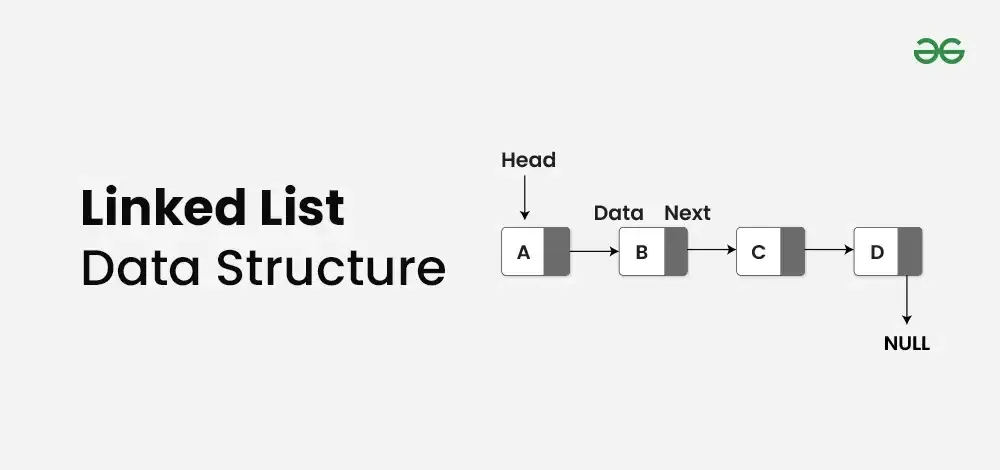
Linked Lists
Theoretical Questions for Interviews on Linked List
1. What is the significance of the head pointer in a linked list?
The head pointer is essential in a linked list as it points to the first node, providing access to the entire list. If the head is NULL, it indicates the list is empty. It is crucial for operations like traversal, insertion, and deletion.
2. What are the different types of linked lists?
Singly linked list, doubly linked list, and circular linked list.
3. What are the advantages of a Linked List?
- **Dynamic memory allocation: Linked lists allocate memory as needed, unlike arrays that require pre-defined size, making them more flexible.
- **Efficient insertion and deletion: Operations like insertion and deletion are faster in linked lists as they don't require shifting elements like in arrays.
- **Can represent complex data structures: Linked lists can easily represent structures like graphs or trees, which can be more complex with arrays.
- **It can be used to implement queues and stacks: Linked lists allow efficient implementation of these structures, unlike arrays, where resizing can be costly.
- **It can be used for memory management and caching: Linked lists are often used in memory management systems due to their ability to dynamically allocate and deallocate memory blocks.
- **It can be used for garbage collection: In systems that need to manage memory, linked lists are often used to track objects for garbage collection.
4. What are the disadvantages of a Linked List?
- **No random access: Unlike arrays, linked lists do not allow direct access to elements via index, requiring traversal from the head, which can be slower.
- **More memory overhead: Each node in a linked list requires additional memory for storing pointers, which increases memory consumption compared to arrays.
- **Difficult to debug: Debugging linked lists can be challenging because of the dynamic memory allocation and pointer manipulation involved, making errors harder to track.
- **Not cache-friendly: Linked lists do not have contiguous memory storage like arrays, which can lead to poor cache performance and slower access times.
- **Memory leaks in C/C++: In languages like C and C++, linked lists are prone to memory leaks if nodes are not properly deallocated, as there's no automatic garbage collection like in other languages.
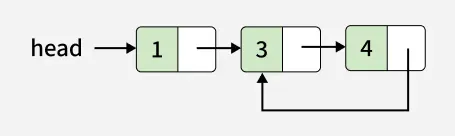
5. What is a cycle/loop in Singly Linked List?
A cycle, also known as a loop, in a singly-linked list occurs when a node in the list points back to a previous node, creating a circular path. This means that if you start traversing the list from any node, you will eventually come back to the same node, forming an infinite loop.
6. What is time complexity of Linked List operations?
The time complexity of common operations on a singly-linked list are as follows:
**Insertion:
- At the beginning: O(1)
- At the end: O(n). We can reduce it to O(1) if we maintain a tail pointer / reference along with head.
- At a specific position: O(n)
Refer Insertion in Linked List for more
**Deletion:
- At the beginning: O(1)
- At the end: O(n)
- At a specific position: O(n)
Refer Deletion in Linked List for more
**Search: O(n)
**Traversal: O(n)
7. How would you compare Dynamic Arrays Vs Linked Lists?
**Dynamic Array Advantages:
- Fast random access (O(1))
- Efficient for large data sets
- Contiguous memory allocation
**Dynamic Array Disadvantages:
- Slow insertion and deletion in the middle (O(n))
- Fixed size, can lead to memory waste or reallocation
**Linked Lists Advantages:
- Efficient insertion and deletion in the middle (O(1))
- Can grow and shrink dynamically
- Can represent complex data structures
**Linked Lists Disadvantages:
- No random access
- More memory overhead due to pointers
- Not cache-friendly
- Elements can be accessed sequentially only
Dynamic arrays are more efficient for random access and large data sets, while linked lists are more efficient for operations that involve insertion and deletion in the middle. Linked lists are also more flexible and can represent complex data structures.
8. Why is a singly linked list inefficient for reverse traversal, and how does a doubly linked list solve this?
- In a singly linked list, each node points only to its next node, so reverse traversal is impossible without starting from the head and moving forward until the target node is found again.
- A doubly linked list stores both next and prev pointers, allowing efficient forward and backward traversal in O(1) time per step.
9. Why is merge sort better than quicksort in a singly linked list?
Merge sort is better than quicksort for a singly linked list because it doesn't require random access to elements. Quicksort relies on indexing, which is inefficient for linked lists, while merge sort works by dividing the list and merging it, making it more suitable for linked lists. Merge sort also guarantees a stable O(n log n) time complexity, even for linked lists, whereas quicksort's performance can degrade to O(n²) in the worst case.
10. What are the applications of a Doubly Linked List?
- **Browser history: Doubly linked lists are used in browsers to track the history of visited pages, enabling users to go forward or backward through the list of pages with efficient navigation.
- **Undo operations in applications: In applications like word processors or image editors, doubly linked lists maintain a history of actions taken (like text changes or editing steps), allowing users to easily undo or redo operations in either direction.
11. What are the applications of a Circular Linked List?
- **Round-robin scheduling: A scheduling algorithm used in multitasking operating systems where each process is assigned a fixed time slice to execute in a cyclic order.
- **Circular buffers: A data structure used to manage data in a fixed-size buffer, where the buffer wraps around when it reaches the end, often used in streaming or real-time data applications.
12. What is the advantage of using a circular doubly linked list over a regular doubly linked list?
A circular doubly linked list has the advantage of continuous traversal from the last node back to the head, and vice versa. This allows for easier and more efficient operations in circular data structures, such as implementing a round-robin scheduler or a playlist, where you need to wrap around to the beginning after reaching the end.
Top Practice Problems for Interviews on Linked List
The following list of 50 linked list coding problems covers a range of difficulty levels, from easy to hard, to help candidates prepare for interviews.
Top 50 Problems on Linked List Data Structure asked in SDE Interviews