Convert an Array to a Circular Doubly Linked List (original) (raw)
Last Updated : 11 Jul, 2025
Prerequisite: Doubly Linked list, Circular Linked List, Circular Doubly Linked List
Given an array of N elements. The task is to write a program to convert the array into a circular doubly linked list.
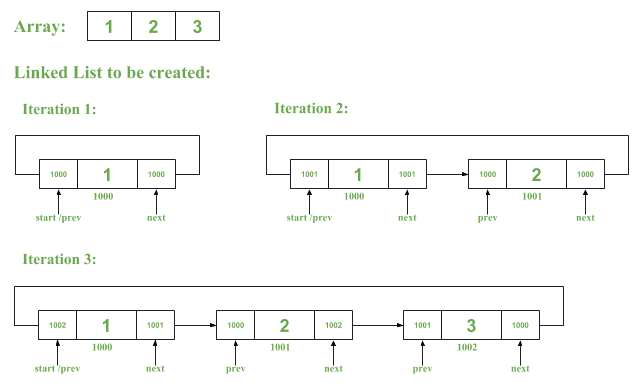
The idea is to start traversing the array and for every array element create a new list node and assign the prev and next pointers of this node accordingly.
- Create a pointer start to point to the starting of the list which will initially point to NULL(Empty list).
- For the first element of the array, create a new node and put that node's prev and next pointers to point to start maintaining the circular fashion of the list.
- For the rest of the array elements, insert those elements to the end of the created circular doubly linked list.
Below is the implementation of the above idea:
C++ `
// CPP program to convert array to // circular doubly linked list
#include<bits/stdc++.h> using namespace std;
// Doubly linked list node struct node { int data; struct node *next; struct node *prev; };
// Utility function to create a node in memory struct node* getNode() { return ((struct node *)malloc(sizeof(struct node))); }
// Function to display the list
int displayList(struct node *temp)
{
struct node *t = temp;
if(temp == NULL)
return 0;
else
{
cout<<"The list is: ";
    while(temp->next != t)
    {
        cout<<temp->data<<" ";
        temp = temp->next;
    }

    cout<<temp->data;

    return 1;
}
}
// Function to convert array into list void createList(int arr[], int n, struct node **start) { // Declare newNode and temporary pointer struct node *newNode,*temp; int i;
// Iterate the loop until array length
for(i=0;i<n;i++)
{
    // Create new node
    newNode = getNode();

    // Assign the array data
    newNode->data = arr[i];

    // If it is first element
    // Put that node prev and next as start
    // as it is circular
    if(i==0)
    {
        *start = newNode;
        newNode->prev = *start;
        newNode->next = *start;
    }
    else
    {
        // Find the last node
        temp = (*start)->prev;

        // Add the last node to make them
        // in circular fashion
        temp->next = newNode;
        newNode->next = *start;
        newNode->prev = temp;
        temp = *start;
        temp->prev = newNode;
    }
}
}
// Driver Code int main() { // Array to be converted int arr[] = {1,2,3,4,5}; int n = sizeof(arr) / sizeof(arr[0]);
// Start Pointer
struct node *start = NULL;

// Create the List
createList(arr, n, &start);

// Display the list
displayList(start);

return 0;
}
Java
// Java program to convert array to // circular doubly linked list class GFG {
// Doubly linked list node static class node { int data; node next; node prev; };
// Utility function to create a node in memory static node getNode() { return new node(); }
// Function to display the list static int displayList( node temp) { node t = temp; if(temp == null) return 0; else { System.out.print("The list is: ");
    while(temp.next != t)
    {
        System.out.print(temp.data+" ");
        temp = temp.next;
    }

    System.out.print(temp.data);

    return 1;
}
}
// Function to convert array into list static node createList(int arr[], int n, node start) { // Declare newNode and temporary pointer node newNode,temp; int i;
// Iterate the loop until array length
for(i = 0; i < n; i++)
{
    // Create new node
    newNode = getNode();

    // Assign the array data
    newNode.data = arr[i];

    // If it is first element
    // Put that node prev and next as start
    // as it is circular
    if(i == 0)
    {
        start = newNode;
        newNode.prev = start;
        newNode.next = start;
    }
    else
    {
        // Find the last node
        temp = (start).prev;

        // Add the last node to make them
        // in circular fashion
        temp.next = newNode;
        newNode.next = start;
        newNode.prev = temp;
        temp = start;
        temp.prev = newNode;
    }
}
return start;
}
// Driver Code public static void main(String args[]) { // Array to be converted int arr[] = {1,2,3,4,5}; int n = arr.length;
// Start Pointer
node start = null;

// Create the List
start = createList(arr, n, start);

// Display the list
displayList(start);
} }
// This code is contributed by Arnab Kundu
Python3
Python3 program to convert array to
circular doubly linked list
Node of the doubly linked list
class Node:
def __init__(self, data):
    self.data = data
    self.prev = None
    self.next = None
Utility function to create a node in memory
def getNode():
return (Node(0))Function to display the list
def displayList(temp):
t = temp
if(temp == None):
    return 0
else:

    print("The list is: ", end = " ")

    while(temp.next != t):

        print(temp.data, end = " ")
        temp = temp.next

    print(temp.data)

    return 1
Function to convert array into list
def createList(arr, n, start):
# Declare newNode and temporary pointer
newNode = None
temp = None
i = 0

# Iterate the loop until array length
while(i < n):

    # Create new node
    newNode = getNode()

    # Assign the array data
    newNode.data = arr[i]

    # If it is first element
    # Put that node prev and next as start
    # as it is circular
    if(i == 0):

        start = newNode
        newNode.prev = start
        newNode.next = start

    else:

        # Find the last node
        temp = (start).prev

        # Add the last node to make them
        # in circular fashion
        temp.next = newNode
        newNode.next = start
        newNode.prev = temp
        temp = start
        temp.prev = newNode
    i = i + 1
return start
Driver Code
if name == "main":
# Array to be converted
arr = [1, 2, 3, 4, 5]
n = len(arr)

# Start Pointer
start = None

# Create the List
start = createList(arr, n, start)

# Display the list
displayList(start)
This code is contributed by Arnab Kundu
C#
// C# program to convert array to // circular doubly linked list using System;
class GFG {
// Doubly linked list node public class node { public int data; public node next; public node prev; };
// Utility function to create a node in memory static node getNode() { return new node(); }
// Function to display the list static int displayList( node temp) { node t = temp; if(temp == null) return 0; else { Console.Write("The list is: ");
    while(temp.next != t)
    {
        Console.Write(temp.data + " ");
        temp = temp.next;
    }

    Console.Write(temp.data);

    return 1;
}
}
// Function to convert array into list static node createList(int []arr, int n, node start) { // Declare newNode and temporary pointer node newNode,temp; int i;
// Iterate the loop until array length
for(i = 0; i < n; i++)
{
    // Create new node
    newNode = getNode();

    // Assign the array data
    newNode.data = arr[i];

    // If it is first element
    // Put that node prev and next as start
    // as it is circular
    if(i == 0)
    {
        start = newNode;
        newNode.prev = start;
        newNode.next = start;
    }
    else
    {
        // Find the last node
        temp = (start).prev;

        // Add the last node to make them
        // in circular fashion
        temp.next = newNode;
        newNode.next = start;
        newNode.prev = temp;
        temp = start;
        temp.prev = newNode;
    }
}
return start;
}
// Driver Code public static void Main(String []args) { // Array to be converted int []arr = {1,2,3,4,5}; int n = arr.Length;
// Start Pointer
node start = null;

// Create the List
start = createList(arr, n, start);

// Display the list
displayList(start);
} }
// This code contributed by Rajput-Ji
JavaScript
`
Output:
The list is: 1 2 3 4 5
Time Complexity: O(n), as we are using a loop to traverse n times. Where n is the number of nodes in the linked list.
Auxiliary Space: O(1), as we are not using any extra space.