Convert Binary Tree to Doubly Linked List by keeping track of visited node (original) (raw)
Last Updated : 23 Jul, 2025
Given a Binary Tree, The task is to convert it to a **Doubly Linked List keeping the same order.
- The left and right pointers in nodes are to be used as previous and next pointers respectively in converted DLL.
- The order of nodes in DLL must be the same as in I**norder for the given Binary Tree.
- The first node of Inorder traversal (leftmost node in BT) must be the head node of the DLL.
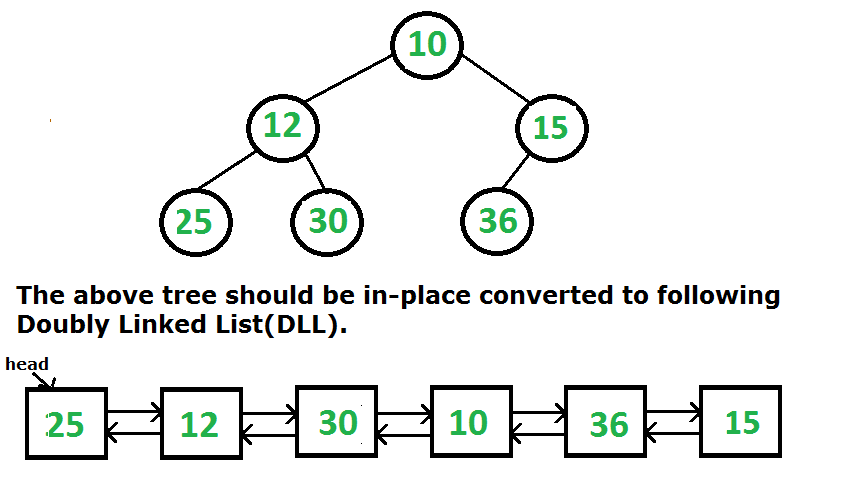
The following two different solutions have been discussed for this problem.
Convert a given Binary Tree to a Doubly Linked List | Set 1
Convert a given Binary Tree to a Doubly Linked List | Set 2
**Approach: Below is the idea to solve the problem:
The idea is to do in-order traversal of the binary tree. While doing inorder traversal, keep track of the previously visited node in a variable, say **prev. For every visited node, make it next to the **prev and set previous of this node as **prev.
Below is the implementation of the above approach:
C++ `
// A C++ program for in-place conversion of Binary Tree to // DLL #include using namespace std;
/* A binary tree node has data, and left and right pointers / struct node { int data; node left; node* right; };
// A simple recursive function to convert a given Binary // tree to Doubly Linked List root --> Root of Binary Tree // head --> Pointer to head node of created doubly linked // list void BinaryTree2DoubleLinkedList(node* root, node** head) { // Base case if (root == NULL) return;
// Initialize previously visited node as NULL. This is
// static so that the same value is accessible in all
// recursive calls
static node* prev = NULL;

// Recursively convert left subtree
BinaryTree2DoubleLinkedList(root->left, head);

// Now convert this node
if (prev == NULL)
    *head = root;
else {
    root->left = prev;
    prev->right = root;
}
prev = root;

// Finally convert right subtree
BinaryTree2DoubleLinkedList(root->right, head);
}
/* Helper function that allocates a new node with the given data and NULL left and right pointers. / node newNode(int data) { node* new_node = new node; new_node->data = data; new_node->left = new_node->right = NULL; return (new_node); }
/* Function to print nodes in a given doubly linked list / void printList(node node) { while (node != NULL) { cout << node->data << " "; node = node->right; } }
// Driver Code int main() { // Let us create the tree shown in above diagram node* root = newNode(10); root->left = newNode(12); root->right = newNode(15); root->left->left = newNode(25); root->left->right = newNode(30); root->right->left = newNode(36);
// Convert to DLL
node* head = NULL;
BinaryTree2DoubleLinkedList(root, &head);

// Print the converted list
printList(head);

return 0;
}
// This code is contributed by Sania Kumari Gupta (kriSania804)
C
// A C program for in-place conversion of Binary Tree to DLL #include <stdio.h> #include <stdlib.h>
/* A binary tree node has data, and left and right pointers / typedef struct node { int data; struct node left; struct node* right; } node;
// A simple recursive function to convert a given Binary // tree to Doubly Linked List root --> Root of Binary Tree // head --> Pointer to head node of created doubly linked // list void BinaryTree2DoubleLinkedList(node* root, node** head) { // Base case if (root == NULL) return;
// Initialize previously visited node as NULL. This is
// static so that the same value is accessible in all
// recursive calls
static node* prev = NULL;

// Recursively convert left subtree
BinaryTree2DoubleLinkedList(root->left, head);

// Now convert this node
if (prev == NULL)
    *head = root;
else {
    root->left = prev;
    prev->right = root;
}
prev = root;

// Finally convert right subtree
BinaryTree2DoubleLinkedList(root->right, head);
}
/* Helper function that allocates a new node with the given data and NULL left and right pointers. / node newNode(int data) { node* new_node = (node*)malloc(sizeof(node)); new_node->data = data; new_node->left = new_node->right = NULL; return (new_node); }
/* Function to print nodes in a given doubly linked list / void printList(node node) { while (node != NULL) { printf("%d ", node->data); node = node->right; } }
/* Driver program to test above functions*/ int main() { // Let us create the tree shown in above diagram node* root = newNode(10); root->left = newNode(12); root->right = newNode(15); root->left->left = newNode(25); root->left->right = newNode(30); root->right->left = newNode(36);
// Convert to DLL
node* head = NULL;
BinaryTree2DoubleLinkedList(root, &head);

// Print the converted list
printList(head);

return 0;
}
// This code is contributed by Sania Kumari Gupta (kriSania804)
Java
// A Java program for in-place conversion of Binary Tree to DLL
// A binary tree node has data, left pointers and right pointers class Node { int data; Node left, right;
public Node(int data)
{
    this.data = data;
    left = right = null;
}
}
class BinaryTree { Node root;
// head --> Pointer to head node of created doubly linked list
Node head;

// Initialize previously visited node as NULL. This is
// static so that the same value is accessible in all recursive
// calls
static Node prev = null;

// A simple recursive function to convert a given Binary tree
// to Doubly Linked List
// root --> Root of Binary Tree
void BinaryTree2DoubleLinkedList(Node root)
{
    // Base case
    if (root == null)
        return;

    // Recursively convert left subtree
    BinaryTree2DoubleLinkedList(root.left);

    // Now convert this node
    if (prev == null)
        head = root;
    else
    {
        root.left = prev;
        prev.right = root;
    }
    prev = root;

    // Finally convert right subtree
    BinaryTree2DoubleLinkedList(root.right);
}

/* Function to print nodes in a given doubly linked list */
void printList(Node node)
{
    while (node != null)
    {
        System.out.print(node.data + " ");
        node = node.right;
    }
}

// Driver program to test above functions
public static void main(String[] args)
{
    // Let us create the tree as shown in above diagram
    BinaryTree tree = new BinaryTree();
    tree.root = new Node(10);
    tree.root.left = new Node(12);
    tree.root.right = new Node(15);
    tree.root.left.left = new Node(25);
    tree.root.left.right = new Node(30);
    tree.root.right.left = new Node(36);

    // convert to DLL
    tree.BinaryTree2DoubleLinkedList(tree.root);

    // Print the converted List
    tree.printList(tree.head);

}
} // This code has been contributed by Mayank Jaiswal(mayank_24)
Python3
Python program for conversion of
binary tree to doubly linked list.
class Node: def init(self, val): self.right = None self.data = val self.left = None
Global variable used in convert
prev = None
def BinaryTree2DoubleLinkedList(root):
# Base case
if root is None:
    return root

# Recursively convert left subtree
head = BinaryTree2DoubleLinkedList(root.left);

# Since we are going to change prev,
# we need to use global keyword
global prev

# If prev is empty, then this is the
# first node of DLL
if prev is None :
    head = root

else:
    root.left = prev
    prev.right = root

# Update prev
prev = root;

# Recursively convert right subtree
BinaryTree2DoubleLinkedList(root.right);

return head
def print_dll(head):
# Function to print nodes in given
# doubly linked list
while head is not None:
    print(head.data, end=" ")
    head = head.right
Driver program to test above functions
Let us create the tree as
shown in above diagram
if name == 'main': root = Node(10) root.left = Node(12) root.right = Node(15) root.left.left = Node(25) root.left.right = Node(30) root.right.left = Node(36)
head = BinaryTree2DoubleLinkedList(root)

# Print the converted list
print_dll(head)
This code is contributed by codesankalp (SANKALP)
C#
// A C# program for in-place conversion // of Binary Tree to DLL using System;
// A binary tree node has data, left // pointers and right pointers public class Node { public int data; public Node left, right;
public Node(int data)
{
    this.data = data;
    left = right = null;
}
}
class GFG { public Node root;
// head --> Pointer to head node of // created doubly linked list public Node head;
// Initialize previously visited node // as NULL. This is static so that the // same value is accessible in all // recursive calls public static Node prev = null;
// A simple recursive function to // convert a given Binary tree // to Doubly Linked List // root --> Root of Binary Tree public virtual void BinaryTree2DoubleLinkedList(Node root) { // Base case if (root == null) { return; }
// Recursively convert left subtree
BinaryTree2DoubleLinkedList(root.left);

// Now convert this node
if (prev == null)
{
    head = root;
}
else
{
    root.left = prev;
    prev.right = root;
}
prev = root;

// Finally convert right subtree
BinaryTree2DoubleLinkedList(root.right);
}
/* Function to print nodes in a given doubly linked list */ public virtual void printList(Node node) { while (node != null) { Console.Write(node.data + " "); node = node.right; } }
// Driver Code public static void Main(string[] args) { // Let us create the tree as // shown in above diagram GFG tree = new GFG(); tree.root = new Node(10); tree.root.left = new Node(12); tree.root.right = new Node(15); tree.root.left.left = new Node(25); tree.root.left.right = new Node(30); tree.root.right.left = new Node(36);
// convert to DLL
tree.BinaryTree2DoubleLinkedList(tree.root);

// Print the converted List
tree.printList(tree.head);
} }
// This code is contributed by Shrikant13
JavaScript
// A binary tree node has data, left pointers and right pointers class Node { constructor(val) { this.data = val; this.left = null; this.right = null; } }
var root;
// head --> Pointer to head node of created doubly linked list var head;
// Initialize previously visited node as NULL. This is // so that the same value is accessible in all recursive // calls var prev = null;
// A simple recursive function to convert a given Binary tree // to Doubly Linked List // root --> Root of Binary Tree function BinaryTree2DoubleLinkedList(root) { // Base case if (root == null) return;
// Recursively convert left subtree
BinaryTree2DoubleLinkedList(root.left);

// Now convert this node
if (prev == null)
    head = root;
else
{
    root.left = prev;
    prev.right = root;
}
prev = root;

// Finally convert right subtree
BinaryTree2DoubleLinkedList(root.right);
}
/* Function to print nodes in a given doubly linked list */ function printList(node) { while (node != null) { console.log(node.data + " "); node = node.right; } }
// Driver program to test above functions
// Let us create the tree as shown in above diagram
root = new Node(10); root.left = new Node(12); root.right = new Node(15); root.left.left = new Node(25); root.left.right = new Node(30); root.right.left = new Node(36);
// convert to DLL BinaryTree2DoubleLinkedList(root);
// Print the converted List printList(head);
// This code contributed by umadevi9616
`
**Note: The use of static variables like above is not a recommended practice, here static is used for simplicity. Imagine if the same function is called for two or more trees. The old value of **prev would be used in the next call for a different tree. To avoid such problems, we can use a double-pointer or a reference to a pointer.
**Time Complexity: O(N), The above program does a simple inorder traversal, so time complexity is O(N) where N is the number of nodes in a given Binary tree.
**Auxiliary Space: O(N), For recursion call stack.
Convert a given Binary Tree to Doubly Linked List iteratively using Stack data structure:
Do iterative inorder traversal and maintain a **prev pointer to point the last visited node then point **current node's perv to prev and **prev's next to current node.
Below is the implementation of the above approach:
C++ `
// A C++ program for in-place conversion of Binary Tree to // DLL #include <bits/stdc++.h> using namespace std;
/* A binary tree node has data, and left and right pointers / struct node { int data; node left; node* right; };
node * bToDLL(node root) { stack<pair<node*, int>> s; s.push({root, 0}); vector res; bool flag = true; node head = NULL; node* prev = NULL; while(!s.empty()) { auto x = s.top(); node* t = x.first; int state = x.second; s.pop(); if(state == 3 or t == NULL) continue; s.push({t, state+1}); if(state == 0) s.push({t->left, 0}); else if(state == 1) { if(prev) prev->right = t; t->left = prev; prev = t; if(flag) { head = t; flag = false; } } else if(state == 2) s.push({t->right, 0}); } return head; }
/* Helper function that allocates a new node with the given data and NULL left and right pointers. / node newNode(int data) { node* new_node = new node; new_node->data = data; new_node->left = new_node->right = NULL; return (new_node); }
/* Function to print nodes in a given doubly linked list / void printList(node node) { while (node != NULL) { cout << node->data << " "; node = node->right; } }
// Driver Code int main() { // Let us create the tree shown in above diagram node* root = newNode(10); root->left = newNode(12); root->right = newNode(15); root->left->left = newNode(25); root->left->right = newNode(30); root->right->left = newNode(36);
// Convert to DLL
node* head = bToDLL(root);

// Print the converted list
printList(head);

return 0;
}
Java
import java.util.Stack;
class Node { int data; Node left; Node right;
/* Helper function that allocates a new node with the given data and NULL left and right pointers. */ public Node(int data) { this.data = data; left = null; right = null; } }
public class Main { static Node bToDLL(Node root) { Stack<Pair<Node, Integer>> s = new Stack<>(); s.push(new Pair<>(root, 0)); boolean flag = true; Node head = null; Node prev = null; while (!s.empty()) { Pair<Node, Integer> x = s.pop(); Node t = x.getKey(); int state = x.getValue(); if (state == 3 || t == null) { continue; } s.push(new Pair<>(t, state + 1)); if (state == 0) { s.push(new Pair<>(t.left, 0)); } else if (state == 1) { if (prev != null) { prev.right = t; } t.left = prev; prev = t; if (flag) { head = t; flag = false; } } else if (state == 2) { s.push(new Pair<>(t.right, 0)); } } return head; }
/* Function to print nodes in a given doubly linked list */ static void printList(Node head) { while (head != null) { System.out.print(head.data + " "); head = head.right; } }
public static void main(String[] args)
{

    // Let us create the tree shown in above diagram
    Node root = new Node(10);
    root.left = new Node(12);
    root.right = new Node(15);
    root.left.left = new Node(25);
    root.left.right = new Node(30);
    root.right.left = new Node(36);

    // Convert to DLL
    Node head = bToDLL(root);

    // Print the converted list
    printList(head);
}
}
class Pair<K, V> { private K key; private V value;
public Pair(K key, V value) {
    this.key = key;
    this.value = value;
}

public K getKey() {
    return key;
}

public V getValue() {
    return value;
}
}
// This code is contributed by aadityamaharshi21.
Python3
def bToDLL(root): s = [] s.append([root, 0]) res = [] flag = True head = None prev = None while len(s) > 0: x = s.pop() t = x[0] state = x[1] if state == 3 or t == None: continue s.append([t, state+1]) if state == 0: s.append([t.left, 0]) elif state == 1: if prev != None: prev.right = t t.left = prev prev = t
        if flag:
            head = t
            flag = False

    elif state == 2: s.append([t.right, 0])

return head
This code is contributed by Tapeshdua420.
C#
// C# code implementation for the above approach
using System; using System.Collections.Generic;
public class Node { public int data; public Node left; public Node right;
/* Helper function that allocates a new node with the given data and NULL left and right pointers. */ public Node(int data) { this.data = data; left = null; right = null; } }
public class GFG {
static Node bToDLL(Node root) { Stack<KeyValuePair<Node, int> > s = new Stack<KeyValuePair<Node, int> >(); s.Push(new KeyValuePair<Node, int>(root, 0)); bool flag = true; Node head = null; Node prev = null; while (s.Count != 0) { KeyValuePair<Node, int> x = s.Pop(); Node t = x.Key; int state = x.Value; if (state == 3 || t == null) { continue; } s.Push( new KeyValuePair<Node, int>(t, state + 1)); if (state == 0) { s.Push( new KeyValuePair<Node, int>(t.left, 0)); } else if (state == 1) { if (prev != null) { prev.right = t; } t.left = prev; prev = t; if (flag) { head = t; flag = false; } } else if (state == 2) { s.Push(new KeyValuePair<Node, int>(t.right, 0)); } } return head; }
/* Function to print nodes in a given doubly linked list */ static void printList(Node head) { while (head != null) { System.Console.Write(head.data + " "); head = head.right; } }
static public void Main() {
// Code
// Let us create the tree shown in above diagram
Node root = new Node(10);
root.left = new Node(12);
root.right = new Node(15);
root.left.left = new Node(25);
root.left.right = new Node(30);
root.right.left = new Node(36);

// Convert to DLL
Node head = bToDLL(root);

// Print the converted list
printList(head);
} }
// This code is contributed by lokesh.
JavaScript
// JavaScript code for above approach
class Node { constructor(data) { this.data = data; this.left = null; this.right = null; } }
function bToDLL(root) { let s = []; s.push([root, 0]); let res = []; let flag = true; let head = null; let prev = null;
while (s.length > 0) {
  let [t, state] = s.pop();
  if (state === 3 || t === null) continue;
  s.push([t, state + 1]);
  if (state === 0) s.push([t.left, 0]);
  else if (state === 1) {
    if (prev) prev.right = t;
    t.left = prev;
    prev = t;
    if (flag) {
      head = t;
      flag = false;
    }
  } else if (state === 2) s.push([t.right, 0]);
}

return head;
}
function newNode(data) { let new_node = new Node(data); return new_node; }
function printList(node) { while (node !== null) { console.log(node.data); node = node.right; } }
let root = newNode(10); root.left = newNode(12); root.right = newNode(15); root.left.left = newNode(25); root.left.right = newNode(30); root.right.left = newNode(36);
let head = bToDLL(root); printList(head);
// This code is contributed by adityamaharshi21
`
**Time complexity: O(N)
**Auxiliary Space: O(N)
Convert a given Binary Tree to Doubly Linked List iteratively using Morris Traversal:
The idea is to keep track of previous node while doing Inorder tree traversal using Morris Traversal. This removes the need for a recursion call stack or a stack thus **reducing space complexity
C++ `
#include
// Structure for a binary tree node struct Node { int data; Node* left; Node* right;
// Constructor
Node(int val) : data(val), left(nullptr), right(nullptr) {}
};
// Function to convert binary tree to doubly linked list Node* bToDLL(Node* root) { // Initialization Node* curr = root; Node* prev = nullptr; // Used to keep track of prev node Node* final_head = nullptr; // Used to return the final head
// Traverse the tree
while (curr) {
    // If no left child
    if (!curr->left) {
        // If final_head is not set, set it to current node
        if (!final_head) {
            prev = curr;
            final_head = curr;
        } else {
            // Set next of prev as curr and prev of curr as prev
            prev->right = curr;
            curr->left = prev;
        }
        // Set the new prev node
        prev = curr;
        curr = curr->right;
    } else {
        // If left child exists
        Node* pre = curr->left;
        while (pre->right && pre->right != curr) {
            pre = pre->right;
        }
        if (!pre->right) {
            pre->right = curr;
            curr = curr->left;
        } else {
            curr = pre->right;
            // Set next of prev as curr and prev of curr as prev
            prev->right = curr;
            curr->left = prev;
            // Set the new prev node
            prev = curr;
            curr = curr->right;
        }
    }
}

return final_head; // Return the final head of the linked list
}
// Function to print nodes in the doubly linked list void print_dll(Node* head) { while (head != nullptr) { std::cout << head->data << " "; head = head->right; } }
// Driver code int main() { // Create the binary tree Node* root = new Node(10); root->left = new Node(12); root->right = new Node(15); root->left->left = new Node(25); root->left->right = new Node(30); root->right->left = new Node(36);
// Convert the binary tree to doubly linked list
Node* head = bToDLL(root);

// Print the converted list
print_dll(head);

return 0;
}
Java
// Definition of Node class representing a tree node class Node { int data; Node left, right;
public Node(int item) {
    data = item;
    left = right = null;
}
}
// Class to convert a binary tree to a doubly linked list public class BinaryTreeToDLL { // Function to convert a binary tree to a doubly linked list static Node bToDLL(Node root) { Node curr = root; Node prev = null; // Used to keep track of prev node Node finalHead = null; // Used to return the final head
    // Traverse the binary tree
    while (curr != null) {
        // If current node has no left child
        if (curr.left == null) {
            // If finalHead is not set, set it to current node
            if (finalHead == null) {
                prev = curr;
                finalHead = curr;
            } else {
                // Connect previous node's right to current node
                prev.right = curr;
                // Connect current node's left to previous node
                curr.left = prev;
            }
            // Move prev pointer to current node
            prev = curr;
            // Move current pointer to its right child
            curr = curr.right;
        } else {
            // If current node has left child, find its inorder predecessor
            Node pre = curr.left;
            while (pre.right != null && pre.right != curr) {
                pre = pre.right;
            }
            if (pre.right == null) {
                // If inorder predecessor's right is not connected, connect it to current node
                pre.right = curr;
                // Move current pointer to its left child
                curr = curr.left;
            } else {
                // If inorder predecessor's right is connected,
                // connect current node to previous node and move pointers
                curr = pre.right;
                prev.right = curr;
                curr.left = prev;
                prev = curr;
                curr = curr.right;
            }
        }
    }

    // Return the final head of the doubly linked list
    return finalHead;
}

// Function to print the doubly linked list
static void printDLL(Node head) {
    StringBuilder result = new StringBuilder();
    // Concatenate nodes data into a single line
    while (head != null) {
        result.append(head.data).append(" ");
        head = head.right;
    }
    System.out.println("Elements are: " + result.toString().trim());
}

// Driver code to test above functions
public static void main(String args[]) {
    // Create the tree as shown in the diagram
    Node root = new Node(10);
    root.left = new Node(12);
    root.right = new Node(15);
    root.left.left = new Node(25);
    root.left.right = new Node(30);
    root.right.left = new Node(36);

    // Convert the binary tree to doubly linked list
    Node head = bToDLL(root);

    // Print the converted list
    printDLL(head);
}
}
Python3
Python program for conversion of
binary tree to doubly linked list.
class Node: def init(self, val): self.right = None self.data = val self.left = None
def bToDLL(root): # do Code here curr = root prev = None #Used to keep track of prev node final_head = None #used to return the final head while curr: if not curr.left: if not final_head: prev = curr final_head = curr else: #set next of prev as curr and prev of curr as prev prev.right = curr curr.left = prev #set the new prev node prev = curr curr = curr.right else: pre = curr.left while pre.right and pre.right != curr: pre = pre.right if not pre.right: pre.right = curr curr = curr.left else: curr = pre.right #set next of prev as curr and prev of curr as prev prev.right = curr curr.left = prev #set the new prev node prev = curr curr = curr.right
return final_headdef print_dll(head):
# Function to print nodes in given
# doubly linked list
while head is not None:
    print(head.data, end=" ")
    head = head.right
Driver program to test above functions
Let us create the tree as
shown in above diagram
if name == 'main': root = Node(10) root.left = Node(12) root.right = Node(15) root.left.left = Node(25) root.left.right = Node(30) root.right.left = Node(36)
head = bToDLL(root)

# Print the converted list
print_dll(head)
JavaScript
class Node { constructor(val) { this.data = val; this.left = null; this.right = null; } }
function bToDLL(root) { let curr = root; let prev = null; // Used to keep track of prev node let final_head = null; // Used to return the final head
while (curr) {
    if (!curr.left) {
        if (!final_head) {
            prev = curr;
            final_head = curr;
        } else {
            prev.right = curr;
            curr.left = prev;
        }
        prev = curr;
        curr = curr.right;
    } else {
        let pre = curr.left;
        while (pre.right && pre.right !== curr) {
            pre = pre.right;
        }
        if (!pre.right) {
            pre.right = curr;
            curr = curr.left;
        } else {
            curr = pre.right;
            prev.right = curr;
            curr.left = prev;
            prev = curr;
            curr = curr.right;
        }
    }
}

return final_head;
}
function printDLL(head) { let result = ""; // Function to concatenate nodes data into a single line while (head !== null) { result += head.data + " "; head = head.right; } console.log(result.trim()); }
// Driver program to test above functions // Let us create the tree as shown in above diagram
let root = new Node(10); root.left = new Node(12); root.right = new Node(15); root.left.left = new Node(25); root.left.right = new Node(30); root.right.left = new Node(36);
let head = bToDLL(root);
// Print the converted list printDLL(head);
`
**Time complexity: O(N)
**Auxiliary Space: O(1)