Count Derangements (original) (raw)
Last Updated : 15 Apr, 2026
Given a **number n, find the total number of Derangements of a set of elements from 1 to n.
A Derangement is a permutation of n elements, such that no element appears in its original position. For example, a derangement of [1, 2, 3] is [2, 3, 1].
**Examples:
**Input: n = 2
**Output: 1
**Explanation: For [1, 2], there is only one possible derangement [2, 1].**Input: n = 3
**Output: 2
**Explanation: For [1, 2, 3], there are two possible derangements [3, 1, 2] and [2, 3, 1].

Table of Content
- [Naive Approach] Using Recursion - O(2 ^ n) Time and O(n) Space
- [Better Approach 1] Top-Down DP (Memoization) - O(n) Time and O(n) Space
- [Better Approach 2] Bottom-Up DP (Tabulation) - O(n) Time and O(n) Space
- [Expected Approach] Space Optimized DP - O(n) Time and O(1) Space
[Naive Approach] Using Recursion - O(2 ^ n) Time and O(n) Space
The idea is to use recursion as, there are n-1 ways to place the first element, which explains the multiplication by (n−1). Let the first element be placed at position **i, now there are two possibilities depending on whether the element at position i goes to the first position or not.
- **Case 1: If the element at position **i is placed at the first position, then both elements are fixed, reducing the problem to n−2 elements.
- **Case 2: If the element at position **i is not placed at the first position, then the problem reduces to finding derangements of the remaining n−1 elements.
The formula used in the solution is:
**F(n) = (n - 1) * (F(n - 1) + F(n - 2))
Dry run for n = 4:
- For n = 1, F(1) = 0 and for n = 2, F(2) = 1 as base cases.
- For n = 4, use formula F(4) = 3 × (F(3) + F(2)).
- First compute F(3): F(3) = 2 × (F(2) + F(1)) = 2 × (1 + 0) = 2.
- Now substitute values in F(4): F(4) = 3 × (2 + 1).
- Here, 3 represents the choices for placing the first element, and (F(3) + F(2)) represents the two cases.
- Final result: F(4) = 3 × 3 = 9. C++ `
#include using namespace std;
int derangeCount(int n) {
// Base cases if (n == 1) return 0; if (n == 2) return 1;
// f(n) = (n-1)[f(n-1) + f(n-2)] return (n - 1) * (derangeCount(n - 1) + derangeCount(n - 2)); }
int main() { int n = 5; cout << derangeCount(n); return 0; }
Java
class GfG {
static int derangeCount(int n) {

    // Base cases
    if (n == 1) return 0;
    if (n == 2) return 1;

    // f(n) = (n-1)[f(n-1) + f(n-2)]
    return (n - 1) * (derangeCount(n - 1) +
                        derangeCount(n - 2));
}

public static void main (String[] args) {
    int n = 5;
    System.out.println(derangeCount(n));
}
}
Python
def derangeCount(n):
# Base cases
if (n == 1): return 0
if (n == 2): return 1

# f(n) = (n-1)[f(n-1) + f(n-2)]
return (n - 1) * (derangeCount(n - 1) +
                    derangeCount(n - 2))
if name == "main": n = 5 print(derangeCount(n))
C#
using System;
class GfG {
static int derangeCount(int n) {

    // Base cases
    if (n == 1) return 0;
    if (n == 2) return 1;

    // f(n) = (n-1)[f(n-1) + f(n-2)]
    return (n - 1) * (derangeCount(n - 1) +
                        derangeCount(n - 2));
}

static void Main () {
    int n = 5;
    Console.Write(derangeCount(n));

}
}
JavaScript
function derangeCount(n) {
// Base cases if (n === 1) return 0; if (n === 2) return 1;
// f(n) = (n-1)[f(n-1) + f(n-2)] return (n - 1) * (derangeCount(n - 1) + derangeCount(n - 2)); }
// Driver code const n = 5; console.log(derangeCount(n));
`
[Better Approach 1] Top-Down DP (Memoization****)** - O(n) Time and O(n) Space
Above recursive solution has properties that make it suitable for optimization using Dynamic Programming:
**1. Optimal Substructure: The recursive relation demonstrates that the solution for **F(n) can be constructed using the solutions to smaller subproblems, specifically **F(n - 1) and F(n - 2).
**2. Overlapping Subproblems: The function F(n) recursively calls itself with n - 1 and n - 2. However, these subproblems are not independent. For example, when calculating F(4), it will internally compute F(3) and F(2). Then, F(3) will again compute F(2), leading to redundant calculations.
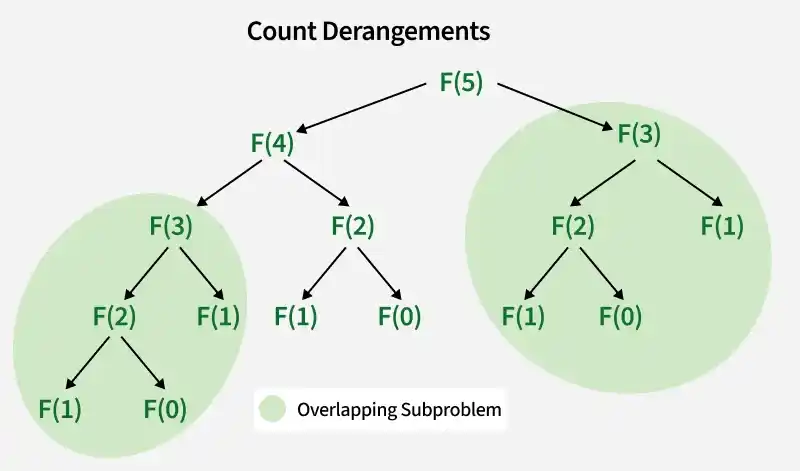
This approach uses recursion with caching (memo array) to store results of subproblems and reuse them, avoiding repeated computations.
C++ `
#include using namespace std;
int calculate(int n, vector &memo) {
  // Base cases
  if (n == 1) return 0;
  if (n == 2) return 1;

  // If the value of n is previously
  // calculated then return it here
if(memo[n] != -1) return memo[n];

  // countDer(n) = (n-1)[countDer(n-1) + der(n-2)]
  return memo[n] = (n - 1) * (calculate(n - 1, memo)
                            + calculate(n - 2, memo));
} int derangeCount(int n) { vector memo(n + 1, -1); return calculate(n, memo); } int main() { int n = 5; cout << derangeCount(n); return 0; }
Java
import java.util.Arrays;
class GfG { static int calculate(int n, int[] memo) {
    // Base cases
    if (n == 1) return 0;
    if (n == 2) return 1;

    // If the value of n is previously calculated
      // then return it here
    if (memo[n] != -1) return memo[n];

    // countDer(n) = (n-1)[countDer(n-1) + der(n-2)]
    return memo[n] = (n - 1) * (calculate(n - 1, memo)
                                + calculate(n - 2, memo));
}

static int derangeCount(int n) {
    int[] memo = new int[n + 1];
    Arrays.fill(memo, -1);
    return calculate(n, memo);
}

public static void main(String[] args) {
    int n = 5;
    System.out.println(derangeCount(n));
}
}
Python
def calculate(n, memo):
# Base cases
if n == 1:
    return 0
if n == 2:
    return 1

# If the value of n is previously
# calculated then return it here
if memo[n] != -1:
    return memo[n]

# countDer(n) = (n-1)[countDer(n-1) + der(n-2)]
memo[n] = (n - 1) * (calculate(n - 1, memo) + calculate(n - 2, memo))
return memo[n]
def derangeCount(n): memo = [-1] * (n + 1) return calculate(n, memo)
if name == "main": n = 5 print(derangeCount(n))
C#
using System;
class GfG { static int Calculate(int n, int[] memo) {
    // Base cases
    if (n == 1) return 0;
    if (n == 2) return 1;

    // If the value of n is previously
      // calculated then return it here
    if (memo[n] != -1) return memo[n];

    // countDer(n) = (n-1)[countDer(n-1) + der(n-2)]
    memo[n] = (n - 1) * (Calculate(n - 1, memo) + Calculate(n - 2, memo));
    return memo[n];
}

static int derangeCount(int n) {
    int[] memo = new int[n + 1];
    Array.Fill(memo, -1);
    return Calculate(n, memo);
}

static void Main() {
    int n = 5;
    Console.WriteLine(derangeCount(n));
}
}
JavaScript
function calculate(n, memo) {
// Base cases
if (n === 1) return 0;
if (n === 2) return 1;

// If the value of n is previously
// calculated then return it here
if (memo[n] !== -1) return memo[n];

// countDer(n) = (n-1)[countDer(n-1) + der(n-2)]
memo[n] = (n - 1) * (calculate(n - 1, memo) + calculate(n - 2, memo));
return memo[n];
}
function derangeCount(n) { let memo = Array(n + 1).fill(-1); return calculate(n, memo); }
// Driver code const n = 5; console.log(derangeCount(n));
`
[Better Approach 2] Bottom-Up DP (Tabulation) - O(n) Time and O(n) Space
The approach is similar to the **previous one. just instead of **breaking down the problem **recursively, we iteratively build up the solution by calculating in **bottom-up manner. Maintain a dp[] table such that **dp[i] stores the Count Derangements for i.
**Base Case:
- For i = 1 dp[i] = 0
- For i = 2 dp[i] = 1
**Recursive Case:
- For i > 2 dp[i] = (i - 1) * (dp[i-1] + dp[i - 1])
C++ `
#include using namespace std;
int derangeCount(int n) {
// Create a DP array to store
  // results
vector<int> dp(n + 1);

// Base cases
dp[1] = 0;
dp[2] = 1;

// Fill the DP array using the recursive relation
for (int i = 3; i <= n; i++) {
    dp[i] = (i - 1) * (dp[i - 1] + dp[i - 2]);
}

return dp[n];
}
int main() { int n = 5; cout << derangeCount(n); return 0; }
Java
class GfG { static int derangeCount(int n) {
    // Create a DP array to store results
    int[] dp = new int[n + 1];

    // Base cases
    dp[1] = 0;
    dp[2] = 1;

    // Fill the DP array using the recursive relation
    for (int i = 3; i <= n; i++) {
        dp[i] = (i - 1) * (dp[i - 1] + dp[i - 2]);
    }

    return dp[n];
}

public static void main(String[] args) {
    int n = 5;
    System.out.println(derangeCount(n));
}
}
Python
def derangeCount(n):
# Create a DP array to store results
dp = [0] * (n + 1)

# Base cases
dp[1] = 0
dp[2] = 1

# Fill the DP array using the
# recursive relation
for i in range(3, n + 1):
    dp[i] = (i - 1) * (dp[i - 1] + dp[i - 2])

return dp[n]
if name == "main": n = 5 print(derangeCount(n))
C#
using System;
class GfG { static int derangeCount(int n) {
    // Create a DP array to store results
    int[] dp = new int[n + 1];

    // Base cases
    dp[1] = 0;
    dp[2] = 1;

    // Fill the DP array using the recursive relation
    for (int i = 3; i <= n; i++) {
        dp[i] = (i - 1) * (dp[i - 1] + dp[i - 2]);
    }

    return dp[n];
}

static void Main() {
    int n = 5;
    Console.WriteLine(derangeCount(n));
}
}
JavaScript
function derangeCount(n) {
// Create a DP array to store results
const dp = new Array(n + 1).fill(0);

// Base cases
dp[1] = 0;
dp[2] = 1;

// Fill the DP array using the recursive relation
for (let i = 3; i <= n; i++) {
    dp[i] = (i - 1) * (dp[i - 1] + dp[i - 2]);
}

return dp[n];
}
// Driver code const n = 5; console.log(derangeCount(n));
`
[Expected Approach] Space Optimized DP - **O(n) Time and O(1) Space
To optimize the space complexity to **O(1) we can avoid using an array and instead use two variables to store the previous two results, as we only need the last two values to compute the next value. This will reduce the space requirement significantly.
Dry run for n = 5:
- For n = 1, derangements = 0 since no rearrangement is possible.
- For n = 2, derangements = 1 as only one valid permutation exists.
- Initialize prev2 = 0 and prev1 = 1 to store results for n = 1 and n = 2.
- For n = 3, D(3) = 2 × (1 + 0) = 2 using prev1 and prev2.
- At each step, update prev2 = prev1 and prev1 = current value.
- For n = 4, D(4) = 3 × (2 + 1) = 9 using updated values.
- For n = 5, D(5) = 4 × (9 + 2) = 44 using updated values.
Final answer: 44.
C++ `
#include using namespace std;
int derangeCount(int n) {
// Base cases
if (n == 1) return 0;
if (n == 2) return 1;

// Variables to store previous two results
  // Equivalent to dp[1]
int prev2 = 0;

  // Equivalent to dp[2]
int prev1 = 1;

// Calculate derangements using the optimized
  // space approach
for (int i = 3; i <= n; i++) {
    int curr = (i - 1) * (prev1 + prev2);
    prev2 = prev1;
    prev1 = curr;
}

return prev1;
}
int main() { int n = 5; cout << derangeCount(n); return 0; }
Java
class GfG { static int derangeCount(int n) {
    // Base cases
    if (n == 1) return 0;
    if (n == 2) return 1;

    // Variables to store previous two results
    // Equivalent to dp[1]
    int prev2 = 0;

    // Equivalent to dp[2]
    int prev1 = 1;

    // Calculate derangements using the
      // optimized space approach
    for (int i = 3; i <= n; i++) {
        int curr = (i - 1) * (prev1 + prev2);
        prev2 = prev1;
        prev1 = curr;
    }

    return prev1;
}

public static void main(String[] args) {

    int n = 5;
    System.out.println(derangeCount(n));
}
}
Python
def derangeCount(n):
# Base cases
if n == 1:
    return 0
if n == 2:
    return 1

# Variables to store previous two results
# Equivalent to dp[1]
prev2 = 0

# Equivalent to dp[2]
prev1 = 1

# Calculate derangements using the
# optimized space approach
for i in range(3, n + 1):
    curr = (i - 1) * (prev1 + prev2)
    prev2 = prev1
    prev1 = curr

return prev1
if name == "main": n = 5 print(derangeCount(n))
C#
using System;
class GfG { static int derangeCount(int n) {
    // Base cases
    if (n == 1) return 0;
    if (n == 2) return 1;

    // Variables to store previous two results
    // Equivalent to dp[1]
    int prev2 = 0;

    // Equivalent to dp[2]
    int prev1 = 1;

    // Calculate derangements using the optimized
      // space approach
    for (int i = 3; i <= n; i++) {
        int curr = (i - 1) * (prev1 + prev2);
        prev2 = prev1;
        prev1 = curr;
    }

    return prev1;
}

static void Main() {
    int n = 5;
    Console.WriteLine(derangeCount(n));
}
}
JavaScript
function derangeCount(n) {
// Base cases
if (n === 1) return 0;
if (n === 2) return 1;

// Variables to store previous two results
// Equivalent to dp[1]
let prev2 = 0;

// Equivalent to dp[2]
let prev1 = 1;

// Calculate derangements using the
// optimized space approach
for (let i = 3; i <= n; i++) {
    let curr = (i - 1) * (prev1 + prev2);
    prev2 = prev1;
    prev1 = curr;
}

return prev1;
}
// Driver code const n = 5; console.log(derangeCount(n));
`