Count of pairs upto N such whose LCM is not equal to their product for Q queries (original) (raw)
Last Updated : 12 Jul, 2025
Given a number N, the task is to find the number of pairs (a, b) in the range [1, N] such that their LCM is not equal to their product, i.e. LCM(a, b) != (a*b) and (b > a). There can be multiple queries to answer.
Examples:
Input: Q[] = {5}
Output: 1
Explanation:
The pair from 1 to 5 is (2, 4)
Input: Q[] = {5, 7}
Output: 1, 4
Explanation:
The pair from 1 to 5 is (2, 4)
The pairs from 1 to 7 are (2, 4), (2, 6), (3, 6), (4, 6)
Approach: The idea is to use Euler's Totient Function.
1. Find the total number of pairs that can be formed using numbers from 1 to N. The number of pairs formed is equal to (N * (N - 1)) / 2.
2. For each integer i ? N, using Euler's Totient Function find all such pairs which are co-prime with i and store them in the array.
Example:
arr[10] = 10 * (1-1/2) * (1-1/5) = 4
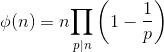
4. Now build the prefix sum table which stores the sum of all phi(i) for all i between 1 to N. Using this, we can answer each query in O(1) time.
5. Finally, the answer for any i ? N is given by the difference between the total number of pairs formed and pref[i].
Below is the implementation of the given approach:
C++ `
// C++ program to find the count of pairs // from 1 to N such that their LCM // is not equal to their product #include <bits/stdc++.h> using namespace std;
#define N 100005
// To store Euler's Totient Function int phi[N];
// To store prefix sum table int pref[N];
// Compute Totients of all numbers // smaller than or equal to N void precompute() { // Make phi[1]=0 since 1 cannot form any pair phi[1] = 0;
// Initialise all remaining phi[] with i
for (int i = 2; i < N; i++)
    phi[i] = i;

// Compute remaining phi
for (int p = 2; p < N; p++) {

    // If phi[p] is not computed already,
    // then number p is prime
    if (phi[p] == p) {

        // phi of prime number is p-1
        phi[p] = p - 1;

        // Update phi of all multiples of p
        for (int i = 2 * p; i < N; i += p) {

            // Add the contribution of p
            // to its multiple i by multiplying
            // it with (1 - 1/p)
            phi[i] = (phi[i] / p) * (p - 1);
        }
    }
}
}
// Function to store prefix sum table void prefix() { // Prefix Sum of all Euler's Totient Values for (int i = 1; i < N; i++) pref[i] = pref[i - 1] + phi[i]; }
void find_pairs(int n) {
// Total number of pairs that can be formed
int total = (n * (n - 1)) / 2;

int ans = total - pref[n];

cout << "Number of pairs from 1 to "
     << n << " are " << ans << endl;
}
// Driver Code int main() {
// Function call to compute all phi
precompute();

// Function call to store all prefix sum
prefix();

int q[] = { 5, 7 };
int n = sizeof(q) / sizeof(q[0]);

for (int i = 0; i < n; i++) {
    find_pairs(q[i]);
}

return 0;
}
Java
// Java program to find the count of pairs // from 1 to N such that their LCM // is not equal to their product
class GFG{
static final int N = 100005;
// To store Euler's Totient Function static int []phi = new int[N];
// To store prefix sum table static int []pref = new int[N];
// Compute Totients of all numbers // smaller than or equal to N static void precompute() { // Make phi[1] = 0 since 1 cannot form any pair phi[1] = 0;
// Initialise all remaining phi[] with i
for (int i = 2; i < N; i++)
    phi[i] = i;

// Compute remaining phi
for (int p = 2; p < N; p++) {

    // If phi[p] is not computed already,
    // then number p is prime
    if (phi[p] == p) {

        // phi of prime number is p-1
        phi[p] = p - 1;

        // Update phi of all multiples of p
        for (int i = 2 * p; i < N; i += p) {

            // Add the contribution of p
            // to its multiple i by multiplying
            // it with (1 - 1/p)
            phi[i] = (phi[i] / p) * (p - 1);
        }
    }
}
}
// Function to store prefix sum table static void prefix() { // Prefix Sum of all Euler's Totient Values for (int i = 1; i < N; i++) pref[i] = pref[i - 1] + phi[i]; }
static void find_pairs(int n) {
// Total number of pairs that can be formed
int total = (n * (n - 1)) / 2;

int ans = total - pref[n];

System.out.print("Number of pairs from 1 to "
    + n + " are " + ans +"\n");
}
// Driver Code public static void main(String[] args) {
// Function call to compute all phi
precompute();

// Function call to store all prefix sum
prefix();

int q[] = { 5, 7 };
int n = q.length;

for (int i = 0; i < n; i++) {
    find_pairs(q[i]);
}
} }
// This code contributed by Rajput-Ji
Python3
Python 3 program to find the count of pairs
from 1 to N such that their LCM
is not equal to their product
N = 100005
To store Euler's Totient Function
phi = [0 for i in range(N)]
To store prefix sum table
pref = [0 for i in range(N)]
Compute Totients of all numbers
smaller than or equal to N
def precompute():
# Make phi[1]=0 since 1 cannot form any pair
phi[1] = 0

# Initialise all remaining phi[] with i
for i in range(2, N, 1):
    phi[i] = i

# Compute remaining phi
for p in range(2,N):
    # If phi[p] is not computed already,
    # then number p is prime
    if (phi[p] == p):
        # phi of prime number is p-1
        phi[p] = p - 1

        # Update phi of all multiples of p
        for i in range(2*p, N, p):

            # Add the contribution of p
            # to its multiple i by multiplying
            # it with (1 - 1/p)
            phi[i] = (phi[i] // p) * (p - 1)
Function to store prefix sum table
def prefix():
# Prefix Sum of all Euler's Totient Values
for i in range(1, N, 1):
    pref[i] = pref[i - 1] + phi[i]
def find_pairs(n): # Total number of pairs that can be formed total = (n * (n - 1)) // 2
ans = total - pref[n]

print("Number of pairs from 1 to",n,"are",ans)
Driver Code
if name == 'main': # Function call to compute all phi precompute()
# Function call to store all prefix sum
prefix()

q =  [5, 7]
n = len(q)

for i in range(n):
    find_pairs(q[i])
This code is contributed by Surendra_Gangwar
C#
// C# program to find the count of pairs // from 1 to N such that their LCM // is not equal to their product using System;
class GFG{
static readonly int N = 100005;
// To store Euler's Totient Function static int []phi = new int[N];
// To store prefix sum table static int []pref = new int[N];
// Compute Totients of all numbers // smaller than or equal to N static void precompute() {
// Make phi[1] = 0 since 1
// cannot form any pair
phi[1] = 0;

// Initialise all remaining
// phi[] with i
for(int i = 2; i < N; i++)
   phi[i] = i;

// Compute remaining phi
for(int p = 2; p < N; p++)
{

   // If phi[p] is not computed already,
   // then number p is prime
   if (phi[p] == p)
   {

       // phi of prime number is p-1
       phi[p] = p - 1;

       // Update phi of all multiples of p
       for(int i = 2 * p; i < N; i += p)
       {

          // Add the contribution of p
          // to its multiple i by multiplying
          // it with (1 - 1/p)
          phi[i] = (phi[i] / p) * (p - 1);
       }
   }
}
}
// Function to store prefix sum table static void prefix() {
// Prefix Sum of all
// Euler's Totient Values
for(int i = 1; i < N; i++)
   pref[i] = pref[i - 1] + phi[i];
}
static void find_pairs(int n) {
// Total number of pairs
// that can be formed
int total = (n * (n - 1)) / 2;
int ans = total - pref[n];

Console.Write("Number of pairs from 1 to " +
                  n + " are " + ans + "\n");
}
// Driver Code public static void Main(String[] args) {
// Function call to compute all phi
precompute();

// Function call to store
// all prefix sum
prefix();

int []q = {5, 7};
int n = q.Length;

for(int i = 0; i < n; i++)
{
   find_pairs(q[i]);
}
} }
// This code is contributed by Rajput-Ji
JavaScript
`
Output:
Number of pairs from 1 to 5 are 1 Number of pairs from 1 to 7 are 4
Time Complexity: O(n2)
Auxiliary Space: O(n)