C++ Program To Write Your Own atoi() (original) (raw)
Last Updated : 23 Jul, 2025
The atoi() function in C takes a string (which represents an integer) as an argument and returns its value of type int. So basically the function is used to convert a string argument to an integer.
Syntax:
int atoi(const char strn)
Parameters: The function accepts one parameter strn which refers to the string argument that is needed to be converted into its integer equivalent.
Return Value: If strn is a valid input, then the function returns the equivalent integer number for the passed string number. If no valid conversion takes place, then the function returns zero.
Example:
C++ `
#include <bits/stdc++.h> using namespace std;
int main() { int val; char strn1[] = "12546";
val = atoi(strn1);
cout <<"String value = " << strn1 << endl;
cout <<"Integer value = " << val << endl;

char strn2[] = "GeeksforGeeks";
val = atoi(strn2);
cout <<"String value = " << strn2 << endl;
cout <<"Integer value = " << val <<endl;

return (0);
}
// This code is contributed by shivanisinghss2110
`
Output
String value = 12546 Integer value = 12546 String value = GeeksforGeeks Integer value = 0
Time Complexity : O(N)
Auxiliary Space : O(1) , as no extra space is needed.
Now let's understand various ways in which one can create their own atoi() function supported by various conditions:
Approach 1: Following is a simple implementation of conversion without considering any special case.
- Initialize the result as 0.
- Start from the first character and update result for every character.
- For every character update the answer as result = result * 10 + (s[i] - '0') C++ `
// A simple C++ program for // implementation of atoi #include <bits/stdc++.h> using namespace std;
// A simple atoi() function int myAtoi(char* str) { // Initialize result int res = 0;
// Iterate through all characters
// of input string and update result
// take ASCII character of corresponding digit and
// subtract the code from '0' to get numerical
// value and multiply res by 10 to shuffle
// digits left to update running total
for (int i = 0; str[i] != ''; ++i)
    res = res * 10 + str[i] - '0';

// return result.
return res;
}
// Driver code int main() { char str[] = "89789";
// Function call
int val = myAtoi(str);
cout << val;
return 0;
}
// This is code is contributed by rathbhupendra
`
Approach 2: This implementation handles the negative numbers. If the first character is '-' then store the sign as negative and then convert the rest of the string to number using the previous approach while multiplying sign with it.
C++ `
// A C++ program for // implementation of atoi #include <bits/stdc++.h> using namespace std;
// A simple atoi() function int myAtoi(char* str) { // Initialize result int res = 0;
// Initialize sign as positive
int sign = 1;

// Initialize index of first digit
int i = 0;

// If number is negative,
// then update sign
if (str[0] == '-') {
    sign = -1;

    // Also update index of first digit
    i++;
}

// Iterate through all digits
// and update the result
for (; str[i] != ''; i++)
    res = res * 10 + str[i] - '0';

// Return result with sign
return sign * res;
}
// Driver code int main() { char str[] = "-123";
// Function call
int val = myAtoi(str);
cout << val;
return 0;
}
// This is code is contributed by rathbhupendra
`
Approach 3: This implementation handles various type of errors. If str is NULL or str contains non-numeric characters then return 0 as the number is not valid.
Approach 4: Four corner cases needs to be handled:
- Discards all leading whitespaces
- Sign of the number
- Overflow
- Invalid input
To remove the leading whitespaces run a loop until a character of the digit is reached. If the number is greater than or equal to INT_MAX/10. Then return INT_MAX if the sign is positive and return INT_MIN if the sign is negative. The other cases are handled in previous approaches.
Dry Run:
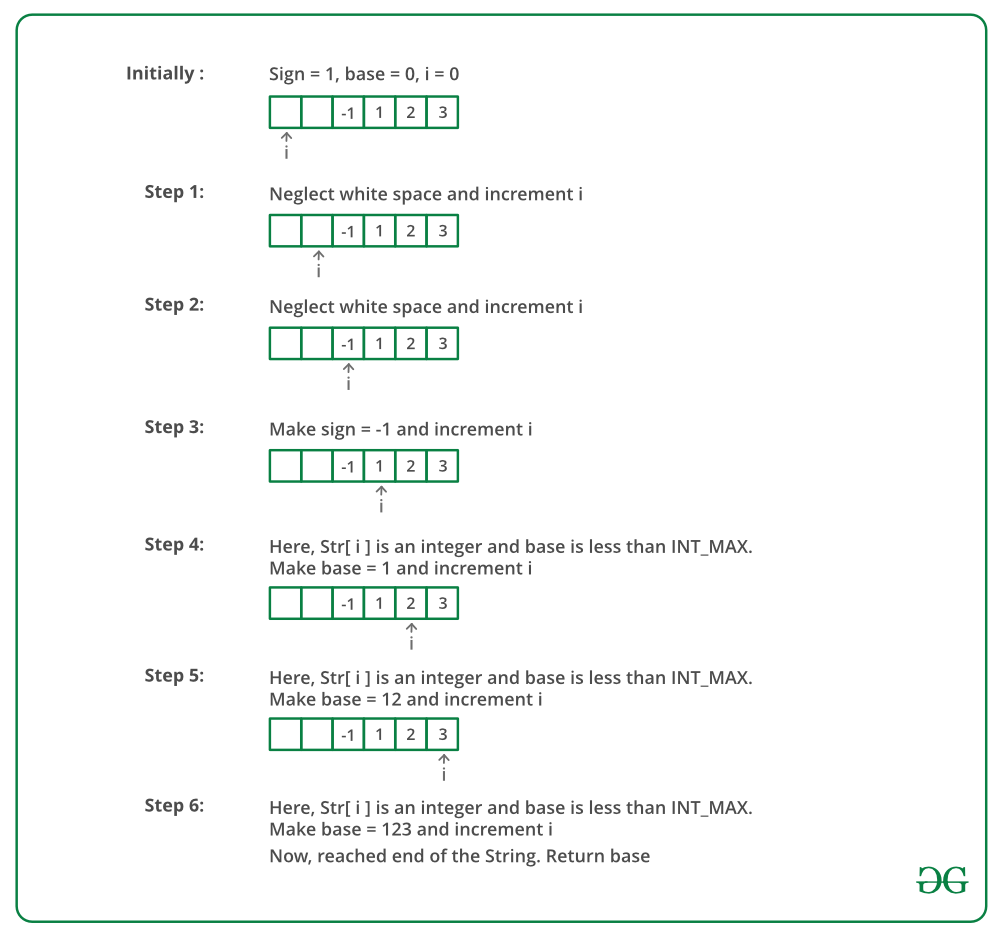
Below is the implementation of the above approach:
C++ `
// A simple C++ program for // implementation of atoi #include <bits/stdc++.h> using namespace std;
int myAtoi(const char* str) { int sign = 1, base = 0, i = 0;
// if whitespaces then ignore.
while (str[i] == ' ')
{
    i++;
}

// sign of number
if (str[i] == '-' || str[i] == '+')
{
    sign = 1 - 2 * (str[i++] == '-');
}

// checking for valid input
while (str[i] >= '0' && str[i] <= '9')
{
    // handling overflow test case
    if (base > INT_MAX / 10
        || (base == INT_MAX / 10
        && str[i] - '0' > 7))
    {
        if (sign == 1)
            return INT_MAX;
        else
            return INT_MIN;
    }
    base = 10 * base + (str[i++] - '0');
}
return base * sign;
}
// Driver Code int main() { char str[] = " -123";
// Functional Code
int val = myAtoi(str);
cout <<" "<< val;
return 0;
}
// This code is contributed by shivanisinghss2110
`
Complexity Analysis for all the above Approaches:
- Time Complexity: O(n).
Only one traversal of string is needed. - Space Complexity: O(1).
As no extra space is required.
Exercise:
Write your won atof() that takes a string (which represents an floating point value) as an argument and returns its value as double.
Please refer complete article on Write your own atoi() for more details!