Delete a Node from linked list without head pointer (original) (raw)
Last Updated : 11 Jul, 2025
You are given a singly linked list and pointer which is pointing to the node which is required to be deleted. Any information about the head pointer or any other node is not given. You need to write a function to delete that node from the linked list. Your function will take only one argument, i.e., a pointer to the node which is to be delete
Note: No head reference is given to you. It is guaranteed that the node to be deleted is not the last node:
A linked list is built as:
Definition of each node is as follows:
struct Node {
int data;
struct Node* next;
};

Examples:
Consider below LL for given examples:
Input: C (a pointer to C)
Output: A-->B-->D-->E-->FInput: A (a pointer to A)
Output: B-->D-->E-->F
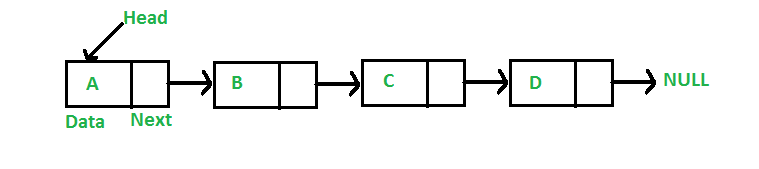
Approach: To solve the problem follow the below idea:
- Why conventional deletion method would fail here?
It would be a simple deletion problem from the singly linked list if the head pointer was given because for deletion you must know the previous node and you can easily reach there by traversing from the head pointer. Conventional deletion is impossible without knowledge of the previous node of a node that needs to be deleted.- How to delete the node when you dont have the head pointer?
The trick here is we can copy the data of the next node to the data field of the current node to be deleted. Then we can move one step forward. Now our next has become the current node and the current has become the previous node. Now we can easily delete the current node by conventional deletion methods.
Illustration of the above approach:
For example, suppose we need to delete B and a pointer to B is given
If we had a pointer to A, we could have deleted B easily.
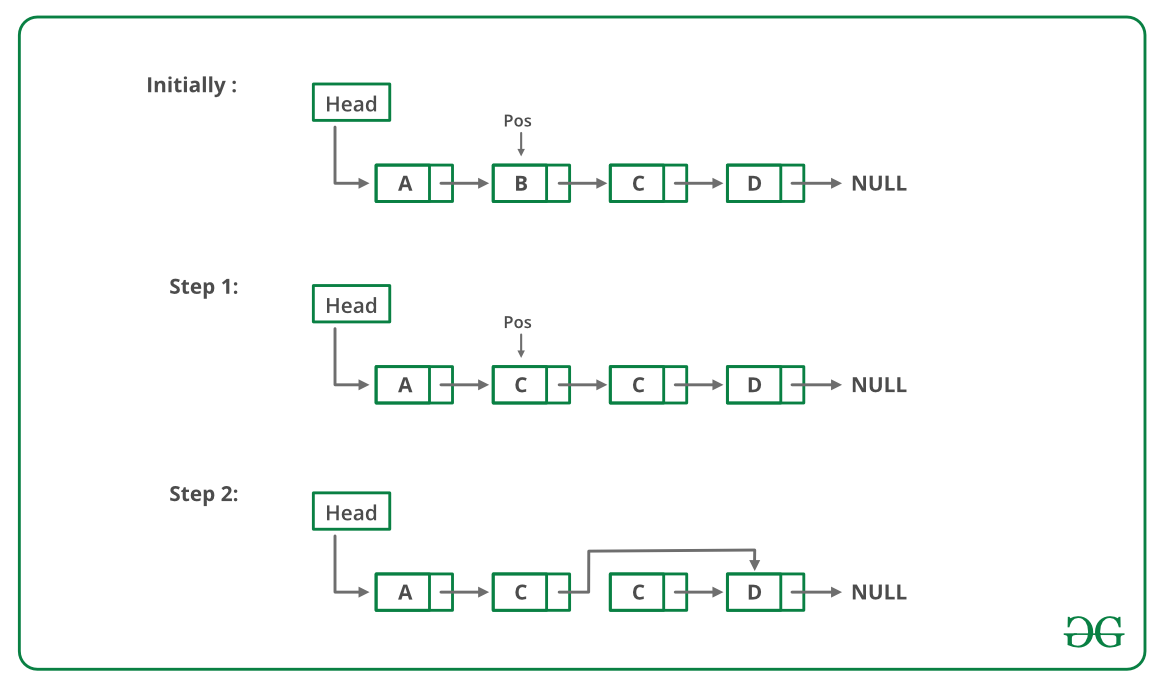
But here we will copy the data field of C to the data field of B. Then we will move forward.Now we are at C and we have a pointer to B i.e. the previous pointer. So we will delete C.
That's how node B will be deleted.
Below image is a dry run of the above approach:
Below is the implementation of the above approach:
C++ `
// C++ program to delete a node #include <bits/stdc++.h> using namespace std;
/* Link list node / struct Node { int data; struct Node next; };
// Function to delete the node without head void deleteNodeWithoutHead(struct Node* pos) { if (pos == NULL) // If linked list is empty return; else {
    if (pos->next == NULL) {
        printf("This is last node, require head, can't "
               "be freed\n");
        return;
    }

    struct Node* temp = pos->next;

    // Copy data of the next node to current node
    pos->data = pos->next->data;

    // Perform conventional deletion
    pos->next = pos->next->next;

    free(temp);
}
}
// Function to print the linked list void print(Node* head) { Node* temp = head; while (temp) { cout << temp->data << " -> "; temp = temp->next; }
cout << "NULL";}
void push(struct Node** head_ref, int new_data) { /* allocate node / struct Node new_node = new Node();
/* put in the data */
new_node->data = new_data;

/* link the old list of the new node */
new_node->next = (*head_ref);

/* move the head to point to the new node */
(*head_ref) = new_node;
}
// Driver Code int main() { /* Start with the empty list / struct Node head = NULL;
// create linked 35->15->4->20
push(&head, 20);
push(&head, 4);
push(&head, 15);
push(&head, 35);
cout << "Initial Linked List: \n";
print(head);
cout << endl << endl;

// Delete 15 without sending head
Node* del = head->next;

// Function call
deleteNodeWithoutHead(del);

// Print the final linked list
cout << "Final Linked List after deletion of 15:\n";
print(head);

return 0;

// This code has been contributed by Striver
}
Java
// Java Program to delete a node
class Node{ int data; Node next; Node(int val){ data = val; next = null; } }
class LinkedList{ Node head;
// Function to delete the node without head void deleteNodeWithoutHead(Node pos){ if(pos == null) // If linked list is empty return; else{ if(pos.next == null){ System.out.println("This is last node, require head, can't be freed\n"); return; } } // copy data of the next node to current node pos.data = pos.next.data;
// perform conventional deletion
pos.next = pos.next.next;
}
public void push(int new_data){ // allocate node and put in the data Node new_node = new Node(new_data);
// link the old list of the new node
new_node.next = head;

// move the head to point to the new node
head = new_node;
}
public void printList(){ Node temp = head; while(temp != null){ System.out.print(temp.data + "->"); temp = temp.next; } System.out.println("NULL\n"); }
public static void main(String args[]){ LinkedList llist = new LinkedList();
// create linked list 35->15->4->20
llist.push(20);
llist.push(4);
llist.push(15);
llist.push(35);

System.out.println("Initial Linked List : ");
llist.printList();

// Delete 15 without sending head
Node del = llist.head.next;

// Function call
llist.deleteNodeWithoutHead(del);

// Print the final Linked List
System.out.println("Final Linked List after deletion of 15 : ");
llist.printList();
} }
// This code is contributed by Yash Agarwal(yashagarwal2852002)
Python3
class Node: def init(self, val): self.data = val self.next = None
class LinkedList: def init(self): self.head = None
# Function to delete the node without head
def delete_node_without_head(self, pos):
    if pos is None:  # If linked list is empty
        return
    elif pos.next is None:
        print("This is last node, require head, can't be freed\n")
        return

    # copy data of the next node to current node
    pos.data = pos.next.data

    # perform conventional deletion
    pos.next = pos.next.next

def push(self, new_data):
    # allocate node and put in the data
    new_node = Node(new_data)

    # link the old list of the new node
    new_node.next = self.head

    # move the head to point to the new node
    self.head = new_node

def print_list(self):
    temp = self.head
    while temp is not None:
        print(temp.data, end='->')
        temp = temp.next
    print("NULL\n")
if name == 'main': llist = LinkedList()
# create linked list 35->15->4->20
llist.push(20)
llist.push(4)
llist.push(15)
llist.push(35)

print("Initial Linked List : ")
llist.print_list()

# Delete 15 without sending head
del_node = llist.head.next

# Function call
llist.delete_node_without_head(del_node)

# Print the final Linked List
print("Final Linked List after deletion of 15 : ")
llist.print_list()
This code has been contributed by Mayank Bohra
C#
// C# Program to delete a node
using System;
class Node { public int data; public Node next; public Node(int val) { data = val; next = null; } }
class LinkedList { public Node head; public LinkedList() { head = null; }
// Function to delete the node without head public void delete_node_without_head(Node pos) { if (pos == null) // If linked list is empty { return; } else if (pos.next == null) { Console.WriteLine("This is last node, require head, can't be freed\n"); return; }
// copy data of the next node to current node
pos.data = pos.next.data;

// perform conventional deletion
pos.next = pos.next.next;
}
public void push(int new_data) { // allocate node and put in the data Node new_node = new Node(new_data);
// link the old list of the new node
new_node.next = head;

// move the head to point to the new node
head = new_node;
}
public void print_list() { Node temp = head; while (temp != null) { Console.Write(temp.data + "->"); temp = temp.next; } Console.WriteLine("NULL\n"); } }
class Program { static void Main(string[] args) { LinkedList llist = new LinkedList(); // create linked list 35->15->4->20 llist.push(20); llist.push(4); llist.push(15); llist.push(35);
Console.WriteLine("Initial Linked List : ");
llist.print_list();

// Delete 15 without sending head
Node del_node = llist.head.next;

// Function call
llist.delete_node_without_head(del_node);

// Print the final Linked List
Console.WriteLine("Final Linked List after deletion of 15 : ");
llist.print_list();
} }
//This code is contributed by shivamsharma215
JavaScript
class Node{
constructor(val){
    this.data = val;
    this.next = null;
}
}
class LinkedList{
constructor(){
    this.head = null;
}

// Function to delete the node without head
delete_node_without_head(pos){
    if(pos == null) //  If linked list is empty
        return;
    else if(pos.next == null){
        console.log("This is last node, require head, can't be freed\n");
        return;
    }

    // copy data of the next node to current node
    pos.data = pos.next.data;

    // perform conventional deletion
    pos.next = pos.next.next;
}

push(new_data){
    // allocate node and put in the data
    let new_node = new Node(new_data);

    // link the old list of the new node
    new_node.next = this.head;

    // move the head to point to the new node
    this.head = new_node;
}

print_list(){

    let temp = this.head;
    while(temp != null){
        console.log(temp.data + "->");
        temp = temp.next;
    }
    console.log("NULL \n\n");
}
}
let llist = new LinkedList();
// create linked list 35->15->4->20 llist.push(20); llist.push(4); llist.push(15); llist.push(35);
console.log("Initial Linked List : \n"); llist.print_list();
// Delete 15 without sending head let del_node = llist.head.next;
// Function call llist.delete_node_without_head(del_node);
// Print the final Linked List console.log("Final Linked List after deletion of 15 : \n"); llist.print_list();
// This code has been contributed by Nidhi goel.
`
Output
Initial Linked List: 35 -> 15 -> 4 -> 20 -> NULL
Final Linked List after deletion of 15: 35 -> 4 -> 20 -> NULL
Time complexity: O(1) since performing constant operations and modifying only a single pointer to delete node
Auxiliary Space: O(1)
Please see Given only a pointer to a node to be deleted in a singly linked list, how do you delete it for more details and complete implementation.