Deletion in Doubly Circular Linked List (original) (raw)
Last Updated : 23 Jul, 2025
We have discussed the doubly circular linked list introduction and its insertion.
Let us formulate the problem statement to understand the deletion process. Given a ‘key’, delete the first occurrence of this key in the circular doubly linked list.
Algorithm:
Case 1: Empty List(start = NULL)
- If the list is empty, simply return it.
Case 2: The List initially contains some nodes, start points at the first node of the List
- If the list is not empty, then we define two pointers curr and prev_1 and initialize the pointer curr points to the first node of the list, and prev_1 = NULL.
- Traverse the list using the curr pointer to find the node to be deleted and before moving from curr to the next node, every time set prev_1 = curr.
- If the node is found, check if it is the only node in the list. If yes, set start = NULL and free the node pointing by curr.
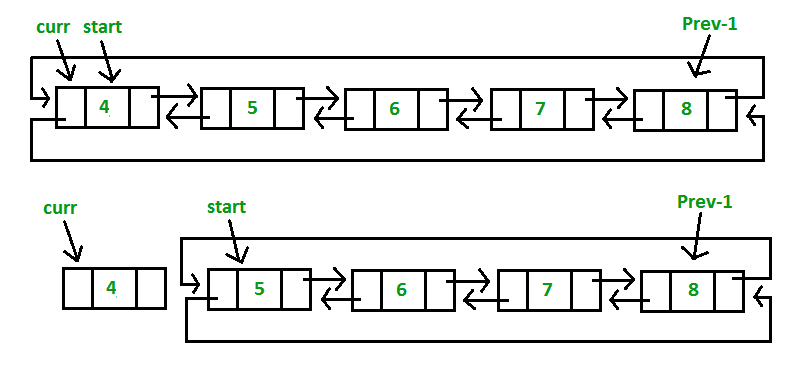
- If the list has more than one node, check if it is the first node of the list. The condition to check this is (curr == start). If yes, then move prev_1 to the last node(prev_1 = start -> prev). After prev_1 reaches the last node, set start = start -> next and prev_1 -> next = start and start -> prev = prev_1. Free the node pointing by curr.
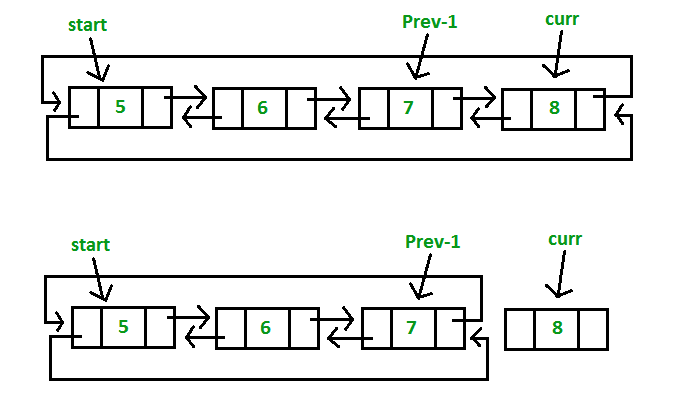
- If curr is not the first node, we check if it is the last node in the list. The condition to check this is (curr -> next == start). If yes, set prev_1 -> next = start and start -> prev = prev_1. Free the node pointing by curr.
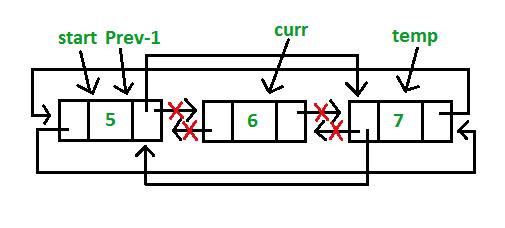
- If the node to be deleted is neither the first node nor the last node, declare one more pointer temp and initialize the pointer temp points to the next of curr pointer (temp = curr->next). Now set, prev_1 -> next = temp and temp ->prev = prev_1. Free the node pointing by curr.
- If the given key(Say 4) matches with the first node of the list(Step 4):
- If the given key(Say 8) matches with the last node of the list(Step 5):
- If the given key(Say 6) matches with the middle node of the list(Step 6):
Implementation:
C++ `
// C++ program to delete a given key from // circular doubly linked list. #include <bits/stdc++.h> using namespace std;
// Structure of a Node struct Node { int data; struct Node* next; struct Node* prev; };
// Function to insert node in the list void insert(struct Node** start, int value) { // If the list is empty, create a single node // circular and doubly list if (start == NULL) { struct Node new_node = new Node; new_node->data = value; new_node->next = new_node->prev = new_node; *start = new_node; return; }
// If list is not empty

/* Find last node */
Node* last = (*start)->prev;

// Create Node dynamically
struct Node* new_node = new Node;
new_node->data = value;

// Start is going to be next of new_node
new_node->next = *start;

// Make new node previous of start
(*start)->prev = new_node;

// Make last previous of new node
new_node->prev = last;

// Make new node next of old last
last->next = new_node;
}
// Function to delete a given node from the list void deleteNode(struct Node** start, int key) { // If list is empty if (*start == NULL) return;
// Find the required node
// Declare two pointers and initialize them
struct Node *curr = *start, *prev_1 = NULL;
while (curr->data != key) {
    // If node is not present in the list
    if (curr->next == *start) {
        printf("\nList doesn't have node with value = %d", key);
        return;
    }

    prev_1 = curr;
    curr = curr->next;
}

// Check if node is the only node in list
if (curr->next == *start && prev_1 == NULL) {
    (*start) = NULL;
    free(curr);
    return;
}

// If list has more than one node,
// check if it is the first node
if (curr == *start) {
    // Move prev_1 to last node
    prev_1 = (*start)->prev;

    // Move start ahead
    *start = (*start)->next;

    // Adjust the pointers of prev_1 and start node
    prev_1->next = *start;
    (*start)->prev = prev_1;
    free(curr);
}

// check if it is the last node
else if (curr->next == *start) {
    // Adjust the pointers of prev_1 and start node
    prev_1->next = *start;
    (*start)->prev = prev_1;
    free(curr);
}
else {
    // create new pointer, points to next of curr node
    struct Node* temp = curr->next;

    // Adjust the pointers of prev_1 and temp node
    prev_1->next = temp;
    temp->prev = prev_1;
    free(curr);
}
}
// Function to display list elements void display(struct Node* start) { struct Node* temp = start;
while (temp->next != start) {
    printf("%d ", temp->data);
    temp = temp->next;
}
printf("%d ", temp->data);
}
// Driver program to test above functions int main() { // Start with the empty list struct Node* start = NULL;
// Created linked list will be 4->5->6->7->8
insert(&start, 4);
insert(&start, 5);
insert(&start, 6);
insert(&start, 7);
insert(&start, 8);

printf("List Before Deletion: ");
display(start);

// Delete the node which is not present in list
deleteNode(&start, 9);
printf("\nList After Deletion: ");
display(start);

// Delete the first node
deleteNode(&start, 4);
printf("\nList After Deleting %d: ", 4);
display(start);

// Delete the last node
deleteNode(&start, 8);
printf("\nList After Deleting %d: ", 8);
display(start);

// Delete the middle node
deleteNode(&start, 6);
printf("\nList After Deleting %d: ", 6);
display(start);

return 0;
}
Java
// Java program to delete a given key from // circular doubly linked list. import java.util.; import java.io.;
class GFG {
// structure of a Node
static class Node {
    int data;
    Node next;
    Node prev;
};

// Function to insert node in the list
static Node insert(Node start, int value)
{
    // If the list is empty, create a single node
    // circular and doubly list
    if (start == null) {
        Node new_node = new Node();
        new_node.data = value;
        new_node.next = new_node.prev = new_node;
        start = new_node;
        return start;
    }

    // If list is not empty

    // Find last node /
    Node last = (start).prev;

    // Create Node dynamically
    Node new_node = new Node();
    new_node.data = value;

    // Start is going to be next of new_node
    new_node.next = start;

    // Make new node previous of start
    (start).prev = new_node;

    // Make last previous of new node
    new_node.prev = last;

    // Make new node next of old last
    last.next = new_node;
    return start;
}

// Function to delete a given node from the list
static Node deleteNode(Node start, int key)
{
    // If list is empty
    if (start == null)
        return null;

    // Find the required node
    // Declare two pointers and initialize them
    Node curr = start, prev_1 = null;
    while (curr.data != key) {
        // If node is not present in the list
        if (curr.next == start) {
            System.out.printf("\nList doesn't have node with value = %d", key);
            return start;
        }

        prev_1 = curr;
        curr = curr.next;
    }

    // Check if node is the only node in list
    if (curr.next == start && prev_1 == null) {
        (start) = null;
        return start;
    }

    // If list has more than one node,
    // check if it is the first node
    if (curr == start) {
        // Move prev_1 to last node
        prev_1 = (start).prev;

        // Move start ahead
        start = (start).next;

        // Adjust the pointers of prev_1 and start node
        prev_1.next = start;
        (start).prev = prev_1;
    }

    // check if it is the last node
    else if (curr.next == start) {
        // Adjust the pointers of prev_1 and start node
        prev_1.next = start;
        (start).prev = prev_1;
    }
    else {
        // create new pointer, points to next of curr node
        Node temp = curr.next;

        // Adjust the pointers of prev_1 and temp node
        prev_1.next = temp;
        temp.prev = prev_1;
    }
    return start;
}

// Function to display list elements
static void display(Node start)
{
    Node temp = start;

    while (temp.next != start) {
        System.out.printf("%d ", temp.data);
        temp = temp.next;
    }
    System.out.printf("%d ", temp.data);
}

// Driver program to test above functions
public static void main(String args[])
{
    // Start with the empty list
    Node start = null;

    // Created linked list will be 4.5.6.7.8
    start = insert(start, 4);
    start = insert(start, 5);
    start = insert(start, 6);
    start = insert(start, 7);
    start = insert(start, 8);

    System.out.printf("List Before Deletion: ");
    display(start);

    // Delete the node which is not present in list
    start = deleteNode(start, 9);
    System.out.printf("\nList After Deletion: ");
    display(start);

    // Delete the first node
    start = deleteNode(start, 4);
    System.out.printf("\nList After Deleting %d: ", 4);
    display(start);

    // Delete the last node
    start = deleteNode(start, 8);
    System.out.printf("\nList After Deleting %d: ", 8);
    display(start);

    // Delete the middle node
    start = deleteNode(start, 6);
    System.out.printf("\nList After Deleting %d: ", 6);
    display(start);
}
}
// This code is contributed by Arnab Kundu
Python3
Python3 program to delete a given key from
circular doubly linked list.
structure of a node of linked list
class Node: def init(self, data): self.data = data self.next = None self.prev = None
def insert( start, value):
# If the list is empty, create a single node
# circular and doubly list
if (start == None):
    new_node = Node(0)
    new_node.data = value
    new_node.next = new_node.prev = new_node
    start = new_node
    return start

# If list is not empty

# Find last node /
last = (start).prev

# Create Node dynamically
new_node = Node(0)
new_node.data = value

# Start is going to be next of new_node
new_node.next = start

# Make new node previous of start
(start).prev = new_node

# Make last previous of new node
new_node.prev = last

# Make new node next of old last
last.next = new_node
return start
Function to delete a given node
from the list
def deleteNode(start, key):
# If list is empty
if (start == None):
    return None

# Find the required node
# Declare two pointers and initialize them
curr = start
prev_1 = None
while (curr.data != key) :

    # If node is not present in the list
    if (curr.next == start) :
        print ("List doesn't have node",
                   "with value = ", key)
        return start

    prev_1 = curr
    curr = curr.next

# Check if node is the only node in list
if (curr.next == start and prev_1 == None) :
    (start) = None
    return start

# If list has more than one node,
# check if it is the first node
if (curr == start) :

    # Move prev_1 to last node
    prev_1 = (start).prev

    # Move start ahead
    start = (start).next

    # Adjust the pointers of prev_1
    # and start node
    prev_1.next = start
    (start).prev = prev_1

# check if it is the last node
elif (curr.next == start) :

    # Adjust the pointers of prev_1
    # and start node
    prev_1.next = start
    (start).prev = prev_1

else :

    # create new pointer,
    # points to next of curr node
    temp = curr.next

    # Adjust the pointers of prev_1
    # and temp node
    prev_1.next = temp
    temp.prev = prev_1

return start
Function to display list elements
def display(start):
temp = start

while (temp.next != start) :
    print (temp.data, end = " ")
    temp = temp.next

print (temp.data)
Driver Code
if name=='main':
# Start with the empty list
start = None

# Created linked list will be 4.5.6.7.8
start = insert(start, 4)
start = insert(start, 5)
start = insert(start, 6)
start = insert(start, 7)
start = insert(start, 8)

print ("List Before Deletion: ")
display(start)

# Delete the node which is not present in list
start = deleteNode(start, 9)
print ("List After Deletion: ")
display(start)

# Delete the first node
start = deleteNode(start, 4)
print ("List After Deleting", 4)
display(start)

# Delete the last node
start = deleteNode(start, 8)
print ("List After Deleting ", 8)
display(start)

# Delete the middle node
start = deleteNode(start, 6)
print ("List After Deleting ", 6)
display(start)
This code is contributed by Arnab Kundu
C#
// C# program to delete a given key from // circular doubly linked list. using System;
class GFG {
// structure of a Node
public class Node {
    public int data;
    public Node next;
    public Node prev;
};

// Function to insert node in the list
static Node insert(Node start, int value)
{
    // If the list is empty, create a single node
    // circular and doubly list
    Node new_node = new Node();
    if (start == null) {

        new_node.data = value;
        new_node.next = new_node.prev = new_node;
        start = new_node;
        return start;
    }

    // If list is not empty

    // Find last node /
    Node last = (start).prev;

    // Create Node dynamically
    new_node = new Node();
    new_node.data = value;

    // Start is going to be next of new_node
    new_node.next = start;

    // Make new node previous of start
    (start).prev = new_node;

    // Make last previous of new node
    new_node.prev = last;

    // Make new node next of old last
    last.next = new_node;
    return start;
}

// Function to delete a given node from the list
static Node deleteNode(Node start, int key)
{
    // If list is empty
    if (start == null)
        return null;

    // Find the required node
    // Declare two pointers and initialize them
    Node curr = start, prev_1 = null;
    while (curr.data != key) {
        // If node is not present in the list
        if (curr.next == start) {
            Console.Write("\nList doesn't have node with value = {0}", key);
            return start;
        }

        prev_1 = curr;
        curr = curr.next;
    }

    // Check if node is the only node in list
    if (curr.next == start && prev_1 == null) {
        (start) = null;
        return start;
    }

    // If list has more than one node,
    // check if it is the first node
    if (curr == start) {
        // Move prev_1 to last node
        prev_1 = (start).prev;

        // Move start ahead
        start = (start).next;

        // Adjust the pointers of prev_1 and start node
        prev_1.next = start;
        (start).prev = prev_1;
    }

    // check if it is the last node
    else if (curr.next == start) {
        // Adjust the pointers of prev_1 and start node
        prev_1.next = start;
        (start).prev = prev_1;
    }
    else {
        // create new pointer, points to next of curr node
        Node temp = curr.next;

        // Adjust the pointers of prev_1 and temp node
        prev_1.next = temp;
        temp.prev = prev_1;
    }
    return start;
}

// Function to display list elements
static void display(Node start)
{
    Node temp = start;

    while (temp.next != start) {
        Console.Write("{0} ", temp.data);
        temp = temp.next;
    }
    Console.Write("{0} ", temp.data);
}

// Driver code
public static void Main(String[] args)
{
    // Start with the empty list
    Node start = null;

    // Created linked list will be 4.5.6.7.8
    start = insert(start, 4);
    start = insert(start, 5);
    start = insert(start, 6);
    start = insert(start, 7);
    start = insert(start, 8);

    Console.Write("List Before Deletion: ");
    display(start);

    // Delete the node which is not present in list
    start = deleteNode(start, 9);
    Console.Write("\nList After Deletion: ");
    display(start);

    // Delete the first node
    start = deleteNode(start, 4);
    Console.Write("\nList After Deleting {0}: ", 4);
    display(start);

    // Delete the last node
    start = deleteNode(start, 8);
    Console.Write("\nList After Deleting {0}: ", 8);
    display(start);

    // Delete the middle node
    start = deleteNode(start, 6);
    Console.Write("\nList After Deleting {0}: ", 6);
    display(start);
}
}
// This code has been contributed by 29AjayKumar
JavaScript
`
Output
List Before Deletion: 4 5 6 7 8 List doesn't have node with value = 9 List After Deletion: 4 5 6 7 8 List After Deleting 4: 5 6 7 8 List After Deleting 8: 5 6 7 List After Deleting 6: 5 7
Time Complexity: O(n), as we are using a loop to traverse n times (for deletion and displaying the linked list). Where n is the number of nodes in the linked list.
Auxiliary Space: O(1), as we are not using any extra space.