Euler's Totient Function (original) (raw)
Given an integer n, find the value of **Euler's Totient Function, denoted as **Φ(n). The function **Φ(n) represents the count of positive integers less than or equal to n that are **relatively prime to n.
Euler's Totient function Φ(n) for an input n is the count of numbers in {1, 2, 3, ..., n-1} that are relatively prime to n, i.e., the numbers whose GCD (Greatest Common Divisor) with n is 1.
If n is a positive integer and its prime factorization is; n = p_1^{e_1} \cdot p_2^{e_2} \cdot \ldots \cdot p_k^{e_k}
Where p_1, p_2, \ldots, p_k are distinct prime factors of n, then:
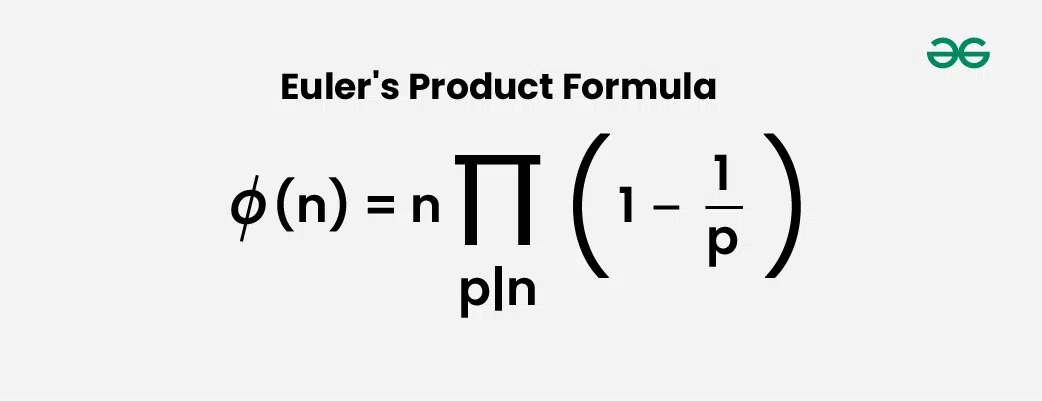
\phi(n) = n \cdot \left(1 - \frac{1}{p_1}\right) \cdot \left(1 - \frac{1}{p_2}\right) \cdot \ldots \cdot \left(1 - \frac{1}{p_k}\right).
**Examples:
**Input: n = 11
**Output: 10
**Explanation: From 1 to 11, 1,2,3,4,5,6,7,8,9,10 are relatively prime to 11.**Input: n = 16
**Output: 8
**Explanation: From 1 to 16, 1,3,5,7,9,11,13,15 are relatively prime to 16.
Table of Content
- [Naive Approach] Iterative GCD Method
- [Expected Approach] Euler’s Product Formula
- Some Interesting Properties of Euler's Totient Function
[Naive Approach] Iterative GCD Method
A simple solution is to iterate through all numbers from 1 to n-1 and count numbers with gcd with n as 1. Below is the implementation of the simple method to compute Euler's Totient function for an input integer n.
C++ `
#include using namespace std;
// Function to return gcd of a and b int gcd(int a, int b) { if (a == 0) return b; return gcd(b % a, a); }
// A simple method to evaluate Euler Totient Function int etf(int n) { int result = 1; for (int i = 2; i < n; i++) if (gcd(i, n) == 1) result++; return result; }
// Driver Code int main() { int n = 11; cout << etf(n); return 0; }
Java
class GfG {
// Function to return gcd of a and b
static int gcd(int a, int b) {
    if (a == 0)
        return b;
    return gcd(b % a, a);
}

// Function to compute Euler's Totient Function
static int etf(int n) {
    int result = 1;
    for (int i = 2; i < n; i++) {
        if (gcd(i, n) == 1)
            result++;
    }
    return result;
}
// Driver Code public static void main(String[] args) { int n = 11; System.out.println(etf(n)); } }
Python
Function to return gcd of a and b
def gcd(a, b): if a == 0: return b return gcd(b % a, a)
A simple method to evaluate Euler Totient Function
def etf(n): result = 1 for i in range(2, n): if gcd(i, n) == 1: result += 1 return result
Driver Code
if name == "main": n = 11 print(etf(n))
C#
using System;
class GfG {
// Function to return gcd of a and b
static int gcd(int a, int b) {
    if (a == 0)
        return b;
    return gcd(b % a, a);
}

// A simple method to evaluate Euler Totient Function
static int etf(int n) {
    int result = 1;
    for (int i = 2; i < n; i++){
        if (gcd(i, n) == 1)
            result++;
    }
    return result;
}
// Driver Code static void Main(){ int n = 11; Console.WriteLine(etf(n)); } }
JavaScript
// Function to return gcd of a and b function gcd(a, b) { if (a === 0) return b; return gcd(b % a, a); }
// A simple method to evaluate Euler Totient Function function etf(n) { let result = 1; for (let i = 2; i < n; i++) { if (gcd(i, n) === 1) result++; } return result; }
// Driver Code let n = 11; console.log(etf(n));
`
**Time Complexity: O(n log n)
**Auxiliary Space: O(log min(a,b)) where a,b are the parameters of gcd function.
[Expected Approach] Euler’s Product Formula
The idea is based on Euler's product formula which states that the value of totient functions is below the product overall prime factors p of n.
- Initialize result as n
- Consider every number 'p' (where 'p' varies from 2 to Φ(n)).
If p divides n, then do following
a) Subtract all multiples of p from 1 to n [all multiples of p
will have gcd more than 1 (at least p) with n]
b) Update n by repeatedly dividing it by p.- If the reduced n is more than 1, then remove all multiples
of n from result.
C++ `
#include using namespace std;
int etf(int n){
int result = n;

// Consider all prime factors of n
// and subtract their multiples
// from result
for (int p = 2; p * p <= n; ++p)
{
    // Check if p is a prime factor.
    if (n % p == 0)
    {
        // If yes, then update n and result
        while (n % p == 0)
            n /= p;

        result -= result / p;
    }
}

// If n has a prime factor greater than sqrt(n)
// (There can be at-most one such prime factor)
if (n > 1)
    result -= result / n;

return result;
}
// Driver Code int main() { int n = 11; cout << etf(n); return 0; }
Java
class GfG {
static int etf(int n) {

    int result = n;

    // Consider all prime factors of n
    // and subtract their multiples
    // from result
    for (int p = 2; p * p <= n; ++p) {

        if (n % p == 0) {
            while (n % p == 0)
                n /= p;

            result -= result / p;
        }
    }

    // If n has a prime factor greater than sqrt(n)
    // (There can be at-most one such prime factor)
    if (n > 1)
        result -= result / n;

    return result;
}
// Driver Code public static void main(String[] args) { int n = 11; System.out.println(etf(n)); } }
Python
def etf(n):
result = n

# Consider all prime factors of n
# and subtract their multiples
# from result
p = 2
while p * p <= n:

    if n % p == 0:
        while n % p == 0:
            n //= p

        result -= result // p
    p += 1

# If n has a prime factor greater than sqrt(n)
# (There can be at-most one such prime factor)
if n > 1:
    result -= result // n

return result
Driver Code
if name == "main": n = 11 print(etf(n))
C#
using System;
class GfG { static int etf(int n) {
    int result = n;

    // Consider all prime factors of n
    // and subtract their multiples
    // from result
    for (int p = 2; p * p <= n; ++p) {

        // Check if p is a prime factor.
        if (n % p == 0) {

            // If yes, then update n and result
            while (n % p == 0)
                n /= p;

            result -= result / p;
        }
    }

    // If n has a prime factor greater than sqrt(n)
    // (There can be at-most one such prime factor)
    if (n > 1)
        result -= result / n;

    return result;
}
// Driver Code static void Main() { int n = 11; Console.WriteLine(etf(n)); } }
JavaScript
function etf(n) {
let result = n;

// Consider all prime factors of n
// and subtract their multiples
// from result
for (let p = 2; p * p <= n; ++p) {
    if (n % p === 0) {

        while (n % p === 0)
            n = Math.floor(n / p);

        result -= Math.floor(result / p);
    }
}

// If n has a prime factor greater than sqrt(n)
// (There can be at-most one such prime factor)
if (n > 1)
    result -= Math.floor(result / n);

return result;
}
// Driver Code const n = 11; console.log(etf(n));
`
**Time Complexity: O(√n)
**Auxiliary Space: O(1)
**Some Interesting Properties of Euler's Totient Function
**1) For a **prime number p, \phi(p) = p - 1
**Proof :
\phi(p) = p - 1 , where p is any prime number
We know that gcd(p, k) = 1 where k is any random number and k \neq p
\\Total number from 1 to p = p
Number for which gcd(p, k) = 1 is 1, i.e the number p itself, so subtracting 1 from p \phi(p) = p - 1
**Examples :
\phi(5) = 5 - 1 = 4\\\phi(13) = 13 - 1 = 12\\\phi(29) = 29 - 1 = 28.
**2) For **two prime numbers a and b \phi(a \cdot b) = \phi(a) \cdot \phi(b) = (a - 1) \cdot (b - 1) , used in RSA Algorithm
**Proof :
Let a and b be distinct primes.
Then:
- ϕ(a)=a−1, ϕ(b)=b−1
Total numbers from 1 to ab: ab
Multiples of a: b numbers
Multiples of b: a numbers
Common multiple (i.e., double-counted): only abSo, numbers **not coprime to ab:
a+b−1
Then,
ϕ(ab) = ab − (a + b − 1) = ab − a − b + 1 = (a−1)(b−1)
Hence,
ϕ(ab) = ϕ(a)* ϕ(b)
Examples :
- ϕ(5⋅7) = ϕ(5)⋅ϕ(7) = (5−1) (7−1) = 4⋅6 = 24
- ϕ(3⋅5) = ϕ(3)⋅ϕ(5) = (3−1) (5−1) = 2⋅4 = 8
- ϕ(3⋅7) = ϕ(3)⋅ϕ(7) = (3−1) (7−1) = 2⋅6 = 12
**3) For a **prime number p and integer k ≥ 1:
ϕ(pk) = pk−pk−1
**Proof :
\phi(p^k) = p ^ k - p ^{k - 1} , where p is a prime number\\Total numbers from 1 to p ^ k = p ^ k Total multiples of p = \frac {p ^ k} {p} = p ^ {k - 1}
Removing these multiples as with them gcd \neq 1\\
**Examples :
p = 2, k = 5, p ^ k = 32
Multiples of 2 (as with them gcd \neq 1) = 32 / 2 = 16\\\phi(p ^ k) = p ^ k - p ^ {k - 1}.
**4) Special Case ****: gcd(a, b) = 1**
\phi(a \cdot b) = \phi(a) \cdot \phi(b) \cdot \frac {1} {\phi(1)} = \phi(a) \cdot \phi(b).
**Examples :
**Special Case:
gcd(a, b) = 1****,** \phi(a \cdot b) = \phi(a) \cdot \phi(b)\phi(2 \cdot 9) = \phi(2) \cdot \phi(9) = 1 \cdot 6 = 6\\\phi(8 \cdot 9) = \phi(8) \cdot \phi(9) = 4 \cdot 6 = 24\\\phi(5 \cdot 6) = \phi(5) \cdot \phi(6) = 4 \cdot 2 = 8
**Normal Case:
gcd(a, b) \neq 1****,** \phi(a \cdot b) = \phi(a) \cdot \phi(b) \cdot \frac {gcd(a, b)} {\phi(gcd(a, b))}\\\phi(4 \cdot 6) = \phi(4) \cdot \phi(6) \cdot \frac {gcd(4, 6)} {\phi(gcd(4, 6))}= 2 \cdot 2 \cdot \frac{2}{1}= 2 \cdot 2 \cdot 2 = 8\\\phi(4 \cdot 8) = \phi(4) \cdot \phi(8) \cdot \frac {gcd(4, 8)} {\phi(gcd(4, 8))} = 2 \cdot 4 \cdot \frac{4}{2} = 2 \cdot 4 \cdot 2 = 16\\\phi(6 \cdot 8) = \phi(6) \cdot \phi(8) \cdot \frac {gcd(6, 8)} {\phi(gcd(6, 8))} = 2 \cdot 4 \cdot \frac{2}{1} = 2 \cdot 4 \cdot 2 = 16.
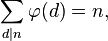
**5) Sum of values of totient functions of all divisors of n is equal to n.
**Example :
n = 6 , factors = {1, 2, 3, 6}
n = \phi(1) + \phi(2) + \phi(3) + \phi(6) = 1 + 1 + 2 + 2 = 6
**6) The most famous and important feature is expressed in **Euler's theorem :
The theorem states that if n and a are coprime
(or relatively prime) positive integers, thenaΦ(n) Φ 1 (mod n)
The RSA cryptosystem is based on this theorem:
In the particular case when m is prime say p, Euler's theorem turns into the so-called **Fermat's little theorem :
ap-1 Φ 1 (mod p)
**Related Article:
Euler’s Totient function for all numbers smaller than or equal to n
Optimized Euler Totient Function for Multiple Evaluations