Evaluation of Expression Tree (original) (raw)
Last Updated : 10 Mar, 2023
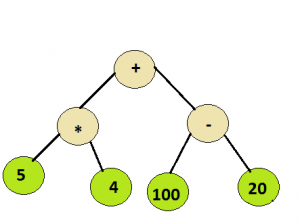
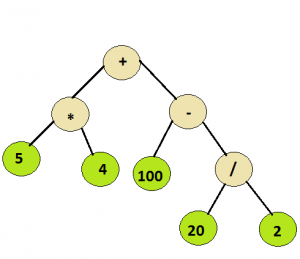
Given a simple expression tree, consisting of basic binary operators i.e., + , - ,* and / and some integers, evaluate the expression tree.
Examples:
Input: Root node of the below tree
**Output:**100
Input: Root node of the below tree
Output: 110
Approach: The approach to solve this problem is based on following observation:
As all the operators in the tree are binary, hence each node will have either 0 or 2 children. As it can be inferred from the examples above, all the integer values would appear at the leaf nodes, while the interior nodes represent the operators.
Therefore we can do inorder traversal of the binary tree and evaluate the expression as we move ahead.
To evaluate the syntax tree, a recursive approach can be followed.
Algorithm:
- Let t be the syntax tree
- If t is not null then
- If t.info is operand then
* Return t.info- Else
* A = solve(t.left)
* B = solve(t.right)
* return A operator B, where operator is the info contained in t
Below is the implementation of the above approach:
C++ `
// C++ program to evaluate an expression tree #include <bits/stdc++.h> using namespace std;
// Class to represent the nodes of syntax tree class node { public: string info; node *left = NULL, *right = NULL; node(string x) { info = x; } };
// Utility function to return the integer value // of a given string int toInt(string s) { int num = 0;
// Check if the integral value is
// negative or not
// If it is not negative, generate the number
// normally
if(s[0]!='-')
    for (int i=0; i<s.length(); i++)
        num = num*10 + (int(s[i])-48);
// If it is negative, calculate the +ve number
// first ignoring the sign and invert the
// sign at the end
else
{
  for (int i=1; i<s.length(); i++)
    num = num*10 + (int(s[i])-48);
  num = num*-1;
}

return num;
}
// This function receives a node of the syntax tree // and recursively evaluates it int eval(node* root) { // empty tree if (!root) return 0;
// leaf node i.e, an integer
if (!root->left && !root->right)
    return toInt(root->info);

// Evaluate left subtree
int l_val = eval(root->left);

// Evaluate right subtree
int r_val = eval(root->right);

// Check which operator to apply
if (root->info=="+")
    return l_val+r_val;

if (root->info=="-")
    return l_val-r_val;

if (root->info=="*")
    return l_val*r_val;

return l_val/r_val;
}
//driver function to check the above program int main() { // create a syntax tree node root = new node("+"); root->left = new node(""); root->left->left = new node("5"); root->left->right = new node("-4"); root->right = new node("-"); root->right->left = new node("100"); root->right->right = new node("20"); cout << eval(root) << endl;
delete(root);

root = new node("+");
root->left = new node("*");
root->left->left = new node("5");
root->left->right = new node("4");
root->right = new node("-");
root->right->left = new node("100");
root->right->right = new node("/");
root->right->right->left = new node("20");
root->right->right->right = new node("2");

cout << eval(root);
return 0;
}
Java
// Java program to evaluate expression tree import java.lang.*;
class GFG{
Node root;
// Class to represent the nodes of syntax tree public static class Node { String data; Node left, right;
Node(String d)
{
    data = d;
    left = null;
    right = null;
}
}
private static int toInt(String s) { int num = 0;
// Check if the integral value is
// negative or not
// If it is not negative, generate
// the number normally
if (s.charAt(0) != '-')
    for(int i = 0; i < s.length(); i++)
        num = num * 10 + ((int)s.charAt(i) - 48);

// If it is negative, calculate the +ve number
// first ignoring the sign and invert the
// sign at the end
else
{
    for(int i = 1; i < s.length(); i++)
      num = num * 10 + ((int)(s.charAt(i)) - 48);
    num = num * -1;
}
return num;
}
// This function receives a node of the syntax // tree and recursively evaluate it public static int evalTree(Node root) {
// Empty tree
if (root == null)
    return 0;

// Leaf node i.e, an integer
if (root.left == null && root.right == null)
    return toInt(root.data);

// Evaluate left subtree
int leftEval = evalTree(root.left);

// Evaluate right subtree
int rightEval = evalTree(root.right);

// Check which operator to apply
if (root.data.equals("+"))
    return leftEval + rightEval;

if (root.data.equals("-"))
    return leftEval - rightEval;

if (root.data.equals("*"))
    return leftEval * rightEval;

return leftEval / rightEval;
}
// Driver code public static void main(String[] args) {
// Creating a sample tree
Node root = new Node("+");
root.left = new Node("*");
root.left.left = new Node("5");
root.left.right = new Node("-4");
root.right = new Node("-");
root.right.left = new Node("100");
root.right.right = new Node("20");
System.out.println(evalTree(root));

root = null;

// Creating a sample tree
root = new Node("+");
root.left = new Node("*");
root.left.left = new Node("5");
root.left.right = new Node("4");
root.right = new Node("-");
root.right.left = new Node("100");
root.right.right = new Node("/");
root.right.right.left = new Node("20");
root.right.right.right = new Node("2");
System.out.println(evalTree(root));
} }
// This code is contributed by Ankit Gupta
Python3
Python program to evaluate expression tree
Class to represent the nodes of syntax tree
class node: def init(self, value): self.left = None self.data = value self.right = None
This function receives a node of the syntax tree
and recursively evaluate it
def evaluateExpressionTree(root):
# empty tree
if root is None:
    return 0

# leaf node
if root.left is None and root.right is None:
    return int(root.data)

# evaluate left tree
left_sum = evaluateExpressionTree(root.left)

# evaluate right tree
right_sum = evaluateExpressionTree(root.right)

# check which operation to apply
if root.data == '+':
    return left_sum + right_sum

elif root.data == '-':
    return left_sum - right_sum

elif root.data == '*':
    return left_sum * right_sum

else:
    return left_sum // right_sum
Driver function to test above problem
if name == 'main':
# creating a sample tree
root = node('+')
root.left = node('*')
root.left.left = node('5')
root.left.right = node('-4')
root.right = node('-')
root.right.left = node('100')
root.right.right = node('20')
print (evaluateExpressionTree(root))

root = None

# creating a sample tree
root = node('+')
root.left = node('*')
root.left.left = node('5')
root.left.right = node('4')
root.right = node('-')
root.right.left = node('100')
root.right.right = node('/')
root.right.right.left = node('20')
root.right.right.right = node('2')
print (evaluateExpressionTree(root))
This code is contributed by Harshit Sidhwa
C#
// C# program to evaluate expression tree using System;
public class GFG {
// Class to represent the nodes of syntax tree
public class Node {
    public
   String data;
          public
   Node left, right;

    public Node(String d) {
        data = d;
        left = null;
        right = null;
    }
}

private static int toInt(String s) {
    int num = 0;

    // Check if the integral value is
    // negative or not
    // If it is not negative, generate
    // the number normally
    if (s[0] != '-')
        for (int i = 0; i < s.Length; i++)
            num = num * 10 + ((int) s[i] - 48);

    // If it is negative, calculate the +ve number
    // first ignoring the sign and invert the
    // sign at the end
    else {
      for (int i = 1; i < s.Length; i++)
        num = num * 10 + ((int) (s[i]) - 48);
      num = num * -1;
    }
    return num;
}

// This function receives a node of the syntax
// tree and recursively evaluate it
public static int evalTree(Node root) {

    // Empty tree
    if (root == null)
        return 0;

    // Leaf node i.e, an integer
    if (root.left == null && root.right == null)
        return toInt(root.data);

    // Evaluate left subtree
    int leftEval = evalTree(root.left);

    // Evaluate right subtree
    int rightEval = evalTree(root.right);

    // Check which operator to apply
    if (root.data.Equals("+"))
        return leftEval + rightEval;

    if (root.data.Equals("-"))
        return leftEval - rightEval;

    if (root.data.Equals("*"))
        return leftEval * rightEval;

    return leftEval / rightEval;
}

// Driver code
public static void Main(String[] args) {

    // Creating a sample tree
    Node root = new Node("+");
    root.left = new Node("*");
    root.left.left = new Node("5");
    root.left.right = new Node("-4");
    root.right = new Node("-");
    root.right.left = new Node("100");
    root.right.right = new Node("20");
    Console.WriteLine(evalTree(root));

    root = null;

    // Creating a sample tree
    root = new Node("+");
    root.left = new Node("*");
    root.left.left = new Node("5");
    root.left.right = new Node("4");
    root.right = new Node("-");
    root.right.left = new Node("100");
    root.right.right = new Node("/");
    root.right.right.left = new Node("20");
    root.right.right.right = new Node("2");
    Console.WriteLine(evalTree(root));
}
}
// This code is contributed by umadevi9616
JavaScript
`
Time Complexity: O(n), as each node is visited once.
Auxiliary Space: O(n)