FIFO (FirstInFirstOut) approach in Programming (original) (raw)
FIFO (First-In-First-Out) approach in Programming
Last Updated : 6 Dec, 2022
FIFO is an abbreviation for first in, first out. It is a method for handling data structures where the first element is processed first and the newest element is processed last.
Real-life example:
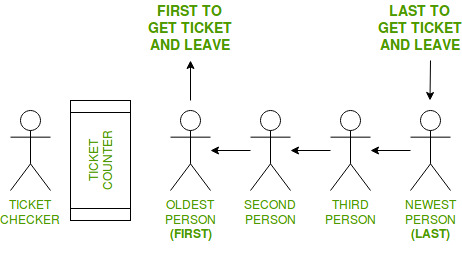
In this example, following things are to be considered:
- There is a ticket counter where people come, take tickets and go.
- People enter a line (queue) to get to the Ticket Counter in an organized manner.
- The person to enter the queue first, will get the ticket first and leave the queue.
- The person entering the queue next will get the ticket after the person in front of him
- In this way, the person entering the queue last will the tickets last
- Therefore, the First person to enter the queue gets the ticket first and the Last person to enter the queue gets the ticket last.
This is known as First-In-First-Out approach or FIFO.
Where is FIFO used:
- Data Structures:
- Certain data structures like Queue and other variants of Queue uses FIFO approach for processing data.
- Disk scheduling:
- Disk controllers can use the FIFO as a disk scheduling algorithm to determine the order in which to service disk I/O requests.
- Communications and networking"
- Communication network bridges, switches and routers used in computer networks use FIFOs to hold data packets en route to their next destination.
Program Examples for FIFO
Program 1: Queue
C++ `
// C++ program to demonstrate // working of FIFO // using Queue interface in C++
#include<bits/stdc++.h> using namespace std;
// print the elements of queue void print_queue(queue q) { while (!q.empty()) { cout << q.front() << " "; q.pop(); } cout << endl; }
// Driver code int main() { queue q ;
// Adds elements {0, 1, 2, 3, 4} to queue
for (int i = 0; i < 5; i++)
    q.push(i);

// Display contents of the queue.
cout << "Elements of queue-";

print_queue(q);

// To remove the head of queue.
// In this the oldest element '0' will be removed
int removedele = q.front();
q.pop();
cout << "removed element-" << removedele << endl;

print_queue(q);

// To view the head of queue
int head = q.front();
cout << "head of queue-" << head << endl;

// Rest all methods of collection interface,
// Like size and contains can be used with this
// implementation.
int size = q.size();
cout << "Size of queue-" << size;

return 0;
}
// This code is contributed by Arnab Kundu
Java
// Java program to demonstrate // working of FIFO // using Queue interface in Java
import java.util.LinkedList; import java.util.Queue;
public class QueueExample { public static void main(String[] args) { Queue q = new LinkedList<>();
    // Adds elements {0, 1, 2, 3, 4} to queue
    for (int i = 0; i < 5; i++)
        q.add(i);

    // Display contents of the queue.
    System.out.println("Elements of queue-" + q);

    // To remove the head of queue.
    // In this the oldest element '0' will be removed
    int removedele = q.remove();
    System.out.println("removed element-" + removedele);

    System.out.println(q);

    // To view the head of queue
    int head = q.peek();
    System.out.println("head of queue-" + head);

    // Rest all methods of collection interface,
    // Like size and contains can be used with this
    // implementation.
    int size = q.size();
    System.out.println("Size of queue-" + size);
}
}
Python3
Python program to demonstrate
working of FIFO
using Queue interface in Python
q = []
Adds elements {0, 1, 2, 3, 4} to queue
for i in range(5): q.append(i)
Display contents of the queue.
print("Elements of queue-" , q)
To remove the head of queue.
In this the oldest element '0' will be removed
removedele = q.pop(0) print("removed element-" , removedele)
print(q)
To view the head of queue
head = q[0] print("head of queue-" , head)
Rest all methods of collection interface,
Like size and contains can be used with this
implementation.
size = len(q) print("Size of queue-" , size)
This code is contributed by patel2127.
C#
// C# program to demonstrate // working of FIFO using System; using System.Collections.Generic;
public class QueueExample { public static void Main(String[] args) { Queue q = new Queue();
    // Adds elements {0, 1, 2, 3, 4} to queue
    for (int i = 0; i < 5; i++)
        q.Enqueue(i);

    // Display contents of the queue.
    Console.Write("Elements of queue-");
    foreach(int s in q)
            Console.Write(s + " ");

    // To remove the head of queue.
    // In this the oldest element '0' will be removed
    int removedele = q.Dequeue();
    Console.Write("\nremoved element-" + removedele + "\n");
    foreach(int s in q)
            Console.Write(s + " ");

    // To view the head of queue
    int head = q.Peek();
    Console.Write("\nhead of queue-" + head);

    // Rest all methods of collection interface,
    // Like size and contains can be used with this
    // implementation.
    int size = q.Count;
    Console.WriteLine("\nSize of queue-" + size);
}
}
// This code has been contributed by 29AjayKumar
JavaScript
`
Output
Elements of queue-0 1 2 3 4 removed element-0 1 2 3 4 head of queue-1 Size of queue-4
Complexities Analysis:
- Time Complexity: O(N)
- Space Complexity: O(N)