Find First Node of Loop in Linked List (original) (raw)
Last Updated : 28 Aug, 2025
Given the head of a linked list, determine the starting node of the loop if a cycle exists. A loop occurs when the last node points back to an earlier node in the list. If no loop is present, return -1.
**Example:
**Input:
**Output: 3
**Explanation: The linked list contains a loop, and the first node of the loop is 3.**Input:
**Output: -1
**Explanation: No loop exists in the above linked list. So the output is -1.
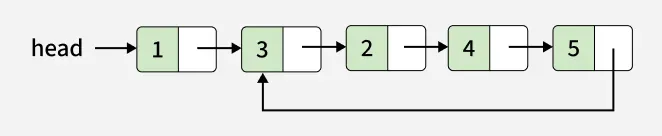


Table of Content
- [Naive approach] Using Hashing - O(n) Time and O(n) Space
- [Expected Approach] Using Floyd's loop detection algorithm - O(n) Time and O(1) Space
[Naive approach] Using Hashing - O(n) Time and O(n) Space
The idea is to start traversing the Linked List from head node and while traversing insert each node into the HashSet. If there is a loop present in the Linked List, there will be a node which will be already present in the hash set.
- If there is a node which is already present in the HashSet, return the node value which represent the starting node of loop.
- else, if there is no node which is already present in the HashSet , then return -1. C++ `
#include #include
using namespace std;
class Node { public: int data; Node* next; Node(int x) { data = x; next = nullptr; } };
int cycleStart(Node* head) {
unordered_set<Node*> st;

Node* currNode = head;

// traverse the linked list
while (currNode != nullptr) {

    // if the current node is already in the HashSet,
    // then this is the starting node of the loop
    if (st.find(currNode) != st.end()) {
        return currNode->data;
    }

    st.insert(currNode);

    currNode = currNode->next;
}

return -1;
}
int main() {
Node* head = new Node(1);
head->next = new Node(2);
head->next->next = new Node(3);
head->next->next->next = new Node(4);
head->next->next->next->next = new Node(5);
head->next->next->next->next->next = new Node(6);


head->next->next->next->next->next = head->next->next;


int loopNode = cycleStart(head);

if (loopNode != -1)
    cout << loopNode;
else
    cout << -1;

return 0;
}
Java
import java.util.HashSet;
class Node { int data; Node next;
Node(int x) {
    data = x;
    next = null;
}
}
class GfG {
static int cycleStart(Node head) {
    HashSet<Node> set = new HashSet<>();

    Node currNode = head;

    // Traverse the linked list
    while (currNode != null) {

        // If current node already in set → loop start
        if (set.contains(currNode)) {
            return currNode.data;
        }

        set.add(currNode);

        currNode = currNode.next;
    }

    return -1;
}

public static void main(String[] args) {

    Node head = new Node(1);
    head.next = new Node(2);
    head.next.next = new Node(3);
    head.next.next.next = new Node(4);
    head.next.next.next.next = new Node(5);
    head.next.next.next.next.next = new Node(6);

    head.next.next.next.next.next = head.next.next;

    int loopNode = cycleStart(head);

    if (loopNode != -1)
        System.out.println(loopNode);
    else
        System.out.println(-1);
}
}
Python
class Node: def init(self, x): self.data = x self.next = None
def cycleStart(head): visited = set() currNode = head
# Traverse the linked list
while currNode is not None:

    # If current node already in set → loop start
    if currNode in visited:
        return currNode.data

    visited.add(currNode)

    currNode = currNode.next

return -1
if name == "main":
head = Node(1)
head.next = Node(2)
head.next.next = Node(3)
head.next.next.next = Node(4)
head.next.next.next.next = Node(5)
head.next.next.next.next.next = Node(6)

head.next.next.next.next.next = head.next.next

loopNode = cycleStart(head)

if loopNode != -1:
    print(loopNode)
else:
    print(-1)
C#
using System; using System.Collections.Generic;
class Node { public int data; public Node next;
public Node(int x) {
    data = x;
    next = null;
}
}
class GfG {
static int cycleStart(Node head) {
    HashSet<Node> visited = new HashSet<Node>();

    Node currNode = head;

    // Traverse the linked list
    while (currNode != null) {

        // If current node already in set → loop start
        if (visited.Contains(currNode)) {
            return currNode.data;
        }

        visited.Add(currNode);

        currNode = currNode.next;
    }

    return -1;
}

public static void Main(string[] args) {

    Node head = new Node(1);
    head.next = new Node(2);
    head.next.next = new Node(3);
    head.next.next.next = new Node(4);
    head.next.next.next.next = new Node(5);
    head.next.next.next.next.next = new Node(6);

    head.next.next.next.next.next = head.next.next;

    int loopNode = cycleStart(head);

    if (loopNode != -1)
        Console.WriteLine(loopNode);
    else
        Console.WriteLine(-1);
}
}
JavaScript
class Node { constructor(x) { this.data = x; this.next = null; } }
function cycleStart(head) { let visited = new Set(); let currNode = head;
// Traverse the linked list
while (currNode !== null) {

    // If current node already in set → loop start
    if (visited.has(currNode)) {
        return currNode.data;
    }

    visited.add(currNode);

    currNode = currNode.next;
}

return -1;
}
// Driver Code
let head = new Node(1); head.next = new Node(2); head.next.next = new Node(3); head.next.next.next = new Node(4); head.next.next.next.next = new Node(5); head.next.next.next.next.next = new Node(6);
head.next.next.next.next.next = head.next.next;
let loopNode = cycleStart(head);
if (loopNode !== -1) console.log(loopNode); else console.log(-1);
`
[Expected Approach] Using Floyd's loop detection algorithm - O(n) Time and O(1) Space
This approach can be divided into two parts:
**1. Detect Loop in Linked List using Floyd’s Cycle Detection Algorithm:
This idea is to use Floyd’s Cycle-Finding Algorithm to find a loop in a linked list. It uses two pointers slow and fast, fast pointer move two steps ahead and slow will move one step ahead at a time.
Illustration:
**2. Find Starting node of Loop:
After detecting that the loop is present using above algorithm, to find the starting node of loop in linked list, we will reset the slow pointer to head node and fast pointer will remain at its position. Both slow and fast pointers move one step ahead until fast not equals to slow. The meeting point will be the Starting node of loop.
Illustration:
For more details about the working & proof of this algorithm, Please refer to this article, How does Floyd’s Algorithm works.
C++ `
#include using namespace std;
class Node { public: int data; Node* next; Node(int x) { data = x; next = nullptr; } };
int cycleStart(Node* head) {
// Initialize two pointers, slow and fast
Node* slow = head;
Node* fast = head;

// Traverse the list
while (fast != nullptr && fast->next != nullptr) {

      // Move slow pointer by one step
    slow = slow->next;

      // Move fast pointer by two steps
    fast = fast->next->next;

    // Detect loop
    if (slow == fast) {

        // Move slow to head, keep fast at meeting point
        slow = head;

        // Move both one step at a time until they meet
        while (slow != fast) {
            slow = slow->next;
            fast = fast->next;
        }

        // Return the meeting node, which
          // is the start of the loop
        return slow->data;
    }
}

// No loop found
return -1;
}
int main() {
Node* head = new Node(1);
head->next = new Node(2);
head->next->next = new Node(3);
head->next->next->next = new Node(4);
head->next->next->next->next = new Node(5);
head->next->next->next->next->next = new Node(6);


head->next->next->next->next->next = head->next->next;

int loopNode = cycleStart(head);

if (loopNode != -1)
    cout << loopNode;
else
    cout << -1;

return 0;
}
Java
class Node { int data; Node next;
Node(int x) {
    data = x;
    next = null;
}
}
class GfG {
static int cycleStart(Node head) {
    Node slow = head;
    Node fast = head;

    // Traverse the list
    while (fast != null && fast.next != null) {
        // Move slow pointer by one step
        slow = slow.next;

        // Move fast pointer by two steps
        fast = fast.next.next;

        if (slow == fast) {

            // Move slow to head
            // keep fast at meeting point
            slow = head;

            // Move both one step at a time until they meet
            while (slow != fast) {
                slow = slow.next;
                fast = fast.next;
            }

            // Return the meeting node's data,
            // which is the start of the loop
            return slow.data;
        }
    }

    return -1;
}

public static void main(String[] args) {

    Node head = new Node(1);
    head.next = new Node(2);
    head.next.next = new Node(3);
    head.next.next.next = new Node(4);
    head.next.next.next.next = new Node(5);
    head.next.next.next.next.next = new Node(6);

    head.next.next.next.next.next = head.next.next;

    int loopNode = cycleStart(head);

    if (loopNode != -1)
        System.out.println(loopNode);
    else
        System.out.println(-1);
}
}
Python
class Node: def init(self, x): self.data = x self.next = None
def cycleStart(head): slow = head fast = head
# Traverse the list
while fast is not None and fast.next is not None:

    # Move slow by one step
    slow = slow.next

    # Move fast by two steps
    fast = fast.next.next

    # Detect loop
    if slow == fast:

        # Move slow to head
        # keep fast at meeting point
        slow = head

        # Move both one step at a time until they meet
        while slow != fast:
            slow = slow.next
            fast = fast.next

        # Return the meeting node's data
        return slow.data

return -1
if name == "main":
head = Node(1)
head.next = Node(2)
head.next.next = Node(3)
head.next.next.next = Node(4)
head.next.next.next.next = Node(5)
head.next.next.next.next.next = Node(6)

head.next.next.next.next.next = head.next.next

loopNode = cycleStart(head)

if loopNode != -1:
    print(loopNode)
else:
    print(-1)
C#
using System;
public class Node { public int data; public Node next;
public Node(int x) {
    data = x;
    next = null;
}
}
class GfG {
static int cycleStart(Node head) {
    Node slow = head;
    Node fast = head;

    // Traverse the list
    while (fast != null && fast.next != null) {

        // Move slow pointer by one step
        slow = slow.next;

        // Move fast pointer by two steps
        fast = fast.next.next;

        // Detect loop
        if (slow == fast) {

            // Move slow to head
            // keep fast at meeting point
            slow = head;

            // Move both one step at a time until they meet
            while (slow != fast) {
                slow = slow.next;
                fast = fast.next;
            }

            // Return the meeting node's data
            return slow.data;
        }
    }

    return -1;
}

public static void Main(string[] args) {

    Node head = new Node(1);
    head.next = new Node(2);
    head.next.next = new Node(3);
    head.next.next.next = new Node(4);
    head.next.next.next.next = new Node(5);
    head.next.next.next.next.next = new Node(6);

    head.next.next.next.next.next = head.next.next;

    int loopNode = cycleStart(head);

    if (loopNode != -1)
        Console.WriteLine(loopNode);
    else
        Console.WriteLine(-1);
}
}
JavaScript
class Node { constructor(x) { this.data = x; this.next = null; } }
function cycleStart(head) { let slow = head; let fast = head;
// traverse the list
while (fast !== null && fast.next !== null) {

    // move slow pointer by one step
    slow = slow.next;

    // move fast pointer by two steps
    fast = fast.next.next;

    // detect loop
    if (slow === fast) {

        // move slow to head, keep fast at meeting point
        slow = head;

        // move both one step at a time until they meet
        while (slow !== fast) {
            slow = slow.next;
            fast = fast.next;
        }

        // return the meeting node, which is
        // the start of the loop
        return slow;
    }
}

// no loop found
return null;
}
// Driver Code
let head = new Node(1); head.next = new Node(2); head.next.next = new Node(3); head.next.next.next = new Node(4); head.next.next.next.next = new Node(5); head.next.next.next.next.next = new Node(6);
head.next.next.next.next.next = head.next.next;
const loopNode = cycleStart(head);
if (loopNode) { console.log(loopNode.data); } else { console.log(-1); }
`
**Related articles: