Find the Missing Point of Parallelogram (original) (raw)
Last Updated : 3 Aug, 2022
Given three coordinate points A, B and C, find the missing point D such that ABCD can be a parallelogram.
Examples :
Input : A = (1, 0) B = (1, 1) C = (0, 1) Output : 0, 0 Explanation: The three input points form a unit square with the point (0, 0)
Input : A = (5, 0) B = (1, 1) C = (2, 5) Output : 6, 4
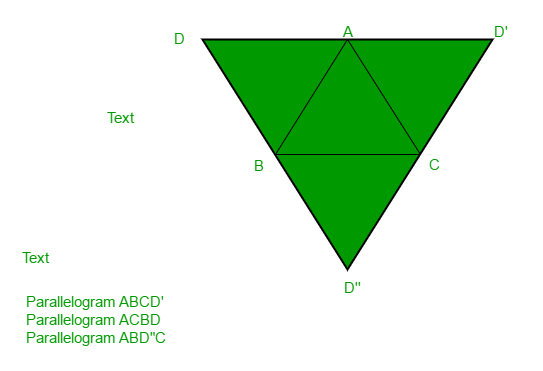
As shown in below diagram, there can be multiple possible outputs, we need to print any one of them.
A quadrilateral is said to be a parallelogram if its opposite sides are parallel and equal in length.
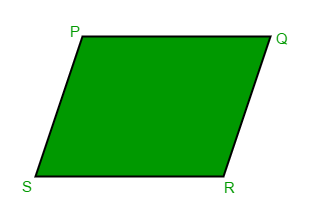
As we're given three points of the parallelogram, we can find the slope of the missing sides as well as their lengths.
The algorithm can be explained as follows
Let R be the missing point. Now from definition, we have
- Length of PR = Length of QS = L1 (Opposite sides are equal)
- Slope of PR = Slope of QS = M1 (Opposite sides are parallel)
- Length of PQ = Length of RS = L2 (Opposite sides are equal)
- Slope of PQ= Slope of RS = M2 (Opposite sides are parallel)
Thus we can find the points at a distance L1 from P having slope M1 as mentioned in below article :
Find points at a given distance on a line of given slope.
Now one of the points will satisfy the above conditions which can easily be checked (using either condition 3 or 4)
Below is the implementation of the above approach:

C++ `
// C++ program to find missing point of a // parallelogram #include <bits/stdc++.h> using namespace std;
// struct to represent a co-ordinate point struct Point { float x, y; Point() { x = y = 0; } Point(float a, float b) { x = a, y = b; } };
// given a source point, slope(m) of line // passing through it this function calculates // and return two points at a distance l away // from the source pair<Point, Point> findPoints(Point source, float m, float l) { Point a, b;
// slope is 0
if (m == 0) {
    a.x = source.x + l;
    a.y = source.y;

    b.x = source.x - l;
    b.y = source.y;
}

// slope if infinity
else if (m == std::numeric_limits<float>::max()) {
    a.x = source.x;
    a.y = source.y + l;

    b.x = source.x;
    b.y = source.y - l;
}

// normal case
else {
    float dx = (l / sqrt(1 + (m * m)));
    float dy = m * dx;
    a.x = source.x + dx, a.y = source.y + dy;
    b.x = source.x - dx, b.y = source.y - dy;
}

return pair<Point, Point>(a, b);
}
// given two points, this function calculates // the slope of the line/ passing through the // points float findSlope(Point p, Point q) { if (p.y == q.y) return 0; if (p.x == q.x) return std::numeric_limits::max(); return (q.y - p.y) / (q.x - p.x); }
// calculates the distance between two points float findDistance(Point p, Point q) { return sqrt(pow((q.x - p.x), 2) + pow((q.y - p.y), 2)); }
// given three points, it prints a point such // that a parallelogram is formed void findMissingPoint(Point a, Point b, Point c) { // calculate points originating from a pair<Point, Point> d = findPoints(a, findSlope(b, c), findDistance(b, c));
// now check which of the two points satisfy
// the conditions
if (findDistance(d.first, c) == findDistance(a, b))
    cout << d.first.x << ", " << d.first.y << endl;
else
    cout << d.second.x << ", " << d.second.y << endl;
}
// Driver code int main() { findMissingPoint(Point(1, 0), Point(1, 1), Point(0, 1)); findMissingPoint(Point(5, 0), Point(1, 1), Point(2, 5)); return 0; }
Java
// Java program to find missing point of a // parallelogram import java.util.*;
// struct to represent a co-ordinate point class Point { public double x, y; public Point() { x = 0; y = 0; }
public Point(double a, double b) { x = a; y = b; } };
class GFG { // given a source point, slope(m) of line // passing through it this function calculates // and return two points at a distance l away // from the source static Point[] findPoints(Point source, double m, double l) { Point a = new Point(); Point b = new Point();
// slope is 0
if (m == 0) {
  a.x = source.x + l;
  a.y = source.y;

  b.x = source.x - l;
  b.y = source.y;
}

// slope if infinity
else if (m == Double.MAX_VALUE) {
  a.x = source.x;
  a.y = source.y + l;

  b.x = source.x;
  b.y = source.y - l;
}

// normal case
else {
  double dx = (l / Math.sqrt(1 + (m * m)));
  double dy = m * dx;
  a.x = source.x + dx;
  a.y = source.y + dy;
  b.x = source.x - dx;
  b.y = source.y - dy;
}

Point[] res = { a, b };
return res;
}
// given two points, this function calculates // the slope of the line/ passing through the // points static double findSlope(Point p, Point q) { if (p.y == q.y) return 0; if (p.x == q.x) return Double.MAX_VALUE; return (q.y - p.y) / (q.x - p.x); }
// calculates the distance between two points static double findDistance(Point p, Point q) { return Math.sqrt(Math.pow((q.x - p.x), 2) + Math.pow((q.y - p.y), 2)); }
// given three points, it prints a point such // that a parallelogram is formed static void findMissingPoint(Point a, Point b, Point c) { // calculate points originating from a Point[] d = findPoints(a, findSlope(b, c), findDistance(b, c));
// now check which of the two points satisfy
// the conditions
if (findDistance(d[0], c) == findDistance(a, b))
  System.out.println(d[0].x + ", " + d[0].y);
else
  System.out.println(d[1].x + ", " + d[1].y);
}
// Driver code public static void main(String[] args) { findMissingPoint(new Point(1, 0), new Point(1, 1), new Point(0, 1)); findMissingPoint(new Point(5, 0), new Point(1, 1), new Point(2, 5)); } }
// This code is contributed by phasing17
Python3
Python program to find missing point of a
parallelogram
import math as Math FLOAT_MAX = 3.40282e+38
given a source point, slope(m) of line
passing through it this function calculates
and return two points at a distance l away
from the source
def findPoints(source, m, l): a = [0] * (2) b = [0] * (2)
# slope is 0
if (m == 0):
    a[0] = source[0] + l
    a[1] = source[1]

    b[0] = source[0] - l
    b[1] = source[1]
# slope if infinity
elif (m == FLOAT_MAX):
    a[0] = source[0]
    a[1] = source[1] + l

    b[0] = source[0]
    b[1] = source[1] - l
# normal case
else:
    dx = (l / ((1 + (m * m)) ** 0.5))
    dy = m * dx
    a[0] = source[0] + dx
    a[1] = source[1] + dy
    b[0] = source[0] - dx
    b[1] = source[1] - dy

return [a, b]
given two points, this function calculates
the slope of the line/ passing through the
points
def findSlope(p, q): if (p[1] == q[1]): return 0 if (p[0] == q[0]): return FLOAT_MAX return (q[1] - p[1]) / (q[0] - p[0])
calculates the distance between two points
def findDistance(p, q): return Math.sqrt(Math.pow((q[0] - p[0]), 2) + Math.pow((q[1] - p[1]), 2))
given three points, it prints a point such
that a parallelogram is formed
def findMissingPoint(a, b, c): # calculate points originating from a d = findPoints(a, findSlope(b, c), findDistance(b, c))
# now check which of the two points satisfy
# the conditions
if (findDistance(d[0], c) == findDistance(a, b)):
    print(f"{(int)(d[0][0])}, {(int)(d[0][1])}")

else:
    print(f"{(int)(d[1][0])}, {(int)(d[1][1])}")
Driver code
Point1 = [1, 0] Point2 = [1, 1] Point3 = [0, 1] findMissingPoint(Point1, Point2, Point3)
Point1 = [5, 0] Point2 = [1, 1] Point3 = [2, 5] findMissingPoint(Point1, Point2, Point3)
The code is contributed by Saurabh Jaiswal
C#
// C# program to find missing point of a // parallelogram using System; using System.Collections.Generic;
// struct to represent a co-ordinate point class Point { public double x, y; public Point() { x = 0; y = 0; }
public Point(double a, double b) { x = a; y = b; } };
class GFG {
// given a source point, slope(m) of line // passing through it this function calculates // and return two points at a distance l away // from the source static Point[] findPoints(Point source, double m, double l) { Point a = new Point(); Point b = new Point();
// slope is 0
if (m == 0) {
  a.x = source.x + l;
  a.y = source.y;

  b.x = source.x - l;
  b.y = source.y;
}

// slope if infinity
else if (m == Double.MaxValue) {
  a.x = source.x;
  a.y = source.y + l;

  b.x = source.x;
  b.y = source.y - l;
}

// normal case
else {
  double dx = (l / Math.Sqrt(1 + (m * m)));
  double dy = m * dx;
  a.x = source.x + dx;
  a.y = source.y + dy;
  b.x = source.x - dx;
  b.y = source.y - dy;
}

Point[] res = { a, b };
return res;
}
// given two points, this function calculates // the slope of the line/ passing through the // points static double findSlope(Point p, Point q) { if (p.y == q.y) return 0; if (p.x == q.x) return Double.MaxValue; return (q.y - p.y) / (q.x - p.x); }
// calculates the distance between two points static double findDistance(Point p, Point q) { return Math.Sqrt(Math.Pow((q.x - p.x), 2) + Math.Pow((q.y - p.y), 2)); }
// given three points, it prints a point such // that a parallelogram is formed static void findMissingPoint(Point a, Point b, Point c) { // calculate points originating from a Point[] d = findPoints(a, findSlope(b, c), findDistance(b, c));
// now check which of the two points satisfy
// the conditions
if (findDistance(d[0], c) == findDistance(a, b))
  Console.WriteLine(d[0].x + ", " + d[0].y);
else
  Console.WriteLine(d[1].x + ", " + d[1].y);
}
// Driver code public static void Main(string[] args) { findMissingPoint(new Point(1, 0), new Point(1, 1), new Point(0, 1)); findMissingPoint(new Point(5, 0), new Point(1, 1), new Point(2, 5)); } }
// This code is contributed by phasing17
JavaScript
// JavaScript program to find missing point of a // parallelogram
const FLOAT_MAX = 3.40282e+38;
// given a source point, slope(m) of line // passing through it this function calculates // and return two points at a distance l away // from the source function findPoints(source, m, l) { let a = new Array(2); let b = new Array(2);
// slope is 0
if (m == 0) {
    a[0] = source[0] + l;
    a[1] = source[1];

    b[0] = source[0] - l;
    b[1] = source[1];
}
// slope if infinity
else if (m == FLOAT_MAX) {
    a[0] = source[0];
    a[1] = source[1] + l;

    b[0] = source[0];
    b[1] = source[1] - l;
}
// normal case
else {
    let dx = (l / Math.sqrt(1 + (m * m)));
    let dy = m * dx;
    a[0] = source[0] + dx, a[1] = source[1] + dy;
    b[0] = source[0] - dx, b[1] = source[1] - dy;
}

return [a, b];
}
// given two points, this function calculates // the slope of the line/ passing through the // points function findSlope(p, q) { if (p[1] == q[1]){ return 0; } if (p[0] == q[0]){ return FLOAT_MAX; } return (q[1] - p[1]) / (q[0] - p[0]); }
// calculates the distance between two points function findDistance(p, q) { return Math.sqrt(Math.pow((q[0] - p[0]), 2) + Math.pow((q[1] - p[1]), 2)); }
// given three points, it prints a point such // that a parallelogram is formed function findMissingPoint(a, b, c) { // calculate points originating from a let d = findPoints(a, findSlope(b, c), findDistance(b, c));
// now check which of the two points satisfy
// the conditions
if (findDistance(d[0], c) === findDistance(a, b)){
    console.log(d[0][0], ",", d[0][1]);
}
else{
    console.log(d[1][0], ",", d[1][1]);
}
}
// Driver code { let Point1 = [1, 0]; let Point2 = [1, 1]; let Point3 = [0, 1]; findMissingPoint(Point1, Point2, Point3);
Point1 = [5, 0];
Point2 = [1, 1];
Point3 = [2, 5];
findMissingPoint(Point1, Point2, Point3);
}
// The code is contributed by Gautam goel (gautamgoel962)
`
Output :
0, 0 6, 4
Time Complexity: O(log(log n)) since using inbuilt sqrt and log functions
Auxiliary Space: O(1)
Alternative Approach:
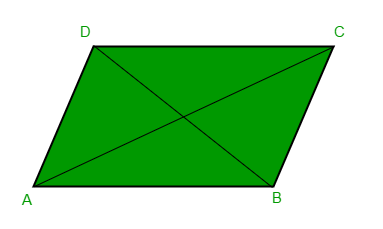
Since the opposite sides are equal, AD = BC and AB = CD, we can calculate the co-ordinates of the missing point (D) as:
AD = BC (Dx - Ax, Dy - Ay) = (Cx - Bx, Cy - By) Dx = Ax + Cx - Bx Dy = Ay + Cy - By
References: https://math.stackexchange.com/questions/887095/find-the-4th-vertex-of-the-parallelogram
Below is the implementation of above approach:
C++ `
// C++ program to find missing point // of a parallelogram #include <bits/stdc++.h> using namespace std;
// main method int main() { int ax = 5, ay = 0; //coordinates of A int bx = 1, by = 1; //coordinates of B int cx = 2, cy = 5; //coordinates of C cout << ax + cx - bx << ", " << ay + cy - by; return 0; }
Java
// Java program to // find missing point // of a parallelogram import java.io.*;
class GFG { public static void main (String[] args) {
int ax = 5, ay = 0; //coordinates of A
int bx = 1, by = 1; //coordinates of B
int cx = 2, cy = 5; //coordinates of C
System.out.println(ax + (cx - bx) + ", " +
                   ay + (cy - by));
} }
// This code is contributed by m_kit
Python 3
Python 3 program to find missing point
of a parallelogram
Main method
if name == "main":
# coordinates of A

ax, ay = 5, 0

# coordinates of B

bx ,by = 1, 1

# coordinates of C

cx ,cy = 2, 5

print(ax + cx - bx , ",", ay + cy - by)
This code is contributed by Smitha
C#
// C# program to // find missing point // of a parallelogram using System;
class GFG { static public void Main () { int ax = 5, ay = 0; //coordinates of A int bx = 1, by = 1; //coordinates of B int cx = 2, cy = 5; //coordinates of C Console.WriteLine(ax + (cx - bx) + ", " + ay + (cy - by)); } }
// This code is contributed by ajit
PHP
JavaScript
`
Output:
6, 4
Time Complexity: O(1)
Auxiliary Space: O(1)