Find all possible coordinates of parallelogram (original) (raw)
Last Updated : 5 Feb, 2024
Find all the possible coordinates from the three coordinates to make a parallelogram of a non-zero area.
Let's call A, B, and C are the three given points. We can have only the three possible situations:
(1) AB and AC are sides, and BC a diagonal
(2) AB and BC are sides, and AC a diagonal
(3) BC and AC are sides, and AB a diagonal
Hence, we can say that only 3 coordinates are possible from which we can generate a parallelogram if three coordinates are given.
To prove that all three points are different let's suppose it's wrong. Without losing of generality suppose that the points got in cases AD and BC are equal.
Consider the system of two equations for the equality of these points:
Bx + Cx - Ax = Ax + Cx - Bx
By + Cy - Ay = Ay + Cy - By
It can be simplified as-
Ax = Bx
Ay = By
And we got a contradiction, as all the points A, B, C are distinct.
**Examples:
Input : A = (0 0)
B = (1 0)
C = (0 1)
Output : 1 -1
-1 1
1 1
Input : A = (-1 -1)
B = (0 1)
C = (1 1)
Output : -2 -1
0 -1
2 3
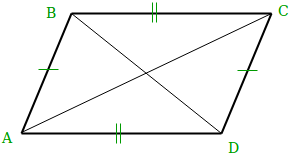
Since the opposite sides are equal, AD = BC and AB = CD, we can calculate the co-ordinates of the missing point (D) as:
**AD = BC
(Dx - Ax, Dy - Ay) = (Cx - Bx, Cy - By)
Dx = Ax + Cx - Bx
Dy = Ay + Cy - By
The cases where the diagonals are AD and BC, CD and AB are processed in the same way.
**Reference: https://math.stackexchange.com/questions/1322535/how-many-different-parallelograms-can-be-drawn-if-given-three-co-ordinates-in-3d
Below is the implementation of above approach:
C++ `
// C++ program to all possible points // of a parallelogram #include <bits/stdc++.h> using namespace std;
// main method int main() { int ax = 5, ay = 0; //coordinates of A int bx = 1, by = 1; //coordinates of B int cx = 2, cy = 5; //coordinates of C cout << ax + bx - cx << ", " << ay + by - cy <<endl; cout << ax + cx - bx << ", " << ay + cy - by <<endl; cout << cx + bx - ax << ", " << cy + by - ax <<endl; return 0; }
Java
// Java program to all possible // points of a parallelogram public class ParallelogramPoints{
// Driver code
public static void main(String[] s)
{
    int ax = 5, ay = 0; //coordinates of A
    int bx = 1, by = 1; //coordinates of B
    int cx = 2, cy = 5; //coordinates of C
    System.out.println(ax + bx - cx + ", "
                       + (ay + by - cy));
    System.out.println(ax + cx - bx + ", "
                       + (ay + cy - by));
    System.out.println(cx + bx - ax + ", "
                       + (cy + by - ax));
}
}
// This code is contributed by Prerna Saini
Python3
Python3 program to find all possible points
of a parallelogram
ax = 5 ay = 0 #coordinates of A bx = 1 by = 1 #coordinates of B cx = 2 cy = 5 #coordinates of C print(ax + bx - cx, ", ", ay + by - cy) print(ax + cx - bx, ", ", ay + cy - by) print(cx + bx - ax, ", ", cy + by - ax)
C#
// C# program to all possible // points of a parallelogram using System;
public class ParallelogramPoints {
// Driver code
public static void Main()
{

    //coordinates of A
    int ax = 5, ay = 0;

    //coordinates of B
    int bx = 1, by = 1;

    //coordinates of C
    int cx = 2, cy = 5;

    Console.WriteLine(ax + bx - cx + ", "
                    + (ay + by - cy));
    Console.WriteLine(ax + cx - bx + ", "
                    + (ay + cy - by));
    Console.WriteLine(cx + bx - ax + ", "
                    + (cy + by - ax));
}
}
// This code is contributed by vt_m.
JavaScript
PHP
`
**Time Complexity: O(1)
**Auxiliary Space: O(1)
Please suggest if someone has a better solution which is more efficient in terms of space and time.