Shortest Safe route in a Matrix (original) (raw)
Given a 2D binary matrix **mat[][] where 0 represents a landmine and 1 represents a safe cell, find the length of the shortest safe route from any cell in the first column to any cell in the last column.
You can move only up, down, left, or right, and can enter only safe cells (cells that are neither landmines nor adjacent to a landmine). If there is no safe path to reach the last column, return -1.
**Examples:
**Input: mat[][] = [ [1, 0, 1, 1, 1],
[1, 1, 1, 1, 1],
[1, 1, 1, 1, 1],
[1, 1, 1, 0, 1],
[1, 1, 1, 1, 0] ]
**Output: 6
**Explanation: The shortest safe path starts from the first column (row 2, column 0) and reaches the last column (row 1, column 4) with length 6.
**Input: mat[][] = [ [1, 1, 1, 1, 1],
[1, 1, 0, 1, 1],
[1, 1, 1, 1, 1] ]
**Output: -1
**Explanation: There is no possible path from first column to last column.
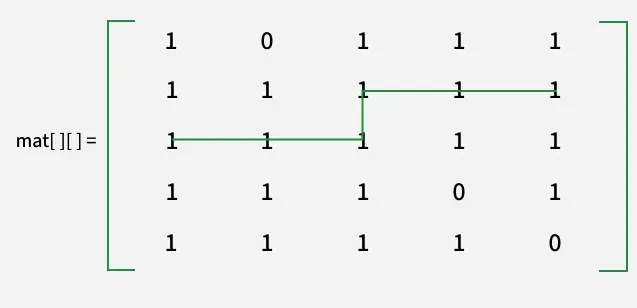
Table of Content
- [Naive Approach] Using Backtracking - O(4^(n*m)) Time and O(n*m) Space
- [Expected Approach] Using Breadth-First Search - O(n*m) Time and O(n*m) Space
[Naive Approach] Using Backtracking - O(4(n*m)) Time and O(n*m) Space
The idea is to use Backtracking. We first mark all adjacent cells of the landmines as unsafe. Then for each safe cell of first column of the matrix, we move forward in all allowed directions and recursively checks if they leads to the destination or not. If destination is found, we update the value of shortest path else if none of the above solutions work we return false from our function.
C++ `
//Driver Code Starts #include #include #include #include using namespace std;
//Driver Code Ends
// Function to mark unsafe cells (landmines and their adjacent cells) void markUnsafeCells(vector<vector> &mat) { int r = mat.size(); int c = mat[0].size();
// Directions for adjacent cells: up, down, left, right
int row[] = {-1, 1, 0, 0};
int col[] = {0, 0, -1, 1};


vector<vector<int>> temp = mat;

// Mark adjacent cells of landmines (0) as unsafe (0)
for (int i = 0; i < r; i++) {
    for (int j = 0; j < c; j++) {
        if (temp[i][j] == 0) {
            for (int k = 0; k < 4; k++) {
                int ni = i + row[k];
                int nj = j + col[k];
                if (ni >= 0 && ni < r && nj >= 0 && nj < c) {
                    mat[ni][nj] = 0;
                }
            }
        }
    }
}
}
// DFS to find shortest path from (i, j) to any cell in last column int dfs(vector<vector> &mat, vector<vector> &visited, int i, int j, int c) { int r = mat.size();
if (i < 0 || i >= r || j < 0 || j >= c || mat[i][j] == 0 || visited[i][j]) {
    return INT_MAX;
}

if (j == c - 1) {
    return 1;
}

visited[i][j] = true;

// Four possible moves: up, down, left, right
int row[] = {-1, 1, 0, 0};
int col[] = {0, 0, -1, 1};

int minPath = INT_MAX;

// Try all four directions
for (int k = 0; k < 4; k++) {
    int ni = i + row[k];
    int nj = j + col[k];

    int pathLength = dfs(mat, visited, ni, nj, c);
    if (pathLength != INT_MAX) {
        minPath = min(minPath, 1 + pathLength);
    }
}

// Backtrack - unmark current cell
visited[i][j] = false;

return minPath;
}
int shortestPath(vector<vector> &mat) { int r = mat.size(); int c = mat[0].size();
// Mark all adjacent cells of landmines as unsafe
markUnsafeCells(mat);

// Initialize visited array
vector<vector<bool>> visited(r, vector<bool>(c, false));

int minPath = INT_MAX;

// Try starting from each safe cell in the first column
for (int i = 0; i < r; i++) {
    if (mat[i][0] == 1) {
        int pathLength = dfs(mat, visited, i, 0, c);
        if (pathLength != INT_MAX) {
            minPath = min(minPath, pathLength);
        }
    }
}

return minPath == INT_MAX ? -1 : minPath;
}
//Driver Code Starts
int main() { vector<vector> mat = { {1, 0, 1, 1, 1}, {1, 1, 1, 1, 1}, {1, 1, 1, 1, 1}, {1, 1, 1, 0, 1}, {1, 1, 1, 1, 0} };
int result = shortestPath(mat);
cout << result << endl;

return 0;
} //Driver Code Ends
Java
//Driver Code Starts import java.util.Arrays;
class GFG {
//Driver Code Ends
// Function to mark unsafe cells (landmines and their adjacent cells)
static void markUnsafeCells(int[][] mat) {
    int r = mat.length;
    int c = mat[0].length;


    int[] row = {-1, 1, 0, 0};
    int[] col = {0, 0, -1, 1};

    int[][] temp = new int[r][c];
    for (int i = 0; i < r; i++) {
        for (int j = 0; j < c; j++) {
            temp[i][j] = mat[i][j];
        }
    }

    // Mark adjacent cells of landmines (0) as unsafe (0)
    for (int i = 0; i < r; i++) {
        for (int j = 0; j < c; j++) {
            if (temp[i][j] == 0) {
                for (int k = 0; k < 4; k++) {
                    int ni = i + row[k];
                    int nj = j + col[k];
                    if (ni >= 0 && ni < r && nj >= 0 && nj < c) {
                        mat[ni][nj] = 0;
                    }
                }
            }
        }
    }
}

// DFS to find shortest path from (i, j) to any cell in last column
static int dfs(int[][] mat, boolean[][] visited, int i, int j, int c) {
    int r = mat.length;

    // If out of bounds, blocked, or visited
    if (i < 0 || i >= r || j < 0 || j >= c || mat[i][j] == 0 || visited[i][j]) {
        return Integer.MAX_VALUE;
    }

    if (j == c - 1) {
        return 1;
    }

    visited[i][j] = true;

    int[] row = {-1, 1, 0, 0};
    int[] col = {0, 0, -1, 1};

    int minPath = Integer.MAX_VALUE;

    // Try all four directions
    for (int k = 0; k < 4; k++) {
        int ni = i + row[k];
        int nj = j + col[k];

        int pathLength = dfs(mat, visited, ni, nj, c);
        if (pathLength != Integer.MAX_VALUE) {
            minPath = Math.min(minPath, 1 + pathLength);
        }
    }

    // Backtrack - unmark current cell
    visited[i][j] = false;

    return minPath;
}

static int shortestPath(int[][] mat) {
    int r = mat.length;
    int c = mat[0].length;

    // Mark all adjacent cells of landmines as unsafe
    markUnsafeCells(mat);

    boolean[][] visited = new boolean[r][c];

    int minPath = Integer.MAX_VALUE;

    // Try starting from each safe cell in the first column
    for (int i = 0; i < r; i++) {
        if (mat[i][0] == 1) {
            int pathLength = dfs(mat, visited, i, 0, c);
            if (pathLength != Integer.MAX_VALUE) {
                minPath = Math.min(minPath, pathLength);
            }
        }
    }

    return minPath == Integer.MAX_VALUE ? -1 : minPath;
}
//Driver Code Starts public static void main(String[] args) { int[][] mat = { {1, 0, 1, 1, 1}, {1, 1, 1, 1, 1}, {1, 1, 1, 1, 1}, {1, 1, 1, 0, 1}, {1, 1, 1, 1, 0} };
    int result = shortestPath(mat);
    System.out.println(result);
}
} //Driver Code Ends
Python
#Driver Code Starts import sys
#Driver Code Ends
Function to mark unsafe cells (landmines and their adjacent cells)
def markUnsafeCells(mat): r = len(mat) c = len(mat[0])
# Directions for adjacent cells: up, down, left, right
row_dir = [-1, 1, 0, 0]
col_dir = [0, 0, -1, 1]

temp = [row[:] for row in mat]

# Mark adjacent cells of landmines (0) as unsafe (0)
for i in range(r):
    for j in range(c):
        if temp[i][j] == 0:
            for k in range(4):
                ni = i + row_dir[k]
                nj = j + col_dir[k]
                if 0 <= ni < r and 0 <= nj < c:
                    mat[ni][nj] = 0
DFS to find shortest path from (i, j) to any cell in last column
def dfs(mat, visited, i, j, c): r = len(mat)
# If out of bounds, blocked, or already visited
if i < 0 or i >= r or j < 0 or j >= c or mat[i][j] == 0 or visited[i][j]:
    return sys.maxsize

# If last column reached
if j == c - 1:
    return 1

visited[i][j] = True

# Four possible moves: up, down, left, right
row_dir = [-1, 1, 0, 0]
col_dir = [0, 0, -1, 1]

minPath = sys.maxsize

# Explore all four directions
for k in range(4):
    ni = i + row_dir[k]
    nj = j + col_dir[k]

    pathLength = dfs(mat, visited, ni, nj, c)
    if pathLength != sys.maxsize:
        minPath = min(minPath, 1 + pathLength)

# Backtrack - unmark current cell
visited[i][j] = False

return minPath
def shortestPath(mat): r = len(mat) c = len(mat[0])
# Mark all adjacent cells of landmines as unsafe
markUnsafeCells(mat)

# Initialize visited array
visited = [[False] * c for _ in range(r)]

minPath = sys.maxsize

# Try starting from each safe cell in the first column
for i in range(r):
    if mat[i][0] == 1:
        pathLength = dfs(mat, visited, i, 0, c)
        if pathLength != sys.maxsize:
            minPath = min(minPath, pathLength)

return -1 if minPath == sys.maxsize else minPath
#Driver Code Starts if name == "main": mat = [ [1, 0, 1, 1, 1], [1, 1, 1, 1, 1], [1, 1, 1, 1, 1], [1, 1, 1, 0, 1], [1, 1, 1, 1, 0] ]
result = shortestPath(mat)
print(result)
#Driver Code Ends
C#
using System;
class GFG {
// Function to mark unsafe cells (landmines and their adjacent cells)
static void markUnsafeCells(int[,] mat) {
    int r = mat.GetLength(0);
    int c = mat.GetLength(1);

    // Directions for adjacent cells: up, down, left, right
    int[] rowDir = {-1, 1, 0, 0};
    int[] colDir = {0, 0, -1, 1};

    int[,] temp = new int[r, c];
    for (int i = 0; i < r; i++)
        for (int j = 0; j < c; j++)
            temp[i, j] = mat[i, j];

    // Mark adjacent cells of landmines (0) as unsafe (0)
    for (int i = 0; i < r; i++) {
        for (int j = 0; j < c; j++) {
            if (temp[i, j] == 0) {
                for (int k = 0; k < 4; k++) {
                    int ni = i + rowDir[k];
                    int nj = j + colDir[k];
                    if (ni >= 0 && ni < r && nj >= 0 && nj < c) {
                        mat[ni, nj] = 0;
                    }
                }
            }
        }
    }
}

// DFS to find shortest path from (i, j) to any cell in last column
static int dfs(int[,] mat, bool[,] visited, int i, int j, int c) {
    int r = mat.GetLength(0);

    // If out of bounds, blocked, or already visited
    if (i < 0 || i >= r || j < 0 || j >= c || mat[i, j] == 0 || visited[i, j])
        return int.MaxValue;

    // If last column reached
    if (j == c - 1)
        return 1;

    visited[i, j] = true;

    int[] rowDir = {-1, 1, 0, 0};
    int[] colDir = {0, 0, -1, 1};

    int minPath = int.MaxValue;

    // Explore all four directions
    for (int k = 0; k < 4; k++) {
        int ni = i + rowDir[k];
        int nj = j + colDir[k];

        int pathLength = dfs(mat, visited, ni, nj, c);
        if (pathLength != int.MaxValue)
            minPath = Math.Min(minPath, 1 + pathLength);
    }

    // Backtrack - unmark current cell
    visited[i, j] = false;

    return minPath;
}

static int shortestPath(int[,] mat) {
    int r = mat.GetLength(0);
    int c = mat.GetLength(1);

    // Mark all adjacent cells of landmines as unsafe
    markUnsafeCells(mat);

    bool[,] visited = new bool[r, c];
    int minPath = int.MaxValue;

    // Try starting from each safe cell in the first column
    for (int i = 0; i < r; i++) {
        if (mat[i, 0] == 1) {
            int pathLength = dfs(mat, visited, i, 0, c);
            if (pathLength != int.MaxValue)
                minPath = Math.Min(minPath, pathLength);
        }
    }

    return minPath == int.MaxValue ? -1 : minPath;
}

public static void Main() {
    int[,] mat = {
        {1, 0, 1, 1, 1},
        {1, 1, 1, 1, 1},
        {1, 1, 1, 1, 1},
        {1, 1, 1, 0, 1},
        {1, 1, 1, 1, 0}
    };

    int result = shortestPath(mat);
    Console.WriteLine(result);
}
}
JavaScript
// Function to mark unsafe cells (landmines and their adjacent cells) function markUnsafeCells(mat) { const r = mat.length; const c = mat[0].length;
const rowDir = [-1, 1, 0, 0];
const colDir = [0, 0, -1, 1];

// Create a copy to avoid modifying original safe cells prematurely
const temp = mat.map(row => row.slice());

// Mark adjacent cells of landmines (0) as unsafe (0)
for (let i = 0; i < r; i++) {
    for (let j = 0; j < c; j++) {
        if (temp[i][j] === 0) {
            for (let k = 0; k < 4; k++) {
                const ni = i + rowDir[k];
                const nj = j + colDir[k];
                if (ni >= 0 && ni < r && nj >= 0 && nj < c) {
                    mat[ni][nj] = 0;
                }
            }
        }
    }
}
}
// DFS to find shortest path from (i, j) to any cell in last column function dfs(mat, visited, i, j, c) { const r = mat.length;
// If out of bounds, blocked, or already visited
if (i < 0 || i >= r || j < 0 || j >= c || mat[i][j] === 0 || visited[i][j]) {
    return Number.MAX_SAFE_INTEGER;
}

// If last column reached
if (j === c - 1) return 1;

visited[i][j] = true;

const rowDir = [-1, 1, 0, 0];
const colDir = [0, 0, -1, 1];

let minPath = Number.MAX_SAFE_INTEGER;

// Explore all four directions
for (let k = 0; k < 4; k++) {
    const ni = i + rowDir[k];
    const nj = j + colDir[k];

    const pathLength = dfs(mat, visited, ni, nj, c);
    if (pathLength !== Number.MAX_SAFE_INTEGER) {
        minPath = Math.min(minPath, 1 + pathLength);
    }
}

// Backtrack - unmark current cell
visited[i][j] = false;

return minPath;
}
function shortestPath(mat) { const r = mat.length; const c = mat[0].length;
markUnsafeCells(mat);

const visited = Array.from({length: r}, () => Array(c).fill(false));

let minPath = Number.MAX_SAFE_INTEGER;

// Try starting from each safe cell in the first column
for (let i = 0; i < r; i++) {
    if (mat[i][0] === 1) {
        const pathLength = dfs(mat, visited, i, 0, c);
        if (pathLength !== Number.MAX_SAFE_INTEGER) {
            minPath = Math.min(minPath, pathLength);
        }
    }
}

return minPath === Number.MAX_SAFE_INTEGER ? -1 : minPath;
}
//Driver Code Starts // Driver code const mat = [ [1, 0, 1, 1, 1], [1, 1, 1, 1, 1], [1, 1, 1, 1, 1], [1, 1, 1, 0, 1], [1, 1, 1, 1, 0] ];
const result = shortestPath(mat); console.log(result);
//Driver Code Ends
`
[Expected Approach] Using Breadth First Search - O(n*m) Time and O(n*m) Space
The idea is to use BFS to find the shortest safe path from any cell in the first column to the last column in a binary matrix. BFS is ideal here because it explores cells level by level, so the first time we reach a cell in the last column, we are guaranteed that it is via the shortest path.
For each cell we visit, we check if it is safe by ensuring it is not a landmine and none of its four neighbors is a landmine. Safe cells are added to the queue with their current distance, and we mark them visited directly in the matrix to avoid revisiting. BFS continues until a last-column cell is reached, returning its distance, or returns -1 if no safe path exists.
C++ `
//Driver Code Starts #include #include #include using namespace std;
//Driver Code Ends
// Check if a cell (i,j) is safe to step on bool isSafe(vector<vector> &mat, int i, int j) { int r = mat.size(); int c = mat[0].size();
// cell itself is a landmine or visited
if (mat[i][j] != 1) return false;

// Check all four neighbors
int rowDir[] = {-1, 1, 0, 0};
int colDir[] = {0, 0, -1, 1};

for (int k = 0; k < 4; k++) {
    int ni = i + rowDir[k];
    int nj = j + colDir[k];
    if (ni >= 0 && ni < r && nj >= 0 && nj < c && mat[ni][nj] == 0)

        // adjacent to a landmine
        return false;
}

return true;
}
// function to find shortest safe path from first column to last column int shortestPath(vector<vector> &mat) { int r = mat.size(); int c = mat[0].size();
int rowDir[] = {-1, 1, 0, 0};
int colDir[] = {0, 0, -1, 1};

// {i, j, distance}
queue<array<int,3>> q;

// Enqueue all safe cells in the first column
for (int i = 0; i < r; i++) {
    if (isSafe(mat, i, 0)) {
        q.push({i, 0, 1});

        // mark visited
        mat[i][0] = -1;
    }
}

while (!q.empty()) {
    auto front = q.front();
    q.pop();
    int i = front[0];
    int j = front[1];
    int dist = front[2];

    // Reached last column
    if (j == c - 1) return dist;

    // Explore four directions
    for (int k = 0; k < 4; k++) {
        int ni = i + rowDir[k];
        int nj = j + colDir[k];

        if (ni >= 0 && ni < r && nj >= 0 && nj < c && isSafe(mat, ni, nj)) {
            q.push({ni, nj, dist + 1});

            // mark visited
            mat[ni][nj] = -1;
        }
    }
}

// no path found
return -1;
}
//Driver Code Starts
int main() { vector<vector> mat = { {1, 0, 1, 1, 1}, {1, 1, 1, 1, 1}, {1, 1, 1, 1, 1}, {1, 1, 1, 0, 1}, {1, 1, 1, 1, 0} };
int result = shortestPath(mat);
cout << result << endl;

return 0;
}
//Driver Code Ends
Java
//Driver Code Starts import java.util.ArrayDeque; import java.util.Deque;
class GFG {
//Driver Code Ends
// Check if a cell (i,j) is safe to step on
static boolean isSafe(int[][] mat, int i, int j) {
    int r = mat.length;
    int c = mat[0].length;

    // cell itself is a landmine or visited
    if (mat[i][j] != 1) return false;

    // Check all four neighbors
    int[] rowDir = {-1, 1, 0, 0};
    int[] colDir = {0, 0, -1, 1};

    for (int k = 0; k < 4; k++) {
        int ni = i + rowDir[k];
        int nj = j + colDir[k];
        if (ni >= 0 && ni < r && nj >= 0 && nj < c && mat[ni][nj] == 0)

            // adjacent to a landmine
            return false;
    }
    return true;
}

// Function to find shortest safe path
// from first column to last column
static int shortestPath(int[][] mat) {
    int r = mat.length;
    int c = mat[0].length;

    int[] rowDir = {-1, 1, 0, 0};
    int[] colDir = {0, 0, -1, 1};

    // {i, j, distance}
    Deque<int[]> q = new ArrayDeque<>();

    // Enqueue all safe cells in the first column
    for (int i = 0; i < r; i++) {
        if (isSafe(mat, i, 0)) {
            q.add(new int[]{i, 0, 1});
            mat[i][0] = -1; // mark visited
        }
    }

    while (!q.isEmpty()) {
        int[] front = q.poll();
        int i = front[0], j = front[1], dist = front[2];

        // Reached last column
        if (j == c - 1) return dist;

        // Explore four directions
        for (int k = 0; k < 4; k++) {
            int ni = i + rowDir[k];
            int nj = j + colDir[k];
            if (ni >= 0 && ni < r && nj >= 0 && nj < c
                                && isSafe(mat, ni, nj)) {
                q.add(new int[]{ni, nj, dist + 1});
                mat[ni][nj] = -1;
            }
        }
    }

    // No path found
    return -1;
}
//Driver Code Starts
public static void main(String[] args) {
    int[][] mat = {
        {1, 0, 1, 1, 1},
        {1, 1, 1, 1, 1},
        {1, 1, 1, 1, 1},
        {1, 1, 1, 0, 1},
        {1, 1, 1, 1, 0}
    };

    int result = shortestPath(mat);
    System.out.println(result);
}
}
//Driver Code Ends
Python
#Driver Code Starts from collections import deque
#Driver Code Ends
Check if a cell (i,j) is safe to step on
def isSafe(mat, i, j): r, c = len(mat), len(mat[0])
# cell itself is a landmine or visited
if mat[i][j] != 1:
    return False

# Check all four neighbors
rowDir = [-1, 1, 0, 0]
colDir = [0, 0, -1, 1]

for k in range(4):
    ni, nj = i + rowDir[k], j + colDir[k]
    if 0 <= ni < r and 0 <= nj < c and mat[ni][nj] == 0:

        # adjacent to a landmine
        return False
return True
Function to find shortest safe path
from first column to last column
def shortestPath(mat): r, c = len(mat), len(mat[0]) rowDir = [-1, 1, 0, 0] colDir = [0, 0, -1, 1]
q = deque()  # stores [i, j, distance]

# Enqueue all safe cells in the first column
for i in range(r):
    if isSafe(mat, i, 0):
        q.append([i, 0, 1])
        mat[i][0] = -1

while q:
    i, j, dist = q.popleft()

    # Reached last column
    if j == c - 1:
        return dist

    # Explore four directions
    for k in range(4):
        ni, nj = i + rowDir[k], j + colDir[k]
        if 0 <= ni < r and 0 <= nj < c and isSafe(mat, ni, nj):
            q.append([ni, nj, dist + 1])
            mat[ni][nj] = -1

# No path found
return -1
#Driver Code Starts
if name == "main": mat = [ [1, 0, 1, 1, 1], [1, 1, 1, 1, 1], [1, 1, 1, 1, 1], [1, 1, 1, 0, 1], [1, 1, 1, 1, 0] ]
result = shortestPath(mat)
print(result)
#Driver Code Ends
C#
//Driver Code Starts using System; using System.Collections.Generic;
class GFG {
//Driver Code Ends
// Check if a cell (i,j) is safe to step on
static bool isSafe(int[,] mat, int i, int j) {
    int r = mat.GetLength(0);
    int c = mat.GetLength(1);

    // cell itself is a landmine or visited
    if (mat[i, j] != 1) return false;

    int[] rowDir = {-1, 1, 0, 0};
    int[] colDir = {0, 0, -1, 1};

    for (int k = 0; k < 4; k++) {
        int ni = i + rowDir[k];
        int nj = j + colDir[k];
        if (ni >= 0 && ni < r && nj >= 0 && nj < c && mat[ni, nj] == 0)

            // adjacent to a landmine
            return false;
    }
    return true;
}

// Function to find shortest safe path
// from first column to last column
static int shortestPath(int[,] mat) {
    int r = mat.GetLength(0);
    int c = mat.GetLength(1);

    int[] rowDir = {-1, 1, 0, 0};
    int[] colDir = {0, 0, -1, 1};

    // {i, j, distance}
    Queue<int[]> q = new Queue<int[]>();

    // Enqueue all safe cells in the first column
    for (int i = 0; i < r; i++) {
        if (isSafe(mat, i, 0)) {
            q.Enqueue(new int[]{i, 0, 1});

            // mark visited
            mat[i, 0] = -1;
        }
    }

    while (q.Count > 0) {
        var front = q.Dequeue();
        int i = front[0], j = front[1], dist = front[2];

        // reached last column
        if (j == c - 1) return dist;

        for (int k = 0; k < 4; k++) {
            int ni = i + rowDir[k];
            int nj = j + colDir[k];
            if (ni >= 0 && ni < r && nj >= 0 && nj < c
                                && isSafe(mat, ni, nj)) {
                q.Enqueue(new int[]{ni, nj, dist + 1});

                // mark visited
                mat[ni, nj] = -1;
            }
        }
    }

    // no path found
    return -1;
}
//Driver Code Starts
static void Main() {
    int[,] mat = {
        {1, 0, 1, 1, 1},
        {1, 1, 1, 1, 1},
        {1, 1, 1, 1, 1},
        {1, 1, 1, 0, 1},
        {1, 1, 1, 1, 0}
    };

    int result = shortestPath(mat);
    Console.WriteLine(result);
}
}
//Driver Code Ends
JavaScript
const Denque = require("denque");
// Check if a cell (i,j) is safe to step on function isSafe(mat, i, j) { let r = mat.length; let c = mat[0].length;
if (mat[i][j] !== 1) return false;

let rowDir = [-1, 1, 0, 0];
let colDir = [0, 0, -1, 1];

for (let k = 0; k < 4; k++) {
    let ni = i + rowDir[k];
    let nj = j + colDir[k];
    if (ni >= 0 && ni < r && nj >= 0 && nj < c
                            && mat[ni][nj] === 0) {
        return false;
    }
}

return true;
}
// Function to find shortest safe path // from first column to last column function shortestPath(mat) { let r = mat.length; let c = mat[0].length;
let rowDir = [-1, 1, 0, 0];
let colDir = [0, 0, -1, 1];

let q = new Denque();

// Enqueue all safe cells in the first column
for (let i = 0; i < r; i++) {
    if (isSafe(mat, i, 0)) {
        q.push([i, 0, 1]);

        // mark visited
        mat[i][0] = -1;
    }
}

// BFS traversal
while (!q.isEmpty()) {
    let [i, j, dist] = q.shift();

    // Reached last column
    if (j === c - 1) return dist;

    // Explore four directions
    for (let k = 0; k < 4; k++) {
        let ni = i + rowDir[k];
        let nj = j + colDir[k];
        if (ni >= 0 && ni < r && nj >= 0 && nj < c
                                && isSafe(mat, ni, nj)) {
            q.push([ni, nj, dist + 1]);

            // mark visited
            mat[ni][nj] = -1;
        }
    }
}

// No safe path found
return -1;
}
//Driver Code Starts // Driver Code let mat = [ [1, 0, 1, 1, 1], [1, 1, 1, 1, 1], [1, 1, 1, 1, 1], [1, 1, 1, 0, 1], [1, 1, 1, 1, 0] ];
console.log(shortestPath(mat));
//Driver Code Ends
`