Finite and Infinite Recursion with examples (original) (raw)
Last Updated : 23 Jul, 2025
The process in which a function calls itself directly or indirectly is called Recursion and the corresponding function is called a Recursive function.
Using Recursion, certain problems can be solved quite easily. Examples of such problems are Towers of Hanoi (TOH), Inorder/Preorder/Postorder Tree Traversals, DFS, etc.
Types of Recursions:
Recursion can be further classified into two kinds, depending on when they terminate:
- Finite Recursion
- Infinite Recursion
Finite Recursion:
Finite Recursion occurs when the recursion terminates after a finite number of recursive calls. A recursion terminates only when a base condition is met.
Example:
Below is an implementation to demonstrate Finite Recursion.
C++ `
// C++ program to demsonstrate Finite Recursion #include <bits/stdc++.h> using namespace std;
// Recursive function void Geek(int N) { // Base condition // When this condition is met, // the recursion terminates if (N == 0) return;
// Print the current value of N
cout << N << " ";

// Call itself recursively
Geek(N - 1);
}
// Driver code int main() {
// Initial value of N
int N = 5;

// Call the recursive function
Geek(N);
return 0;
}
Java
// Java program for the above approach class GFG{
// Recursive function static void Geek(int N) {
// Base condition
// When this condition is met,
// the recursion terminates
if (N == 0)
    return;

// Print the current value of N
System.out.println(N + " ");

// Call itself recursively
Geek(N - 1);
}
// Driver code public static void main(String[] args) {
// Initial value of N
int N = 5;

// Call the recursive function
Geek(N);
} }
// This code is contributed by abhinavjain194
Python3
Python program to demsonstrate Finite Recursion
Recursive function
def Geek( N):
# Base condition
# When this condition is met,
# the recursion terminates
if (N == 0):
    return

# Pr the current value of N
print( N, end =" " )

# Call itself recursively
Geek(N - 1)
Driver code
Initial value of N
N = 5
Call the recursive function
Geek(N)
this code is contributed by shivanisinghss2110
C#
// C# program for the above approach using System; using System.Collections.Generic;
class GFG{
// Recursive function static void Geek(int N) {
// Base condition
// When this condition is met,
// the recursion terminates
if (N == 0)
    return;

// Print the current value of N
Console.Write(N + " ");

// Call itself recursively
Geek(N - 1);
}
// Driver Code public static void Main(String[] args) {
// Initial value of N
int N = 5;

// Call the recursive function
Geek(N);
} }
// This code is contributed by target_2.
JavaScript
`
Time Complexity: O(n)
Auxiliary Space: O(n)
The recursion tree for the above recursive function looks like this.
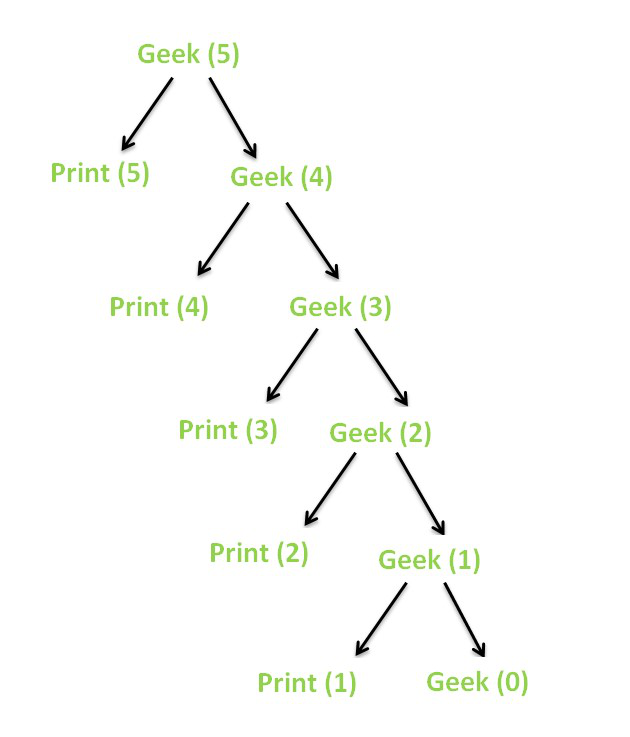
Recursion Tree
When the value of N becomes 0, because of the base condition, the recursion terminates.
Infinite Recursion:
Infinite Recursion occurs when the recursion does not terminate after a finite number of recursive calls. As the base condition is never met, the recursion carries on infinitely.
Example:
Below is an implementation to demonstrate Infinite Recursion.
C++ `
// C++ program to demsonstrate Infinite Recursion #include <bits/stdc++.h> using namespace std;
// Recursive function void Geek(int N) { // Base condition // This condition is never met here if (N == 0) return;
// Print the current value of N
cout << N << " ";

// Call itself recursively
Geek(N);
}
// Driver code int main() {
// Initial value of N
int N = 5;

// Call the recursive function
Geek(N);
return 0;
}
Java
// Java program to demsonstrate Infinite Recursion import java.io.*;
class GFG { // Recursive function static void Geek(int N) { // Base condition // This condition is never met here if (N == 0) return;
// Print the current value of N
System.out.print( N +" ");

// Call itself recursively
Geek(N);
}
// Driver code public static void main(String[] args) {
// Initial value of N
int N = 5;

// Call the recursive function
Geek(N);
}
}
// This code is contributed by shivanisinghss2110
Python3
Python3 to demsonstrate Infinite Recursion
Recursive function
def Geek(N):
# Base condition
# This condition is never met here
if (N == 0):
    return

# Print the current value of N
print(N, end = " " )

# Call itself recursively
Geek(N)
Driver code
Initial value of N
N = 5
Call the recursive function
Geek(N)
This code is contributed by shivanisinghss2110
C#
// C# program to demsonstrate Infinite Recursion using System;
class GFG { // Recursive function static void Geek(int N) { // Base condition // This condition is never met here if (N == 0) return;
// Print the current value of N
Console.Write( N +" ");

// Call itself recursively
Geek(N);
}
// Driver code public static void Main(String[] args) {
// Initial value of N
int N = 5;

// Call the recursive function
Geek(N);
}
}
// This code is contributed by shivanisinghss2110
JavaScript
`
Time Complexity: non finite as this recursion will never end.
Auxiliary Space: non finite
The recursion tree for the above recursive function looks like this.
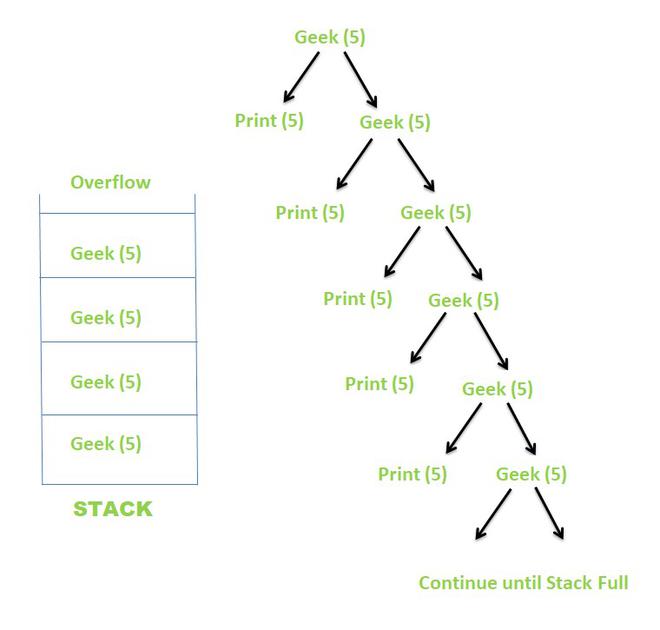
Recursion Tree
Since the value of N never becomes 0, so the recursion never terminates. Instead, the recursion continues until the implicit stack becomes full which results in a Stack Overflow. Some compilers directly give the output as Segmentation Fault (Core Dumped), while others may abnormally terminate for some value and then show Segmentation fault.