Flip Binary Tree (original) (raw)
Last Updated : 23 Oct, 2024
Given a **binary tree, the task is to flip the binary tree towards the **right direction that is **clockwise.
**Input:
**Output:
**Explanation: In the flip operation, the leftmost node becomes the root of the flipped tree and its parent becomes its right child and the right sibling becomes its left child and the same should be done for all leftmost nodes recursively.
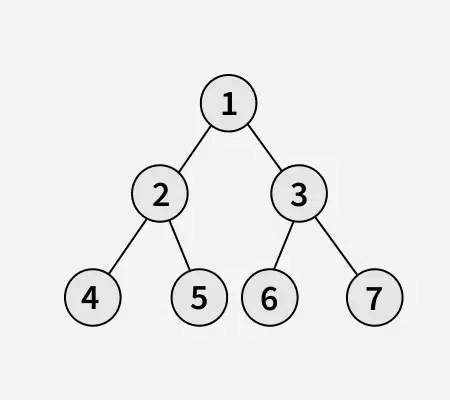
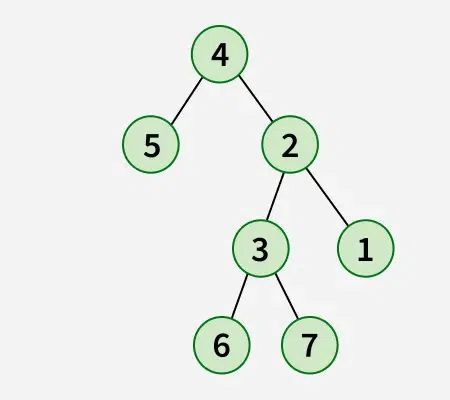
Table of Content
- [Expected Approach - 1] Using Recursion - O(n) Time and O(n) Space
- [Expected Approach - 2] Iterative Approach - O(n) Time and O(1) Space
[Expected Approach - 1] Using Recursion - O(n) Time and O(n) Space
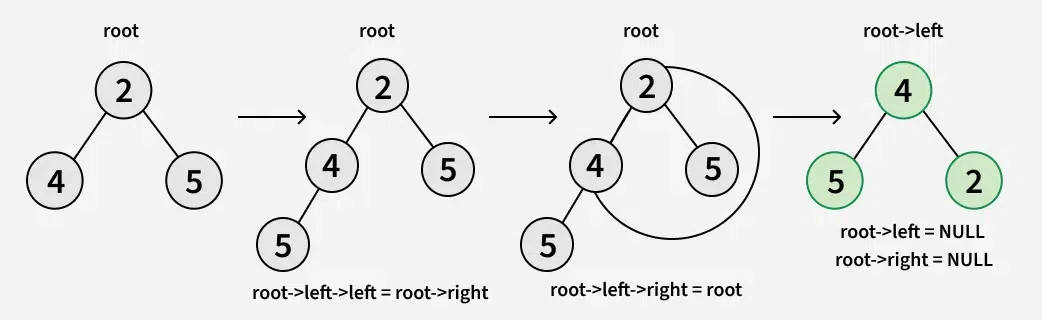
The idea is to **recursively flip the binary tree by swapping the **left and **right subtrees of each node. After flipping, the tree's structure will be reversed, and the new root of the **flipped tree will be the original leftmost leaf node.
Below is the main rotation code of a subtree:
- root->left->left = root->right
- root->left->right = root
- root->left = NULL
- root->right = NULL
Below is the implementation of the above approach:
C++ `
// C++ program to flip a binary tree // using recursion #include <bits/stdc++.h> using namespace std;
class Node { public: int data; Node *left, *right; Node(int x) { data = x; left = right = nullptr; } };
// method to flip the binary tree iteratively Node* flipBinaryTree(Node* root) {
// Base cases
if (root == nullptr)
    return root;
if (root->left == nullptr && root->right == nullptr)
    return root;

// Recursively call the same method
Node* flippedRoot = flipBinaryTree(root->left);

// Rearranging main root Node after returning
// from recursive call
root->left->left = root->right;
root->left->right = root;
root->left = root->right = nullptr;

return flippedRoot;
}
// Iterative method to do level order traversal // line by line void printLevelOrder(Node *root) {
// Base Case
if (root == nullptr)  return;

// Create an empty queue for
  // level order traversal
queue<Node *> q;

// Enqueue Root and initialize height
q.push(root);

while (1) {

    // nodeCount (queue size) indicates number
    // of nodes at current level.
    int nodeCount = q.size();
    if (nodeCount == 0)
        break;

    // Dequeue all nodes of current level and
    // Enqueue all nodes of next level
    while (nodeCount > 0) {
        Node *node = q.front();
        cout << node->data << " ";
        q.pop();
        if (node->left != nullptr)
            q.push(node->left);
        if (node->right != nullptr)
            q.push(node->right);
        nodeCount--;
    }
    cout << endl;
}
}
int main() {
  // Make a binary tree
//
 //  	  1
//       / \
//      2   3
//         / \
//        4   5
Node* root = new Node(1);
root->left = new Node(2);
root->right = new Node(3);
root->right->left = new Node(4);
root->right->right = new Node(5);


root = flipBinaryTree(root);
printLevelOrder(root);
return 0;
}
Java
// Java program to flip a binary tree // using recursion
class Node { int data; Node left, right;
Node(int x) {
    data = x;
    left = right = null;
}
}
class GfG {
// Method to flip the binary tree
static Node flipBinaryTree(Node root) {

    // Base cases
    if (root == null)
        return root;
    if (root.left == null && root.right == null)
        return root;

    // Recursively call the same method
    Node flippedRoot = flipBinaryTree(root.left);

    // Rearranging main root Node after returning
    // from recursive call
    root.left.left = root.right;
    root.left.right = root;
    root.left = root.right = null;

    return flippedRoot;
}

// Iterative method to do level order
  // traversal line by line
static void printLevelOrder(Node root) {

    // Base Case
    if (root == null) return;

    // Create an empty queue for level
      // order traversal
    java.util.Queue<Node> q = new java.util.LinkedList<>();

    // Enqueue Root and initialize height
    q.add(root);

    while (!q.isEmpty()) {

        // nodeCount (queue size) indicates
          // number of nodes at current level
        int nodeCount = q.size();

        // Dequeue all nodes of current level
          // and Enqueue all nodes of next level
        while (nodeCount > 0) {
            Node node = q.poll();
            System.out.print(node.data + " ");
            if (node.left != null)
                q.add(node.left);
            if (node.right != null)
                q.add(node.right);
            nodeCount--;
        }
        System.out.println();
    }
}

public static void main(String[] args) {

    // Make a binary tree
    //
    //  	  1
    //       / \
    //      2   3
    //         / \
    //        4   5
    Node root = new Node(1);
    root.left = new Node(2);
    root.right = new Node(3);
    root.right.left = new Node(4);
    root.right.right = new Node(5);

    root = flipBinaryTree(root);
    printLevelOrder(root);
}
}
Python
Python program to flip a binary
tree using recursion
class Node: def init(self, x): self.data = x self.left = None self.right = None
def flipBinaryTree(root):
# Base cases
if root is None:
    return root
if root.left is None and root.right is None:
    return root

# Recursively call the same method
flippedRoot = flipBinaryTree(root.left)

# Rearranging main root Node after returning
# from recursive call
root.left.left = root.right
root.left.right = root
root.left = root.right = None

return flippedRoot
Iterative method to do level order
traversal line by line
def printLevelOrder(root):
# Base Case
if root is None:
    return

# Create an empty queue for
# level order traversal
queue = []
queue.append(root)

while queue:
    nodeCount = len(queue)

    while nodeCount > 0:
        node = queue.pop(0)
        print(node.data, end=" ")
        if node.left is not None:
            queue.append(node.left)
        if node.right is not None:
            queue.append(node.right)
        nodeCount -= 1
    print()
if name == "main":
# Make a binary tree
#
#        1
#       / \
#      2   3
#         / \
#        4   5

root = Node(1)
root.left = Node(2)
root.right = Node(3)
root.right.left = Node(4)
root.right.right = Node(5)

root = flipBinaryTree(root)
printLevelOrder(root)
C#
// C# program to flip a binary tree // using recursion
using System; using System.Collections.Generic;
class Node { public int data; public Node left, right;
public Node(int x) {
    data = x;
    left = right = null;
}
}
class GfG {
// Method to flip the binary tree
static Node FlipBinaryTree(Node root) {

    if (root == null)
        return root;
    if (root.left == null && root.right == null)
        return root;

    // Recursively call the same method
    Node flippedRoot = FlipBinaryTree(root.left);

    // Rearranging main root Node after returning
    // from recursive call
    root.left.left = root.right;
    root.left.right = root;
    root.left = root.right = null;

    return flippedRoot;
}

// Iterative method to do level order
  // traversal line by line
static void PrintLevelOrder(Node root) {

    if (root == null) return;

    // Create an empty queue for level
      // order traversal
    Queue<Node> q = new Queue<Node>();

    // Enqueue Root and initialize height
    q.Enqueue(root);

    while (q.Count > 0) {

        // nodeCount (queue size) indicates
          // number of nodes at current level
        int nodeCount = q.Count;

        // Dequeue all nodes of current level
          // and Enqueue all nodes of next level
        while (nodeCount > 0) {
            Node node = q.Dequeue();
            Console.Write(node.data + " ");
            if (node.left != null)
                q.Enqueue(node.left);
            if (node.right != null)
                q.Enqueue(node.right);
            nodeCount--;
        }
        Console.WriteLine();
    }
}

static void Main(string[] args) {

    // Make a binary tree
    //
    //  	  1
    //       / \
    //      2   3
    //         / \
    //        4   5
    Node root = new Node(1);
    root.left = new Node(2);
    root.right = new Node(3);
    root.right.left = new Node(4);
    root.right.right = new Node(5);

    root = FlipBinaryTree(root);
    PrintLevelOrder(root);
}
}
JavaScript
// JavaScript program to flip a binary // tree using recursion
class Node { constructor(x) { this.data = x; this.left = null; this.right = null; } }
// Method to flip the binary tree function flipBinaryTree(root) {
if (root === null) return root;
if (root.left === null && root.right === null) return root;

// Recursively call the same method
const flippedRoot = flipBinaryTree(root.left);

// Rearranging main root Node after returning
// from recursive call
root.left.left = root.right;
root.left.right = root;
root.left = root.right = null;

return flippedRoot;
}
// Iterative method to do level order traversal // line by line function printLevelOrder(root) {
if (root === null) return;

// Create an empty queue for level
// order traversal
const queue = [root];

while (queue.length > 0) {
    let nodeCount = queue.length;

    while (nodeCount > 0) {
        const node = queue.shift();
        console.log(node.data + " ");
        if (node.left !== null) queue.push(node.left);
        if (node.right !== null) queue.push(node.right);
        nodeCount--;
    }
    console.log();
}
}
// Make a binary tree
//
// 1
// /
// 2 3
// /
// 4 5
const root = new Node(1);
root.left = new Node(2);
root.right = new Node(3);
root.right.left = new Node(4);
root.right.right = new Node(5);
const flippedRoot = flipBinaryTree(root); printLevelOrder(flippedRoot);
`
[Expected Approach - 2] **Iterative Approach - O(n) Time and O(n) Space
The **iterative solution follows the same approach as the **recursive one, the only thing we need to pay attention to is **saving the node information that will be **overwritten.
Below is the implementation of the above approach:
C++ `
// C++ program to flip a binary tree using // iterative approach #include <bits/stdc++.h> using namespace std;
class Node { public: int data; Node *left, *right; Node(int x) { data = x; left = right = nullptr; } };
// Method to flip the binary tree iteratively Node* flipBinaryTree(Node* root) {
// intiliazing the pointers to do the
  // swapping and storing states
Node *curr = root, *next = nullptr,
  *prev = nullptr, *ptr = nullptr;
while (curr != nullptr) {

    // pointing the next pointer to the
      // current next of left
    next = curr->left;

    // making the right child of prev
      // as curr left child
    curr->left = ptr;

    // storign the right child of
      // curr in temp
    ptr = curr->right;

    curr->right = prev;
    prev = curr;
    curr = next;
}
return prev;
}
// Iterative method to do level order traversal // line by line void printLevelOrder(Node *root) {
// Base Case
if (root == nullptr)  return;

// Create an empty queue for level
  // order traversal
queue<Node *> q;

// Enqueue Root and
  // initialize height
q.push(root);

while (1) {

    // nodeCount (queue size) indicates number
    // of nodes at current level.
    int nodeCount = q.size();
    if (nodeCount == 0)
        break;

    // Dequeue all nodes of current level and
    // Enqueue all nodes of next level
    while (nodeCount > 0) {

        Node *node = q.front();
        cout << node->data << " ";
        q.pop();
        if (node->left != nullptr)
            q.push(node->left);
        if (node->right != nullptr)
            q.push(node->right);
        nodeCount--;
    }
    cout << endl;
}
}
int main() {
// Make a binary tree
//
 //  	  1
//       / \
//      2   3
//         / \
//        4   5
Node* root = new Node(1);
root->left = new Node(2);
root->right = new Node(3);
root->right->left = new Node(4);
root->right->right = new Node(5);


root = flipBinaryTree(root);
printLevelOrder(root);
return 0;
}
Java
// Java program to flip a binary tree // using iterative approach
class Node { int data; Node left, right;
Node(int x) {
    data = x;
    left = right = null;
}
}
class GfG {
// Method to flip the binary tree
static Node flipBinaryTree(Node root) {

    // Initializing the pointers to do the
      // swapping and storing states
    Node curr = root;
    Node next = null;
    Node prev = null;
    Node ptr = null;

    while (curr != null) {

        // Pointing the next pointer to
          // the current next of left
        next = curr.left;

        // Making the right child of
         // prev as curr left child
        curr.left = ptr;

        // Storing the right child
         // of curr in ptr
        ptr = curr.right;

        curr.right = prev;
        prev = curr;
        curr = next;
    }

    return prev;
}

// Iterative method to do level order
// traversal line by line static void printLevelOrder(Node root) {
    if (root == null) return;

    // Create an empty queue for level
   // order traversal
    java.util.Queue<Node> q = new java.util.LinkedList<>();

    // Enqueue Root and initialize
      // height
    q.add(root);

    while (!q.isEmpty()) {

        // nodeCount (queue size) indicates
          // number of nodes at current level
        int nodeCount = q.size();

        // Dequeue all nodes of current level
          // and Enqueue all nodes of next level
        while (nodeCount > 0) {
            Node node = q.poll();
            System.out.print(node.data + " ");
            if (node.left != null)
                q.add(node.left);
            if (node.right != null)
                q.add(node.right);
            nodeCount--;
        }
        System.out.println();
    }
}

public static void main(String[] args) {

    // Make a binary tree
    //
    //  	  1
    //       / \
    //      2   3
    //         / \
    //        4   5
    Node root = new Node(1);
    root.left = new Node(2);
    root.right = new Node(3);
    root.right.left = new Node(4);
    root.right.right = new Node(5);

    root = flipBinaryTree(root);
    printLevelOrder(root);
}
}
Python
Python program to flip a binary tree
using iterative approach
class Node: def init(self, x): self.data = x self.left = None self.right = None
Method to flip the binary tree
iteratively
def flip_binary_tree(root):
# Initializing the pointers to do
# the swapping and storing states
curr = root
next = None
prev = None
ptr = None

while curr is not None:

    # Pointing the next pointer to the
    # current next of left
    next = curr.left

    # Making the right child of prev
    # as curr left child
    curr.left = ptr

    # Storing the right child of
    # curr in ptr
    ptr = curr.right

    curr.right = prev
    prev = curr
    curr = next

return prev
Iterative method to do level order
traversal line by line
def printLevelOrder(root):
if root is None:
    return

# Create an empty queue for
# level order traversal
queue = []
queue.append(root)

while queue:
    nodeCount = len(queue)

    while nodeCount > 0:
        node = queue.pop(0)
        print(node.data, end=" ")
        if node.left is not None:
            queue.append(node.left)
        if node.right is not None:
            queue.append(node.right)
        nodeCount -= 1
    print()
if name == "main":
# Make a binary tree
#
#        1
#       / \
#      2   3
#         / \
#        4   5
root = Node(1)
root.left = Node(2)
root.right = Node(3)
root.right.left = Node(4)
root.right.right = Node(5)

root = flip_binary_tree(root)
printLevelOrder(root)
C#
// C# program to flip a binary tree // using iterative approach
using System; using System.Collections.Generic;
class Node { public int data; public Node left, right;
public Node(int x) {
    data = x;
    left = right = null;
}
}
class GfG {
// Method to flip the binary tree
static Node FlipBinaryTree(Node root) {

    // Initializing the pointers to
      // do the swapping and storing states
    Node curr = root;
    Node next = null;
    Node prev = null;
    Node ptr = null;

    while (curr != null) {

        // Pointing the next pointer to
          // the current next of left
        next = curr.left;

        // Making the right child of prev
          // as curr left child
        curr.left = ptr;

        // Storing the right child
          // of curr in ptr
        ptr = curr.right;

        curr.right = prev;
        prev = curr;
        curr = next;
    }

    return prev;
}

// Iterative method to do level order
  // traversal line by line
static void PrintLevelOrder(Node root) {

    if (root == null) return;

    // Create an empty queue for
      // level order traversal
    Queue<Node> q = new Queue<Node>();

    // Enqueue Root and initialize height
    q.Enqueue(root);

    while (q.Count > 0) {

        // nodeCount (queue size) indicates
          // number of nodes at current level
        int nodeCount = q.Count;

        // Dequeue all nodes of current level
          // and Enqueue all nodes of next level
        while (nodeCount > 0) {
            Node node = q.Dequeue();
            Console.Write(node.data + " ");
            if (node.left != null)
                q.Enqueue(node.left);
            if (node.right != null)
                q.Enqueue(node.right);
            nodeCount--;
        }
        Console.WriteLine();
    }
}

static void Main(string[] args) {

    // Make a binary tree
    //
    //  	  1
    //       / \
    //      2   3
    //         / \
    //        4   5
    Node root = new Node(1);
    root.left = new Node(2);
    root.right = new Node(3);
    root.right.left = new Node(4);
    root.right.right = new Node(5);

    root = FlipBinaryTree(root);
    PrintLevelOrder(root);
}
}
JavaScript
// JavaScript program to flip a binary // tree using iterative approach
class Node { constructor(x) { this.data = x; this.left = null; this.right = null; } }
function flipBinaryTree(root) {
// Initializing the pointers to do the
// swapping and storing states
let curr = root;
let next = null;
let prev = null;
let ptr = null;

while (curr !== null) {

    // Pointing the next pointer to the
    // current next of left
    next = curr.left;

    // Making the right child of prev
    // as curr left child
    curr.left = ptr;

    // Storing the right child of
    // curr in ptr
    ptr = curr.right;

    curr.right = prev;
    prev = curr;
    curr = next;
}

return prev;
}
// Iterative method to do level order // traversal line by line function printLevelOrder(root) {
if (root === null) return;

// Create an empty queue for
// level order traversal
const queue = [root];

while (queue.length > 0) {
    let nodeCount = queue.length;

    while (nodeCount > 0) {
        const node = queue.shift();
        console.log(node.data + " ");
        if (node.left !== null) queue.push(node.left);
        if (node.right !== null) queue.push(node.right);
        nodeCount--;
    }
    console.log();
}
}
// Make a binary tree
//
// 1
// /
// 2 3
// /
// 4 5
const root = new Node(1);
root.left = new Node(2);
root.right = new Node(3);
root.right.left = new Node(4);
root.right.right = new Node(5);
const flippedRoot = flipBinaryTree(root); printLevelOrder(flippedRoot);
`