Gnome Sort (original) (raw)
Last Updated : 10 Jan, 2023
Gnome Sort also called Stupid sort is based on the concept of a Garden Gnome sorting his flower pots. A garden gnome sorts the flower pots by the following method-
- He looks at the flower pot next to him and the previous one; if they are in the right order he steps one pot forward, otherwise he swaps them and steps one pot backwards.
- If there is no previous pot (he is at the starting of the pot line), he steps forwards; if there is no pot next to him (he is at the end of the pot line), he is done.
Input -
Array- arr[]
Total elements - n
How gnome sort works?
Lets consider an example: arr[] = {34, 2, 10, -9}
- Underlined elements are the pair under consideration.
- “Red” colored are the pair which needs to be swapped.
- Result of the swapping is colored as “blue”
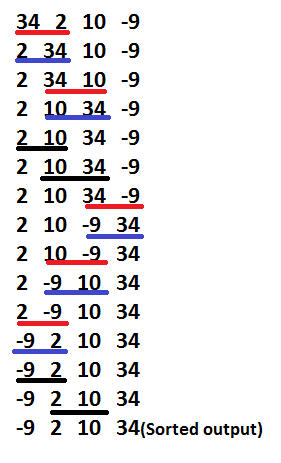
Algorithm Steps:
- If you are at the start of the array then go to the right element (from arr[0] to arr[1]).
- If the current array element is larger or equal to the previous array element then go one step right
if (arr[i] >= arr[i-1])
i++;
- If the current array element is smaller than the previous array element then swap these two elements and go one step backwards
if (arr[i] < arr[i-1])
{
swap(arr[i], arr[i-1]);
i--;
}
- Repeat steps 2) and 3) till ‘i’ reaches the end of the array (i.e- ‘n-1’)
- If the end of the array is reached then stop and the array is sorted.
Below is the implementation of the algorithm.
C++ `
// A C++ Program to implement Gnome Sort #include using namespace std;
// A function to sort the algorithm using gnome sort void gnomeSort(int arr[], int n) { int index = 0;
while (index < n) {
    if (index == 0)
        index++;
    if (arr[index] >= arr[index - 1])
        index++;
    else {
        swap(arr[index], arr[index - 1]);
        index--;
    }
}
return;
}
// A utility function ot print an array of size n void printArray(int arr[], int n) { cout << "Sorted sequence after Gnome sort: "; for (int i = 0; i < n; i++) cout << arr[i] << " "; cout << "\n"; }
// Driver program to test above functions. int main() { int arr[] = { 34, 2, 10, -9 }; int n = sizeof(arr) / sizeof(arr[0]);
gnomeSort(arr, n);
printArray(arr, n);

return (0);
}
Java
// Java Program to implement Gnome Sort
import java.util.Arrays; public class GFG { static void gnomeSort(int arr[], int n) { int index = 0;
    while (index < n) {
        if (index == 0)
            index++;
        if (arr[index] >= arr[index - 1])
            index++;
        else {
            int temp = 0;
            temp = arr[index];
            arr[index] = arr[index - 1];
            arr[index - 1] = temp;
            index--;
        }
    }
    return;
}

// Driver program to test above functions.
public static void main(String[] args)
{
    int arr[] = { 34, 2, 10, -9 };

    gnomeSort(arr, arr.length);

    System.out.print("Sorted sequence after applying Gnome sort: ");
    System.out.println(Arrays.toString(arr));
}
}
// Code Contributed by Mohit Gupta_OMG
Python
Python program to implement Gnome Sort
A function to sort the given list using Gnome sort
def gnomeSort( arr, n): index = 0 while index < n: if index == 0: index = index + 1 if arr[index] >= arr[index - 1]: index = index + 1 else: arr[index], arr[index-1] = arr[index-1], arr[index] index = index - 1
return arrDriver Code
arr = [ 34, 2, 10, -9] n = len(arr)
arr = gnomeSort(arr, n) print "Sorted sequence after applying Gnome Sort :", for i in arr: print i,
Contributed By Harshit Agrawal
C#
// C# Program to implement Gnome Sort using System;
class GFG {
static void gnomeSort(int[] arr, int n)
{
    int index = 0;

    while (index < n)
    {
        if (index == 0)
            index++;
        if (arr[index] >= arr[index - 1])
            index++;
        else {
            int temp = 0;
            temp = arr[index];
            arr[index] = arr[index - 1];
            arr[index - 1] = temp;
            index--;
        }
    }
    return;
}

// Driver program to test above functions.
public static void Main()
{
    int[] arr = { 34, 2, 10, -9 };

    // Function calling
    gnomeSort(arr, arr.Length);

    Console.Write("Sorted sequence after applying Gnome sort: ");

    for (int i = 0; i < arr.Length; i++)
        Console.Write(arr[i] + " ");
}
}
// This code is contributed by Sam007
PHP
JavaScript
`
Output
Sorted sequence after Gnome sort: -9 2 10 34
Time Complexity: As there are no nested loop (only one while) it may seem that this is a linear O(N) time algorithm. But the time complexity is O(N^2).
This is because:
- The variable – ‘index’ in our program doesn’t always gets incremented, it gets decremented too.
- However this sorting algorithm is adaptive and performs better if the array is already/partially sorted.
Auxiliary Space: This is an in-place algorithm. So O(1) auxiliary space is needed.