Greatest Integer Function (original) (raw)
Last Updated : 11 Jul, 2025
The greatest Integer Function [X] indicates an integral part of the real number x which is the nearest and smaller integer to x . It is also known as the floor of X.
[x]=the largest integer that is less than or equal to x.
**In general: If, n <= X < n+1 . Then, (n \epsilon Integer)\Longrightarrow [X]=n
This means if X lies in [n, n+1), then the Greatest Integer Function of X will be n.
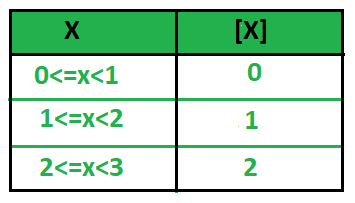
In the above figure, we are taking the floor of the values each time. When the intervals are in the form of [n, n+1), the value of the greatest integer function is n, where n is an integer.
- 0<=x<1 will always lie in the interval [0, 0.9), so here the Greatest Integer Function of X will be 0.
- 1<=x<2 will always lie in the interval [1, 1.9), so here the Greatest Integer Function of X will be 1.
- 2<=x<3 will always lie in the interval [2, 2.9), so here the Greatest Integer Function of X will be 2.
**Examples:
**Input: X = 2.3
**Output: [2.3] = 2
**Input: X = -8.0725
**Output: [-8.0725] = -9
**Input: X = 2
**Output: [2] = 2
**Number Line Representation
- If we examine a number line with the integers and plot 2.7 on it, we see:
- The largest integer that is less than 2.7 is 2. So **[2.7] = 2.
- If we examine a number line with the integers and plot -1.3 on it, we see:

Since the largest integer that is less than -1.3 is -2, so **[-1.3] = 2.
Here, **f(x)=[X] could be expressed graphically as:
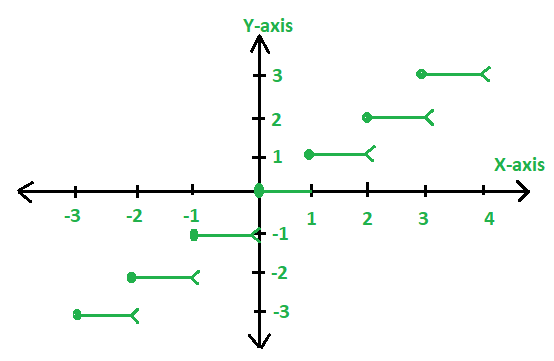
**Note: In the above graph, the left endpoint at every step is blocked(dark dot) to show that the point is a member of the graph, and the other right endpoint (open circle) indicates the points that are not part of the graph.
**Properties of Greatest Integer Function:
- [X]=X holds if X is an integer.
- [X+I]=[X]+I, if I is an integer, then we can I separately in the Greatest Integer Function.
- [X+Y]>=[X]+[Y], means the greatest integer of the sum of X and Y is the equal sum of the GIF of X and the GIF of Y.
- If [f(X)]>=I, then f(X) >= I.
- If [f(X)]<=I, then f(X) < I+1.
- [-X]= -[X], If X\epsilon Integer.
- [-X]=-[X]-1, If X is not an Integer.
It is also known as the stepwise function or **floor of X.
The below program shows the implementation of the Greatest Integer Function using floor() method.
C++ `
// CPP program to illustrate // greatest integer Function #include <bits/stdc++.h> using namespace std;
// Function to calculate the // GIF value of a number int GIF(float n) { // GIF is the floor of a number return floor(n); }
// Driver code int main() { int n = 2.3;
cout << GIF(n);

return 0;
}
Java
// Java program to illustrate // greatest integer Function
class GFG{ // Function to calculate the // GIF value of a number static int GIF(double n) { // GIF is the floor of a number return (int)Math.floor(n); }
// Driver code public static void main(String[] args) { double n = 2.3;
System.out.println(GIF(n));} } // This code is contributed by mits
Python3
Python3 program to illustrate
greatest integer Function
import math
Function to calculate the
GIF value of a number
def GIF(n):
# GIF is the floor of a number
return int(math.floor(n));
Driver code
n = 2.3;
print(GIF(n));
This code is contributed by mits
C#
// C# program to illustrate // greatest integer Function using System;
class GFG{ // Function to calculate the // GIF value of a number static int GIF(double n) { // GIF is the floor of a number return (int)Math.Floor(n); }
// Driver code static void Main() { double n = 2.3;
Console.WriteLine(GIF(n)); } }
// This code is contributed by mits
JavaScript
PHP
`
**Time Complexity: O(1)
**Auxiliary Space: O(1)