Greedy Best first search algorithm (original) (raw)
Last Updated : 27 May, 2026
Greedy Best-First Search is an AI search algorithm used to find a path from a starting node to a goal node by selecting the path that appears most promising at each step. It uses heuristic values to guide the search toward the goal efficiently.
- Prioritizes faster exploration over guaranteed optimal solutions
- Expands the node with the lowest heuristic value
- Reduces search effort by focusing on promising paths
- Commonly applied in navigation systems and pathfinding problems
Working
Greedy Best-First Search works by selecting the node that appears closest to the goal using heuristic values and continues expanding the most promising path until the destination is reached.
- Starts from the initial node and evaluates neighboring nodes using heuristic values
- Selects the node with the lowest heuristic value for expansion
- Expands the most promising path instead of exploring all possible paths
- Repeats the process until the goal node is reached
- Uses heuristic estimates to reduce search time and guide traversal efficiently
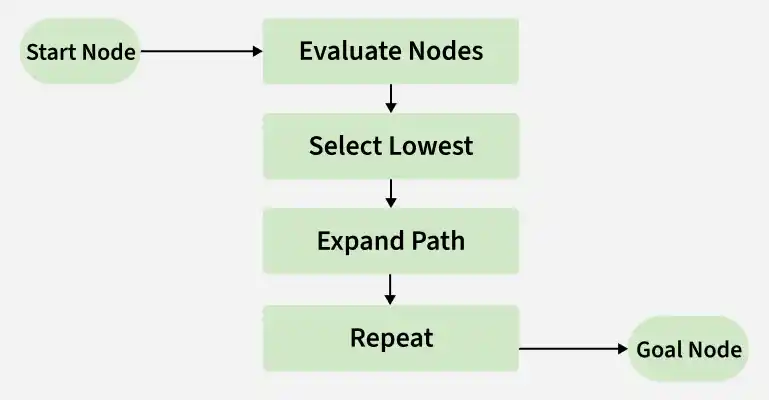
Workflow of Greedy Best first Search Algorithm
Implementation
Let's implement the Greedy Best-First Search algorithm using a graph where heuristic values estimate the distance from each node to the goal node.
**Step 1: Importing the heapq module for priority queue operations and define the graph structure.
Python `
import heapq
graph = { 'A': [('B', 1), ('C', 1), ('D', 1)], 'B': [('E', 1), ('F', 1)], 'C': [('F', 1)], 'D': [('G', 1)], 'E': [('G', 1)], 'F': [('G', 1)], 'G': [] }
`
**Step 2: Now we assign heuristic values to each node representing estimated distance to the goal node.
Python `
heuristic = { 'A': 40, 'B': 32, 'C': 25, 'D': 35, 'E': 19, 'F': 17, 'G': 0 }
`
**Step 3: Creating a function that selects and expands the node with the lowest heuristic value until the goal node is reached.
Python `
def greedy_best_first_search(start, goal):
visited = set()
priority_queue = []

heapq.heappush(priority_queue, (heuristic[start], start, [start]))

while priority_queue:

    h, current, path = heapq.heappop(priority_queue)

    if current == goal:
        return path

    if current not in visited:
        visited.add(current)

        for neighbor, cost in graph[current]:
            if neighbor not in visited:
                heapq.heappush(
                    priority_queue,
                    (heuristic[neighbor], neighbor, path + [neighbor])
                )

return None
`
**Step 4: We call the function to find the path from node A to node G.
Python `
result = greedy_best_first_search('A', 'G')
print("Path found:", " -> ".join(result))
`
**Output:
Path found: A -> C -> F -> G
Advantages
- Easy to implement due to its simple heuristic-based approach
- Finds solutions quickly by expanding the most promising nodes first
- Requires comparatively less memory than many other search algorithms
- Flexible enough to be adapted for different search and pathfinding problems
- Performs efficiently when the heuristic function accurately estimates the goal distance
Limitations
- Does not guarantee the shortest or most optimal solution as it only focuses on the most promising path
- Can get trapped in local optima, leading to suboptimal path selection
- Requires a suitable heuristic function, which may increase algorithm complexity
- May fail in highly complex or cyclic search spaces without additional handling mechanisms
Applications
- **Pathfinding: Used to find efficient paths in video games, robotics, and navigation systems
- **Machine Learning: Helps explore promising solutions within large search spaces
- **Optimization: Assists in selecting parameter values for desired outcomes
- **Game AI: Evaluates possible moves to choose favorable actions
- **Natural Language Processing: Applied in tasks like language translation and speech recognition
- **Image Processing: Helps segment images into meaningful regions