Hitting Set problem is NP Complete (original) (raw)
Last Updated : 15 Jul, 2025
**Prerequisite:
**Problem: Given a ground set X of elements and also a grouping collection **C of subsets available in **X and an integer **k, the task is to find the smallest subset of **X, such that the smallest subset, **H hits every set comprised in **C. This implies that the intersection of **H and S is null for every set **S belonging to **C, with **size ≤ k.
**Proof: An instance of the problem is an input specified to the problem. An instance of the Hitting Set is a collection C of subset, S in X, and k. Since an NP-complete problem, by definition, is a problem which is both NP and NP-Hard, the proof or statement that a problem is NP-Complete consists of two parts:
- The problem itself is NP-Complete.
- All other problems in NP class can be polynomial-time reducible to that. (B is poly-time reducible to C).
If the only second condition is satisfied, the problem is called NP-Hard.
But it is not possible to reduce every NP problem into another NP problem to show its NP-Completeness all the time. That is why to show a problem is NP-complete, prove that the problem is in NP and any NP-Complete problem is reducible to that then we are done. Thus, it can be verified that the hitting set problem is NP-Complete using the following propositions:
- ****Hitting Set is in NP:**It any problem is in NP, then given a 'certificate', which is a solution to the problem and an instance of the problem (a ground set X, a collection, C of subsets, S), we will be able to verify (check whether the solution is correct or not) the certificate in polynomial time. This can be done by:
Provided a Hitting Set, HS of size k, verify it covers at least one element in every set Si of X.
This takes polynomial time, hence in NP - **Hitting Set is NP-Hard: In order to prove Hitting Set is NP-Hard, we will perform a reduction from which vertex cover problem can be reduced to the Hitting Set problem.
In the Vertex Cover problem, we have a graph **G = (V, E)
Now, Let X, that is the ground set = vertices of G. That is X = V(G) and the collection C of subset Si in X is **S i = {u, v} is an edge in graph G.
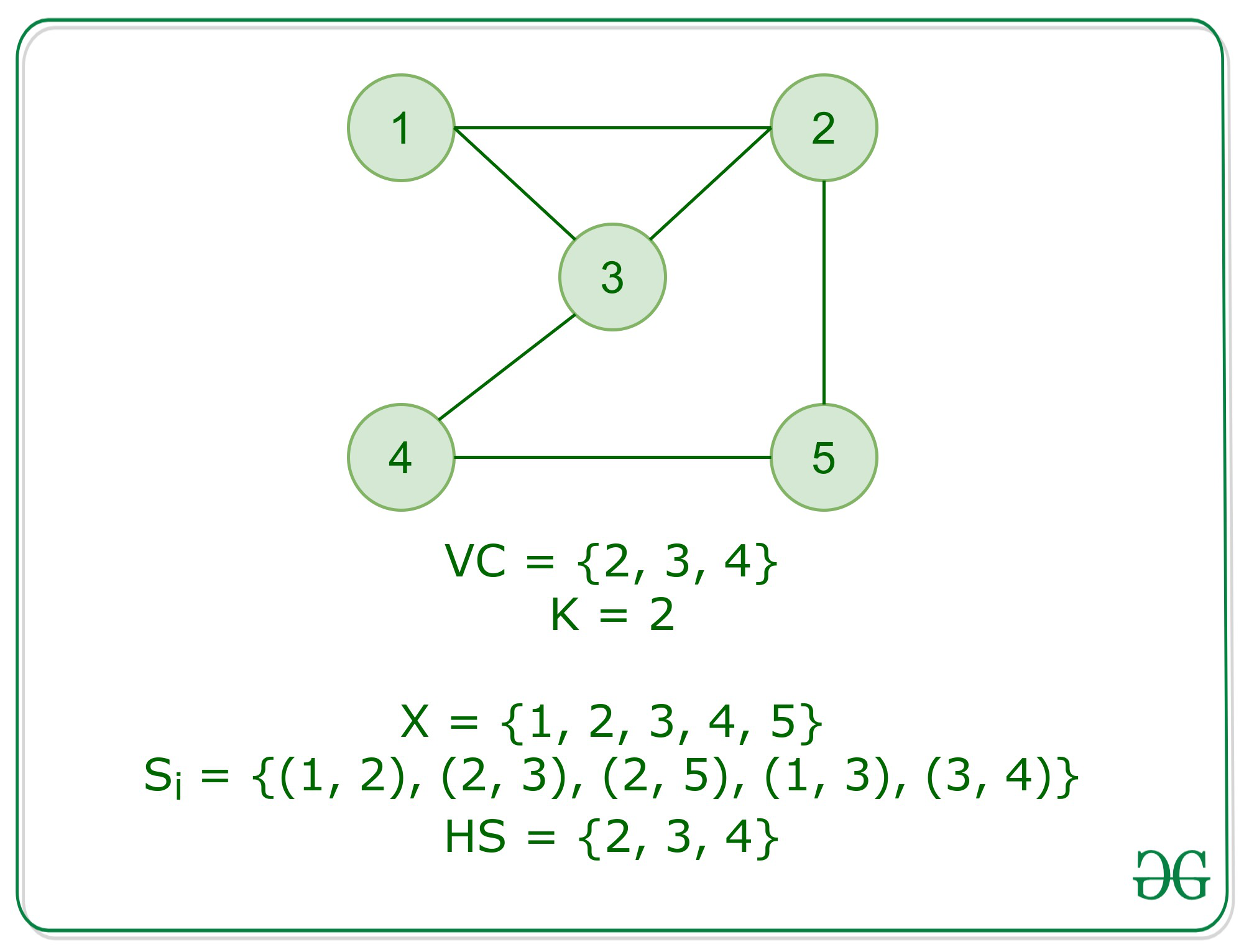
Now, the following properties hold:
- If VC is the vertex cover of graph G of **size k, this implies that for every edge ****{u, v}** either u or v belongs to VC. Therefore, VC forms the Hitting Set because all the subsets will form an intersection with the vertices in VC.
- If HS is hitting a set of **X of size **k. Now since HS intersects every subset of X, at least one of the endpoints of every edge ****{u, v}** must belong to the solution. Therefore, it spans at least one vertex for every edge, Hence forming VC.
**Conclusion:
The Hitting Set Problem is **NP and NP-Hard. Therefore, the **Hitting Set Problem **is NP-Complete.