Huffman Coding Algorithm (original) (raw)
Huffman coding is a lossless data compression algorithm.
- The idea is to assign variable-length codes to input characters, lengths of the codes are based on the frequencies of characters. The greedy idea is to assign the least length code to the most frequent character.
- The variable-length codes assigned to input characters are Prefix Codes, means the codes (bit sequences) are assigned in such a way that the code assigned to one character is not the prefix of code assigned to any other character. This is how Huffman Coding makes sure that there is no ambiguity when decoding the generated bitstream.
Let us understand prefix codes with a counter example. Let there be four characters a, b, c and d, and their corresponding variable length codes be 00, 01, 0 and 1. This coding leads to ambiguity because code assigned to c is the prefix of codes assigned to a and b. If the compressed bit stream is 0001, the de-compressed output may be "cccd" or "ccb" or "acd" or "ab".'
**Example:
**Input: s = "abcdef", f[] = [5, 9, 12, 13, 16, 45]
**Output: [0, 100, 101, 1100, 1101, 111]
**Explanation: Huffman Tree would beHuffman Codes would be:
f : 0
c : 100
d : 101
a : 1100
b : 1101
e : 111
These codes are generated using Huffman Tree by considering 0 value for left child and 1 for right. We get codes by traversing from root to every character and using 0 or 1 for every edge along the path.
There are mainly two major parts in Huffman Coding
- Build a Huffman Tree from input characters.
- Traverse the Huffman Tree and assign codes to characters.
Steps to build Huffman Tree
This algorithm builds a tree in bottom up manner using a priority queue (or heap)_._ Input is an array of unique characters along with their frequency of occurrences and output is Huffman Tree.
- Create a leaf node for each unique character and build a min heap of all leaf nodes (Min Heap is used as a priority queue. The value of frequency field is used to compare two nodes in min heap. Initially, the least frequent character is at root)
- Extract two nodes with the minimum frequency from the min heap.
- Create a new internal node with a frequency equal to the sum of the two nodes frequencies. Make the first extracted node as its left child and the other extracted node as its right child. Add this node to the min heap.
- Repeat steps#2 and #3 until the heap contains only one node. The remaining node is the root node and the tree is complete.
Let us understand the algorithm with an example:
**Characters Frequencies
a 5
b 9
c 12
d 13
e 16
f 45
**Step 1. Build a min heap that contains 6 nodes where each node represents root of a tree with single node.
**Step 2 Extract two minimum frequency nodes from min heap. Add a new internal node with frequency 5 + 9 = 14.
Please note that the below images show partial Huffman Tree to be built.
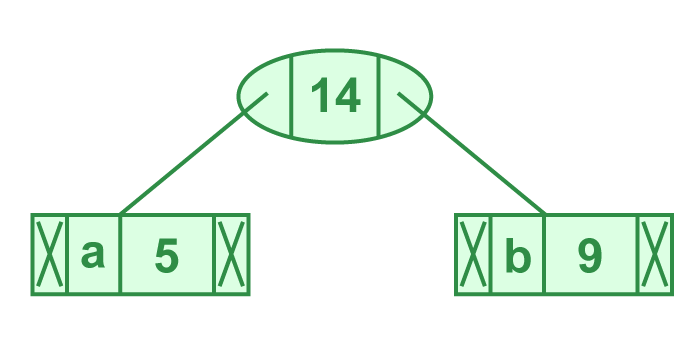
Illustration of step 2
Now min heap contains below 5 nodes where 4 nodes are roots of trees with single element each, and one heap node is root of tree with 3 elements
Nodes Frequencies
c 12
d 13
Internal 14
e 16
f 45**Note : Here internal means an internal node of the Huffman Tree
**Step 3: Extract two minimum frequency nodes from heap. Add a new internal node with frequency 12 + 13 = 25
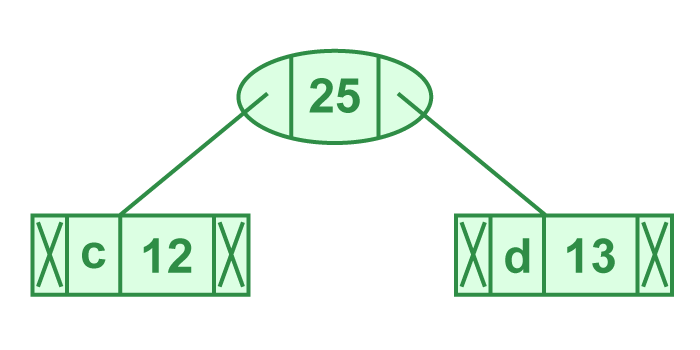
Illustration of step 3
Now min heap contains 4 nodes where 2 nodes are roots of trees with single element each, and two heap nodes are root of tree with more than one nodes
**Nodes Frequencies
Internal 14
e 16
Internal 25
f 45
**Step 4: Extract two minimum frequency nodes. Add a new internal node with frequency 14 + 16 = 30
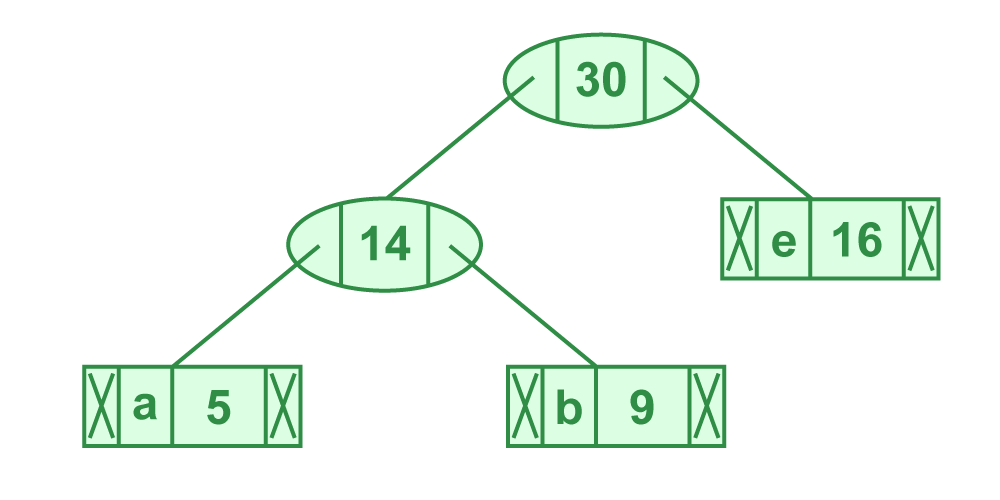
Illustration of step 4
Now min heap contains 3 nodes.
**Nodes Frequencies
Internal 25
Internal 30
f 45
**Step 5: Extract two minimum frequency nodes. Add a new internal node with frequency 25 + 30 = 55
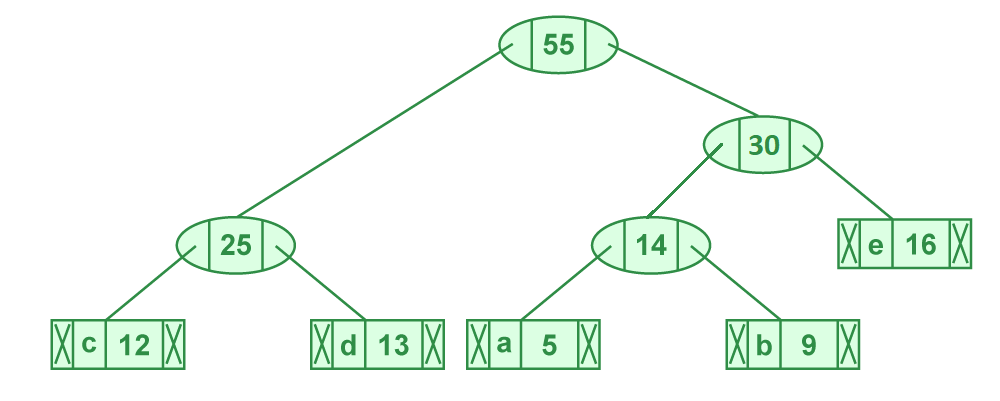
Illustration of step 5
Now min heap contains 2 nodes.
**Nodes Frequencies
f 45
Internal 55
**Step 6: Extract two minimum frequency nodes. Add a new internal node with frequency 45 + 55 = 100
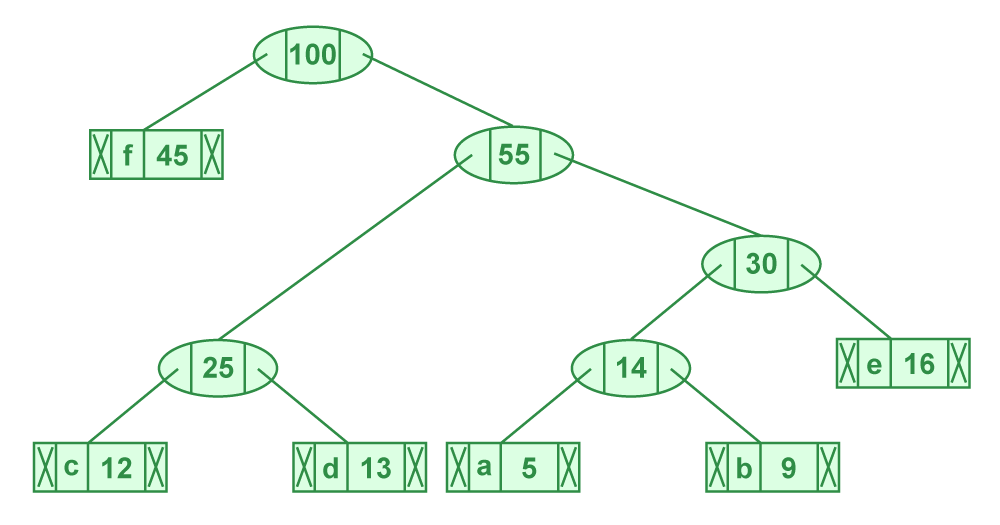
Illustration of step 6
Now min heap contains only one node.
**Nodes Frequencies
Internal 100
Since the heap contains only one node, the algorithm stops here.
**Steps to print codes from Huffman Tree:
Traverse the tree formed starting from the root. Maintain an auxiliary array. While moving to the left child, write 0 to the array. While moving to the right child, write 1 to the array. Print the array when a leaf node is encountered.
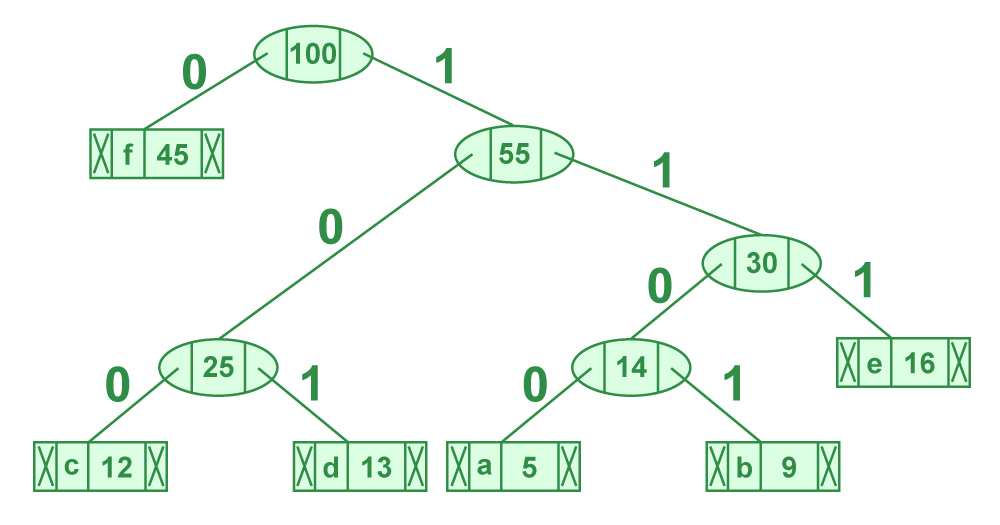
Steps to print code from HuffmanTree
The codes are as follows:
**Characters and their Huffman Codes
f 0
c 100
d 101
a 1100
b 1101
e 111
C++ `
//Driver Code Starts #include #include #include #include #include using namespace std;
//Driver Code Ends
// Class to represent Huffman tree node class Node { public: // frequency int data;
// smallest original index in subtree
int index;

// smallest original index in subtree
Node *left, *right;

// Leaf node
Node(int d, int i) {
    data = d;
    index = i;
    left = right = nullptr;
}

// Internal node
Node(Node* l, Node* r) {
    data = l->data + r->data;

    // important for tie-break
    index = min(l->index, r->index);
    left = l;
    right = r;
}
};
// Custom min heap for Node class
class Compare {
public:
bool operator() (Node* a, Node* b) {
// smaller freq first
if (a->data != b->data)
return a->data > b->data;
// when freq are equal
return a->index > b->index;
}
};
// Function to traverse tree in preorder // manner and push the Huffman representation // of each character. void preOrder(Node* root, vector &ans, string curr) { if (root == nullptr) return;
// Leaf node represents a character.
if (root->left == nullptr && root->right == nullptr) {
    // single character case
    if (curr == "") curr = "0";
    ans.push_back(curr);
    return;
}

preOrder(root->left, ans, curr + '0');
preOrder(root->right, ans, curr + '1');
}
vector huffmanCodes(string &s, vector freq) {
int n = s.length();

// Min heap for Node class.
priority_queue<Node*, vector<Node*>, Compare> pq;
for (int i = 0; i < n; i++) {
    // include index
    Node* tmp = new Node(freq[i], i);
    pq.push(tmp);
}

// single character
if (n == 1)
    return {"0"};

// Construct Huffman tree.
while (pq.size() >= 2) {

    // Left node
    Node* l = pq.top();
    pq.pop();

    // Right node
    Node* r = pq.top();
    pq.pop();

    // internal node with freq + index
    Node* newNode = new Node(l, r);
    pq.push(newNode);
}

Node* root = pq.top();
vector<string> ans;
preOrder(root, ans, "");
return ans;
}
//Driver Code Starts
int main() { string s = "abcdef"; vector freq = {5, 9, 12, 13, 16, 45}; vector ans = huffmanCodes(s, freq); for (int i = 0; i < ans.size(); i++) { cout << ans[i] << " "; }
return 0;} //Driver Code Ends
Java
//Driver Code Starts import java.util.*;
//Driver Code Ends
// Class to represent Huffman tree node class Node {
// frequency
int data;

// smallest original index in subtree
int index;

// smallest original index in subtree
Node left, right;

// Leaf node
Node(int d, int i) {
    data = d;
    index = i;
    left = right = null;
}

// Internal node
Node(Node l, Node r) {
    data = l.data + r.data;

    // important for tie-break
    index = Math.min(l.index, r.index);
    left = l;
    right = r;
}
}
// Custom min heap for Node class
class Compare implements Comparator {
public int compare(Node a, Node b) {
// smaller freq first
if (a.data != b.data)
return a.data - b.data;
// when freq are equal
return a.index - b.index;
}
}
public class GfG {
// Function to traverse tree in preorder
// manner and push the Huffman representation
// of each character.
static void preOrder(Node root, ArrayList<String> ans, String curr) {
    if (root == null) return;

    // Leaf node represents a character.
    if (root.left == null && root.right == null) {
        // single character case
        if (curr.equals("")) curr = "0";
        ans.add(curr);
        return;
    }

    preOrder(root.left, ans, curr + '0');
    preOrder(root.right, ans, curr + '1');
}

static ArrayList<String> huffmanCodes(String s, int[] freq) {

    int n = s.length();

    // Min heap for Node class.
    PriorityQueue<Node> pq = new PriorityQueue<>(new Compare());
    for (int i = 0; i < n; i++) {
        // include index
        Node tmp = new Node(freq[i], i);
        pq.add(tmp);
    }

    // single character
    if (n == 1) {
        ArrayList<String> res = new ArrayList<>();
        res.add("0");
        return res;
    }

    // Construct Huffman tree.
    while (pq.size() >= 2) {

        // Left node
        Node l = pq.poll();

        // Right node
        Node r = pq.poll();

        // internal node with freq + index
        Node newNode = new Node(l, r);
        pq.add(newNode);
    }

    Node root = pq.peek();
    ArrayList<String> ans = new ArrayList<>();
    preOrder(root, ans, "");
    return ans;
}
//Driver Code Starts
public static void main(String[] args) {
    String s = "abcdef";
    int[] freq = {5, 9, 12, 13, 16, 45};
    ArrayList<String> ans = huffmanCodes(s, freq);
    for (int i = 0; i < ans.size(); i++) {
        System.out.print(ans.get(i) + " ");
    }
}
} //Driver Code Ends
Python
#Driver Code Starts import heapq
#Driver Code Ends
Class to represent Huffman tree node
class Node:
# Leaf node
def __init__(self, d, i, left=None, right=None):
    # frequency
    self.data = d

    # smallest original index in subtree
    self.index = i

    # smallest original index in subtree
    self.left = left
    self.right = right
Function to traverse tree in preorder
manner and push the Huffman representation
of each character.
def preOrder(root, ans, curr): if root is None: return
# Leaf node represents a character.
if root.left is None and root.right is None:
    # single character case
    if curr == "":
        curr = "0"
    ans.append(curr)
    return

preOrder(root.left, ans, curr + '0')
preOrder(root.right, ans, curr + '1')
def huffmanCodes(s, freq):
n = len(s)

# Min heap for Node class.
pq = []

for i in range(n):
    # include index
    tmp = Node(freq[i], i)
    heapq.heappush(pq, (tmp.data, tmp.index, tmp))

# single character
if n == 1:
    return ["0"]

# Construct Huffman tree.
while len(pq) >= 2:

    # Left node
    f1, i1, l = heapq.heappop(pq)

    # Right node
    f2, i2, r = heapq.heappop(pq)

    # internal node with freq + index
    newNode = Node(l.data + r.data, min(l.index, r.index), l, r)
    heapq.heappush(pq, (newNode.data, newNode.index, newNode))

root = pq[0][2]
ans = []
preOrder(root, ans, "")
return ans
#Driver Code Starts
Example usage
if name == "main": s = "abcdef" freq = [5, 9, 12, 13, 16, 45] ans = huffmanCodes(s, freq) for i in range(len(ans)): print(ans[i], end=" ") #Driver Code Ends
C#
//Driver Code Starts using System; using System.Collections.Generic;
//Driver Code Ends
// Class to represent Huffman tree node class Node {
// frequency
public int data;

// smallest original index in subtree
public int index;

// smallest original index in subtree
public Node left, right;

// Leaf node
public Node(int d, int i) {
    data = d;
    index = i;
    left = right = null;
}

// Internal node
public Node(Node l, Node r) {
    data = l.data + r.data;

    // tie-break using smallest index
    index = Math.Min(l.index, r.index);
    left = l;
    right = r;
}
}
class GfG {
// Traverse tree in preorder and collect Huffman codes
static void preOrder(Node root, List<string> ans, string curr) {
    if (root == null) return;

    // Leaf node
    if (root.left == null && root.right == null) {
        if (curr == "") curr = "0";
        ans.Add(curr);
        return;
    }

    preOrder(root.left, ans, curr + "0");
    preOrder(root.right, ans, curr + "1");
}

static List<string> huffmanCodes(string s, int[] freq) {

    int n = s.Length;

    // Min heap simulation
    var pq = new List<(int data, int index, Node node)>();
    for (int i = 0; i < n; i++) {
        Node tmp = new Node(freq[i], i);
        pq.Add((tmp.data, tmp.index, tmp));
    }

    // single character case
    if (n == 1)
        return new List<string> { "0" };

    // Build Huffman tree
    while (pq.Count >= 2) {

        pq.Sort((a, b) => {
            if (a.data != b.data)
                return a.data.CompareTo(b.data);
            return a.index.CompareTo(b.index);
        });

        var l = pq[0];
        pq.RemoveAt(0);

        var r = pq[0];
        pq.RemoveAt(0);

        Node newNode = new Node(l.node, r.node);
        pq.Add((newNode.data, newNode.index, newNode));
    }

    pq.Sort((a, b) => {
        if (a.data != b.data)
            return a.data.CompareTo(b.data);
        return a.index.CompareTo(b.index);
    });

    Node root = pq[0].node;
    List<string> ans = new List<string>();
    preOrder(root, ans, "");
    return ans;
}
//Driver Code Starts
static void Main() {
    string s = "abcdef";
    int[] freq = {5, 9, 12, 13, 16, 45};

    List<string> ans = huffmanCodes(s, freq);

    for (int i = 0; i < ans.Count; i++) {
        Console.Write(ans[i] + " ");
    }
}
} //Driver Code Ends
JavaScript
// Class to represent Huffman tree node class Node { constructor(d, i, left = null, right = null) { // frequency this.data = d;
    // smallest original index in subtree
    this.index = i;

    this.left = left;
    this.right = right;
}
}
// Function to traverse tree in preorder // manner and push the Huffman representation // of each character. function preOrder(root, ans, curr) { if (root === null) return;
// Leaf node represents a character.
if (root.left === null && root.right === null) {
    // single character case
    if (curr === "") curr = "0";
    ans.push(curr);
    return;
}

preOrder(root.left, ans, curr + '0');
preOrder(root.right, ans, curr + '1');
}
// Huffman Codes function function huffmanCodes(s, freq) {
let n = s.length;

// Min heap simulation
let pq = [];

for (let i = 0; i < n; i++) {
    pq.push([freq[i], i, new Node(freq[i], i)]);
}

// single character case
if (n === 1) return ["0"];

// Construct Huffman tree
while (pq.length > 1) {

    pq.sort((a, b) => {
        // smaller freq first
        if (a[0] !== b[0]) return a[0] - b[0];
        // when freq are equal
        return a[1] - b[1];
    });

    // Left node
    let l = pq.shift();

    // Right node
    let r = pq.shift();

    // internal node (same as C++)
    let newNode = new Node(
        l[0] + r[0],
        Math.min(l[1], r[1]),
        l[2],
        r[2]
    );

    pq.push([newNode.data, newNode.index, newNode]);
}

let root = pq[0][2];

let ans = [];
preOrder(root, ans, "");

return ans;
}
//Driver Code Starts // Driver code let s = "abcdef"; let freq = [5, 9, 12, 13, 16, 45];
let ans = huffmanCodes(s, freq); console.log(ans.join(" ")); //Driver Code Ends
`
Output
0 100 101 1100 1101 111
**Time complexity: O(n log n) where n is the number of unique characters
**Space complexity :- O(n)
Applications of Huffman Coding:
- They are used for transmitting fax and text.
- They are used by conventional compression formats like PKZIP, GZIP, etc.
- Multimedia codecs like JPEG, PNG, and MP3 use Huffman encoding(to be more precise the prefix codes).
It is useful in cases where there is a series of frequently occurring characters.