Hypercube Graph (original) (raw)
Last Updated : 8 Feb, 2023
You are given input as order of graph n (highest number of edges connected to a node), you have to find the number of vertices in a Hypercube graph of order n.
Examples:
Input : n = 3 Output : 8
Input : n = 2 Output : 4
In hypercube graph Q(n), n represents the degree of the graph. Hypercube graph represents the maximum number of edges that can be connected to a graph to make it an n degree graph, every vertex has the same degree n and in that representation, only a fixed number of edges and vertices are added as shown in the figure below:
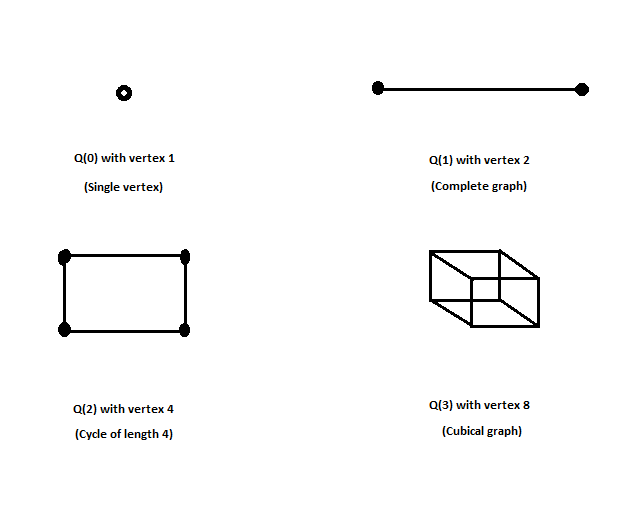
All hypercube graphs are Hamiltonian, hypercube graph of order n has (2^n) vertices, , for input n as the order of graph we have to find the corresponding power of 2.
Recursive Approach
C++ `
// C++ program to find vertices in a hypercube // graph of order n #include using namespace std;
// function to find power of 2 int power(int n) { if (n == 1) return 2; return 2 * power(n - 1); }
// driver program int main() { // n is the order of the graph int n = 4; cout << power(n); return 0; }
Java
// Java program to find vertices in // a hypercube graph of order n class GfG {
// Function to find power of 2
static int power(int n)
{
    if (n == 1)
        return 2;
    return 2 * power(n - 1);
}

// Driver program
public static void main(String []args)
{

    // n is the order of the graph
    int n = 4;
    System.out.println(power(n));
}
}
// This code is contributed by Rituraj Jain
Python3
Python3 program to find vertices in a hypercube
graph of order n
function to find power of 2
def power(n): if n==1: return 2 return 2*power(n-1)
Driver code
n =4 print(power(n))
This code is contributed by Shrikant13
C#
// C# program to find vertices in // a hypercube graph of order n using System;
class GfG {
// Function to find power of 2
static int power(int n)
{
    if (n == 1)
        return 2;
    return 2 * power(n - 1);
}

// Driver code
public static void Main()
{

    // n is the order of the graph
    int n = 4;
    Console.WriteLine(power(n));
}
}
// This code is contributed by Mukul Singh
PHP
JavaScript
`
Iterative Approach
C++ `
// C++ program to find vertices in // a hypercube graph of order n #include <bits/stdc++.h> using namespace std;
// Function to find power of 2 int power(int n) {
if (n == 0)
    return 0;

int pow = 1;

for (int i = 1; i <= n; i++)
{
    pow *= 2;
}

return pow;
}
int main() { // n is the order of the graph int n = 4; cout << power(n); return 0; }
// This code is contributed by akashish__
Java
/*package whatever //do not write package name here */
import java.io.*;
// Java program to find vertices in // a hypercube graph of order n class GFG {
// Function to find power of 2 static int power(int n) {
  if(n==0) return 0;

  int pow = 1;

  for(int i=1;i<=n;i++){
      pow *= 2;
  }

  return pow;
}

public static void main (String[] args) {
     // n is the order of the graph
    int n = 4;
    System.out.println(power(n));
}
}
Python3
Python program to find vertices in
a hypercube graph of order n
Function to find power of 2
def power(n):
if n == 0:
    return 0

pow = 1

for i in range(1, n+1):
    pow *= 2

return pow
n is the order of the graph
n = 4 print(power(n))
This code is contributed by akashish__
C#
// C# program to find vertices in // a hypercube graph of order n using System;
public class GFG {
// Function to find power of 2 public static int power(int n) {
if (n == 0)
  return 0;

int pow = 1;

for (int i = 1; i <= n; i++) {
  pow *= 2;
}

return pow;
}
static public void Main() {
// n is the order of the graph
int n = 4;
Console.WriteLine(power(n));
} }
// This code is contributed by akashish__
JavaScript
// Function to find power of 2 function power(n) { if (n === 0) return 0;
let pow = 1;
for (let i = 1; i <= n; i++) { pow *= 2; }
return pow; }
// n is the order of the graph const n = 4; console.log(power(n));
// This code is contributed by akashish__
`
Java Using Math.pow()
C++ `
#include <bits/stdc++.h> using namespace std;
// Function to find power of 2 int power(int n) { return pow(2, n); }
int main() {
// n is the order of the graph
int n = 4;
cout << power(n) << endl;
return 0;
}
// This code is contributed by akashish__
Java
/*package whatever //do not write package name here */
import java.io.*;
// Java program to find vertices in // a hypercube graph of order n class GFG {
// Function to find power of 2 static int power(int n) { return (int)Math.pow(2,n); }
public static void main (String[] args) {
     // n is the order of the graph
    int n = 4;
    System.out.println(power(n));
}
}
Python3
Function to find power of 2
def power(n): return pow(2, n)
n is the order of the graph
n = 4 print(power(n))
contributed by akashish__
C#
using System;
// Java program to find vertices in // a hypercube graph of order n public class GFG {
// Function to find power of 2 static int power(int n) { return (int)Math.Pow(2, n); }
static public void Main() {
// n is the order of the graph
int n = 4;
Console.WriteLine(power(n));
} }
// This code is contributed by akashish__
JavaScript
// Function to find power of 2 function power(n) { return Math.pow(2, n); }
// n is the order of the graph let n = 4; console.log(power(n)); // contributed by akashish__
`