Implement Quicksort with first element as pivot (original) (raw)
Last Updated : 23 Jul, 2025
**QuickSort is a Divide and Conquer algorithm. It picks an element as a pivot and partitions the given array around the pivot. There are many different versions of quickSort that pick the pivot in different ways.
- Always pick the first element as a pivot.
- Always pick the last element as a pivot.
- Pick a random element as a pivot.
- Pick the median as the pivot.
**Note: Here we will be implementing quick sort by picking the first element as the pivot.
**Quick Sort by picking the first element as the Pivot:
The key function in quick sort is a partition. The target of partitions is to put the pivot in its correct position if the array is sorted and the smaller (or equal) to its left and higher elements to its right and do all this in linear time****.**
**Partition Algorithm:
There can be many ways to do partition, the following pseudo-code adopts the method given in the CLRS book.
- We start from the leftmost element and keep track of the index of smaller (or equal) elements as **i.
- While traversing, if we find a smaller (or equal) element, we swap the current element with arr[i].
- Otherwise, we ignore the current element.
**Pseudo Code for recursive QuickSort function:
// low –> Starting index, high –> Ending index
quickSort(arr[], low, high) {
if (low < high) {// pi is partitioning index, arr[pi] is now at right place
pi = partition(arr, low, high);
quickSort(arr, low, pi – 1); // Before pi
quickSort(arr, pi + 1, high); // After pi
}
}
**Pseudo code for partition() function
/* This function takes first element as pivot, places the pivot element at its correct position in sorted array, and places all smaller (smaller than or equal to pivot) to left of pivot and all greater elements to right of pivot */
partition (arr[], low, high) {
// first element as pivot
pivot = arr[low]
k = high
for (i = high; i > low; i--) {
if (arr[i] > pivot){
swap arr[i] and arr[k];
k--;
}
}
swap arr[k] and arr[low]
return k;
}
**Illustration of partition() :
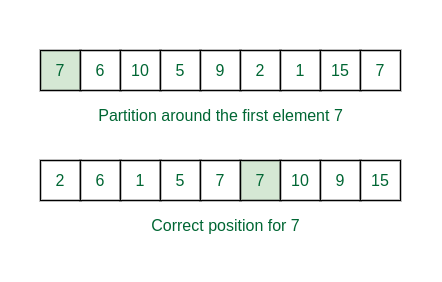
Consider: arr[] = { 7, 6, 10, 5, 9, 2, 1, 15, 7 }
**First Partition: low = 0, high = 8, pivot = arr[low] = 7
Initialize index of right most element k = high = 8.
- Traverse from i = high to low:
- if arr[i] is greater than pivot:
* Swap arr[i] and arr[k].
* Decrement k;- At the end swap arr[low] and arr[k].
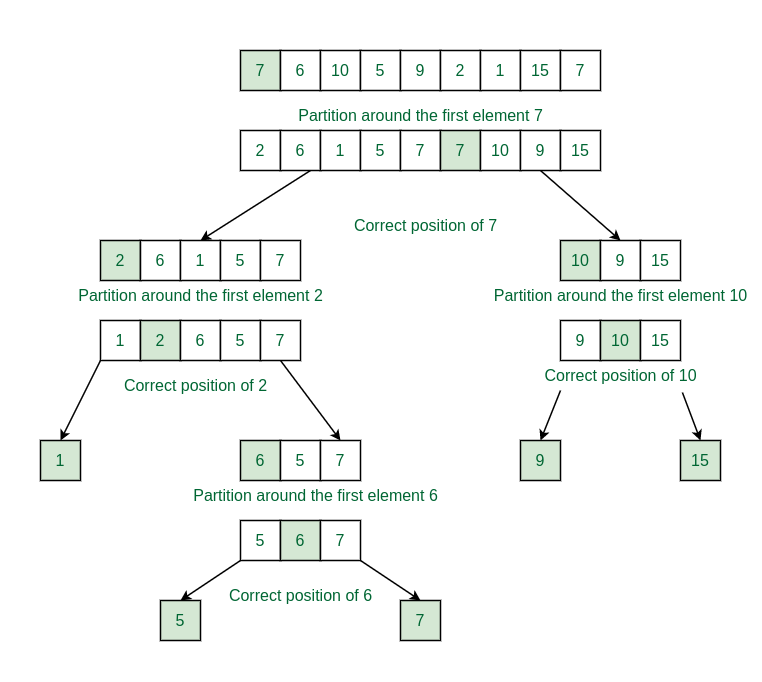
Now the correct position of pivot is index **5
First partition
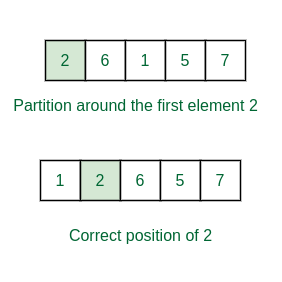
**Second Partition: low = 0, high = 4, pivot = arr[low] = 2
Similarly initialize k = high = 4;The correct position of 2 becomes **index 1. And the left part is only one element and the right part has {6, 5, 7}.
Partition of the left half
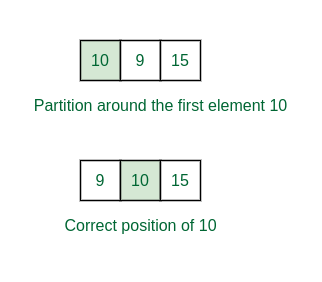
On the other hand partition happens on the segment [6, 8] i.e., the array {10, 9, 15}.
Here low = 6, high = 8, pivot = 10 and k = 8.The correct position of 10 becomes **index 7 and the right and left part both has only one element.
Partition of the right half
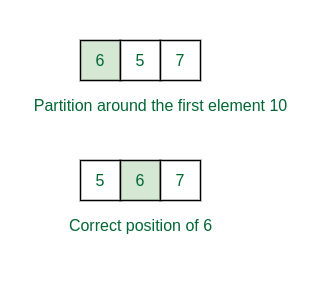
**Third partition: Here partition the segment {6, 5, 7}. The low = 2, high = 4, pivot = 6 and k = 4.
If the same process is applied, we get correct position of 6 as index 3 and the left and the right part is having only one element.
Third partition
The total array becomes sorted in this way. Check the below image for the recursion tree
Recursion tree for partitions
Follow the below steps to implement the approach.
- Use a recursive function (say **quickSort) to initialize the function.
- Call the partition function to partition the array and inside the partition function do the following
- Take the first element as pivot and initialize and iterator **k = high.
- Iterate in a for loop from **i = high to low+1:
* If arr[i] is greater than pivot then swap **arr[i] and **arr[k] and decrement k. - After the iteration is swap the pivot with **arr[k].
- Return k-1 as the point of partition.
- Now recursively call quickSort for the left half and right half of the partition index.
Implementation of the above approach.
C++ `
#include <bits/stdc++.h> using namespace std;
/This function takes first element as pivot, the function places the pivot element(first element) on its sorted position and all the element lesser than pivot will placed left to it, and all the element greater than pivot placed right to it./
int partition(int arr[], int low, int high) {
// First element as pivot
int pivot = arr[low];

int k = high;
for (int i = high; i > low; i--) {
    if (arr[i] > pivot)
        swap(arr[i], arr[k--]);
}
swap(arr[low], arr[k]);
// As we got pivot element index is end
// now pivot element is at its sorted position
// return pivot element index (end)
return k;
}
/* The main function that implements QuickSort arr[] --> Array to be sorted, low --> Starting index, high --> Ending index */ void quickSort(int arr[], int low, int high) { // If low is lesser than high if (low < high) { // idx is index of pivot element which is at its // sorted position int idx = partition(arr, low, high);
    // Separately sort elements before
    // partition and after partition
    quickSort(arr, low, idx - 1);
    quickSort(arr, idx + 1, high);
}
}
/* Function to print an array */ void printArray(int arr[], int size) { int i; for (i = 0; i < size; i++) cout << arr[i] << " "; cout << endl; }
// Driver Code int main() { int arr[] = { 7, 6, 10, 5, 9, 2, 1, 15, 7 }; int n = sizeof(arr) / sizeof(arr[0]); quickSort(arr, 0, n - 1); cout << "Sorted array: \n"; printArray(arr, n); return 0; }
// This Code is contributed by Harsh Raghav
C
#include <stdio.h>
void swap(int *a, int *b) { int temp = *a; *a = *b; *b = temp; }
int partition(int arr[], int low, int high) { int pivot = arr[low]; // Choosing the pivot element int start = low; int end = high; int k = high;
// Iterate from the end of the array to the start
for (int i = high; i > low; i--) {
    // If the current element is greater than the pivot,
    // swap it with the element at index k and decrement k
    if (arr[i] > pivot)
        swap(&arr[i], &arr[k--]);
}

// Swap the pivot element with the element at index k
swap(&arr[low], &arr[k]);

return k; // Return the index of the pivot element after partitioning
}
void quickSort(int arr[], int low, int high) { if (low < high) { // Partition the array and get the index of the pivot element int idx = partition(arr, low, high);
    // Recursively sort the subarrays before and after the pivot element
    quickSort(arr, low, idx - 1);
    quickSort(arr, idx + 1, high);
}
}
void printArray(int arr[], int size) { for (int i = 0; i < size; i++) printf("%d ", arr[i]); printf("\n"); }
int main() { int arr[] = {7, 6, 10, 5, 9, 2, 1, 15, 7}; int n = sizeof(arr) / sizeof(arr[0]);
// Call quickSort to sort the array
quickSort(arr, 0, n - 1);

printf("Sorted array: \n");
printArray(arr, n);

return 0;
}
Java
import java.util.Arrays;
class QuickSort { /* This function takes first element as pivot, the function places the pivot element(first element) on its sorted position and all the element lesser than pivot will placed left to it, and all the element greater than pivot placed right to it.*/ int partition(int arr[], int low, int high) { // First element as pivot int pivot = arr[low]; int st = low; // st points to the starting of array int end = high; // end points to the ending of the array int k = high; for (int i = high; i > low; i--) { if (arr[i] > pivot) swap(arr, i, k--); } swap(arr, low, k); // As we got pivot element index is end // now pivot element is at its sorted position // return pivot element index (end) return k; }
// Function to swap two elements
public static void swap(int[] arr, int i, int j)
{
    int temp = arr[i];
    arr[i] = arr[j];
    arr[j] = temp;
}

/* The main function that implements QuickSort
arr[] --> Array to be sorted,
low --> Starting index,
high --> Ending index */
void quickSort(int arr[], int low, int high)
{
    // If low is lesser than high
    if (low < high) {
        // idx is index of pivot element which is at its
        // sorted position
        int idx = partition(arr, low, high);

        // Separately sort elements before
        // partition and after partition
        quickSort(arr, low, idx - 1);
        quickSort(arr, idx + 1, high);
    }
}

/* Function to print an array */
void printArray(int arr[], int size)
{
    int i;
    for (i = 0; i < size; i++)
        System.out.print(arr[i] + " ");
    System.out.println();
}

// Driver Code
public static void main(String args[])
{
    int arr[] = { 7, 6, 10, 5, 9, 2, 1, 15, 7 };
    int n = arr.length;

    QuickSort ob = new QuickSort();
    ob.quickSort(arr, 0, n - 1);

    System.out.println("Sorted array");
    ob.printArray(arr, n);
}
}
Python
This function takes first element as pivot, the function
places the pivot element(first element) on its sorted
position and all the element lesser than pivot will placed
left to it, and all the element greater than pivot placed
right to it.
def partition(array, low, high):
# First Element as pivot
pivot = array[low]

# st points to the starting of array
start = low + 1

# end points to the ending of the array
end = high

while True:
    # It indicates we have already moved all the elements to their correct side of the pivot
    while start <= end and array[end] >= pivot:
        end = end - 1

    # Opposite process
    while start <= end and array[start] <= pivot:
        start = start + 1

    # Case in which we will exit the loop
    if start <= end:
        array[start], array[end] = array[end], array[start]
        # The loop continues
    else:
        # We exit out of the loop
        break

array[low], array[end] = array[end], array[low]
# As we got pivot element index is end
# now pivot element is at its sorted position
# return pivot element index (end)
return end
The main function that implements QuickSort
arr[] --> Array to be sorted,
low --> Starting index,
high --> Ending index
def quick_sort(array, start, end):
# If low is lesser than high
if start < end:

    # idx is index of pivot element which is at its
    # sorted position
    idx = partition(array, start, end)

    # Separately sort elements before
    # partition and after partition
    quick_sort(array, start, idx-1)
    quick_sort(array, idx+1, end)
Function to print an array
def print_arr(arr, n): for i in range(n): print(arr[i], end=" ") print()
Driver Code
arr1 = [7, 6, 10, 5, 9, 2, 1, 15, 7] quick_sort(arr1, 0, len(arr1)-1) print_arr(arr1, len(arr1))
This code is contributed by Aditya Sharma
C#
using System;
class QuickSort { /* This function takes first element as pivot, the function places the pivot element(first element) on its sorted position and all the element lesser than pivot will placed left to it, and all the element greater than pivot placed right to it.*/ int partition(int[] arr, int low, int high) { // First element as pivot int pivot = arr[low]; int st = low; // st points to the starting of array int end = high; // end points to the ending of the array int k = high; for (int i = high; i > low; i--) { if (arr[i] > pivot) { swap(arr, i, k--); } } swap(arr, low, k); // As we got pivot element index is end // now pivot element is at its sorted position // return pivot element index (end) return k; }
// Function to swap two elements
public static void swap(int[] arr, int i, int j)
{
    int temp = arr[i];
    arr[i] = arr[j];
    arr[j] = temp;
}

/* The main function that implements QuickSort
arr[] --> Array to be sorted,
low --> Starting index,
high --> Ending index */
void quickSort(int[] arr, int low, int high)
{
    // If low is lesser than high
    if (low < high)
    {
        // idx is index of pivot element which is at its
        // sorted position
        int idx = partition(arr, low, high);

        // Separately sort elements before
        // partition and after partition
        quickSort(arr, low, idx - 1);
        quickSort(arr, idx + 1, high);
    }
}

/* Function to print an array */
void printArray(int[] arr, int size)
{
    int i;
    for (i = 0; i < size; i++)
        Console.Write(arr[i] + " ");
    Console.WriteLine();
}

// Driver Code
public static void Main()
{
    int[] arr = { 7, 6, 10, 5, 9, 2, 1, 15, 7 };
    int n = arr.Length;

    QuickSort ob = new QuickSort();
    ob.quickSort(arr, 0, n - 1);

    Console.WriteLine("Sorted array");
    ob.printArray(arr, n);
}
}
JavaScript
function partition(function partition(array, low, high) { // First Element as pivot let pivot = array[low];
// st points to the starting of array let start = low + 1;
// end points to the ending of the array let end = high;
while (true) { // It indicates we have already moved all the elements to their correct side of the pivot while (start <= end && array[end] >= pivot) { end--; }
// Opposite process
while (start <= end && array[start] <= pivot) {
  start++;
}

// Case in which we will exit the loop
if (start <= end) {
  [array[start], array[end]] = [array[end], array[start]];
  // The loop continues
} else {
  // We exit out of the loop
  break;
}
}
[array[low], array[end]] = [array[end], array[low]]; // As we got pivot element index is end // now pivot element is at its sorted position // return pivot element index (end) return end; }
function quick_sort(array, start, end) { // If low is lesser than high if (start < end) { // idx is index of pivot element which is at its // sorted position let idx = partition(array, start, end);
// Separately sort elements before
// partition and after partition
quick_sort(array, start, idx - 1);
quick_sort(array, idx + 1, end);
} }
function print_arr(arr) { console.log(arr.join(" ")); }
// Driver Code let arr1 = [7, 6, 10, 5, 9, 2, 1, 15, 7]; quick_sort(arr1, 0, arr1.length - 1); console.log("Sorted array: "); print_arr(arr1);
//contributed by Aditya Sharma
`
Output
Sorted array: 1 2 5 6 7 7 9 10 15
**Complexity Analysis:
- **Time Complexity:
- **Average Case: O(N * logN), where N is the length of the array.
- **Best Case: O(N * logN)
- **Worst Case: O(N2)
- **Auxiliary Space: O(1)