Stack using Array (original) (raw)
A stack is a linear data structure that follows the Last-In-First-Out (LIFO) principle. It can be implemented using an array by treating the end of the array as the top of the stack.
A stack can be implemented using an array where we maintain:
- An integer array to store elements.
- A variable capacity to represent the maximum size of the stack.
- A variable top to track the index of the top element. Initially, top = -1 to indicate an empty stack.
C++ `
class myStack {
// array to store elements
int *arr;

// maximum size of stack
int capacity;

// index of top element
int top;
public:
// constructor
myStack(int cap) {
    capacity = cap;
    arr = new int[capacity];
    top = -1;
}
};
C
typedef struct { int *arr; // array to store elements int capacity; // maximum size of stack int top; // index of top element } Stack;
// Function to create a stack (constructor equivalent) Stack *createStack(int capacity) { Stack *stack = (Stack *)malloc(sizeof(Stack)); stack->capacity = capacity; stack->arr = (int *)malloc(capacity * sizeof(int)); stack->top = -1; return stack; }
// Function to free stack memory void freeStack(Stack *stack) { free(stack->arr); free(stack); }
Java
class myStack {
// array to store elements
private int[] arr;

// maximum size of stack
private int capacity;

// index of top element
private int top;

// constructor
public myStack(int cap) {
    capacity = cap;
    arr = new int[capacity];
    top = -1;
}
}
Python
class myStack:
def __init__(self, cap):

    # array to store elements
    self.arr = [0] * cap

    # maximum size of stack
    self.capacity = cap

    # index of top element
    self.top = -1
C#
class myStack {
// array to store elements
private int[] arr;

// maximum size of stack
private int capacity;

// index of top element
private int top;

// constructor
public myStack(int cap) {
    capacity = cap;
    arr = new int[capacity];
    top = -1;
}
}
JavaScript
class myStack {
// constructor
constructor(cap) {

    // array to store elements
    this.arr = new Array(cap);

    // maximum size of stack
    this.capacity = cap;

    // index of top element
    this.top = -1;
}
}
`
Operations On Stack
Push Operation:
Adds an item to the stack. If the stack is full, then it is said to be an **Overflow condition.
- Before pushing the element to the stack, we check if the stack is full.
- If the stack is full (top == capacity-1) , then Stack Overflows and we cannot insert the element to the stack.
- Otherwise, we increment the value of top by 1 (top = top + 1) and the new value is inserted at top position .
- The elements can be pushed into the stack till we reach the capacity of the stack. C++ `
void push(int x) {
if (top == capacity - 1) {
    cout << "Stack Overflow\n";
    return;
}

arr[++top] = x;
}
C
typedef struct { int* arr; int capacity; int top; } Stack;
void push(Stack* stack, int x) { if (stack->top == stack->capacity - 1) { printf("Stack Overflow\n"); return; } stack->arr[++stack->top] = x; }
Java
void push(int x) {
if (top == capacity - 1) {
    System.out.println("Stack Overflow");
    return;
}

arr[++top] = x;
}
Python
def push(self, x):
if self.top == self.capacity - 1:
    print("Stack Overflow")
    return

self.top += 1

self.arr[self.top] = x
C#
void push(int x) {
if (top == capacity - 1) {
    Console.WriteLine("Stack Overflow");
    return;
}

arr[++top] = x;
}
JavaScript
function push(x) {
if (top === capacity - 1) {
    console.log('Stack Overflow');
    return;
}

arr[++top] = x;
}
`
**Time Complexity: O(1)
**Auxiliary Space: O(1)
Pop Operation:
Removes an item from the stack. The items are popped in the reversed order in which they are pushed. If the stack is empty, then it is said to be an **Underflow condition.
- Before popping the element from the stack, we check if the stack is empty .
- If the stack is empty (top == -1), then Stack Underflows and we cannot remove any element from the stack.
- Otherwise, we store the value at top, decrement the value of top by 1 (top = top – 1) and return the stored top value. C++ `
int pop() {
if (top == -1) {
    cout << "Stack Underflow\n";
    return -1;
}

return arr[top--];
}
C
int pop() {
if (top == -1)
{
    cout << "Stack Underflow\n";
    return -1;
}

return arr[top--];
}
Java
int pop() {
if (top == -1) {
    System.out.println("Stack Underflow");
    return -1;
}

return arr[top--];
}
Python
def pop(self):
if self.top == -1:
    print("Stack Underflow")
    return -1

value = self.arr[self.top]
self.top -= 1

return value
C#
int pop() {
if (top == -1) {
    Console.WriteLine("Stack Underflow");
    return -1;
}

return arr[top--];
}
JavaScript
function pop() {
if (top == -1) {
    console.log('Stack Underflow');
    return -1;
}

return arr[top--];
}
`
**Time Complexity: O(1)
**Auxiliary Space: O(1)
Top or Peek Operation in Stack:
Returns the top element of the stack.
- Before returning the top element from the stack, we check if the stack is empty.
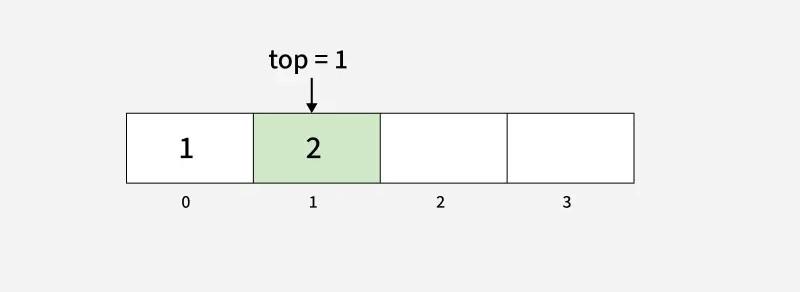
- If the stack is empty (top == -1), we simply print “Stack is empty”.
- Otherwise, we return the element stored at **index = top.
C++ `
int peek() {
if (top == -1) {
    cout << "Stack is Empty\n";
    return -1;
}

return arr[top];
}
C
int peek() {
if (top == -1)
{
    cout << "Stack is Empty\n";
    return -1;
}

return arr[top];
}
Java
int peek() {
if (top == -1) {
    System.out.println("Stack is Empty");
    return -1;
}

return arr[top];
}
Python
def peek(self):
if self.top == -1:
    print("Stack is Empty")
    return -1

return self.arr[self.top]
C#
int peek() {
if (top == -1) {
    Console.WriteLine("Stack is Empty");
    return -1;
}

return arr[top];
}
JavaScript
function peek() {
if (top == -1) {
    console.log('Stack is Empty');
    return -1;
}

return arr[top];
}
`
**Time Complexity: O(1)
**Auxiliary Space: O(1)
isEmpty Operation in Stack:
Returns true if the stack is empty, else false.
- Check for the value of top in stack.
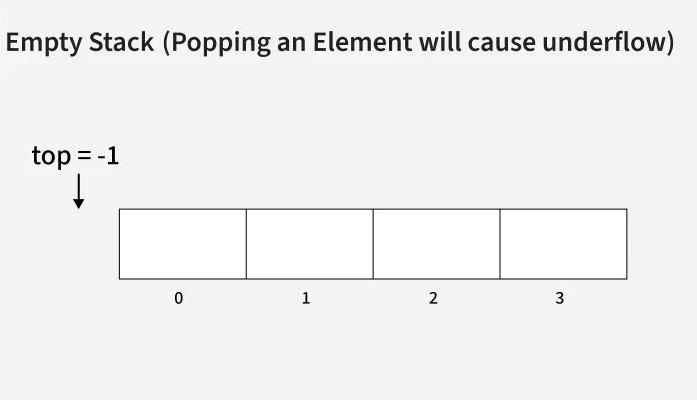
- If (top == -1) , then the stack is empty so return true.
- Otherwise, the stack is not empty so return false.
C++ `
bool isEmpty() {
return top == -1;}
C
bool isEmpty() {
return top == -1;}
Java
boolean isEmpty() {
return top == -1;}
Python
def isEmpty(self):
return self.top == -1C#
bool isEmpty() { return top == -1; }
JavaScript
isEmpty() {
return this.top === -1;}
`
**Time Complexity: O(1)
**Auxiliary Space: O(1)
isFull Operation in Stack :
Returns true if the stack is full, else false.
- Check for the value of top in stack.
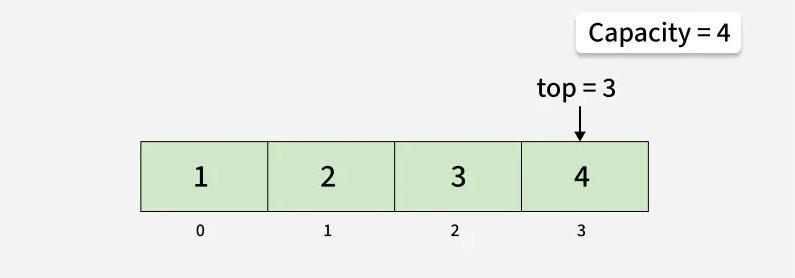
- If (top == capacity-1), then the stack is full so return true.
- Otherwise, the stack is not full so return false.
**Time Complexity: O(1)
**Auxiliary Space: O(1)
Full Implementation of Stack using Array
C++ `
#include using namespace std;
class myStack {
// array to store elements
int *arr;

// maximum size of stack
int capacity;

// index of top element
int top;
public:
// constructor
myStack(int cap) {
    capacity = cap;
    arr = new int[capacity];
    top = -1;
}

// push operation
void push(int x) {
    if (top == capacity - 1) {
        cout << "Stack Overflow\n";
        return;
    }
    arr[++top] = x;
}

// pop operation
int pop() {
    if (top == -1) {
        cout << "Stack Underflow\n";
        return -1;
    }
    return arr[top--];
}

// peek (or top) operation
int peek() {
    if (top == -1) {
        cout << "Stack is Empty\n";
        return -1;
    }
    return arr[top];
}

// check if stack is empty
bool isEmpty() {
    return top == -1;
}

// check if stack is full
bool isFull() {
    return top == capacity - 1;
}
};
int main() { myStack st(4);
// pushing elements
st.push(1);
st.push(2);
st.push(3);
st.push(4);

// popping one element
cout << "Popped: " << st.pop() << "\n";

// checking top element
cout << "Top element: " << st.peek() << "\n";

// checking if stack is empty
cout << "Is stack empty: " << (st.isEmpty() ? "Yes" : "No") << "\n";

// checking if stack is full
cout << "Is stack full: " << (st.isFull() ? "Yes" : "No") << "\n";

return 0;
}
C
#include <stdbool.h> #include <stdio.h> #include <stdlib.h>
// Define stack structure typedef struct { int *arr; // array to store elements int capacity; // maximum size of stack int top; // index of top element } Stack;
// Function to create a stack Stack *createStack(int capacity) { Stack *stack = (Stack *)malloc(sizeof(Stack)); stack->capacity = capacity; stack->arr = (int *)malloc(capacity * sizeof(int)); stack->top = -1; return stack; }
// Push operation void push(Stack *stack, int x) { if (stack->top == stack->capacity - 1) { printf("Stack Overflow\n"); return; } stack->arr[++stack->top] = x; }
// Pop operation int pop(Stack *stack) { if (stack->top == -1) { printf("Stack Underflow\n"); return -1; } return stack->arr[stack->top--]; }
// Peek operation int peek(Stack *stack) { if (stack->top == -1) { printf("Stack is Empty\n"); return -1; } return stack->arr[stack->top]; }
// Check if stack is empty bool isEmpty(Stack *stack) { return stack->top == -1; }
// Check if stack is full bool isFull(Stack *stack) { return stack->top == stack->capacity - 1; }
// Free stack memory void freeStack(Stack *stack) { free(stack->arr); free(stack); }
int main() { Stack *st = createStack(4);
// Push elements
push(st, 1);
push(st, 2);
push(st, 3);
push(st, 4);

// Pop one element
printf("Popped: %d\n", pop(st));

// Peek top element
printf("Top element: %d\n", peek(st));

// Check if stack is empty
printf("Is stack empty: %s\n", isEmpty(st) ? "Yes" : "No");

// Check if stack is full
printf("Is stack full: %s\n", isFull(st) ? "Yes" : "No");

freeStack(st); // free memory
return 0;
}
Java
import java.util.Arrays;
class myStack {
// array to store elements
private int[] arr;

// maximum size of stack
private int capacity;

// index of top element
private int top;

// constructor
public myStack(int cap) {
    capacity = cap;
    arr = new int[capacity];
    top = -1;
}

// push operation
public void push(int x) {
    if (top == capacity - 1) {
        System.out.println("Stack Overflow");
        return;
    }
    arr[++top] = x;
}

// pop operation
public int pop() {
    if (top == -1) {
        System.out.println("Stack Underflow");
        return -1;
    }
    return arr[top--];
}

// peek (or top) operation
public int peek() {
    if (top == -1) {
        System.out.println("Stack is Empty");
        return -1;
    }
    return arr[top];
}

// check if stack is empty
public boolean isEmpty() {
    return top == -1;
}

// check if stack is full
public boolean isFull() {
    return top == capacity - 1;
}
}
public class Main { public static void main(String[] args) { myStack st = new myStack(4);
    // pushing elements
    st.push(1);
    st.push(2);
    st.push(3);
    st.push(4);

    // popping one element
    System.out.println("Popped: " + st.pop());

    // checking top element
    System.out.println("Top element: " + st.peek());

    // checking if stack is empty
    System.out.println("Is stack empty: " +
                        (st.isEmpty() ? "Yes" : "No"));

    // checking if stack is full
    System.out.println("Is stack full: " +
                        (st.isFull() ? "Yes" : "No"));
}
}
Python
class myStack: # constructor def init(self, cap): self.capacity = cap self.arr = [0] * self.capacity self.top = -1
# push operation
def push(self, x):
    if self.top == self.capacity - 1:
        print("Stack Overflow")
        return
    self.top += 1
    self.arr[self.top] = x

# pop operation
def pop(self):
    if self.top == -1:
        print("Stack Underflow")
        return -1
    val = self.arr[self.top]
    self.top -= 1
    return val

# peek (or top) operation
def peek(self):
    if self.top == -1:
        print("Stack is Empty")
        return -1
    return self.arr[self.top]

# check if stack is empty
def isEmpty(self):
    return self.top == -1

# check if stack is full
def isFull(self):
    return self.top == self.capacity - 1
if name == "main": st = myStack(4)
# pushing elements
st.push(1)
st.push(2)
st.push(3)
st.push(4)

# popping one element
print("Popped:", st.pop())

# checking top element
print("Top element:", st.peek())

# checking if stack is empty
print("Is stack empty: ", "Yes" if st.isEmpty() else "No")

# checking if stack is full
print("Is stack full: ", "Yes" if st.isFull() else "No")
C#
using System;
class myStack {
// array to store elements
private int[] arr;

// maximum size of stack
private int capacity;

// index of top element
private int top;

public myStack(int cap) {
    capacity = cap;
    arr = new int[capacity];
    top = -1;
}

// push operation
public void push(int x) {
    if (top == capacity - 1) {
        Console.WriteLine("Stack Overflow");
        return;
    }
    arr[++top] = x;
}

// pop operation
public int pop() {
    if (top == -1) {
        Console.WriteLine("Stack Underflow");
        return -1;
    }
    return arr[top--];
}

// peek (or top) operation
public int peek() {
    if (top == -1) {
        Console.WriteLine("Stack is Empty");
        return -1;
    }
    return arr[top];
}

// check if stack is empty
public bool isEmpty() {
    return top == -1;
}

// check if stack is full
public bool isFull() {
    return top == capacity - 1;
}
}
class GfG { static void Main() { myStack st = new myStack(4);
    // pushing elements
    st.push(1);
    st.push(2);
    st.push(3);
    st.push(4);

    // popping one element
    Console.WriteLine("Popped:" + st.pop());

    // checking top element
    Console.WriteLine("Top element:" + st.peek());

    // checking if stack is empty
    Console.WriteLine("Is stack empty:" + (st.isEmpty() ? "Yes" : "No"));

    // checking if stack is full
    Console.WriteLine("Is stack full:" + (st.isFull() ? "Yes" : "No"));
}
}
JavaScript
class myStack { constructor(cap) {
    // array to store elements
    this.arr = new Array(cap);

    // maximum size of stack
    this.capacity = cap;

    // index of top element
    this.top = -1;
}

// push operation
push(x) {
    if (this.top === this.capacity - 1) {
        console.log("Stack Overflow");
        return;
    }
    this.arr[++this.top] = x;
}

// pop operation
pop() {
    if (this.top === -1) {
        console.log("Stack Underflow");
        return -1;
    }
    return this.arr[this.top--];
}

// peek (or top) operation
peek() {
    if (this.top === -1) {
        console.log("Stack is Empty");
        return -1;
    }
    return this.arr[this.top];
}

// check if stack is empty
isEmpty() {
    return this.top === -1;
}

// check if stack is full
isFull() {
    return this.top === this.capacity - 1;
}
}
// Driver Code let st = new myStack(4);
// pushing elements st.push(1); st.push(2); st.push(3); st.push(4);
// popping one element console.log("Popped: " + st.pop());
// checking top element console.log("Top element: " + st.peek());
// checking if stack is empty console.log("Is stack empty: " + (st.isEmpty() ? "Yes" : "No"));
// checking if stack is full console.log("Is stack full: " + (st.isFull() ? "Yes" : "No"));
`
Output
Popped: 4 Top element: 3 Is stack empty: No Is stack full: No
Stack Implementation using Dynamic Array
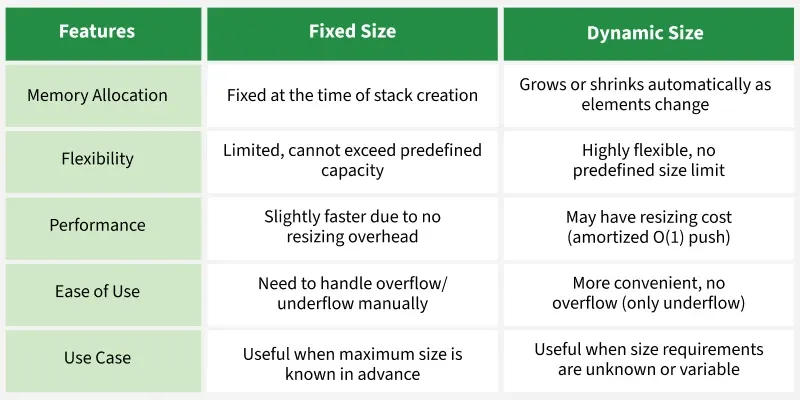
When using a fixed-size array, the stack has a maximum capacity that cannot grow beyond its initial size. To overcome this limitation, we can use **dynamic arrays. Dynamic arrays automatically resize themselves as elements are added or removed, which makes the stack more flexible.
- In C++, we can use vector.
- In Java, we can use ArrayList.
- In Python, we can use list.
- In C#, we can use List.
- In JavaScript, we can use Array. C++ `
#include #include using namespace std;
class myStack { vector arr;
public:
// push operation
void push(int x) {
    arr.push_back(x);
}

// pop operation
int pop() {
    if (arr.empty()) {
        cout << "Stack Underflow" << endl;
        return -1;
    }
    int val = arr.back();
    arr.pop_back();
    return val;
}

// peek operation
int peek() {
    if (arr.empty()) {
        cout << "Stack is Empty" << endl;
        return -1;
    }
    return arr.back();
}

// check if stack is empty
bool isEmpty() {
    return arr.empty();
}

// current size
int size() {
    return arr.size();
}
};
int main() { myStack st;
// pushing elements
st.push(1);
st.push(2);
st.push(3);
st.push(4);

// popping one element
cout << "Popped: " << st.pop() << endl;

// checking top element
cout << "Top element: " << st.peek() << endl;

// checking if stack is empty
cout << "Is stack empty: " << (st.isEmpty() ? "Yes" : "No") << endl;

// checking current size
cout << "Current size: " << st.size() << endl;
}
C
#include <stdbool.h> #include <stdio.h> #include <stdlib.h>
typedef struct { int *arr; // dynamic array to store stack elements int top; // index of top element int capacity; // current capacity of the stack } Stack;
// Initialize stack Stack *createStack(int initialCapacity) { Stack *stack = (Stack *)malloc(sizeof(Stack)); stack->arr = (int *)malloc(initialCapacity * sizeof(int)); stack->top = -1; stack->capacity = initialCapacity; return stack; }
// Push operation void push(Stack *stack, int value) { // Resize array if needed if (stack->top + 1 >= stack->capacity) { stack->capacity *= 2; // double the capacity stack->arr = (int *)realloc(stack->arr, stack->capacity * sizeof(int)); } stack->arr[++stack->top] = value; }
// Pop operation int pop(Stack *stack) { if (stack->top == -1) { printf("Stack Underflow\n"); return -1; } return stack->arr[stack->top--]; }
// Peek operation int peek(Stack *stack) { if (stack->top == -1) { printf("Stack is Empty\n"); return -1; } return stack->arr[stack->top]; }
// Check if stack is empty bool isEmpty(Stack *stack) { return stack->top == -1; }
// Current size of stack int size(Stack *stack) { return stack->top + 1; }
// Free stack memory void freeStack(Stack *stack) { free(stack->arr); free(stack); }
int main() { Stack *st = createStack(2); // initial capacity 2
// Push elements
push(st, 1);
push(st, 2);
push(st, 3);
push(st, 4);

// Pop one element
printf("Popped: %d\n", pop(st));

// Peek top element
printf("Top element: %d\n", peek(st));

// Check if stack is empty
printf("Is stack empty: %s\n", isEmpty(st) ? "Yes" : "No");

// Current size
printf("Current size: %d\n", size(st));

freeStack(st); // free memory
return 0;
}
Java
import java.util.ArrayList;
class myStack { ArrayList arr = new ArrayList<>();
// push operation
void push(int x) {
    arr.add(x);
}

// pop operation
int pop() {
    if (arr.isEmpty()) {
        System.out.println("Stack Underflow");
        return -1;
    }
    int val = arr.get(arr.size() - 1);
    arr.remove(arr.size() - 1);
    return val;
}

// peek operation
int peek() {
    if (arr.isEmpty()) {
        System.out.println("Stack is Empty");
        return -1;
    }
    return arr.get(arr.size() - 1);
}

// check if stack is empty
boolean isEmpty() {
    return arr.isEmpty();
}

// current size
int size() {
    return arr.size();
}

public static void main(String[] args) {
    myStack st = new myStack();

    // pushing elements
    st.push(1);
    st.push(2);
    st.push(3);
    st.push(4);

    // popping one element
    System.out.println("Popped: " + st.pop());

    // checking top element
    System.out.println("Top element: " + st.peek());

    // checking if stack is empty
    System.out.println("Is stack empty: " +
                        (st.isEmpty() ? "Yes" : "No"));

    // checking current size
    System.out.println("Current size: " + st.size());
}
}
Python
class myStack: def init(self): self.arr = []
# push operation
def push(self, x):
    self.arr.append(x)

# pop operation
def pop(self):
    if not self.arr:
        print("Stack Underflow")
        return -1
    return self.arr.pop()

# peek operation
def peek(self):
    if not self.arr:
        print("Stack is Empty")
        return -1
    return self.arr[-1]

# check if stack is empty
def isEmpty(self):
    return len(self.arr) == 0

# current size
def size(self):
    return len(self.arr)
if name == "main": st = myStack()
# pushing elements
st.push(1)
st.push(2)
st.push(3)
st.push(4)

# popping one element
print("Popped:", st.pop())

# checking top element
print("Top element:", st.peek())

# checking if stack is empty
print("Is stack empty:", "Yes" if st.isEmpty() else "No")

# checking current size
print("Current size:", st.size())
C#
using System; using System.Collections.Generic;
class myStack { List arr = new List();
// push operation
public void push(int x) {
    arr.Add(x);
}

// pop operation
public int pop() {
    if (arr.Count == 0) {
        Console.WriteLine("Stack Underflow");
        return -1;
    }
    int val = arr[arr.Count - 1];
    arr.RemoveAt(arr.Count - 1);
    return val;
}

// peek operation
public int peek() {
    if (arr.Count == 0) {
        Console.WriteLine("Stack is Empty");
        return -1;
    }
    return arr[arr.Count - 1];
}

// check if stack is empty
public bool isEmpty() {
    return arr.Count == 0;
}

// current size
public int size() {
    return arr.Count;
}

public static void Main() {
    myStack st = new myStack();

    // pushing elements
    st.push(1);
    st.push(2);
    st.push(3);
    st.push(4);

    // popping one element
    Console.WriteLine("Popped: " + st.pop());

    // checking top element
    Console.WriteLine("Top element: " + st.peek());

    // checking if stack is empty
    Console.WriteLine("Is stack empty: " +
                        (st.isEmpty() ? "Yes" : "No"));

    // checking current size
    Console.WriteLine("Current size: " + st.size());
}
}
JavaScript
class myStack { constructor() { this.arr = []; }
// push operation
push(x) {
    this.arr.push(x);
}

// pop operation
pop() {
    if (this.arr.length === 0) {
        console.log("Stack Underflow");
        return -1;
    }
    return this.arr.pop();
}

// peek operation
peek() {
    if (this.arr.length === 0) {
        console.log("Stack is Empty");
        return -1;
    }
    return this.arr[this.arr.length - 1];
}

// check if stack is empty
isEmpty() {
    return this.arr.length === 0;
}

// current size
size() {
    return this.arr.length;
}
}
// Driver Code let st = new myStack();
// pushing elements st.push(1); st.push(2); st.push(3); st.push(4);
// popping one element console.log("Popped:", st.pop());
// checking top element console.log("Top element:", st.peek());
// checking if stack is empty console.log("Is stack empty:", st.isEmpty() ? "Yes" : "No");
// checking current size console.log("Current size:", st.size());
`
Output
Popped: 4 Top element: 3 Is stack empty: No Current size: 3
Fixed Size Stack Vs Dynamic Size Stack