Implementation of Hash Table in C/C++ using Separate Chaining (original) (raw)
Last Updated : 28 May, 2026
Hashing is a technique used to map a large amount of data to a smaller, fixed-size value using a hash function.
- The process is irreversible - the original data cannot be reconstructed from the hash.
- Since large data is mapped into a smaller space, collisions can occur (different inputs producing the same hash).
- Collisions are common and unavoidable when the input set is larger than the output range.
Some Examples of Hash Functions
- key % number of buckets
- ASCII value of character * PrimeNumberx. Where x = 1, 2, 3....n
- You can make your own hash function but it should be a good hash function that gives less number of collisions.
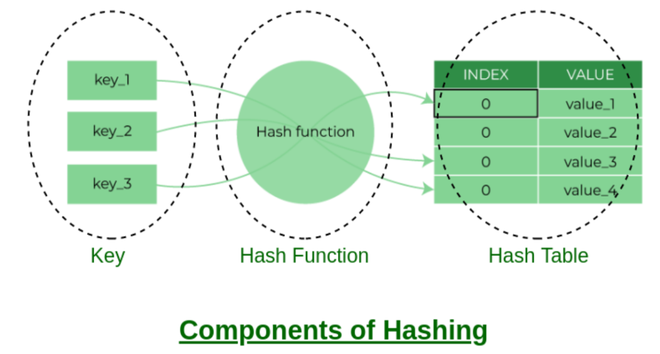
Components of Hashing
Bucket Index
The value returned by the Hash function is the bucket index for a key in a separate chaining method. Each index in the array is called a bucket as it is a bucket of a linked list.
Rehashing
Rehashing is a technique used in hash tables to reduce collisions when the number of elements increases. In rehashing, a new hash table with larger capacity (usually double the previous size) is created, and all existing elements are reinserted using the updated hash function.
**Note: Rehashing generally occurs when the load factor becomes greater than 0.5.
Steps in Rehashing
- Double the size of the hash table.
- Reinsert all existing elements into the new table using the hash function.
- Delete the old table and replace it with the new one.
Load Factor Formula
Load Factor = Number of Elements / Total Number of Buckets
Collision
Collision is the situation when the bucket index is not empty. It means that a linked list head is present at that bucket index. We have two or more values that map to the same bucket index.
Major Functions in our Program
- Insertion
- Search
- Hash Function
- Delete
- Rehashing
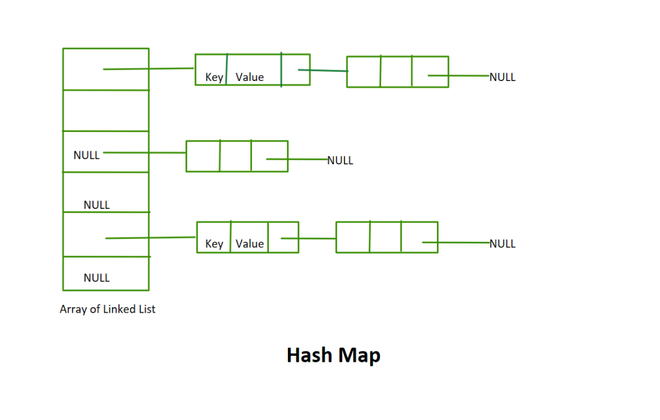
Hash Map
Implementation without Rehashing:
C++ `
#include #include #include
using namespace std;
// Linked List node struct node {
// key is string
char* key;

// value is also string
char* value;

struct node* next;
};
// Like constructor void setNode(struct node* node, char* key, char* value) {
node->key = key;
node->value = value;
node->next = NULL;

return;
}
struct hashMap {
// Current number of elements in hashMap
// and capacity of hashMap
int numOfElements, capacity;

// Holds base address array of linked lists
struct node** arr;
};
// Like constructor void initializeHashMap(struct hashMap* mp) {
// Default capacity
mp->capacity = 100;

mp->numOfElements = 0;

// Array of linked list pointers
mp->arr = (struct node**)calloc(
    mp->capacity,
    sizeof(struct node*)
);

return;
}
int hashFunction(struct hashMap* mp, char* key) {
int bucketIndex;

int sum = 0, factor = 31;

for (int i = 0; i < strlen(key); i++) {

    sum = (
        (sum % mp->capacity)
        + (((int)key[i]) * factor) % mp->capacity
    ) % mp->capacity;

    factor = (
        (factor % __INT16_MAX__)
        * (31 % __INT16_MAX__)
    ) % __INT16_MAX__;
}

bucketIndex = sum;

return bucketIndex;
}
void insert(struct hashMap* mp, char* key, char* value) {
// Getting bucket index
int bucketIndex = hashFunction(mp, key);

// Creating a new node
struct node* newNode =
    (struct node*)malloc(sizeof(struct node));

// Setting node values
setNode(newNode, key, value);

// No collision
if (mp->arr[bucketIndex] == NULL) {

    mp->arr[bucketIndex] = newNode;
}

// Collision occurred
else {

    // Insert at head of linked list
    newNode->next = mp->arr[bucketIndex];

    mp->arr[bucketIndex] = newNode;
}

// Update number of elements
mp->numOfElements++;

return;
}
void deleteKey(struct hashMap* mp, char* key) {
// Getting bucket index
int bucketIndex = hashFunction(mp, key);

struct node* prevNode = NULL;

// Head node of linked list
struct node* currNode = mp->arr[bucketIndex];

while (currNode != NULL) {

    // Key found
    if (strcmp(key, currNode->key) == 0) {

        // Head node deletion
        if (currNode == mp->arr[bucketIndex]) {

            mp->arr[bucketIndex] = currNode->next;
        }

        // Middle or last node deletion
        else {

            prevNode->next = currNode->next;
        }

        free(currNode);

        // Update number of elements
        mp->numOfElements--;

        break;
    }

    prevNode = currNode;

    currNode = currNode->next;
}

return;
}
char* search(struct hashMap* mp, char* key) {
// Getting bucket index
int bucketIndex = hashFunction(mp, key);

// Head of linked list
struct node* bucketHead =
    mp->arr[bucketIndex];

while (bucketHead != NULL) {

    // Key found
    if (strcmp(bucketHead->key, key) == 0) {

        return bucketHead->value;
    }

    bucketHead = bucketHead->next;
}

// Key not found
char* errorMssg =
    (char*)malloc(sizeof(char) * 25);

strcpy(errorMssg,
       "Oops! No data found.\n");

return errorMssg;
}
// Driver code int main() {
// Initialize hash map
struct hashMap* mp =
    (struct hashMap*)malloc(sizeof(struct hashMap));

initializeHashMap(mp);

insert(mp, "Yogaholic", "Anjali");
insert(mp, "pluto14", "Vartika");
insert(mp, "elite_Programmer", "Manish");
insert(mp, "GFG", "GeeksforGeeks");
insert(mp, "decentBoy", "Mayank");

printf("%s\n", search(mp, "elite_Programmer"));
printf("%s\n", search(mp, "Yogaholic"));
printf("%s\n", search(mp, "pluto14"));
printf("%s\n", search(mp, "decentBoy"));
printf("%s\n", search(mp, "GFG"));

// Key not inserted
printf("%s\n", search(mp, "randomKey"));

printf("\nAfter deletion : \n");

// Delete key
deleteKey(mp, "decentBoy");

// Search deleted key
printf("%s\n", search(mp, "decentBoy"));

return 0;
}
C
#include <stdio.h> #include <stdlib.h> #include <string.h>
// Linked List node struct node {
// key is string
char* key;

// value is also string
char* value;
struct node* next;
};
// like constructor void setNode(struct node* node, char* key, char* value) { node->key = key; node->value = value; node->next = NULL; return; };
struct hashMap {
// Current number of elements in hashMap
// and capacity of hashMap
int numOfElements, capacity;

// hold base address array of linked list
struct node** arr;
};
// like constructor void initializeHashMap(struct hashMap* mp) {
// Default capacity in this case
mp->capacity = 100;
mp->numOfElements = 0;

// array of size = 1
mp->arr = (struct node**)malloc(sizeof(struct node*)
                                * mp->capacity);
return;
}
int hashFunction(struct hashMap* mp, char* key) { int bucketIndex; int sum = 0, factor = 31; for (int i = 0; i < strlen(key); i++) {
    // sum = sum + (ascii value of
    // char * (primeNumber ^ x))...
    // where x = 1, 2, 3....n
    sum = ((sum % mp->capacity)
           + (((int)key[i]) * factor) % mp->capacity)
          % mp->capacity;

    // factor = factor * prime
    // number....(prime
    // number) ^ x
    factor = ((factor % __INT16_MAX__)
              * (31 % __INT16_MAX__))
             % __INT16_MAX__;
}

bucketIndex = sum;
return bucketIndex;
}
void insert(struct hashMap* mp, char* key, char* value) {
// Getting bucket index for the given
// key - value pair
int bucketIndex = hashFunction(mp, key);
struct node* newNode = (struct node*)malloc(

    // Creating a new node
    sizeof(struct node));

// Setting value of node
setNode(newNode, key, value);

// Bucket index is empty....no collision
if (mp->arr[bucketIndex] == NULL) {
    mp->arr[bucketIndex] = newNode;
}

// Collision
else {

    // Adding newNode at the head of
    // linked list which is present
    // at bucket index....insertion at
    // head in linked list
    newNode->next = mp->arr[bucketIndex];
    mp->arr[bucketIndex] = newNode;
}
return;
}
void delete (struct hashMap* mp, char* key) {
// Getting bucket index for the
// given key
int bucketIndex = hashFunction(mp, key);

struct node* prevNode = NULL;

// Points to the head of
// linked list present at
// bucket index
struct node* currNode = mp->arr[bucketIndex];

while (currNode != NULL) {

    // Key is matched at delete this
    // node from linked list
    if (strcmp(key, currNode->key) == 0) {

        // Head node
        // deletion
        if (currNode == mp->arr[bucketIndex]) {
            mp->arr[bucketIndex] = currNode->next;
        }

        // Last node or middle node
        else {
            prevNode->next = currNode->next;
        }
        free(currNode);
        break;
    }
    prevNode = currNode;
    currNode = currNode->next;
}
return;
}
char* search(struct hashMap* mp, char* key) {
// Getting the bucket index
// for the given key
int bucketIndex = hashFunction(mp, key);

// Head of the linked list
// present at bucket index
struct node* bucketHead = mp->arr[bucketIndex];
while (bucketHead != NULL) {

    // Key is found in the hashMap
    if (bucketHead->key == key) {
        return bucketHead->value;
    }
    bucketHead = bucketHead->next;
}

// If no key found in the hashMap
// equal to the given key
char* errorMssg = (char*)malloc(sizeof(char) * 25);
errorMssg = "Oops! No data found.\n";
return errorMssg;
}
// Drivers code int main() {
// Initialize the value of mp
struct hashMap* mp
    = (struct hashMap*)malloc(sizeof(struct hashMap));
initializeHashMap(mp);

insert(mp, "Yogaholic", "Anjali");
insert(mp, "pluto14", "Vartika");
insert(mp, "elite_Programmer", "Manish");
insert(mp, "GFG", "GeeksforGeeks");
insert(mp, "decentBoy", "Mayank");

printf("%s\n", search(mp, "elite_Programmer"));
printf("%s\n", search(mp, "Yogaholic"));
printf("%s\n", search(mp, "pluto14"));
printf("%s\n", search(mp, "decentBoy"));
printf("%s\n", search(mp, "GFG"));

// Key is not inserted
printf("%s\n", search(mp, "randomKey"));

printf("\nAfter deletion : \n");

// Deletion of key
delete (mp, "decentBoy");
printf("%s\n", search(mp, "decentBoy"));

return 0;
}
`
Output
Manish Anjali Vartika Mayank GeeksforGeeks Oops! No data found.
After deletion : Oops! No data found.
**Explanation:
- **Insertion: Inserts the key-value pair at the head of the linked list at the calculated bucket index and increments numOfElements.
- **hashFunction: Calculates the bucket index using ASCII values of characters multiplied by powers of the prime number 31.
- **Deletion: Removes the key-value pair associated with the given key from the hash table. After successful deletion, numOfElements is decremented.
- **Search: Searches for the value associated with the given key in the hash table.
This implementation does not use rehashing and works with a fixed-size array of linked lists. In the given example, both keys and values are strings.
**Time Complexity and Space Complexity:
The time complexity of hash table insertion and deletion operations is O(1) on average. There is some mathematical calculation that proves it.
- **Time Complexity of Insertion: In the average case it is constant. In the worst case, it is linear.
- **Time Complexity of Search: In the average case it is constant. In the worst case, it is linear.
- **Time Complexity of Deletion: In average cases it is constant. In the worst case, it is linear.
- **Space Complexity: O(n) as it has n number of elements.
Related Article: Separate Chaining Collision Handling Technique in Hashing.