InPlace Algorithm (original) (raw)
In-Place Algorithm
Last Updated : 11 Jul, 2025
In-place has more than one definition. One strict definition is.
An in-place algorithm is an algorithm that does not need an extra space and produces an output in the same memory that contains the data by transforming the input 'in-place'. However, a small constant extra space used for variables is allowed.
A more broad definition is,
In-place means that the algorithm does not use extra space for manipulating the input but may require a small though non-constant extra space for its operation. Usually, this space is O(log n), though sometimes anything in O(n) (Smaller than linear) is allowed.
A Not In-Place Implementation of reversing an array
Implementation:
C++ `
// An Not in-place C++ program to reverse an array #include <bits/stdc++.h> using namespace std;
/* Function to reverse arr[] from start to end*/ void reverseArray(int arr[], int n) { // Create a copy array and store reversed // elements int rev[n]; for (int i=0; i<n; i++) rev[n-i-1] = arr[i];
// Now copy reversed elements back to arr[] for (int i=0; i<n; i++) arr[i] = rev[i]; }
/* Utility function to print an array */ void printArray(int arr[], int size) { for (int i = 0; i < size; i++) cout << arr[i] << " "; cout << endl; }
/* Driver function to test above functions */
int main()
{
int arr[] = {1, 2, 3, 4, 5, 6};
int n = sizeof(arr)/sizeof(arr[0]);
printArray(arr, n);
reverseArray(arr, n);
cout << "Reversed array is" << endl;
printArray(arr, n);
return 0;
}
Java
// An Not in-place Java program // to reverse an array import java.util.*;
class GFG { /* Function to reverse arr[] from start to end*/ public static void reverseArray(int []arr, int n) { // Create a copy array // and store reversed // elements int []rev = new int[n]; for (int i = 0; i < n; i++) rev[n - i - 1] = arr[i];
    // Now copy reversed
    // elements back to arr[]
    for (int i = 0; i < n; i++)
        arr[i] = rev[i];
}

/* Utility function to
   print an array */
public static void printArray(int []arr,
                              int size)
{
for (int i = 0; i < size; i++)
    System.out.print(arr[i] + " ");
System.out.println("");
}

// Driver code
public static void main(String[] args)
{
    int arr[] = {1, 2, 3, 4, 5, 6};
    int n = arr.length;
    printArray(arr, n);
    reverseArray(arr, n);
    System.out.println("Reversed array is");
    printArray(arr, n);
}
}
// This code is contributed // by Harshit Saini
Python3
An Not in-place Python program
to reverse an array
''' Function to reverse arr[] from start to end ''' def reverseArray(arr, n):
# Create a copy array
# and store reversed
# elements
rev = n * [0]
for i in range(0, n):
    rev[n - i - 1] = arr[i]

# Now copy reversed
# elements back to arr[]
for i in range(0, n):
    arr[i] = rev[i]
Driver code
if name == "main": arr = [1, 2, 3, 4, 5, 6] n = len(arr) print(*arr) reverseArray(arr, n); print("Reversed array is") print(*arr)
This code is contributed
by Harshit Saini
C#
// An Not in-place C# program // to reverse an array using System;
class GFG { /* Function to reverse arr[] from start to end*/ public static void reverseArray(int[] arr, int n) { // Create a copy array // and store reversed // elements int[] rev = new int[n]; for (int i = 0; i < n; i++) rev[n - i - 1] = arr[i];
    // Now copy reversed
    // elements back to arr[]
    for (int i = 0; i < n; i++)
        arr[i] = rev[i];
}

/* Utility function to
print an array */
public static void printArray(int[] arr,
                            int size)
{
for (int i = 0; i < size; i++)
    Console.Write(arr[i] + " ");
Console.Write("\n");
}

// Driver code
public static void Main()
{
    int[] arr = {1, 2, 3, 4, 5, 6};
    int n = arr.Length;
    printArray(arr, n);
    reverseArray(arr, n);
    Console.WriteLine("Reversed array is");
    printArray(arr, n);
}
}
// This code is contributed by Ita_c.
JavaScript
`
Output
1 2 3 4 5 6 Reversed array is 6 5 4 3 2 1
Time Complexity: O(n)
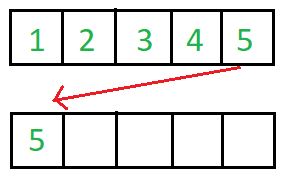
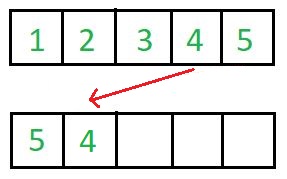
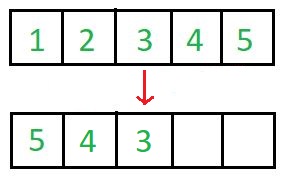
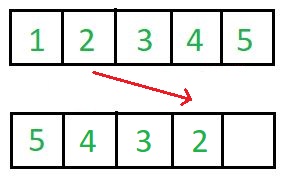
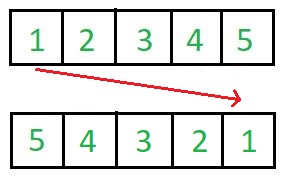
This needs O(n) extra space and is an example of a not-in-place algorithm.
An In-Place Implementation of Reversing an array.
Implementation:
C++ `
// An in-place C++ program to reverse an array #include <bits/stdc++.h> using namespace std;
/* Function to reverse arr[] from start to end*/ void reverseArray(int arr[], int n) { for (int i=0; i<n/2; i++) swap(arr[i], arr[n-i-1]); }
/* Utility function to print an array */ void printArray(int arr[], int size) { for (int i = 0; i < size; i++) cout << arr[i] << " "; cout << endl; }
/* Driver function to test above functions */
int main()
{
int arr[] = {1, 2, 3, 4, 5, 6};
int n = sizeof(arr)/sizeof(arr[0]);
printArray(arr, n);
reverseArray(arr, n);
cout << "Reversed array is" << endl;
printArray(arr, n);
return 0;
}
Java
// An in-place Java program // to reverse an array import java.util.*;
class GFG { public static int __(int x, int y) {return x;}
/* Function to reverse arr[]
   from start to end*/
public static void reverseArray(int []arr,
                                 int n)
{
    for (int i = 0; i < n / 2; i++)
        arr[i] = __(arr[n - i - 1],
                    arr[n - i - 1] = arr[i]);
}

/* Utility function to
   print an array */
public static void printArray(int []arr,
                              int size)
{
    for (int i = 0; i < size; i++)
        System.out.print(Integer.toString(arr[i]) + " ");
    System.out.println("");
}

// Driver code
public static void main(String[] args)
{
    int []arr = new int[]{1, 2, 3, 4, 5, 6};
    int n = arr.length;
    printArray(arr, n);
    reverseArray(arr, n);
    System.out.println("Reversed array is");
    printArray(arr, n);
}
}
// This code is contributed // by Harshit Saini
Python3
An in-place Python program
to reverse an array
''' Function to reverse arr[] from start to end''' def reverseArray(arr, n):
for i in range(0, int(n / 2)):
    arr[i], arr[n - i - 1] = arr[n - i - 1], arr[i]
Driver code
if name == "main":
arr = [1, 2, 3, 4, 5, 6]
n = len(arr)
print(*arr)
reverseArray(arr, n)
print("Reversed array is")
print(*arr)
This code is contributed
by Harshit Saini
C#
// An in-place C# program // to reverse an array using System;
class GFG { public static int __(int x, int y) {return x;}
/* Function to reverse arr[]
from start to end*/
public static void reverseArray(int []arr,
                                int n)
{
    for (int i = 0; i < n / 2; i++)
        arr[i] = __(arr[n - i - 1],
                    arr[n - i - 1] = arr[i]);
}

/* Utility function to
print an array */
public static void printArray(int []arr,
                            int size)
{
    for (int i = 0; i < size; i++)
        Console.Write(arr[i] + " ");
    Console.WriteLine("");
}

// Driver code
public static void Main(String[] args)
{
    int []arr = new int[]{1, 2, 3, 4, 5, 6};
    int n = arr.Length;
    printArray(arr, n);
    reverseArray(arr, n);
    Console.WriteLine("Reversed array is");
    printArray(arr, n);
}
}
/* This code is contributed by PrinciRaj1992 */
JavaScript
`
Output
1 2 3 4 5 6 Reversed array is 6 5 4 3 2 1
Time Complexity: O(n)
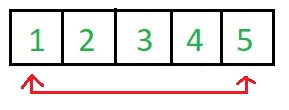
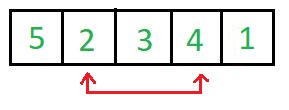
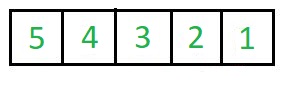
This needs O(1) extra space for exchanging elements and is an example of an in-place algorithm.
Which Sorting Algorithms are In-Place and which are not?
In Place: Bubble sort, Selection Sort, Insertion Sort, Heapsort.
Not In-Place: Merge Sort. Note that merge sort requires O(n) extra space.
What about QuickSort? Why is it called In-Place?
QuickSort uses extra space for recursive function calls. It is called in-place according to broad definition as extra space required is not used to manipulate input, but only for recursive calls.