Introduction to Dynamic Programming on Trees (original) (raw)
Last Updated : 4 Dec, 2024
**Dynamic Programming is a technique to solve problems by breaking them down into **overlapping sub-problems which follows the optimal substructure. There are various problems using DP like subset sum, knapsack, coin change etc. DP can also be applied to **trees to solve some specific problems.
Given a **binary tree with **n nodes and **n-1 edges, calculate the **maximum sum of the node values from the **root to any of the leaves without **re-visiting any node.
**Examples:
**Input:
**Output: 22
**Explanation: Given above is a diagram of a tree with n = 14 nodes and n-1 = 13 edges.The below shows all the paths from root to leaves:
- 3 -> 2 -> 1 -> 4: sum of all node values = 10
- 3 -> 2 -> 1 -> 5: sum of all node values = 11
- 3 -> 2 -> 3: sum of all node values = 8
- 3 -> 1 -> 9 -> 9: sum of all node values = 22
- 3 -> 1 -> 9 -> 8 : sum of all node values = 21
- 3 -> 10 -> 1: sum of all node values = 14
- 3 -> 10 -> 5 : sum of all node values = 18
- 3 -> 10 -> 3 : sum of all node values = 16
The answer is 22, as Path 4 has the maximum sum of values of nodes in its path from a root to leaves.
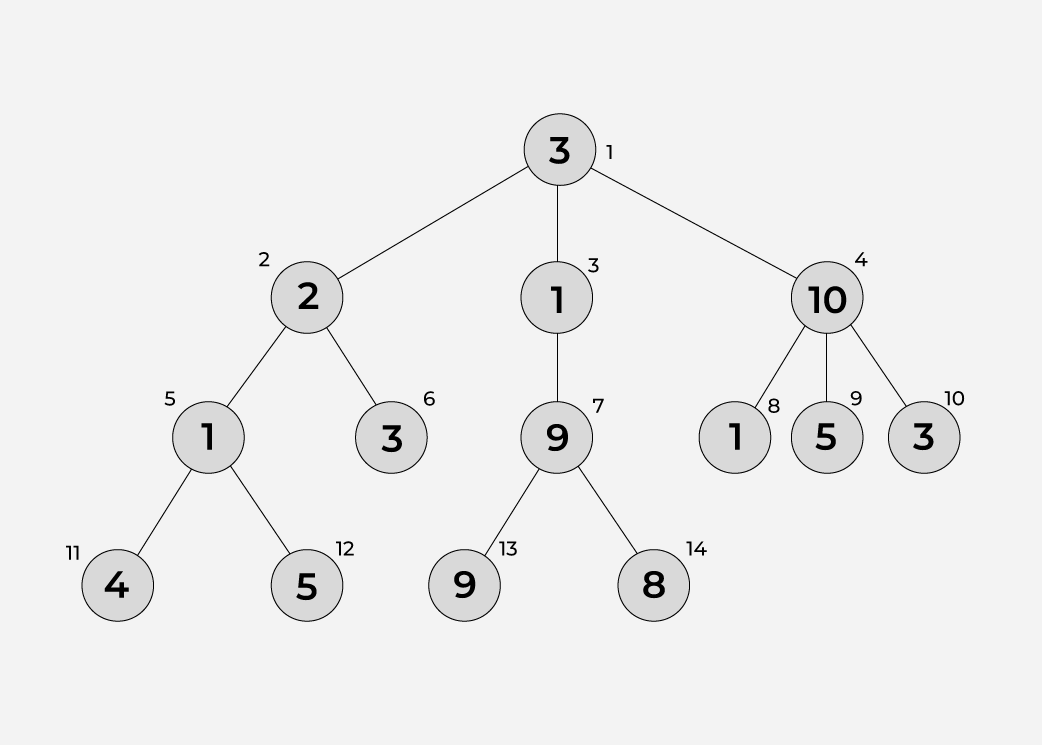
**The greedy approach fails in this case. Starting from the **root andtake 3 from the **first level, 10 from the **next level and 5 from the **third level greedily. **Result is path -7 if after following the greedy approach, hence do not apply greedy approach over here.
Using Recursion - O(n) Time and O(h) Space
For the recursive approach, the task is to calculate the maximum sum from the root to any leaf node. At each node, there are two cases:
- *Add the value of the *current node to the currentSum and proceed to it*s left and right* children recursively.
- If the node is a leaf (both **left and right children are null), compare the **currentSum with the **maxSum. Update maxSum if currentSum is greater.
Mathematically, the recurrence relation can be expressed as:
- **maxSumPath(node) = node->data + max(maxSumPath(node->left), maxSumPath(node->right))
**Base Case:
If the **current node is **nullptr, return from the **recursion (no addition to the sum is possible).
C++ `
// C++ code to calculate the maximum sum from root // to leaf node using recursion. #include #include using namespace std;
class Node { public: int data; Node *left; Node *right;
Node(int x) {
    data = x;
    left = right = nullptr;
}
};
// Helper function to find maximum sum path void maxSumPath(Node *node, int currentSum, int &maxSum) { if (node == nullptr) { return; }
// Add current node's data to the path sum
currentSum += node->data;

// Check if leaf node is reached, update maxSum
if (node->left == nullptr && node->right == nullptr) {
    if (currentSum > maxSum) {
        maxSum = currentSum;
    }
}
else {

    // Recurse for left and right subtrees
    maxSumPath(node->left, currentSum, maxSum);
    maxSumPath(node->right, currentSum, maxSum);
}
}
// Function to get the maximum sum from root to any leaf int maxRootToLeafSum(Node *root) { int maxSum = 0; maxSumPath(root, 0, maxSum); return maxSum; }
int main() {
// Harcoded binary tree
//        1
//       / \
//      2   3
//     /\   /
//    4  5 6
Node *root = new Node(1);
root->left = new Node(2);
root->right = new Node(3);
root->left->left = new Node(4);
root->left->right = new Node(5);
root->right->left = new Node(6);

cout << maxRootToLeafSum(root) << endl;

return 0;
}
Java
// Java code to calculate the maximum sum from root // to leaf node using recursion. import java.util.*;
class Node { int data; Node left, right;
Node(int x) {
    data = x;
    left = right = null;
}
}
class GfG {
static void maxSumPath(Node node, int currentSum,
                                    int[] maxSum) {
    if (node == null) {
        return;
    }

    // Add current node's data to the path sum
    currentSum += node.data;

    // Check if leaf node is reached, update maxSum
    if (node.left == null && node.right == null) {
        if (currentSum > maxSum[0]) {
            maxSum[0] = currentSum;
        }
    }
    else {

        // Recurse for left and right subtrees
        maxSumPath(node.left, currentSum, maxSum);
        maxSumPath(node.right, currentSum, maxSum);
    }
}

// Function to get the maximum sum from
// root to any leaf
static int maxRootToLeafSum(Node root) {
    int[] maxSum = {0};
    maxSumPath(root, 0, maxSum);
    return maxSum[0];
}

public static void main(String[] args) {

    // Hardcoded binary tree
    //        1
    //       / \
    //      2   3
    //     /\   /
    //    4  5 6
    Node root = new Node(1);
    root.left = new Node(2);
    root.right = new Node(3);
    root.left.left = new Node(4);
    root.left.right = new Node(5);
    root.right.left = new Node(6);

    System.out.print(maxRootToLeafSum(root));
}
}
Python
Python code to calculate the maximum sum from root
to leaf node using recursion.
class Node: def init(self, x): self.data = x self.left = None self.right = None
Helper function to find maximum sum path
def max_sum_path(node, current_sum, max_sum): if node is None: return
# Add current node's data to the path sum
current_sum += node.data

# Check if leaf node is reached, update max_sum
if node.left is None and node.right is None:
    max_sum[0] = max(max_sum[0], current_sum)
else:

    # Recurse for left and right subtrees
    max_sum_path(node.left, current_sum, max_sum)
    max_sum_path(node.right, current_sum, max_sum)
Function to get the maximum sum from root to any leaf
def max_root_to_leaf_sum(root): max_sum = [0] max_sum_path(root, 0, max_sum) return max_sum[0]
if name == "main":
# Hardcoded binary tree
#        1
#       / \
#      2   3
#     / \  /
#    4   5 6
root = Node(1)
root.left = Node(2)
root.right = Node(3)
root.left.left = Node(4)
root.left.right = Node(5)
root.right.left = Node(6)

print(max_root_to_leaf_sum(root))
C#
// C# code to calculate the maximum sum from root // to leaf node using recursion. using System;
class Node { public int data; public Node left, right;
public Node(int x) {
    data = x;
    left = right = null;
}
}
class GfG {
// Helper function to find maximum sum path
static void MaxSumPath(Node node,
                          int currentSum, int[] maxSum) {
    if (node == null) {
        return;
    }

    // Add current node's data to the path sum
    currentSum += node.data;

    // Check if leaf node is reached, update maxSum
    if (node.left == null && node.right == null) {
        if (currentSum > maxSum[0]) {
            maxSum[0] = currentSum;
        }
    }
   else {

        // Recurse for left and right subtrees
        MaxSumPath(node.left, currentSum, maxSum);
        MaxSumPath(node.right, currentSum, maxSum);
    }
}

// Function to get the maximum sum from root to any leaf
static int MaxRootToLeafSum(Node root) {
    int[] maxSum = {0};
    MaxSumPath(root, 0, maxSum);
    return maxSum[0];
}

static void Main(string[] args) {

    // Hardcoded binary tree
    //        1
    //       / \
    //      2   3
    //     / \  /
    //    4   5 6
    Node root = new Node(1);
    root.left = new Node(2);
    root.right = new Node(3);
    root.left.left = new Node(4);
    root.left.right = new Node(5);
    root.right.left = new Node(6);

    Console.WriteLine(MaxRootToLeafSum(root));
}
}
JavaScript
// JavaScript code to calculate the maximum sum
// from root to leaf node using recursion.
class Node {
constructor(data) {
this.data = data;
this.left = null;
this.right = null;
}
}
// Helper function to find the maximum sum path function maxSumPath(node, currentSum, maxSum) { if (node === null) { return; }
// Add current node's data to the path sum
currentSum += node.data;

// Check if leaf node is reached, update maxSum
if (node.left === null && node.right === null) {
    if (currentSum > maxSum[0]) {
        maxSum[0] = currentSum;
    }
} else {

    // Recurse for left and right subtrees
    maxSumPath(node.left, currentSum, maxSum);
    maxSumPath(node.right, currentSum, maxSum);
}
}
// Function to get the maximum sum from root to any leaf function maxRootToLeafSum(root) { let maxSum = [0]; maxSumPath(root, 0, maxSum); return maxSum[0]; }
// Hardcoded binary tree // 1 // / \ // 2 3 // / \ / // 4 5 6 const root = new Node(1); root.left = new Node(2); root.right = new Node(3); root.left.left = new Node(4); root.left.right = new Node(5); root.right.left = new Node(6);
console.log(maxRootToLeafSum(root));
`
Using Top-Down DP (Memoization) - O(n) Time and O(n) Space
**1. Optimal Substructure: The solution to the **maximum sum problem can be derived from the optimal solutions of smaller subproblems. At any given node, the maximum path sum is the **sum of the node’s value and the maximum of the sums obtained from its **left and **right children.
**2. Overlapping Subproblems: The maximum sum for a node may be recomputed **multiple times. Using a **memoization table we:
- Check if the result for a node **exists.If not, compute and store it.
- This avoids redundant calculations and ensures each node is processed once.
**Memoization Condition: If the **result for the current node is already stored in the memoization table:
- **if memo[node] exists, return memo[node]

C++ `
// C++ code to calculate the maximum sum from root // to leaf node using recursion and memoization. #include #include using namespace std;
class Node { public: int data; Node *left; Node *right;
Node(int x) {
    data = x;
    left = right = nullptr;
}
};
// Helper function to find maximum sum path with memoization int maxSumPath(Node *node, unordered_map<Node*, int> &memo) { if (node == nullptr) { return 0; }
// Check if the result is already in memo
if (memo.find(node) != memo.end()) {
    return memo[node];
}

// If it's a leaf node, the maximum sum is its own data
if (node->left == nullptr && node->right == nullptr) {
    return memo[node] = node->data;
}

// Recurse for left and right subtrees and
// choose the maximum path
int leftSum = maxSumPath(node->left, memo);
int rightSum = maxSumPath(node->right, memo);

// Store the computed result in memo
memo[node] = node->data + max(leftSum, rightSum);
return memo[node];
}
// Function to get the maximum sum from root to any leaf int maxRootToLeafSum(Node *root) { unordered_map<Node*, int> memo; return maxSumPath(root, memo); }
int main() {
// Hardcoded binary tree
//        1
//       / \
//      2   3
//     /\   /
//    4  5 6
Node *root = new Node(1);
root->left = new Node(2);
root->right = new Node(3);
root->left->left = new Node(4);
root->left->right = new Node(5);
root->right->left = new Node(6);

cout << maxRootToLeafSum(root) << endl;

return 0;
}
Java
// Java code to calculate the maximum sum from root // to leaf node using recursion and memoization. import java.util.HashMap;
class Node { int data; Node left, right;
Node(int x) {
    data = x;
    left = right = null;
}
}
class GfG {
// Helper function to find maximum sum path with memoization
static int maxSumPath(Node node,
                      HashMap<Node, Integer> memo) {
    if (node == null) {
        return 0;
    }

    // Check if the result is already in memo
    if (memo.containsKey(node)) {
        return memo.get(node);
    }

    // If it's a leaf node, the maximum sum is its own data
    if (node.left == null && node.right == null) {
        memo.put(node, node.data);
        return node.data;
    }

    // Recurse for left and right subtrees and
    // choose the maximum path
    int leftSum = maxSumPath(node.left, memo);
    int rightSum = maxSumPath(node.right, memo);

    // Store the computed result in memo
    int result = node.data + Math.max(leftSum, rightSum);
    memo.put(node, result);
    return result;
}

// Function to get the maximum sum from root to any leaf
static int maxRootToLeafSum(Node root) {
    HashMap<Node, Integer> memo = new HashMap<>();
    return maxSumPath(root, memo);
}

public static void main(String[] args) {

    // Hardcoded binary tree
    //        1
    //       / \
    //      2   3
    //     /\   /
    //    4  5 6
    Node root = new Node(1);
    root.left = new Node(2);
    root.right = new Node(3);
    root.left.left = new Node(4);
    root.left.right = new Node(5);
    root.right.left = new Node(6);

    System.out.print(maxRootToLeafSum(root));
}
}
Python
Python code to calculate the maximum sum from root
to leaf node recursion and memoization.
class Node: def init(self, data): self.data = data self.left = None self.right = None
Helper function to find maximum sum
path with memoization
def max_sum_path(node, memo): if node is None: return 0
# Check if the result is already in memo
if node in memo:
    return memo[node]

# If it's a leaf node, the maximum sum
# is its own data
if node.left is None and node.right is None:
    memo[node] = node.data
    return memo[node]

# Recurse for left and right subtrees and
# choose the maximum path
left_sum = max_sum_path(node.left, memo)
right_sum = max_sum_path(node.right, memo)

# Store the computed result in memo
memo[node] = node.data + max(left_sum, right_sum)
return memo[node]
Function to get the maximum sum from root to any leaf
def max_root_to_leaf_sum(root): memo = {} return max_sum_path(root, memo)
if name == "main":
# Hardcoded binary tree
#        1
#       / \
#      2   3
#     /\   /
#    4  5 6
root = Node(1)
root.left = Node(2)
root.right = Node(3)
root.left.left = Node(4)
root.left.right = Node(5)
root.right.left = Node(6)

print(max_root_to_leaf_sum(root))
C#
// C# code to calculate the maximum sum from root // to leaf node using recursion and memoization. using System; using System.Collections.Generic;
class Node { public int data; public Node left, right;
public Node(int x) {
    data = x;
    left = right = null;
}
}
class GfG {
// Helper function to find maximum sum path with memoization
static int MaxSumPath(Node node, Dictionary<Node, int> memo) {
    if (node == null) {
        return 0;
    }

    // Check if the result is already in memo
    if (memo.ContainsKey(node)) {
        return memo[node];
    }

    // If it's a leaf node, the maximum sum is its own data
    if (node.left == null && node.right == null) {
        memo[node] = node.data;
        return node.data;
    }

    // Recurse for left and right subtrees and choose the maximum path
    int leftSum = MaxSumPath(node.left, memo);
    int rightSum = MaxSumPath(node.right, memo);

    // Store the computed result in memo
    int result = node.data + Math.Max(leftSum, rightSum);
    memo[node] = result;
    return result;
}

// Function to get the maximum sum from root to any leaf
static int MaxRootToLeafSum(Node root) {
    Dictionary<Node, int> memo
            = new Dictionary<Node, int>();

    return MaxSumPath(root, memo);
}

static void Main(string[] args) {

    // Hardcoded binary tree
    //        1
    //       / \
    //      2   3
    //     /\   /
    //    4  5 6
    Node root = new Node(1);
    root.left = new Node(2);
    root.right = new Node(3);
    root.left.left = new Node(4);
    root.left.right = new Node(5);
    root.right.left = new Node(6);

    Console.WriteLine(MaxRootToLeafSum(root));
}
}
JavaScript
// JavaScript code to calculate the maximum sum from root // to leaf node using recursion and memoization. class Node { constructor(data) { this.data = data; this.left = null; this.right = null; } }
// Helper function to find maximum sum // path with memoization function maxSumPath(node, memo) { if (node === null) { return 0; }
// Check if the result is already in memo
if (memo.has(node)) {
    return memo.get(node);
}

// If it's a leaf node, the maximum sum is its own data
if (node.left === null && node.right === null) {
    memo.set(node, node.data);
    return node.data;
}

// Recurse for left and right subtrees and
// choose the maximum path
const leftSum = maxSumPath(node.left, memo);
const rightSum = maxSumPath(node.right, memo);

// Store the computed result in memo
const result = node.data + Math.max(leftSum, rightSum);
memo.set(node, result);
return result;
}
// Function to get the maximum sum from root to any leaf function maxRootToLeafSum(root) { const memo = new Map(); return maxSumPath(root, memo); }
// Hardcoded binary tree // 1 // / \ // 2 3 // /\ / // 4 5 6 const root = new Node(1); root.left = new Node(2); root.right = new Node(3); root.left.left = new Node(4); root.left.right = new Node(5); root.right.left = new Node(6);
console.log(maxRootToLeafSum(root));
`