Johnson's algorithm for Allpairs shortest paths (original) (raw)
Last Updated : 5 Feb, 2026
The problem is to find the shortest paths between every pair of vertices in a given weighted directed Graph and weights may be negative. We have discussed Floyd Warshall Algorithm for this problem. The time complexity of the Floyd Warshall Algorithm is Θ(V3).
_Using Johnson's algorithm, we can find all pair shortest paths in O(V 2 log V + VE) time. Johnson’s algorithm uses both Dijkstra and Bellman-Ford as subroutines. If we apply Dijkstra's Single Source shortest path algorithm for every vertex, considering every vertex as the source, we can find all pair shortest paths in O(V*(V + E) * Log V) time.
So using Dijkstra's single-source shortest path seems to be a better option than Floyd Warshall's Algorithm , but the problem with Dijkstra's algorithm is, that it doesn't work for negative weight edge. _The idea of Johnson's algorithm is to re-weight all edges and make them all positive, then apply Dijkstra's algorithm for every vertex.
**How to transform a given graph into a graph with all non-negative weight edges?
One may think of a simple approach of finding the minimum weight edge and adding this weight to all edges. Unfortunately, this doesn't work as there may be a different number of edges in different paths (See this for an example). If there are multiple paths from a vertex u to v, then all paths must be increased by the same amount, so that the shortest path remains the shortest in the transformed graph. The idea of Johnson's algorithm is to assign a weight to every vertex. Let the weight assigned to vertex u be h[u].
We reweight edges using vertex weights. For example, for an edge (u, v) of weight w(u, v), the new weight becomes w(u, v) + h[u] - h[v]. The great thing about this reweighting is, that all set of paths between any two vertices is increased by the same amount and all negative weights become non-negative. Consider any path between two vertices s and t, the weight of every path is increased by h[s] - h[t], and all h[] values of vertices on the path from s to t cancel each other.
How do we calculate h[] values?
Bellman-Ford algorithm is used for this purpose. Following is the complete algorithm. A new vertex is added to the graph and connected to all existing vertices. The shortest distance values from the new vertex to all existing vertices are h[] values.
**Algorithm:
- Let the given graph be G. Add a new vertex s to the graph, add edges from the new vertex to all vertices of G. Let the modified graph be G'.
- Run the Bellman-Ford algorithm on G' with s as the source. Let the distances calculated by Bellman-Ford be h[0], h[1], .. h[V-1]. If we find a negative weight cycle, then return. Note that the negative weight cycle cannot be created by new vertex s as there is no edge to s. All edges are from s.
- Reweight the edges of the original graph. For each edge (u, v), assign the new weight as "original weight + h[u] - h[v]".
- Remove the added vertex s and run Dijkstra's algorithm for every vertex.
**How does the transformation ensure nonnegative weight edges?
The following property is always true about h[] values as they are the shortest distances.
h[v] <= h[u] + w(u, v)
The property simply means that the shortest distance from s to v must be smaller than or equal to the shortest distance from s to u plus the weight of the edge (u, v). The new weights are w(u, v) + h[u] - h[v]. The value of the new weights must be greater than or equal to zero because of the inequality "h[v] <= h[u] + w(u, v)".
**Example: Let us consider the following graph.
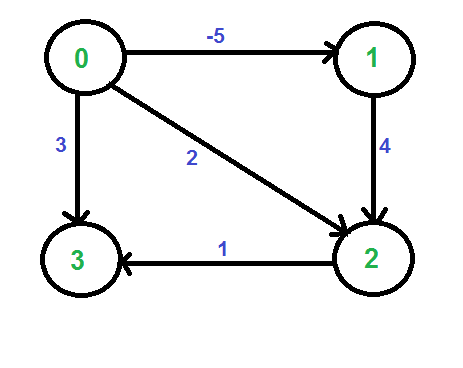
We add a source s and add edges from s to all vertices of the original graph. In the following diagram s is 4.
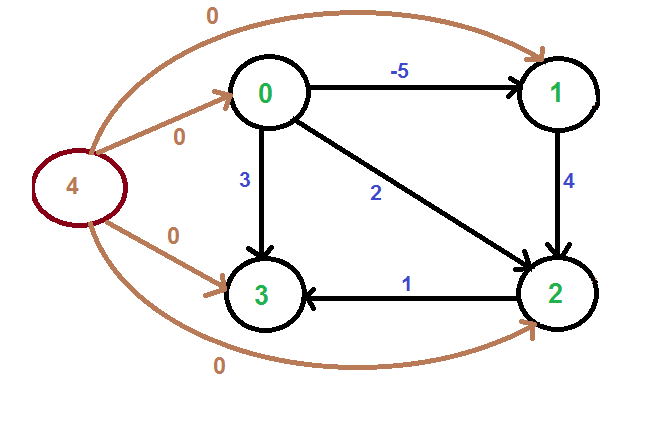
We calculate the shortest distances from 4 to all other vertices using Bellman-Ford algorithm. The shortest distances from 4 to 0, 1, 2 and 3 are 0, -5, -1 and 0 respectively, i.e., h[] = {0, -5, -1, 0}. Once we get these distances, we remove the source vertex 4 and reweight the edges using following formula. w(u, v) = w(u, v) + h[u] - h[v].
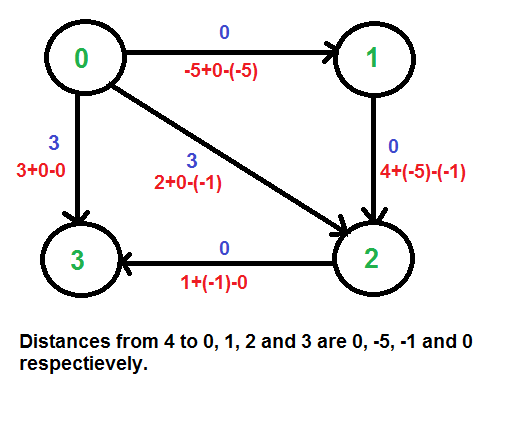
Since all weights are positive now, we can run Dijkstra's shortest path algorithm for every vertex as the source.
C++ `
#include #include #include #include #include #include // For matrix formatting
using namespace std;
const long long INF = 1e15;
struct Edge { int to; int weight; };
typedef pair<long long, int> pii;
// Dijkstra's algorithm for non-negative edge weights vector Dijkstra(int V, const vector<vector>& adj, int src) { vector dist(V, INF); priority_queue<pii, vector, greater> pq;
dist[src] = 0;
pq.push({0, src});

while (!pq.empty()) {
    long long d = pq.top().first;
    int u = pq.top().second; // Fixed: added .top()
    pq.pop();

    if (d > dist[u]) continue;

    for (auto& edge : adj[u]) {
        if (dist[u] + edge.weight < dist[edge.to]) {
            dist[edge.to] = dist[u] + edge.weight;
            pq.push({dist[edge.to], edge.to});
        }
    }
}
return dist;
}
// Bellman-Ford to find h[] and detect negative cycles vector BellmanFord(int V, const vector<vector>& edges, bool& hasCycle) { vector h(V + 1, INF); h[V] = 0;
vector<vector<int>> all_edges = edges;
for (int i = 0; i < V; i++) all_edges.push_back({V, i, 0});

for (int i = 0; i < V; i++) {
    for (auto& e : all_edges) {
        if (h[e[0]] != INF && h[e[0]] + e[2] < h[e[1]]) {
            h[e[1]] = h[e[0]] + e[2];
        }
    }
}

hasCycle = false;
for (auto& e : all_edges) {
    if (h[e[0]] != INF && h[e[0]] + e[2] < h[e[1]]) {
        hasCycle = true;
        return {};
    }
}

h.pop_back();
return h;
}
void JohnsonAlgorithm(int V, const vector<vector>& edgeList) { bool hasCycle; vector h = BellmanFord(V, edgeList, hasCycle);
if (hasCycle) {
    cout << "The graph contains a negative weight cycle. Algorithm cannot proceed." << endl;
    return;
}

// Reweight edges to be non-negative
vector<vector<Edge>> adj(V);
for (auto& e : edgeList) {
    int u = e[0], v = e[1], w = e[2];
    adj[u].push_back({v, (int)(w + h[u] - h[v])});
}

vector<vector<long long>> resultMatrix(V, vector<long long>(V));

// Run Dijkstra for every vertex
for (int s = 0; s < V; s++) {
    vector<long long> d_prime = Dijkstra(V, adj, s);
    for (int v = 0; v < V; v++) {
        if (d_prime[v] == INF) resultMatrix[s][v] = INF;
        else resultMatrix[s][v] = d_prime[v] + h[v] - h[s];
    }
}

// Display the Matrix
cout << "Shortest Distance Matrix:\n";
for (int i = 0; i < V; i++) {
    for (int j = 0; j < V; j++) {
        if (resultMatrix[i][j] >= INF/2) cout << setw(7) << "INF";
        else cout << setw(7) << resultMatrix[i][j];
    }
    cout << endl;
}
}
int main() { int V = 4; vector<vector> edgeList = { {0, 1, -5}, {0, 2, 2}, {0, 3, 3}, {1, 2, 4}, {2, 3, 1} };
JohnsonAlgorithm(V, edgeList);
return 0;
}
Java
import java.util.*;
class Edge { int to; int weight;
Edge(int to, int weight) {
    this.to = to;
    this.weight = weight;
}
}
class Pair implements Comparable { long dist; int vertex;
Pair(long dist, int vertex) {
    this.dist = dist;
    this.vertex = vertex;
}

public int compareTo(Pair other) {
    return Long.compare(this.dist, other.dist);
}
}
public class GFG { private static final long INF = 1000000000000000L;
private static List<Long> dijkstra(int V, List<List<Edge>> adj, int src) {
    List<Long> dist = new ArrayList<>(Collections.nCopies(V, INF));
    PriorityQueue<Pair> pq = new PriorityQueue<>();

    dist.set(src, 0L);
    pq.add(new Pair(0, src));

    while (!pq.isEmpty()) {
        Pair p = pq.poll();
        long d = p.dist;
        int u = p.vertex;

        if (d > dist.get(u)) continue;

        for (Edge edge : adj.get(u)) {
            if (dist.get(u) + edge.weight < dist.get(edge.to)) {
                dist.set(edge.to, dist.get(u) + edge.weight);
                pq.add(new Pair(dist.get(edge.to), edge.to));
            }
        }
    }
    return dist;
}

private static List<Long> bellmanFord(int V, List<int[]> edges, boolean[] hasCycle) {
    List<Long> h = new ArrayList<>(Collections.nCopies(V + 1, INF));
    h.set(V, 0L);

    List<int[]> all_edges = new ArrayList<>(edges);
    for (int i = 0; i < V; i++) all_edges.add(new int[] {V, i, 0});

    for (int i = 0; i < V; i++) {
        for (int[] e : all_edges) {
            if (h.get(e[0])!= INF && h.get(e[0]) + e[2] < h.get(e[1])) {
                h.set(e[1], h.get(e[0]) + e[2]);
            }
        }
    }

    hasCycle[0] = false;
    for (int[] e : all_edges) {
        if (h.get(e[0])!= INF && h.get(e[0]) + e[2] < h.get(e[1])) {
            hasCycle[0] = true;
            return new ArrayList<>();
        }
    }

    h.remove(h.size() - 1);
    return h;
}

public static void johnsonAlgorithm(int V, List<int[]> edgeList) {
    boolean[] hasCycle = {false};
    List<Long> h = bellmanFord(V, edgeList, hasCycle);

    if (hasCycle[0]) {
        System.out.println("The graph contains a negative weight cycle. Algorithm cannot proceed.");
        return;
    }

    List<List<Edge>> adj = new ArrayList<>();
    for (int i = 0; i < V; i++) adj.add(new ArrayList<>());
    for (int[] e : edgeList) {
        int u = e[0], v = e[1], w = e[2];
        adj.get(u).add(new Edge(v, (int)(w + h.get(u) - h.get(v))));
    }

    long[][] resultMatrix = new long[V][V];

    for (int s = 0; s < V; s++) {
        List<Long> d_prime = dijkstra(V, adj, s);
        for (int v = 0; v < V; v++) {
            if (d_prime.get(v) == INF) resultMatrix[s][v] = INF;
            else resultMatrix[s][v] = d_prime.get(v) + h.get(v) - h.get(s);
        }
    }

    System.out.println("Shortest Distance Matrix:");
    for (int i = 0; i < V; i++) {
        for (int j = 0; j < V; j++) {
            if (resultMatrix[i][j] >= INF / 2) System.out.printf("%7s", "INF");
            else System.out.printf("%7d", resultMatrix[i][j]);
        }
        System.out.println();
    }
}

public static void main(String[] args) {
    int V = 4;
    List<int[]> edgeList = Arrays.asList(
        new int[] {0, 1, -5},
        new int[] {0, 2, 2},
        new int[] {0, 3, 3},
        new int[] {1, 2, 4},
        new int[] {2, 3, 1}
    );

    johnsonAlgorithm(V, edgeList);
}
}
Python
import heapq
class Edge: def init(self, to, weight): self.to = to self.weight = weight
class Pair: def init(self, dist, vertex): self.dist = dist self.vertex = vertex
def __lt__(self, other):
    return self.dist < other.dist
INF = 1000000000000000
def dijkstra(V, adj, src): dist = [INF] * V pq = [] heapq.heappush(pq, Pair(0, src)) dist[src] = 0
while pq:
    p = heapq.heappop(pq)
    d = p.dist
    u = p.vertex

    if d > dist[u]:
        continue

    for edge in adj[u]:
        if dist[u] + edge.weight < dist[edge.to]:
            dist[edge.to] = dist[u] + edge.weight
            heapq.heappush(pq, Pair(dist[edge.to], edge.to))
return dist
def bellmanFord(V, edges, hasCycle): h = [INF] * (V + 1) h[V] = 0
all_edges = edges + [(V, i, 0) for i in range(V)]

for _ in range(V):
    for u, v, w in all_edges:
        if h[u]!= INF and h[u] + w < h[v]:
            h[v] = h[u] + w

hasCycle[0] = False
for u, v, w in all_edges:
    if h[u]!= INF and h[u] + w < h[v]:
        hasCycle[0] = True
        return []

del h[-1]
return h
def johnsonAlgorithm(V, edgeList): hasCycle = [False] h = bellmanFord(V, edgeList, hasCycle)
if hasCycle[0]:
    print('The graph contains a negative weight cycle. Algorithm cannot proceed.')
    return

adj = [[] for _ in range(V)]
for u, v, w in edgeList:
    adj[u].append(Edge(v, w + h[u] - h[v]))

resultMatrix = [[INF] * V for _ in range(V)]

for s in range(V):
    d_prime = dijkstra(V, adj, s)
    for v in range(V):
        if d_prime[v] == INF:
            resultMatrix[s][v] = INF
        else:
            resultMatrix[s][v] = d_prime[v] + h[v] - h[s]

print('Shortest Distance Matrix:')
for row in resultMatrix:
    print(' '.join('INF' if x >= INF // 2 else str(x) for x in row))
if name == 'main': V = 4 edgeList = [ (0, 1, -5), (0, 2, 2), (0, 3, 3), (1, 2, 4), (2, 3, 1) ] johnsonAlgorithm(V, edgeList)
C#
'use strict';
class Edge { constructor(to, weight) { this.to = to; this.weight = weight; } }
class Pii { constructor(d, u) { this.d = d; this.u = u; } }
Pii.prototype.compareTo = function(other) { return this.d < other.d; };
const INF = 1000000000000000;
function Dijkstra(V, adj, src) { let dist = new Array(V).fill(INF); dist[src] = 0; let pq = [new Pii(0, src)]; while (pq.length > 0) { pq.sort((a, b) => a.d - b.d); let top = pq.shift(); let d = top.d; let u = top.u; if (d > dist[u]) { continue; } for (let edge of adj[u]) { if (dist[u] + edge.weight < dist[edge.to]) { dist[edge.to] = dist[u] + edge.weight; pq.push(new Pii(dist[edge.to], edge.to)); } } } return dist; }
function BellmanFord(V, edges, hasCycle) { let h = new Array(V + 1).fill(INF); h[V] = 0; let all_edges = edges.slice(); for (let i = 0; i < V; i++) { all_edges.push([V, i, 0]); } for (let i = 0; i < V; i++) { for (let e of all_edges) { if (h[e[0]]!== INF && h[e[0]] + e[2] < h[e[1]]) { h[e[1]] = h[e[0]] + e[2]; } } } hasCycle[0] = false; for (let e of all_edges) { if (h[e[0]]!== INF && h[e[0]] + e[2] < h[e[1]]) { hasCycle[0] = true; return []; } } let result = h.slice(0, -1); return result; }
function JohnsonAlgorithm(V, edgeList) { let hasCycle = [false]; let h = BellmanFord(V, edgeList, hasCycle); if (hasCycle[0]) { console.log('The graph contains a negative weight cycle. Algorithm cannot proceed.'); return; } let adj = new Array(V).fill(0).map(() => []); for (let e of edgeList) { let u = e[0], v = e[1], w = e[2]; adj[u].push(new Edge(v, w + h[u] - h[v])); } for (let s = 0; s < V; s++) { let d_prime = Dijkstra(V, adj, s); console.log('\nShortest distances from vertex', s + 1, ':'); for (let v = 0; v < V; v++) { if (d_prime[v] === INF) { console.log('To', v + 1, ': INF'); } else { let actual_dist = d_prime[v] + h[v] - h[s]; console.log('To', v + 1, ':', actual_dist); } } } }
function main() { let V = 4; let edgeList = [ [0, 1, -5], [0, 2, 2], [0, 3, 3], [1, 2, 4], [2, 3, 1] ]; JohnsonAlgorithm(V, edgeList); }
main();
JavaScript
class Edge { constructor(to, weight) { this.To = to; this.Weight = weight; } }
class GFG { // Using a large value for INF that won't overflow during reweighting static INF = Number.MAX_SAFE_INTEGER / 4;
// Dijkstra's Algorithm using JavaScript's PriorityQueue
static Dijkstra(V, adj, src) {
    const dist = Array(V).fill(this.INF);
    const pq = new PriorityQueue();

    dist[src] = 0;
    pq.enqueue({ vertex: src, distance: 0 });

    while (!pq.isEmpty()) {
        const { vertex: u, distance: d } = pq.dequeue();

        if (d > dist[u]) continue;

        for (const edge of adj[u]) {
            if (dist[u] + edge.Weight < dist[edge.To]) {
                dist[edge.To] = dist[u] + edge.Weight;
                pq.enqueue({ vertex: edge.To, distance: dist[edge.To] });
            }
        }
    }
    return dist;
}

// Bellman-Ford to find h[] and detect negative cycles
static BellmanFord(V, edges, hasCycle) {
    const h = Array(V + 1).fill(this.INF);
    h[V] = 0;

    const allEdges = [...edges];
    for (let i = 0; i < V; i++) allEdges.push([V, i, 0]);

    for (let i = 0; i < V; i++) {
        for (const e of allEdges) {
            if (h[e[0]]!== this.INF && h[e[0]] + e[2] < h[e[1]]) {
                h[e[1]] = h[e[0]] + e[2];
            }
        }
    }

    hasCycle = false;
    for (const e of allEdges) {
        if (h[e[0]]!== this.INF && h[e[0]] + e[2] < h[e[1]]) {
            hasCycle = true;
            return null;
        }
    }

    return h.slice(0, V);
}

static JohnsonAlgorithm(V, edgeList) {
    let h = this.BellmanFord(V, edgeList, (hasCycle) => hasCycle);

    if (h === null) {
        console.log('The graph contains a negative weight cycle. Algorithm cannot proceed.');
        return;
    }

    const adj = Array.from({ length: V }, () => []);

    for (const e of edgeList) {
        const u = e[0], v = e[1], w = e[2];
        adj[u].push(new Edge(v, w + h[u] - h[v]));
    }

    const distanceMatrix = Array.from({ length: V }, () => Array(V).fill(this.INF));

    for (let s = 0; s < V; s++) {
        const dPrime = this.Dijkstra(V, adj, s);
        for (let v = 0; v < V; v++) {
            distanceMatrix[s][v] = dPrime[v] === this.INF ? this.INF : dPrime[v] + h[v] - h[s];
        }
    }

    // Print the Matrix without row/column numbering
    console.log('Shortest Distance Matrix:');
    for (let i = 0; i < V; i++) {
        let row = [];
        for (let j = 0; j < V; j++) {
            row.push(distanceMatrix[i][j] >= this.INF / 2? 'INF' : distanceMatrix[i][j]);
        }
        console.log(row.join(' ').padStart(8));
    }
}
}
class PriorityQueue { constructor() { this.elements = []; }
enqueue(item) {
    this.elements.push(item);
    this.elements.sort((a, b) => a.distance - b.distance);
}

dequeue() {
    return this.elements.shift();
}

isEmpty() {
    return this.elements.length === 0;
}
}
// Main function (function() { const V = 4; const edgeList = [ [0, 1, -5], [0, 2, 2], [0, 3, 3], [1, 2, 4], [2, 3, 1] ];
GFG.JohnsonAlgorithm(V, edgeList);})();
`
Output
Shortest Distance Matrix: 0 -5 -1 0 INF 0 4 5 INF INF 0 1 INF INF INF 0
**Time Complexity: The main steps in the algorithm are Bellman-Ford Algorithm called once and Dijkstra called V times. Time complexity of Bellman Ford is O(VE) and time complexity of Dijkstra is O((V + E)Log V). So overall time complexity is O(V2log V + VE).
The time complexity of Johnson's algorithm becomes the same as Floyd Warshall's Algorithm when the graph is complete (For a complete graph E = O(V2). But for sparse graphs, the algorithm performs much better than Floyd Warshall's Algorithm.
**Auxiliary Space: O(V2)