Largest Rectangular Area in a Histogram (original) (raw)
Given an array **arr[] representing a histogram, where each element denotes the height of a bar and every bar has a uniform width of 1 unit, find the largest rectangular area that can be formed within the histogram. The rectangle must be formed using contiguous bars.
**Example:
**Input: arr[] = [60, 20, 50, 40, 10, 50, 60]
**Output: 100
**Explanation: We get the maximum area by picking bars highlighted above in green (50, and 60). The area is computed (smallest height) * (no. of the picked bars) = 50 * 2 = 100.
**Input: arr[] = [3, 5, 1, 7, 5, 9]
**Output: 15
**Explanation: We get the maximum are by picking bars 7, 5 and 9. The area is computed (smallest height) * (no. of the picked bars) = 5 * 3 = 15.
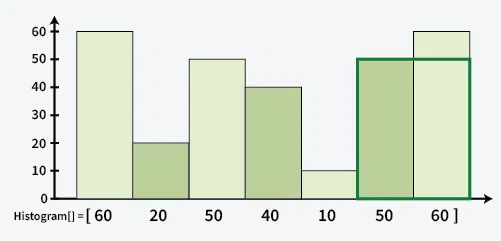
Table of Content
- [Naive Approach] By Finding Max Area of Rectangles all Heights - O(n2) Time and O(1) Space
- [Expected Approach] Using Two Stacks - O(n) Time and O(n) Space
- [Optimized Approach] Using Single Stack - O(n) Time and O(n) Space
[Naive Approach] By Finding Max Area of Rectangles all Heights - O(n2) Time and O(1) Space
The idea is to fix each bar as the height of the rectangle and expand towards the left and right while the bars are at least as tall as the current bar. For every valid step, we keep adding the current bar’s height to the area. By doing this for all bars and keeping track of the maximum value.
C++ `
#include #include using namespace std;
int getMaxArea(vector &arr){ int res = 0, n = arr.size();
// Consider every bar one by one
for(int i = 0; i < n; i++){
    int curr = arr[i];

    // Traverse left while we have a greater height bar
    for(int j = i-1; j>=0 && arr[j] >= arr[i]; j--)
         curr += arr[i];

    // Traverse right while we have a greater height bar
    for(int j = i+1; j<n && arr[j] >= arr[i]; j++)
        curr += arr[i];

    res = max(res, curr);
}

return res;
}
int main() { vector arr = {60, 20, 50, 40, 10, 50, 60}; cout << getMaxArea(arr); return 0; }
C
#include <stdio.h>
int getMaxArea(int arr[],int n) { int res = 0;
// Consider every bar one by one
for (int i = 0; i < n; i++) {
    int curr = arr[i];

    // Traverse left while we have a greater height bar
    for (int j = i - 1; j >= 0 && arr[j] >= arr[i]; j--) {
        curr += arr[i];
    }

    // Traverse right while we have a greater height bar
    for (int j = i + 1; j < n && arr[j] >= arr[i]; j++) {
        curr += arr[i];
    }

    if (curr > res) {
        res = curr;
    }
}

return res;
}
int main() { int arr[] = {60, 20, 50, 40, 10, 50, 60}; int n = sizeof(arr) / sizeof(arr[0]); printf("%d\n", getMaxArea(arr,n)); return 0; }
Java
class GfG {
static int getMaxArea(int[] arr) {
    int res = 0, n = arr.length;

    for (int i = 0; i < n; i++) {
        int curr = arr[i];

        // Traverse left while we have a greater height bar
        for (int j = i - 1; j >= 0 && arr[j] >= arr[i]; j--)
            curr += arr[i];

        // Traverse right while we have a greater height bar
        for (int j = i + 1; j < n && arr[j] >= arr[i]; j++)
            curr += arr[i];

        res = Math.max(res, curr);
    }
    return res;
}

public static void main(String[] args) {
    int[] arr = {60, 20, 50, 40, 10, 50, 60};
    System.out.println(getMaxArea(arr));
}
}
Python
def getMaxArea(arr): res = 0 n = len(arr)
for i in range(n):
    curr = arr[i]

    # Traverse left while we have a greater height bar
    j = i - 1
    while j >= 0 and arr[j] >= arr[i]:
        curr += arr[i]
        j -= 1

    # Traverse right while we have a greater height bar
    j = i + 1
    while j < n and arr[j] >= arr[i]:
        curr += arr[i]
        j += 1

    res = max(res, curr)

return res
if name == "main": arr = [60, 20, 50, 40, 10, 50, 60] print(getMaxArea(arr))
C#
using System;
class GfG {
static int getMaxArea(int[] arr) {
    int n = arr.Length;
    int res = 0;

    // Consider every bar one by one
    for (int i = 0; i < n; i++) {
        int curr = arr[i];

        // Traverse left while we have a greater height bar
        int j = i - 1;
        while (j >= 0 && arr[j] >= arr[i]) {
            curr += arr[i];
            j--;
        }

        // Traverse right while we have a greater height bar
        j = i + 1;
        while (j < n && arr[j] >= arr[i]) {
            curr += arr[i];
            j++;
        }

        res = Math.Max(res, curr);
    }

    return res;
}

static void Main(string[] args) {
    int[] arr = {60, 20, 50, 40, 10, 50, 60};
    Console.WriteLine(getMaxArea(arr));
}
}
JavaScript
function getMaxArea(arr) { let n = arr.length; let res = 0;
// Consider every bar one by one
for (let i = 0; i < n; i++) {
    let curr = arr[i];

    // Traverse left while we have a greater height bar
    let j = i - 1;
    while (j >= 0 && arr[j] >= arr[i]) {
        curr += arr[i];
        j--;
    }

    // Traverse right while we have a greater height bar
    j = i + 1;
    while (j < n && arr[j] >= arr[i]) {
        curr += arr[i];
        j++;
    }

    res = Math.max(res, curr);
}

return res;
}
// Driver code let arr = [ 60, 20, 50, 40, 10, 50, 60 ]; console.log(getMaxArea(arr));
`
[Expected Approach] Using Two Stacks - O(n) Time and O(n) Space
The idea is that Instead of recalculating the left and right boundary for every bar, we can precompute them once.
- The Previous Smaller Element (PSE) tells us the nearest bar on the left that is smaller than the current bar.
- The Next Smaller Element (NSE) tells us the nearest bar on the right that is smaller than the current bar.
With these two values, we instantly know the maximum width a bar can extend while maintaining itself as the limiting height. Finally, multiplying this width with the current bar’s height gives the largest rectangle for that bar, and taking the maximum across all bars gives the answer.
C++ `
#include #include #include using namespace std;
// Function to find next smaller for every element vector nextSmaller(vector& arr) { int n = arr.size();
vector<int> nextS(n, n);

stack<int> st;

for (int i = 0; i < n; ++i) {
    while (!st.empty() && arr[i] < arr[st.top()]) {

        // Setting the index of the next smaller element
        // for the top of the stack
        nextS[st.top()] = i;
        st.pop();
    }
    st.push(i);
}
return nextS;
}
// Function to find previous smaller for every element vector prevSmaller(vector& arr) { int n = arr.size();
vector<int> prevS(n, -1);

stack<int> st;

for (int i = 0; i < n; ++i) {
    while (!st.empty() && arr[i] < arr[st.top()]) {

        // Setting the index of the previous smaller element
        //  for the top of the stack
        st.pop();
    }
    if (!st.empty()) {
        prevS[i] = st.top();
    }
    st.push(i);
}
return prevS;
}
// Function to calculate the maximum rectangular // area in the Histogram int getMaxArea(vector& arr) { vector prevS = prevSmaller(arr); vector nextS = nextSmaller(arr);
int maxArea = 0;

// Calculate the area for each Histogram bar
for (int i = 0; i < arr.size(); ++i) {
    int width = nextS[i] - prevS[i] - 1;
    int area = arr[i] * width;
    maxArea = max(maxArea, area);
}

return maxArea;
}
int main() { vector arr = {60, 20, 50, 40, 10, 50, 60}; cout << getMaxArea(arr) << endl; return 0; }
C
#include <stdio.h> #include <stdlib.h>
// Stack structure struct Stack { int top; int capacity; int* items; };
// Function to create an empty stack with dynamic memory allocation struct Stack* createStack(int capacity) { struct Stack* stack = (struct Stack*)malloc(sizeof(struct Stack)); stack->capacity = capacity; stack->top = -1; stack->items = (int*)malloc(stack->capacity * sizeof(int)); return stack; }
// Function to check if the stack is empty int isEmpty(struct Stack* stack) { return stack->top == -1; }
// Function to push an element onto the stack void push(struct Stack* stack, int value) { if (stack->top == stack->capacity - 1) { printf("Stack overflow\n"); return; } stack->items[++(stack->top)] = value; }
// Function to pop an element from the stack int pop(struct Stack* stack) { if (isEmpty(stack)) { printf("Stack underflow\n"); return -1; } return stack->items[(stack->top)--]; }
// Function to get the top element of the stack int peek(struct Stack* stack) { if (!isEmpty(stack)) { return stack->items[stack->top]; } return -1; }
// Function to find the next smaller element for every element void nextSmaller(int arr[], int n, int nextS[]) { struct Stack* stack = createStack(n);
for (int i = 0; i < n; i++) {
    nextS[i] = n;
}

for (int i = 0; i < n; i++) {
    while (!isEmpty(stack) && arr[i] < arr[peek(stack)]) {
        nextS[peek(stack)] = i;
        pop(stack);
    }
    push(stack, i);
}
}
// Function to find the previous smaller element for every element void prevSmaller(int arr[], int n, int prevS[]) { struct Stack* stack = createStack(n);
for (int i = 0; i < n; i++) {
    prevS[i] = -1;
}

for (int i = 0; i < n; i++) {
    while (!isEmpty(stack) && arr[i] < arr[peek(stack)]) {
        pop(stack);
    }
    if (!isEmpty(stack)) {
        prevS[i] = peek(stack);
    }
    push(stack, i);
}
}
// Function to calculate the maximum rectangular // area in the Histogram int getMaxArea(int arr[],int n) {
int* prevS = (int*)malloc(n * sizeof(int));
int* nextS = (int*)malloc(n * sizeof(int));
int maxArea = 0;

// Find previous and next smaller elements
prevSmaller(arr, n, prevS);
nextSmaller(arr, n, nextS);

// Calculate the area for each arrogram bar
for (int i = 0; i < n; i++) {
    int width = nextS[i] - prevS[i] - 1;
    int area = arr[i] * width;
    if (area > maxArea) {
        maxArea = area;
    }
}
return maxArea;
}
// Driver code int main() { int arr[] = {60, 20, 50, 40, 10, 50, 60}; int n = sizeof(arr) / sizeof(arr[0]); printf("%d\n", getMaxArea(arr,n)); return 0; }
Java
import java.util.Stack;
class GfG {
// Function to find next smaller for every element
static int[] nextSmaller(int[] arr) {
    int n = arr.length;

    int[] nextS = new int[n];
    for (int i = 0; i < n; i++) {
        nextS[i] = n;
    }

    Stack<Integer> st = new Stack<>();

    for (int i = 0; i < n; i++) {
        while (!st.isEmpty() && arr[i] < arr[st.peek()]) {

            // Setting the index of the next smaller element
            // for the top of the stack
            nextS[st.pop()] = i;
        }
        st.push(i);
    }
    return nextS;
}

// Function to find previous smaller for every element
static int[] prevSmaller(int[] arr) {
    int n = arr.length;

    int[] prevS = new int[n];
    for (int i = 0; i < n; i++) {
        prevS[i] = -1;
    }

    Stack<Integer> st = new Stack<>();

    for (int i = 0; i < n; i++) {
        while (!st.isEmpty() && arr[i] < arr[st.peek()]) {
            st.pop();
        }
        if (!st.isEmpty()) {
            prevS[i] = st.peek();
        }
        st.push(i);
    }
    return prevS;
}

// Function to calculate the maximum rectangular
// area in the histogram
static int getMaxArea(int[] arr) {
    int[] prevS = prevSmaller(arr);
    int[] nextS = nextSmaller(arr);
    int maxArea = 0;

    // Calculate the area for each arrogram bar
    for (int i = 0; i < arr.length; i++) {
        int width = nextS[i] - prevS[i] - 1;
        int area = arr[i] * width;
        maxArea = Math.max(maxArea, area);
    }
    return maxArea;
}

public static void main(String[] args) {
    int[] arr = {60, 20, 50, 40, 10, 50, 60};
    System.out.println(getMaxArea(arr));
}
}
Python
Function to find next smaller for every element
def nextSmaller(arr): n = len(arr)
nextS = [n] * n
st = []

for i in range(n):
    while st and arr[i] < arr[st[-1]]:
        # Setting the index of the next smaller element
        # for the top of the stack
        nextS[st.pop()] = i
    st.append(i)

return nextS
Function to find previous smaller for every element
def prevSmaller(arr): n = len(arr)
prevS = [-1] * n
st = []

for i in range(n):
    while st and arr[i] < arr[st[-1]]:
        st.pop()
    if st:
        prevS[i] = st[-1]
    st.append(i)

return prevS
Function to calculate the maximum rectangular
area in the Histogram
def getMaxArea(arr): prevS = prevSmaller(arr) nextS = nextSmaller(arr) maxArea = 0
# Calculate the area for each arrogram bar
for i in range(len(arr)):
    width = nextS[i] - prevS[i] - 1
    area = arr[i] * width
    maxArea = max(maxArea, area)

return maxArea
if name == "main": arr = [60, 20, 50, 40, 10, 50, 60] print(getMaxArea(arr))
C#
using System; using System.Collections.Generic;
class GfG {
// Function to find next smaller for every element
static int[] nextSmaller(int[] arr) {
    int n = arr.Length;


    int[] nextS = new int[n];
    for (int i = 0; i < n; i++) {
        nextS[i] = n;
    }

    Stack<int> st = new Stack<int>();

    for (int i = 0; i < n; i++) {
        while (st.Count > 0 && arr[i] < arr[st.Peek()]) {

            // Setting the index of the next smaller element
            // for the top of the stack
            nextS[st.Pop()] = i;
        }
        st.Push(i);
    }
    return nextS;
}

// Function to find previous smaller for every element
static int[] prevSmaller(int[] arr) {
    int n = arr.Length;

    int[] prevS = new int[n];
    for (int i = 0; i < n; i++) {
        prevS[i] = -1;
    }

    Stack<int> st = new Stack<int>();

    for (int i = 0; i < n; i++) {
        while (st.Count > 0 && arr[i] < arr[st.Peek()]) {
            st.Pop();
        }
        if (st.Count > 0) {
            prevS[i] = st.Peek();
        }
        st.Push(i);
    }
    return prevS;
}

// Function to calculate the maximum rectangular
// area in the Histogram
static int getMaxArea(int[] arr) {
    int[] prevS = prevSmaller(arr);
    int[] nextS = nextSmaller(arr);
    int maxArea = 0;

    // Calculate the area for each arrogram bar
    for (int i = 0; i < arr.Length; i++) {
        int width = nextS[i] - prevS[i] - 1;
        int area = arr[i] * width;
        maxArea = Math.Max(maxArea, area);
    }
    return maxArea;
}

static void Main() {
    int[] arr = {60, 20, 50, 40, 10, 50, 60};
    Console.WriteLine(getMaxArea(arr));
}
}
JavaScript
// Function to find next smaller for every element function nextSmaller(arr){ const n = arr.length;
const nextS = new Array(n).fill(n);
const stack = [];

for (let i = 0; i < n; i++) {
    while (stack.length
           && arr[i] < arr[stack[stack.length - 1]]) {

        // Setting the index of the next smaller element
        // for the top of the stack
        nextS[stack.pop()] = i;
    }
    stack.push(i);
}

return nextS;
}
// Function to find previous smaller for every element function prevSmaller(arr) { const n = arr.length;
const prevS = new Array(n).fill(-1);
const stack = [];

for (let i = 0; i < n; i++) {
    while (stack.length
           && arr[i] < arr[stack[stack.length - 1]]) {
        stack.pop();
    }
    if (stack.length) {
        prevS[i] = stack[stack.length - 1];
    }
    stack.push(i);
}

return prevS;
}
// Function to calculate the maximum rectangular // area in the Histogram function getMaxArea(arr) { const prevS = prevSmaller(arr); const nextS = nextSmaller(arr); let maxArea = 0;
// Calculate the area for each arrogram bar
for (let i = 0; i < arr.length; i++) {
    const width = nextS[i] - prevS[i] - 1;
    const area = arr[i] * width;
    maxArea = Math.max(maxArea, area);
}

return maxArea;
}
// Driver code const arr = [60, 20, 50, 40, 10, 50, 60]; console.log(getMaxArea(arr));
`
[Optimized Approach] Using Single Stack - O(n) Time and O(n) Space
This approach is mainly an optimization over the previous approach.
The idea is to maintain a stack of bar indices in increasing height order. When a shorter bar is encountered, it means the bar at the top of the stack cannot extend further to the right. We pop it, and using the current index as the right boundary and the new top of the stack as the left boundary, compute the area with the popped bar’s height as the smallest height.
Below are the detailed steps of implementation.
- Start with an empty stack and process bars from left to right.
- Keep pushing bars into the stack as long as their heights are in **non-decreasing order.
- When you encounter a bar shorter than the bar at the top of the stack:
- The bar at stack.top() cannot extend further to the right.
- Pop it from the stack this popped bar’s height becomes the smallest height for its rectangle.
- The **current index is the right boundary.
- The **index now at the top of the stack (after popping) gives the previous smaller element, marking the left boundary.
- Compute width = right_boundary - left_boundary - 1 and update max area.Continue until the stack is empty or the current bar is taller, then push the current index.
- After processing all bars, pop any remaining bars in the stack and Compute width, area, and update the maximum. C++ `
#include #include #include using namespace std;
int getMaxArea(vector& arr) { int n = arr.size();
stack<int> st;

int res = 0;
int tp, curr;

for (int i = 0; i < n; i++) {

    while (!st.empty() && arr[st.top()] >= arr[i]) {

        // The popped item is to be considered as the
        // smallest element of the Histogram
        tp = st.top();
        st.pop();

        // For the popped item previous smaller element is
        // just below it in the stack (or current stack top)
        // and next smaller element is i
        int width = st.empty() ? i : i - st.top() - 1;

        res = max(res,  arr[tp] * width);
    }
    st.push(i);
}

// For the remaining items in the stack, next smaller does
// not exist. Previous smaller is the item just below in
// stack.
while (!st.empty()) {
    tp = st.top(); st.pop();
    curr = arr[tp] * (st.empty() ? n : n - st.top() - 1);
    res = max(res, curr);
}

return res;
}
int main() { vector arr = {60, 20, 50, 40, 10, 50, 60}; cout << getMaxArea(arr); return 0; }
C
#include <stdio.h> #include <stdlib.h>
// Stack structure struct Stack { int top; int capacity; int* array; };
// Function to create a stack struct Stack* createStack(int capacity) { struct Stack* stack = (struct Stack*) malloc(sizeof(struct Stack)); stack->capacity = capacity; stack->top = -1; stack->array = (int*)malloc(stack->capacity * sizeof(int)); return stack; }
int isEmpty(struct Stack* stack) { return stack->top == -1; }
void push(struct Stack* stack, int item) { stack->array[++stack->top] = item; }
int pop(struct Stack* stack) { return stack->array[stack->top--]; }
int peek(struct Stack* stack) { return stack->array[stack->top]; }
// Function to calculate the maximum rectangular area int getMaxArea(int arr[],int n) { struct Stack* st = createStack(n); int res = 0, tp, curr;
// Traverse all bars of the arrogram
for (int i = 0; i < n; i++) {

    // Process the stack while the current element
    // is smaller than the element corresponding to
    // the top of the stack
    while (!isEmpty(st) && arr[peek(st)] >= arr[i]) {
        tp = pop(st);

        // Calculate width and update result
        int width = isEmpty(st) ? i : i - peek(st) - 1;
        res = (res > arr[tp] * width) ? res : arr[tp] * width;
    }
    push(st, i);
}

// Process remaining elements in the stack
while (!isEmpty(st)) {
    tp = pop(st);
    curr = arr[tp] * (isEmpty(st) ? n : n - peek(st) - 1);
    res = (res > curr) ? res : curr;
}

return res;
}
int main() { int arr[] = {60, 20, 50, 40, 10, 50, 60}; int n = sizeof(arr) / sizeof(arr[0]); printf("%d\n", getMaxArea(arr,n)); return 0; }
Java
import java.util.Stack;
class GfG {
static int getMaxArea(int[] arr) {
    int n = arr.length;
    Stack<Integer> st = new Stack<>();
    int res = 0, tp, curr;

    for (int i = 0; i < n; i++) {

        // Process the stack while the current element
        // is smaller than the element corresponding to
        // the top of the stack
        while (!st.isEmpty() && arr[st.peek()] >= arr[i]) {

            // The popped item is to be considered as the
            // smallest element of the Histogram
            tp = st.pop();

            // For the popped item, previous smaller element
            // is just below it in the stack (or current stack
            // top) and next smaller element is i
            int width = st.isEmpty() ? i : i - st.peek() - 1;

            // Update the result if needed
            res = Math.max(res, arr[tp] * width);
        }
        st.push(i);
    }

    // For the remaining items in the stack, next smaller does
    // not exist. Previous smaller is the item just below in
    // the stack.
    while (!st.isEmpty()) {
        tp = st.pop();
        curr = arr[tp] * (st.isEmpty() ? n : n - st.peek() - 1);
        res = Math.max(res, curr);
    }

    return res;
}

public static void main(String[] args) {
    int[] arr = {60, 20, 50, 40, 10, 50, 60};
    System.out.println(getMaxArea(arr));
}
}
Python
def getMaxArea(arr): n = len(arr) st = [] res = 0
for i in range(n):

    # Process the stack while the current element
    # is smaller than the element corresponding to
    # the top of the stack
    while st and arr[st[-1]] >= arr[i]:

        # The popped item is to be considered as the
        # smallest element of the Histogram
        tp = st.pop()

        # For the popped item, the previous smaller
        # element is just below it in the stack (or
        # the current stack top) and the next smaller
        # element is i
        width = i if not st else i - st[-1] - 1

        # Update the result if needed
        res = max(res, arr[tp] * width)

    st.append(i)

# For the remaining items in the stack, next smaller does
# not exist. Previous smaller is the item just below in
# the stack.
while st:
    tp = st.pop()
    width = n if not st else n - st[-1] - 1
    res = max(res, arr[tp] * width)

return res
if name == "main": arr = [60, 20, 50, 40, 10, 50, 60] print(getMaxArea(arr))
C#
// C# program to find the largest rectangular area possible // in a given histogram
using System; using System.Collections.Generic;
class GfG {
// Function to calculate the maximum rectangular area
static int getMaxArea(int[] arr) {
    int n = arr.Length;
    Stack<int> st = new Stack<int>();
    int res = 0, tp, curr;

    // Traverse all bars of the arrogram
    for (int i = 0; i < n; i++) {

        // Process the stack while the current element
        // is smaller than the element corresponding to
        // the top of the stack
        while (st.Count > 0 && arr[st.Peek()] >= arr[i]) {
            tp = st.Pop();

            // Calculate width and update result
            int width = st.Count == 0 ? i : i - st.Peek() - 1;
            res = Math.Max(res, arr[tp] * width);
        }
        st.Push(i);
    }

    // Process remaining elements in the stack
    while (st.Count > 0) {
        tp = st.Pop();
        curr = arr[tp] * (st.Count == 0 ? n : n - st.Peek() - 1);
        res = Math.Max(res, curr);
    }

    return res;
}

public static void Main() {
    int[] arr = {60, 20, 50, 40, 10, 50, 60};
    Console.WriteLine(getMaxArea(arr));
}
}
JavaScript
function getMaxArea(arr) { let n = arr.length; let st = []; let res = 0;
// Traverse all bars of the arrogram
for (let i = 0; i < n; i++) {

    // Process the stack while the current element
    // is smaller than the element corresponding to
    // the top of the stack
    while (st.length
           && arr[st[st.length - 1]] >= arr[i]) {
        let tp = st.pop();

        // Calculate width and update result
        let width
            = st.length === 0 ? i: i
                        - st[st.length - 1] - 1;
        res = Math.max(res, arr[tp] * width);
    }
    st.push(i);
}

// Process remaining elements in the stack
while (st.length) {
    let tp = st.pop();
    let curr = arr[tp] * (st.length === 0 ? n
                 : n - st[st.length - 1] - 1);
    res = Math.max(res, curr);
}

return res;
}
// Driver code let arr = [ 60, 20, 50, 40, 10, 50, 60 ]; console.log(getMaxArea(arr));
`