Leaf nodes from Preorder of a Binary Search Tree (original) (raw)
Given **Preorder traversal of a Binary Search Tree. Then the task is to print **leaf nodes of the Binary Search Tree from the given preorder.
**Examples:
**Input: preorder[] = [4, 2, 1, 3, 6, 5]
**Output: [1, 3, 5]
**Explaination: 1, 3 and 5 are the leaf nodes as shown in the figure.
**Input: preorder[] = [5, 2, 10]
**Output: [2, 10]
**Explaination: 2 and 10 are the leaf nodes as shown in the figure.
**Input: preorder[] = [8, 2, 5, 10, 12]
**Output: [5, 12]
**Explaination: 5 and 12 are the leaf nodes as shown in the figure.
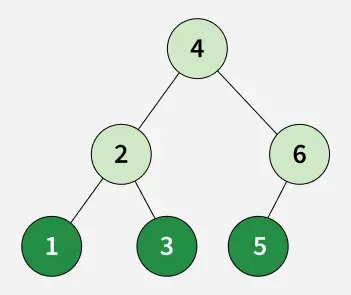
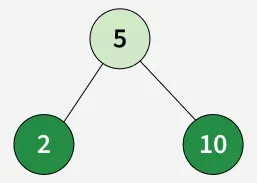
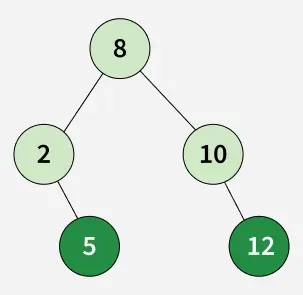
Table of Content
- [Expected Approach - 1] Using Inorder and Preorder - O(nlogn) Time and O(n) Space
- [Expected Approach - 2] Using Stack - O(n) Time and O(n) Space
**[Expected Approach - 1] Using Inorder and Preorder - O(nlogn) Time and O(n) Space
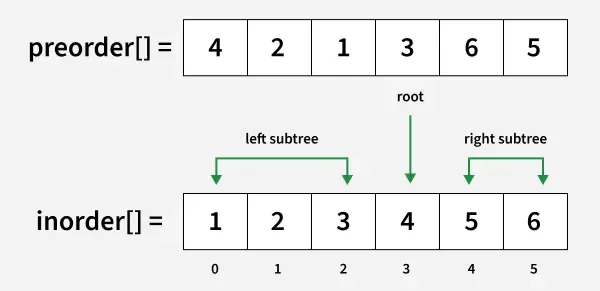
The idea is to find Inorder by sorting the input preorder traversal, then traverse the tree in **preorder fashion (using both **inorder and **preorder traversals) and while traversing **store the leaf nodes.
**How to traverse in preorder fashion using two arrays representing inorder and preorder traversals?
- We iterate the **preorder array and for each element find that element in the **inorder array. For **searching, we can use binary search, since inorder traversal of the binary search tree is always sorted. Now, for each element of preorder array, in binary search, we set the **range [l, r].
- And when l == r, the leaf node is **found. So, initially, l = 0 and l = n - 1 for first element (i.e root) of preorder array. Now, to search for the element on the left subtree of the root, set l = 0 and r= index of root - 1. Also, for all element of right subtree set l = index of root + 1 and r = n -1. Recursively, follow this, until l == r.
C++ `
// C++ program to print leaf node from preorder of // binary search tree using inorder + preorder #include <bits/stdc++.h> using namespace std;
int binarySearch(vector& inorder, int l, int r, int d) { int mid = (l + r) >> 1;
if (inorder[mid] == d)
    return mid;

else if (inorder[mid] > d)
    return binarySearch(inorder, l, mid - 1, d);

else
    return binarySearch(inorder, mid + 1, r, d);
}
// Function to find Leaf Nodes by doing preorder // traversal of tree using preorder and inorder vectors. void leafNodesRec(vector& preorder, vector& inorder, int l, int r, int& ind, vector& leaves) {
// If l == r, therefore no right or left subtree.
// So, it must be leaf Node, store it.
if (l == r) {
    leaves.push_back(inorder[l]);
    ind++;
    return;
}

// If array is out of bound, return.
if (l < 0 || l > r || r >= inorder.size())
    return;

// Finding the index of preorder element
// in inorder vector using binary search.
int loc = binarySearch(inorder, l, r, preorder[ind]);

ind++;

// Finding on the left subtree.
leafNodesRec(preorder, inorder, l, loc - 1,
                                      ind, leaves);

// Finding on the right subtree.
leafNodesRec(preorder, inorder, loc + 1, r,
                                      ind, leaves);
}
// Finds leaf nodes from given preorder traversal.
vector leafNodes(vector& preorder) {
int n = preorder.size();
vector inorder(n);
vector leaves;
// Copy the preorder into another vector.
for (int i = 0; i < n; i++)
    inorder[i] = preorder[i];

// Finding the inorder by sorting the vector.
sort(inorder.begin(), inorder.end());

// Point to the index in preorder.
int ind = 0;

// Find the Leaf Nodes.
leafNodesRec(preorder, inorder, 0, n - 1,
                                  ind, leaves);
return leaves;
}
int main() {
vector<int> preorder = {4, 2, 1, 3, 6, 5};

vector<int> result = leafNodes(preorder);

for (int val : result) {
    cout << val << " ";
}

return 0;
}
Java
import java.util.ArrayList; import java.util.Arrays;
class GfG {
static int binarySearch(ArrayList<Integer> inorder, int l, int r, int d) {
    int mid = (l + r) / 2;

    if (inorder.get(mid) == d)
        return mid;
    else if (inorder.get(mid) > d)
        return binarySearch(inorder, l, mid - 1, d);
    else
        return binarySearch(inorder, mid + 1, r, d);
}

static void leafNodesRec(int[] preorder, ArrayList<Integer> inorder,
                          int l, int r, int[] ind, ArrayList<Integer> leaves) {

    if (l == r) {
        leaves.add(inorder.get(l));
        ind[0]++;
        return;
    }

    if (l < 0 || l > r || r >= inorder.size())
        return;

    int loc = binarySearch(inorder, l, r, preorder[ind[0]]);
    ind[0]++;

    leafNodesRec(preorder, inorder, l, loc - 1, ind, leaves);
    leafNodesRec(preorder, inorder, loc + 1, r, ind, leaves);
}

static ArrayList<Integer> leafNodes(int[] preorder) {
    int n = preorder.length;
    ArrayList<Integer> inorder = new ArrayList<>();
    for (int val : preorder)
        inorder.add(val);

    ArrayList<Integer> leaves = new ArrayList<>();
    inorder.sort(null);  // sort inorder

    int[] ind = {0};

    leafNodesRec(preorder, inorder, 0, n - 1, ind, leaves);
    return leaves;
}

public static void main(String[] args) {
    int[] preorder = {4, 2, 1, 3, 6, 5};

    ArrayList<Integer> result = leafNodes(preorder);

    for (int val : result) {
        System.out.print(val + " ");
    }
}
}
Python
Python program to print leaf nodes from preorder of
binary search tree using inorder + preorder
def binarySearch(inorder, l, r, d): mid = (l + r) // 2
if inorder[mid] == d:
    return mid
elif inorder[mid] > d:
    return binarySearch(inorder, l, mid - 1, d)
else:
    return binarySearch(inorder, mid + 1, r, d)
Function to find Leaf Nodes by doing preorder
traversal of tree using preorder and inorder lists.
def leafNodesRec(preorder, inorder, l, r, ind, leaves):
# If l == r, therefore no right or left subtree.
# So, it must be leaf Node, store it.
if l == r:
    leaves.append(inorder[l])
    ind[0] += 1
    return

# If array is out of bounds, return.
if l < 0 or l > r or r >= len(inorder):
    return

# Finding the index of preorder element in
# inorder list using binary search.
loc = binarySearch(inorder, l, r, preorder[ind[0]])

ind[0] += 1

# Finding on the left subtree.
leafNodesRec(preorder, inorder, l, loc - 1, ind, leaves)

# Finding on the right subtree.
leafNodesRec(preorder, inorder, loc + 1, r, ind, leaves)
Finds leaf nodes from given preorder traversal.
def leafNodes(preorder):
n = len(preorder)
inorder = sorted(preorder)
leaves = []
# Point to the index in preorder.
ind = [0]

# Find the Leaf Nodes.
leafNodesRec(preorder, inorder, 0, n - 1, ind, leaves)
return leaves
if name == "main":
preorder = [4, 2, 1, 3, 6, 5]
result = leafNodes(preorder)
for val in result:
    print(val, end=" ")
C#
using System; using System.Collections.Generic;
class GfG {
static int BinarySearch(List<int> inorder, int l, int r, int d) {
    int mid = (l + r) / 2;

    if (inorder[mid] == d)
        return mid;
    else if (inorder[mid] > d)
        return BinarySearch(inorder, l, mid - 1, d);
    else
        return BinarySearch(inorder, mid + 1, r, d);
}

static void LeafNodesRec(int[] preorder, List<int> inorder, int l,
                         int r, int[] ind, List<int> leaves) {
    if (l == r) {
        leaves.Add(inorder[l]);
        ind[0]++;
        return;
    }

    if (l < 0 || l > r || r >= inorder.Count)
        return;

    int loc = BinarySearch(inorder, l, r, preorder[ind[0]]);
    ind[0]++;

    LeafNodesRec(preorder, inorder, l, loc - 1, ind, leaves);
    LeafNodesRec(preorder, inorder, loc + 1, r, ind, leaves);
}

static List<int> leafNodes(int[] preorder) {
    int n = preorder.Length;

    // Convert array to List and sort for inorder
    List<int> inorder = new List<int>(preorder);
    inorder.Sort();

    List<int> leaves = new List<int>();
    int[] ind = new int[1] { 0 };

    LeafNodesRec(preorder, inorder, 0, n - 1, ind, leaves);
    return leaves;
}

static void Main() {
    int[] preorder = {4, 2, 1, 3, 6, 5};

    List<int> result = leafNodes(preorder);

    foreach (int val in result) {
        Console.Write(val + " ");
    }
}
}
JavaScript
// JavaScript program to print leaf nodes from preorder of // binary search tree using inorder + preorder
function binarySearch(inorder, l, r, d) { const mid = Math.floor((l + r) / 2);
if (inorder[mid] === d) {
    return mid;
} else if (inorder[mid] > d) {
    return binarySearch(inorder, l, mid - 1, d);
} else {
    return binarySearch(inorder, mid + 1, r, d);
}
}
// Function to find Leaf Nodes by doing preorder // traversal of tree using preorder and inorder arrays. function leafNodesRec(preorder, inorder, l, r, ind, leaves) {
// If l == r, therefore no right or left subtree.
// So, it must be a leaf Node, store it.
if (l === r) {
    leaves.push(inorder[l]);
    ind[0]++;
    return;
}

// If array is out of bounds, return.
if (l < 0 || l > r || r >= inorder.length) {
    return;
}

// Finding the index of preorder element
// in inorder array using binary search.
const loc = binarySearch(inorder, l, r, preorder[ind[0]]);

ind[0]++;

// Finding on the left subtree.
leafNodesRec(preorder, inorder, l, loc - 1, ind, leaves);

// Finding on the right subtree.
leafNodesRec(preorder, inorder, loc + 1, r, ind, leaves);
}
// Finds leaf nodes from given preorder traversal. function leafNodes(preorder) { const n = preorder.length; const inorder = [...preorder]; inorder.sort((a, b) => a - b); const leaves = [];
// Point to the index in preorder.
const ind = [0];

// Find the Leaf Nodes.
leafNodesRec(preorder, inorder, 0, n - 1, ind, leaves);
return leaves;
}
// Driver Code const preorder = [4, 2, 1, 3, 6, 5];
const result = leafNodes(preorder); console.log(result.join(' '));
`
**[Expected Approach - 2] Using Stack - O(n) Time and O(n) Space
The idea is to use the property of the Binary Search Tree and stack. Traverse the array using two pointer **i and **j to the array, initially **i = 0 and **j = 1. Whenever a[i] > a[j], we can say **a[j] is **left part of **a[i], since **preorder traversal follows **Node -> Left -> Right. So, we **push a[i] into the stack.
For those points **violating the rule, we start to **pop element from the stack till **a[i] > top element of the stack and break when it doesn't and print the corresponding **j th value.
**How does this algorithm work?
Preorder traversal traverse in the order: **Node, Left, Right.
And we know the left node of any node in **BST is always **less than the node. So **preorder traversal will first traverse from **root to **leftmost node. Therefore, preorder will be in **decreasing order first. Now, after **decreasing order, there may be a node that is **greater or which breaks the **decreasing order. So, there can be a case like this :
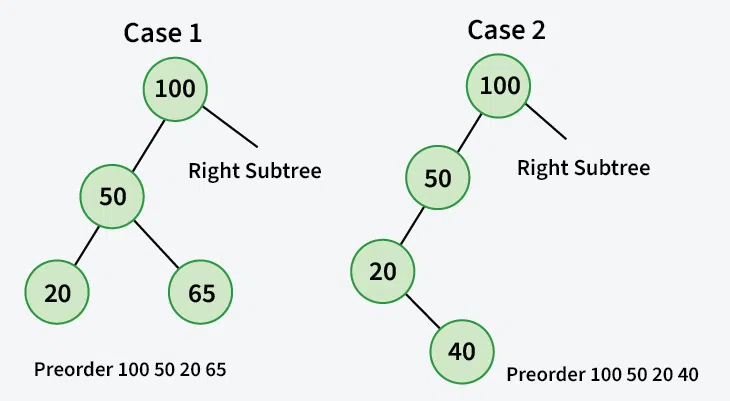
In **case 1, 20 is a leaf node whereas in case 2, 20 is not the leaf node.
So, our problem is how to identify if we have to print 20 as a leaf node or not?
This is solved using stack.
While running above algorithm on case 1 and case 2, when i = 2 and j = 3, state of a stack will be the same in both the case:
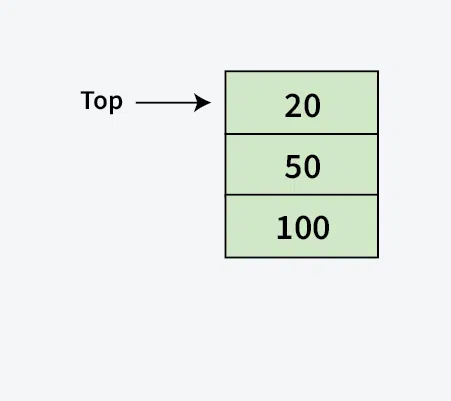
So, node 65 will pop 20 and 50 from the stack. This is because 65 is the right child of a node which is before 20. This information we store using the found variable. So, 20 is a leaf node.
While in **case 2, 40 will not able to pop any element from the stack. Because 40 is the right node of a node which is after 20. So, 20 is not a leaf node.
**Note: In the algorithm, we will not be able to check the condition of the leaf node of the rightmost node or rightmost element of the preorder. So, simply print the rightmost node because we know this will always be a leaf node in preorder traversal.
C++ `
// C++ program to print leaf nodes from the preorder // traversal of a Binary Search Tree using a stack #include #include #include
using namespace std;
// Function to find leaf nodes from the // preorder traversal vector leafNodes(vector& preorder) { stack s; vector leaves; int n = preorder.size();
// Iterate through the preorder vector
for (int i = 0, j = 1; j < n; i++, j++) {
    bool found = false;

    // Push current node if it's greater than
    // the next node
    if (preorder[i] > preorder[j]) {
        s.push(preorder[i]);
    }
    else {

        // Pop elements from stack until current node is
        // less than or equal to top of stack
        while (!s.empty()) {
            if (preorder[j] > s.top()) {
                s.pop();
                found = true;
            }
            else {
                break;
            }
        }
    }

    // If a leaf node is found, add it
    // to the leaves vector
    if (found) {
        leaves.push_back(preorder[i]);
    }
}

// Since the rightmost element
// is always a leaf node
leaves.push_back(preorder[n - 1]);

return leaves;
}
int main() {
vector<int> preorder = {4, 2, 1, 3, 6, 5};
vector<int> result = leafNodes(preorder);

for (int val : result) {
    cout << val << " ";
}

return 0;
}
Java
import java.util.ArrayList; import java.util.Stack; import java.util.Arrays;
class GfG {
// Function to find leaf nodes from the
// preorder traversal
static ArrayList<Integer> leafNodes(int[] preorder) {

    Stack<Integer> s = new Stack<>();
    ArrayList<Integer> leaves = new ArrayList<>();
    int n = preorder.length;

    // Iterate through the preorder array
    for (int i = 0, j = 1; j < n; i++, j++) {
        boolean found = false;

        // Push current node if it's greater than the next
        if (preorder[i] > preorder[j]) {
            s.push(preorder[i]);
        } else {
            // Pop elements from stack until the next value is
            // less than or equal to top
            while (!s.isEmpty()) {
                if (preorder[j] > s.peek()) {
                    s.pop();
                    found = true;
                } else {
                    break;
                }
            }
        }

        // If a leaf node is found, add it to result
        if (found) {
            leaves.add(preorder[i]);
        }
    }

    // Add the last element, it's always a leaf in BST preorder
    leaves.add(preorder[n - 1]);

    return leaves;
}

public static void main(String[] args) {

    int[] preorder = {4, 2, 1, 3, 6, 5};

    ArrayList<Integer> result = leafNodes(preorder);

    for (int val : result) {
        System.out.print(val + " ");
    }
}
}
Python
Python program to print leaf nodes from the preorder
traversal of a Binary Search Tree using a stack
def leafNodes(preorder):
s = []
leaves = []
n = len(preorder)
# Iterate through the preorder list
for i in range(n - 1):
    found = False

    # Push current node if it's greater
    # than the next node
    if preorder[i] > preorder[i + 1]:
        s.append(preorder[i])
    else:
        # Pop elements from stack until current node is
        # less than or equal to top of stack
        while s and preorder[i + 1] > s[-1]:
            s.pop()
            found = True

    # If a leaf node is found, add it to the
    # leaves list
    if found:
        leaves.append(preorder[i])

# Since the rightmost element is always
# a leaf node
leaves.append(preorder[-1])

return leaves
if name == "main":
preorder = [4, 2, 1, 3, 6, 5]

result = leafNodes(preorder)

print(" ".join(map(str, result)))
C#
using System; using System.Collections.Generic;
class GfG {
// Function to find leaf nodes from the preorder traversal
static List<int> leafNodes(int[] preorder) {
    Stack<int> s = new Stack<int>();
    List<int> leaves = new List<int>();
    int n = preorder.Length;

    // Iterate through the preorder array
    for (int i = 0, j = 1; j < n; i++, j++) {
        bool found = false;

        // Push current node if it's greater than the next node
        if (preorder[i] > preorder[j]) {
            s.Push(preorder[i]);
        } else {
            // Pop elements until next is not greater than top
            while (s.Count > 0) {
                if (preorder[j] > s.Peek()) {
                    s.Pop();
                    found = true;
                } else {
                    break;
                }
            }
        }

        if (found) {
            leaves.Add(preorder[i]);
        }
    }

    // Last node is always a leaf
    leaves.Add(preorder[n - 1]);

    return leaves;
}

static void Main(string[] args) {
    int[] preorder = {4, 2, 1, 3, 6, 5};

    List<int> result = leafNodes(preorder);
    foreach (int val in result) {
        Console.Write(val + " ");
    }
}
}
JavaScript
// JavaScript program to print leaf nodes from the preorder // traversal of a Binary Search Tree using a stack
function leafNodes(preorder) { let s = []; let leaves = []; let n = preorder.length;
// Iterate through the preorder list
for (let i = 0, j = 1; j < n; i++, j++) {
    let found = false;

    // Push current node if it's greater
    // than the next node
    if (preorder[i] > preorder[j]) {
        s.push(preorder[i]);
    }
    else {

        // Pop elements from stack until current node is
        // less than or equal to top of stack
        while (s.length > 0 && preorder[j] > s[s.length - 1]) {
            s.pop();
            found = true;
        }
    }

    // If a leaf node is found, add it to the leaves array
    if (found) {
        leaves.push(preorder[i]);
    }
}

// Since the rightmost element is always a leaf node
leaves.push(preorder[n - 1]);

return leaves;
}
// Driver Code let preorder = [4, 2, 1, 3, 6, 5];
let result = leafNodes(preorder); console.log(result.join(' '));
`
**Related articles: