Level of Each node in a Tree from source node (using BFS) (original) (raw)
Last Updated : 1 Aug, 2022
Given a tree with v vertices, find the level of each node in a tree from the source node.
Examples:
Input :
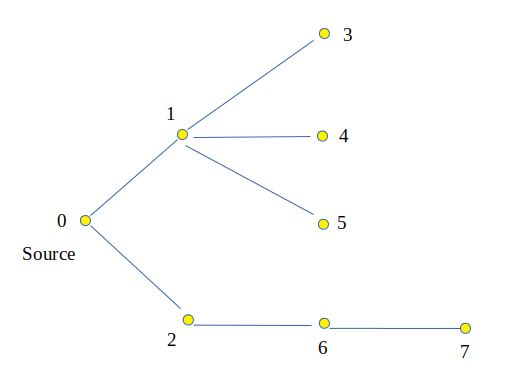
Output : Node Level 0 0 1 1 2 1 3 2 4 2 5 2 6 2 7 3
Explanation :
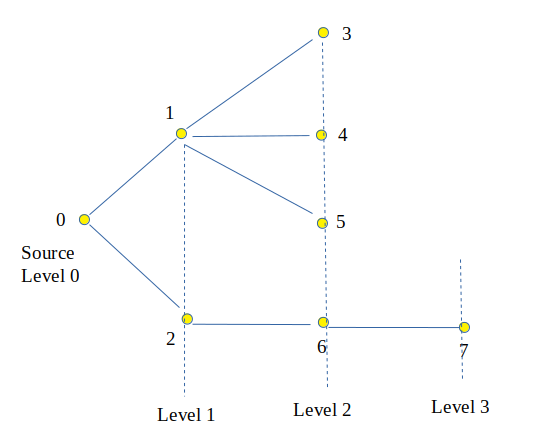
Input:
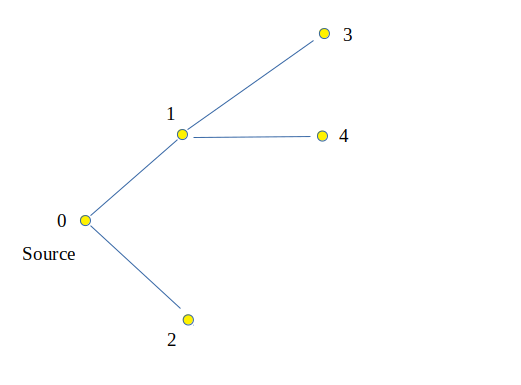
Output : Node Level 0 0 1 1 2 1 3 2 4 2 Explanation:
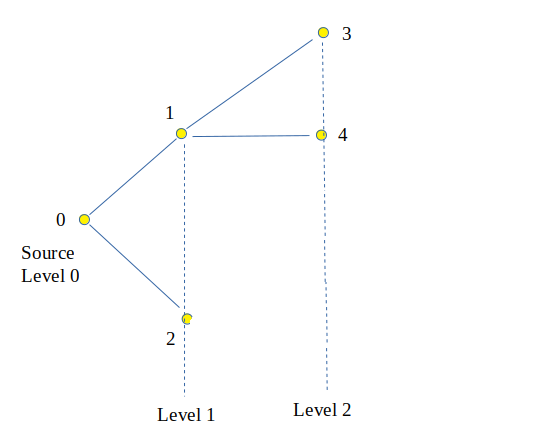
Approach:
BFS(Breadth-First Search) is a graph traversal technique where a node and its neighbours are visited first and then the neighbours of neighbours. In simple terms, it traverses level-wise from the source. First, it traverses level 1 nodes (direct neighbours of source node) and then level 2 nodes (neighbours of source node) and so on. The BFS can be used to determine the level of each node from a given source node.
Algorithm:
- Create the tree, a queue to store the nodes and insert the root or starting node in the queue. Create an extra array level of size v (number of vertices) and create a visited array.
- Run a loop while size of queue is greater than 0.
- Mark the current node as visited.
- Pop one node from the queue and insert its childrens (if present) and update the size of the inserted node as level[child] = level[node] + 1.
- Print all the node and its level.
Implementation:
C++ `
// CPP Program to determine level of each node // and print level #include <bits/stdc++.h> using namespace std;
// function to determine level of each node starting // from x using BFS void printLevels(vector graph[], int V, int x) { // array to store level of each node int level[V]; bool marked[V];
// create a queue
queue<int> que;

// enqueue element x
que.push(x);

// initialize level of source node to 0
level[x] = 0;

// marked it as visited
marked[x] = true;

// do until queue is empty
while (!que.empty()) {

    // get the first element of queue
    x = que.front();

    // dequeue element
    que.pop();

    // traverse neighbors of node x
    for (int i = 0; i < graph[x].size(); i++) {
        // b is neighbor of node x
        int b = graph[x][i];

        // if b is not marked already
        if (!marked[b]) {

            // enqueue b in queue
            que.push(b);

            // level of b is level of x + 1
            level[b] = level[x] + 1;

            // mark b
            marked[b] = true;
        }
    }
}

// display all nodes and their levels
cout << "Nodes"
     << "    "
     << "Level" << endl;
for (int i = 0; i < V; i++)
    cout << " " << i << "   -->   " << level[i] << endl;
}
// Driver Code int main() { // adjacency graph for tree int V = 8; vector graph[V];
graph[0].push_back(1);
graph[0].push_back(2);
graph[1].push_back(3);
graph[1].push_back(4);
graph[1].push_back(5);
graph[2].push_back(5);
graph[2].push_back(6);
graph[6].push_back(7);

// call levels function with source as 0
printLevels(graph, V, 0);

return 0;
}
Java
// Java Program to determine level of each node // and print level import java.util.*;
class GFG {
// function to determine level of each node starting
// from x using BFS
static void printLevels(Vector<Vector<Integer> > graph,
                        int V, int x)
{
    // array to store level of each node
    int level[] = new int[V];
    boolean marked[] = new boolean[V];

    // create a queue
    Queue<Integer> que = new LinkedList<Integer>();

    // enqueue element x
    que.add(x);

    // initialize level of source node to 0
    level[x] = 0;

    // marked it as visited
    marked[x] = true;

    // do until queue is empty
    while (que.size() > 0) {

        // get the first element of queue
        x = que.peek();

        // dequeue element
        que.remove();

        // traverse neighbors of node x
        for (int i = 0; i < graph.get(x).size(); i++) {
            // b is neighbor of node x
            int b = graph.get(x).get(i);

            // if b is not marked already
            if (!marked[b]) {

                // enqueue b in queue
                que.add(b);

                // level of b is level of x + 1
                level[b] = level[x] + 1;

                // mark b
                marked[b] = true;
            }
        }
    }

    // display all nodes and their levels
    System.out.println("Nodes"
                       + " "
                       + "Level");
    for (int i = 0; i < V; i++)
        System.out.println(" " + i + " --> "
                           + level[i]);
}

// Driver Code
public static void main(String args[])
{
    // adjacency graph for tree
    int V = 8;
    Vector<Vector<Integer> > graph
        = new Vector<Vector<Integer> >();

    for (int i = 0; i < V + 1; i++)
        graph.add(new Vector<Integer>());

    graph.get(0).add(1);
    graph.get(0).add(2);
    graph.get(1).add(3);
    graph.get(1).add(4);
    graph.get(1).add(5);
    graph.get(2).add(5);
    graph.get(2).add(6);
    graph.get(6).add(7);

    // call levels function with source as 0
    printLevels(graph, V, 0);
}
}
// This code is contributed by Arnab Kundu
Python3
Python3 Program to determine level
of each node and print level
import queue
function to determine level of
each node starting from x using BFS
def printLevels(graph, V, x):
# array to store level of each node
level = [None] * V
marked = [False] * V

# create a queue
que = queue.Queue()

# enqueue element x
que.put(x)

# initialize level of source
# node to 0
level[x] = 0

# marked it as visited
marked[x] = True

# do until queue is empty
while (not que.empty()):

    # get the first element of queue
    x = que.get()

    # traverse neighbors of node x
    for i in range(len(graph[x])):

        # b is neighbor of node x
        b = graph[x][i]

        # if b is not marked already
        if (not marked[b]):

            # enqueue b in queue
            que.put(b)

            # level of b is level of x + 1
            level[b] = level[x] + 1

            # mark b
            marked[b] = True

# display all nodes and their levels
print("Nodes", " ", "Level")
for i in range(V):
    print(" ", i,  " --> ", level[i])
Driver Code
if name == 'main':
# adjacency graph for tree
V = 8
graph = [[] for i in range(V)]

graph[0].append(1)
graph[0].append(2)
graph[1].append(3)
graph[1].append(4)
graph[1].append(5)
graph[2].append(5)
graph[2].append(6)
graph[6].append(7)

# call levels function with source as 0
printLevels(graph, V, 0)
This code is contributed by PranchalK
C#
// C# Program to determine level of each node // and print level using System; using System.Collections.Generic;
class GFG {
// function to determine level of each node starting
// from x using BFS
static void printLevels(List<List<int> > graph, int V,
                        int x)
{
    // array to store level of each node
    int[] level = new int[V];
    Boolean[] marked = new Boolean[V];

    // create a queue
    Queue<int> que = new Queue<int>();

    // enqueue element x
    que.Enqueue(x);

    // initialize level of source node to 0
    level[x] = 0;

    // marked it as visited
    marked[x] = true;

    // do until queue is empty
    while (que.Count > 0) {

        // get the first element of queue
        x = que.Peek();

        // dequeue element
        que.Dequeue();

        // traverse neighbors of node x
        for (int i = 0; i < graph[x].Count; i++) {
            // b is neighbor of node x
            int b = graph[x][i];

            // if b is not marked already
            if (!marked[b]) {

                // enqueue b in queue
                que.Enqueue(b);

                // level of b is level of x + 1
                level[b] = level[x] + 1;

                // mark b
                marked[b] = true;
            }
        }
    }

    // display all nodes and their levels
    Console.WriteLine("Nodes"
                      + " "
                      + "Level");
    for (int i = 0; i < V; i++)
        Console.WriteLine(" " + i + " --> " + level[i]);
}

// Driver Code
public static void Main(String[] args)
{
    // adjacency graph for tree
    int V = 8;
    List<List<int> > graph = new List<List<int> >();

    for (int i = 0; i < V + 1; i++)
        graph.Add(new List<int>());

    graph[0].Add(1);
    graph[0].Add(2);
    graph[1].Add(3);
    graph[1].Add(4);
    graph[1].Add(5);
    graph[2].Add(5);
    graph[2].Add(6);
    graph[6].Add(7);

    // call levels function with source as 0
    printLevels(graph, V, 0);
}
}
// This code is contributed by Princi Singh
JavaScript
`
Output
Nodes Level 0 --> 0 1 --> 1 2 --> 1 3 --> 2 4 --> 2 5 --> 2 6 --> 2 7 --> 3
Complexity Analysis:
- Time Complexity: O(n).
In BFS traversal every node is visited only once, so Time Complexity is O(n). - Space Complexity: O(n).
The space is required to store the nodes in a queue.