MColoring Problem (original) (raw)
M-Coloring Problem
Last Updated : 23 Jul, 2025
Given an edges of graph and a number m, the your task is to check it is possible to color the given graph with at most m colors such that no two adjacent vertices of the graph are colored with the same color.**
**Examples
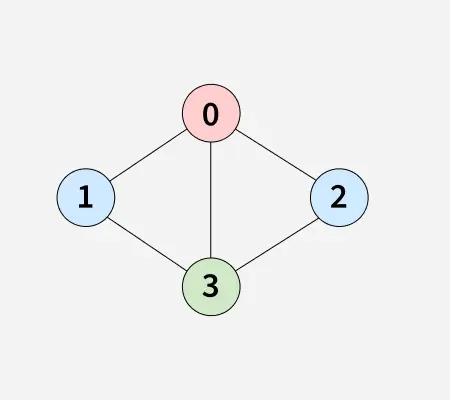
**Input: V = 4, edges[][] = [[0, 1], [0, 2], [0,3], [1, 3], [2, 3]], m = 3
**Output: true
**Explanation: Structure allows enough separation between connected vertices, so using 3 colors is sufficient to ensure no two adjacent vertices share the same color—hence, the answer is **true
**Input: V = 5, edges[][] = [[0, 1], [0, 2], [0, 3], [1, 2], [1, 4], [2, 3], [2, 4], [3, 4]], m = 3
**Output: false
**Explanation: In this graph, the vertices are highly interconnected, especially vertex 2, which connects to four others. With only 3 colors, it's impossible to assign colors so that no two adjacent vertices share the same color, hence, the answer is **false.

Approach 1: Generate all possible configurations - O((V + E)*m^V) Time and O(E+V) Space
Generate all possible configurations of length V of colors. Since each node can be colored using any of the **m available colors, the total number of color configurations possible is mV. After generating a configuration of color, check if the adjacent vertices have the **same color or **not. If the conditions are met, print the combination.
C++ `
#include <bits/stdc++.h> using namespace std;
bool goodcolor(vector adj[], vector col){
for(int i=0;i<col.size();i++){
   for(auto it:adj[i]){
    if(i != it && col[i] == col[it])return false;
   }
}
return true;
} bool genratecolor(int i,vector col, int m, vector adj[]){ if(i>=col.size()){ if(goodcolor(adj, col))return true;
    return false;
}


for(int j=0;j<m;j++){
    col[i] = j;
    if(genratecolor(i+1,col,m, adj)) return true;
    col[i] = -1;
} return false; }
bool graphColoring(int v, vector<vector> &edges, int m) { vector adj[v];
// Build adjacency list from edges
for (auto it : edges) {
    adj[it[0]].push_back(it[1]);
    adj[it[1]].push_back(it[0]);
}

vector<int> color(v, -1);
return genratecolor(0, color, m, adj);
}
int main() { int V = 4; vector<vector> edges = {{0, 1}, {0, 2},{0,3}, {1, 3}, {2, 3}}; int m = 3;
// Check if the graph can be colored with m colors
// such that no adjacent nodes share the same color
cout << (graphColoring(V, edges, m) ? "true" : "false") << endl;

return 0;
}
Java
import java.util.*;
class GfG {
static boolean goodcolor(List<Integer> adj[], int[] col) {
    for (int i = 0; i < col.length; i++) {
        for (int it : adj[i]) {
            if (i != it && col[i] == col[it]) return false;
        }
    }
    return true;
}

static boolean genratecolor(int i, int[] col, int m, List<Integer> adj[]) {
    if (i >= col.length) {
        if (goodcolor(adj, col)) return true;
        return false;
    }

    for (int j = 0; j < m; j++) {
        col[i] = j;
        if (genratecolor(i + 1, col, m, adj)) return true;
        col[i] = -1;
    }
    return false;
}

static boolean graphColoring(int v, int[][] edges, int m) {
    List<Integer>[] adj = new ArrayList[v];

    // Build adjacency list from edges
    for (int i = 0; i < v; i++) {
        adj[i] = new ArrayList<>();
    }

    for (int[] it : edges) {
        adj[it[0]].add(it[1]);
        adj[it[1]].add(it[0]);
    }

    int[] color = new int[v];
    Arrays.fill(color, -1);

    return genratecolor(0, color, m, adj);
}

public static void main(String[] args) {
    int V = 4;
    int[][] edges = {{0, 1}, {0, 2},{0,3}, {1, 3}, {2, 3}};
    int m = 3;

    // Check if the graph can be colored with m colors
    // such that no adjacent nodes share the same color
    System.out.println(graphColoring(V, edges, m) ? "true" : "false");
}
}
Python
def goodcolor(adj, col): # Check if the coloring is valid for i in range(len(col)): for it in adj[i]: if i != it and col[i] == col[it]: return False return True
def genratecolor(i, col, m, adj): if i >= len(col): if goodcolor(adj, col): return True return False
for j in range(m):
    col[i] = j
    if genratecolor(i + 1, col, m, adj):
        return True
    col[i] = -1
return False
def graphColoring(v, edges, m): adj = [[] for _ in range(v)]
# Build adjacency list from edges
for u, w in edges:
    adj[u].append(w)
    adj[w].append(u)

color = [-1] * v
return genratecolor(0, color, m, adj)
Test
V = 4 edges = [[0, 1], [0, 2], [0,3], [1, 3], [2, 3]] m = 3
Check if the graph can be colored with m colors
such that no adjacent nodes share the same color
print("true" if graphColoring(V, edges, m) else "false")
C#
using System; using System.Collections.Generic;
class GfG{
static bool goodcolor(List<int>[] adj, int[] col){

    for (int i = 0; i < col.Length; i++){

        foreach (int it in adj[i]){

            if (i != it && col[i] == col[it]) return false;
        }
    }
    return true;
}

static bool genratecolor(int i, int[] col, int m, List<int>[] adj){
    if (i >= col.Length){

        if (goodcolor(adj, col)) return true;
        return false;
    }

    for (int j = 0; j < m; j++){

        col[i] = j;
        if (genratecolor(i + 1, col, m, adj)) return true;
        col[i] = -1;
    }
    return false;
}

static bool graphColoring(int v, int[,] edges, int m){

    List<int>[] adj = new List<int>[v];

    // Build adjacency list from edges
    for (int i = 0; i < v; i++){

      adj[i] = new List<int>();
    }

    for (int i = 0; i < edges.GetLength(0); i++)
    {
        int u = edges[i, 0];
        int v2 = edges[i, 1];
        adj[u].Add(v2);
        adj[v2].Add(u);
    }

    int[] color = new int[v];
    for (int i = 0; i < v; i++) color[i] = -1;

    return genratecolor(0, color, m, adj);
}

public static void Main(string[] args)
{
    int V = 4;
    int[,] edges = {{0, 1}, {0, 2},{0,3}, {1, 3}, {2, 3}};
    int m = 3;

    // Check if the graph can be colored with m colors
    // such that no adjacent nodes share the same color
    Console.WriteLine(graphColoring(V, edges, m) ? "true" : "false");
}
}
JavaScript
function goodcolor(adj, col) { // Check if the coloring is valid for (let i = 0; i < col.length; i++) { for (let it of adj[i]) { if (i !== it && col[i] === col[it]) return false; } } return true; }
function genratecolor(i, col, m, adj) { if (i >= col.length) { if (goodcolor(adj, col)) return true; return false; }
for (let j = 0; j < m; j++) {
    col[i] = j;
    if (genratecolor(i + 1, col, m, adj)) return true;
    col[i] = -1;
}
return false;
}
function graphColoring(v, edges, m) { let adj = Array.from({ length: v }, () => []);
// Build adjacency list from edges
for (let [u, w] of edges) {
    adj[u].push(w);
    adj[w].push(u);
}

let color = new Array(v).fill(-1);
return genratecolor(0, color, m, adj);
}
// Test let V = 4; let edges = [[0, 1], [0, 2], [0,3], [1, 3], [2, 3]]; let m = 3;
// Check if the graph can be colored with m colors // such that no adjacent nodes share the same color console.log(graphColoring(V, edges, m) ? "true" : "false");
`
Approach 2: Using Backtracking - O(V * m^V) Time and O(V+E) Space
Assign colors one by one to different vertices, starting from vertex 0. Before assigning a color, check for safety by considering already assigned colors to the adjacent vertices i.e check if the adjacent vertices have the same color or not. If there is any color assignment that does not violate the conditions, mark the color assignment as part of the solution. If no assignment of color is possible then backtrack and return false
**Illustration:
C++ `
#include <bits/stdc++.h> using namespace std;
// Function to check if it's safe to color the current vertex // with the given color bool issafe(int vertex, int col, vector adj[], vector &color) { for (auto it : adj[vertex]) { // If adjacent vertex has the same color, not safe if (color[it] != -1 && col == color[it]) return false; } return true; }
// Recursive function to try all colorings bool cancolor(int vertex, int m, vector adj[], vector &color) { // If all vertices are colored successfully if (vertex == color.size()) return true;
// Try all colors from 0 to m-1
for (int i = 0; i < m; i++) {
    if (issafe(vertex, i, adj, color)) {
        color[vertex] = i;
        if (cancolor(vertex + 1, m, adj, color))
            // If the rest can be colored, return true
            return true;
        color[vertex] = -1;
    }
}

// No valid coloring found
return false;
}
bool graphColoring(int v, vector<vector> &edges, int m) { vector adj[v];
// Build adjacency list from edges
for (auto it : edges) {
    adj[it[0]].push_back(it[1]);
    adj[it[1]].push_back(it[0]);
}

vector<int> color(v, -1);
return cancolor(0, m, adj, color);
}
int main() { int V = 4; vector<vector> edges = {{0, 1}, {0, 2},{0,3}, {1, 3}, {2, 3}}; int m = 3;
// Check if the graph can be colored with m colors
// such that no adjacent nodes share the same color
cout << (graphColoring(V, edges, m) ? "true" : "false") << endl;

return 0;
}
Java
import java.util.*;
public class Main {
// Function to check if it's safe to color the current
// vertex with the given color
static boolean issafe(int vertex, int col, List<Integer>[] adj,
                                             int[] color) {

    for (int it : adj[vertex]) {
        // If adjacent vertex has the same color, not safe
        if (color[it] != -1 && col == color[it])
            return false;
    }
    return true;
}

// Recursive function to try all colorings
static boolean cancolor(int vertex, int m, List<Integer>[] adj,
                                                      int[] color) {

    // If all vertices are colored successfully
    if (vertex == color.length)
        return true;

    // Try all colors from 0 to m-1
    for (int i = 0; i < m; i++) {
        if (issafe(vertex, i, adj, color)) {
            color[vertex] = i;
            if (cancolor(vertex + 1, m, adj, color))
                // If the rest can be colored, return true
                return true;
            color[vertex] = -1;
        }
    }

    return false; // No valid coloring found
}

static boolean graphColoring(int v, int[][] edges, int m) {
    List<Integer>[] adj = new ArrayList[v];
    for (int i = 0; i < v; i++)
        adj[i] = new ArrayList<>();

    // Build adjacency list from edges
    for (int[] it : edges) {
        adj[it[0]].add(it[1]);
        adj[it[1]].add(it[0]);
    }

    int[] color = new int[v];
    Arrays.fill(color, -1);
    return cancolor(0, m, adj, color);
}

public static void main(String[] args) {
    int V = 4;
    int[][] edges = {{0, 1}, {0, 2},{0,3}, {1, 3}, {2, 3}};
    int m = 3;

    // Check if the graph can be colored with m colors
    // such that no adjacent nodes share the same color
    System.out.println(graphColoring(V, edges, m) ? "true" : "false");
}
}
Python
Function to check if it's safe to color the current vertex
with the given color
def issafe(vertex, col, adj, color): for it in adj[vertex]: # If adjacent vertex has the same color, not safe if color[it] != -1 and col == color[it]: return False return True
Recursive function to try all colorings
def cancolor(vertex, m, adj, color): # If all vertices are colored successfully if vertex == len(color): return True
# Try all colors from 0 to m-1
for i in range(m):
    if issafe(vertex, i, adj, color):
        color[vertex] = i
        if cancolor(vertex + 1, m, adj, color):
            # If the rest can be colored, return true
            return True
        color[vertex] = -1  # Backtrack

# No valid coloring found
return False
Main function to set up the graph and call coloring logic
def graphColoring(v, edges, m): adj = [[] for _ in range(v)]
# Build adjacency list from edges
for u, w in edges:
    adj[u].append(w)
    adj[w].append(u)

color = [-1] * v
return cancolor(0, m, adj, color)
Driver code
if name == "main": V = 4 edges = [[0, 1], [0, 2], [0,3], [1, 3], [2, 3]] m = 3
# Check if the graph can be colored with m colors
# such that no adjacent nodes share the same color
print("true" if graphColoring(V, edges, m) else "false")
C#
using System; using System.Collections.Generic;
class GfG{ // Function to check if it's safe to color the current // vertex with the given color static bool issafe(int vertex, int col, List[] adj, int[] color){
    foreach (int it in adj[vertex]){

        // If adjacent vertex has the same color, not safe
        if (color[it] != -1 && col == color[it])
            return false;
    }
    return true;
}

// Recursive function to try all colorings
static bool cancolor(int vertex, int m, List<int>[] adj, int[] color){

    // If all vertices are colored successfully
    if (vertex == color.Length)
        return true;

    // Try all colors from 0 to m-1
    for (int i = 0; i < m; i++){

        if (issafe(vertex, i, adj, color)){

            color[vertex] = i;
            if (cancolor(vertex + 1, m, adj, color))
                // If the rest can be colored, return true
                return true;
            color[vertex] = -1;
        }
    }

    return false; // No valid coloring found
}

static bool graphColoring(int v, int[,] edges, int m){

    List<int>[] adj = new List<int>[v];
    for (int i = 0; i < v; i++)
        adj[i] = new List<int>();

    // Build adjacency list from edges
    for (int i = 0; i < edges.GetLength(0); i++){

        int u = edges[i, 0];
        int v2 = edges[i, 1];
        adj[u].Add(v2);
        adj[v2].Add(u);
    }

    int[] color = new int[v];
    for (int i = 0; i < v; i++)
        color[i] = -1;

    return cancolor(0, m, adj, color);
}

static void Main(string[] args){

    int V = 4;
    int[,] edges = {{0, 1}, {0, 2},{0,3}, {1, 3}, {2, 3}};
    int m = 3;

    // Check if the graph can be colored with m colors
    // such that no adjacent nodes share the same color
    Console.WriteLine(graphColoring(V, edges, m) ? "true" : "false");
}
}
JavaScript
// Function to check if it's safe to color the current vertex // with the given color function issafe(vertex, col, adj, color) { for (let it of adj[vertex]) { // If adjacent vertex has the same color, not safe if (color[it] !== -1 && col === color[it]) return false; } return true; }
// Recursive function to try all colorings function cancolor(vertex, m, adj, color) { // If all vertices are colored successfully if (vertex === color.length) return true;
// Try all colors from 0 to m-1
for (let i = 0; i < m; i++) {
    if (issafe(vertex, i, adj, color)) {
        color[vertex] = i;
        if (cancolor(vertex + 1, m, adj, color))
            // If the rest can be colored, return true
            return true;
        color[vertex] = -1;
    }
}

// No valid coloring found
return false;
}
// Main function to set up the graph and call coloring logic function graphColoring(v, edges, m) { let adj = new Array(v).fill(0).map(() => []);
// Build adjacency list from edges
for (let [u, w] of edges) {
    adj[u].push(w);
    adj[w].push(u);
}

let color = new Array(v).fill(-1);
return cancolor(0, m, adj, color);
}
// Driver code const V = 4; const edges = [[0, 1], [0, 2], [0,3], [1, 3], [2, 3]]; const m = 3;
// Check if the graph can be colored with m colors // such that no adjacent nodes share the same color console.log(graphColoring(V, edges, m) ? "true" : "false");
`
**Time Complexity: O(V * mV). There is a total of O(mV) combinations of colors. For each attempted coloring of a vertex you call issafe(), can have up to V–1 neighbors, so issafe() is O(V)
**Auxiliary Space: O(V + E). The recursive Stack of the graph coloring function will require O(V) space, Adjacency list and color array will required O(V+E).