Maximum difference between node and its ancestor in Binary Tree (original) (raw)
Last Updated : 23 Jul, 2025
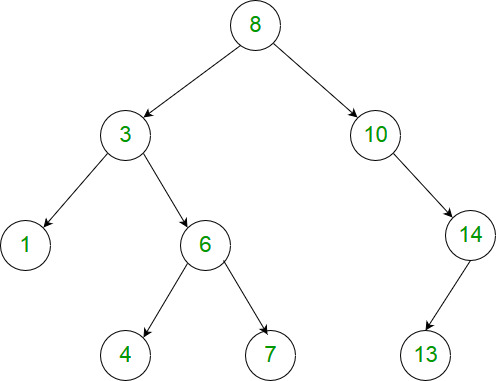
Given a Binary tree, The task is to find the maximum value by subtracting the value of node B from the value of node A, where A and B are two nodes of the binary tree and A is an ancestor of B.
Examples:
Input:
Output: 7
Explanation: We can have various ancestor-node difference, some of which are given below :
8 – 3 = 5 , 3 – 7 = -4, 8 – 1 = 7, 10 – 13 = -3
Among all those differences maximum value is 7 obtained by subtracting 1 from 8, which we need to return as result.Input:
9
/ \
6 3
/ \
1 4
Output: 8

Approach:
Traverse whole binary tree to get max difference and we can obtain the result in one traversal only by following below steps :
- If current node is a leaf node then just return its value because it can’t be ancestor of any node.
- Then at each internal node try to get minimum value from left subtree and right subtree and calculate the difference between node value and this minimum value and according to that update the result.
Follow the below steps to Implement the idea:
- Recursively traverse every node (say t) of the tree:
- If t = NULL return INT_MAX
- If the current node is the leaf node then just return the node's value.
- Recursively calling for left and right subtree for minimum value
* Update res if node value - minimum value from subtree is bigger than res i.e res = max(*res, t->key - val). - Return minimum value got so far i.e. return min(val, t->key);.
Below is the implementation of the above idea.
C++ `
// C++ program to find maximum difference between node // and its ancestor #include <bits/stdc++.h> using namespace std;
/* A binary tree node has key, pointer to left child and a pointer to right child */ struct Node { int key; struct Node *left, *right; };
/* To create a newNode of tree and return pointer / struct Node newNode(int key) { Node* temp = new Node; temp->key = key; temp->left = temp->right = NULL; return (temp); }
/* Recursive function to calculate maximum ancestor-node difference in binary tree. It updates value at 'res' to store the result. The returned value of this function is minimum value in subtree rooted with 't' / int maxDiffUtil(Node t, int* res) { /* Returning Maximum int value if node is not there (one child case) */ if (t == NULL) return INT_MAX;
/* If leaf node then just return node's value  */
if (t->left == NULL && t->right == NULL)
    return t->key;

/* Recursively calling left and right subtree
   for minimum value  */
int val = min(maxDiffUtil(t->left, res),
              maxDiffUtil(t->right, res));

/* Updating res if (node value - minimum value
   from subtree) is bigger than res  */
*res = max(*res, t->key - val);

/* Returning minimum value got so far */
return min(val, t->key);
}
/* This function mainly calls maxDiffUtil() / int maxDiff(Node root) { // Initialising result with minimum int value int res = INT_MIN;
maxDiffUtil(root, &res);

return res;
}
/* Helper function to print inorder traversal of binary tree / void inorder(Node root) { if (root) { inorder(root->left); cout << root->key << " "; inorder(root->right); } }
// Driver program to test above functions int main() { // Making above given diagram's binary tree Node* root; root = newNode(8); root->left = newNode(3);
root->left->left = newNode(1);
root->left->right = newNode(6);
root->left->right->left = newNode(4);
root->left->right->right = newNode(7);

root->right = newNode(10);
root->right->right = newNode(14);
root->right->right->left = newNode(13);

cout << maxDiff(root);
}
Java
/* Java program to find maximum difference between node and its ancestor */
// A binary tree node has key, pointer to left // and right child class Node { int key; Node left, right;
public Node(int key)
{
    this.key = key;
    left = right = null;
}
}
/* Class Res created to implement pass by reference of 'res' variable */ class Res { int r = Integer.MIN_VALUE; }
public class BinaryTree { Node root;
/* Recursive function to calculate maximum ancestor-node
   difference in  binary tree. It updates value at 'res'
   to store the result.  The returned value of this
   function
   is minimum value in subtree rooted with 't' */
int maxDiffUtil(Node t, Res res)
{
    /* Returning Maximum int value if node is not
       there (one child case)  */
    if (t == null)
        return Integer.MAX_VALUE;

    /* If leaf node then just return node's value  */
    if (t.left == null && t.right == null)
        return t.key;

    /* Recursively calling left and right subtree
       for minimum value  */
    int val = Math.min(maxDiffUtil(t.left, res),
                       maxDiffUtil(t.right, res));

    /* Updating res if (node value - minimum value
       from subtree) is bigger than res  */
    res.r = Math.max(res.r, t.key - val);

    /* Returning minimum value got so far */
    return Math.min(val, t.key);
}

/* This function mainly calls maxDiffUtil() */
int maxDiff(Node root)
{
    // Initialising result with minimum int value
    Res res = new Res();
    maxDiffUtil(root, res);

    return res.r;
}

/* Helper function to print inorder traversal of
   binary tree   */
void inorder(Node root)
{
    if (root != null) {
        inorder(root.left);
        System.out.print(root.key + "");
        inorder(root.right);
    }
}

// Driver program to test the above functions
public static void main(String[] args)
{
    BinaryTree tree = new BinaryTree();

    // Making above given diagram's binary tree
    tree.root = new Node(8);
    tree.root.left = new Node(3);
    tree.root.left.left = new Node(1);
    tree.root.left.right = new Node(6);
    tree.root.left.right.left = new Node(4);
    tree.root.left.right.right = new Node(7);

    tree.root.right = new Node(10);
    tree.root.right.right = new Node(14);
    tree.root.right.right.left = new Node(13);

    System.out.println(tree.maxDiff(tree.root));
}
}
// This code has been contributed by Mayank // Jaiswal(mayank_24)
Python3
Python3 program to find maximum difference
between node and its ancestor
_MIN = -2147483648 _MAX = 2147483648
Helper function that allocates a new
node with the given data and None left
and right pointers.
class newNode:
# Constructor to create a new node
def __init__(self, key):
    self.key = key
    self.left = None
    self.right = None
""" Recursive function to calculate maximum ancestor-node difference in binary tree. It updates value at 'res' to store the result. The returned value of this function is minimum value in subtree rooted with 't' """
def maxDiffUtil(t, res): """ Returning Maximum value if node is not there (one child case) """ if (t == None): return _MAX, res
""" If leaf node then just return
    node's value """
if (t.left == None and t.right == None):
    return t.key, res

""" Recursively calling left and right
subtree for minimum value """
a, res = maxDiffUtil(t.left, res)
b, res = maxDiffUtil(t.right, res)
val = min(a, b)

""" Updating res if (node value - minimum
value from subtree) is bigger than res """
res = max(res, t.key - val)

""" Returning minimum value got so far """
return min(val, t.key), res
""" This function mainly calls maxDiffUtil() """
def maxDiff(root):
# Initialising result with minimum value
res = _MIN
x, res = maxDiffUtil(root, res)
return res
""" Helper function to print inorder traversal of binary tree """
def inorder(root):
if (root):

    inorder(root.left)
    prf("%d ", root.key)
    inorder(root.right)
Driver Code
if name == 'main':
"""
Let us create Binary Tree shown
in above example """
root = newNode(8)
root.left = newNode(3)

root.left.left = newNode(1)
root.left.right = newNode(6)
root.left.right.left = newNode(4)
root.left.right.right = newNode(7)

root.right = newNode(10)
root.right.right = newNode(14)
root.right.right.left = newNode(13)
print(maxDiff(root))
This code is contributed by
Shubham Singh(SHUBHAMSINGH10)
C#
using System;
/* C# program to find maximum difference between node and its ancestor */
// A binary tree node has key, pointer to left // and right child public class Node { public int key; public Node left, right;
public Node(int key)
{
    this.key = key;
    left = right = null;
}
}
/* Class Res created to implement pass by reference of 'res' variable */ public class Res { public int r = int.MinValue; }
public class BinaryTree { public Node root;
/* Recursive function to calculate maximum ancestor-node
   difference in  binary tree. It updates value at 'res'
   to store the result.  The returned value of this
   function
   is minimum value in subtree rooted with 't' */
public virtual int maxDiffUtil(Node t, Res res)
{
    /* Returning Maximum int value if node is not
       there (one child case)  */
    if (t == null) {
        return int.MaxValue;
    }

    /* If leaf node then just return node's value  */
    if (t.left == null && t.right == null) {
        return t.key;
    }

    /* Recursively calling left and right subtree
       for minimum value  */
    int val = Math.Min(maxDiffUtil(t.left, res),
                       maxDiffUtil(t.right, res));

    /* Updating res if (node value - minimum value
       from subtree) is bigger than res  */
    res.r = Math.Max(res.r, t.key - val);

    /* Returning minimum value got so far */
    return Math.Min(val, t.key);
}

/* This function mainly calls maxDiffUtil() */
public virtual int maxDiff(Node root)
{
    // Initialising result with minimum int value
    Res res = new Res();
    maxDiffUtil(root, res);

    return res.r;
}

/* Helper function to print inorder traversal of
   binary tree   */
public virtual void inorder(Node root)
{
    if (root != null) {
        inorder(root.left);
        Console.Write(root.key + "");
        inorder(root.right);
    }
}

// Driver program to test the above functions
public static void Main(string[] args)
{
    BinaryTree tree = new BinaryTree();

    // Making above given diagram's binary tree
    tree.root = new Node(8);
    tree.root.left = new Node(3);
    tree.root.left.left = new Node(1);
    tree.root.left.right = new Node(6);
    tree.root.left.right.left = new Node(4);
    tree.root.left.right.right = new Node(7);

    tree.root.right = new Node(10);
    tree.root.right.right = new Node(14);
    tree.root.right.right.left = new Node(13);

    Console.WriteLine(tree.maxDiff(tree.root));
}
}
// This code is contributed by Shrikant13
JavaScript
`
Time Complexity: O(N), for visiting every node of the tree.
Auxiliary Space: O(N) for recursion call stack.