Maximum Number of Envelopes That Can be Put inside other bigger envelopes (original) (raw)
Last Updated : 14 Mar, 2026
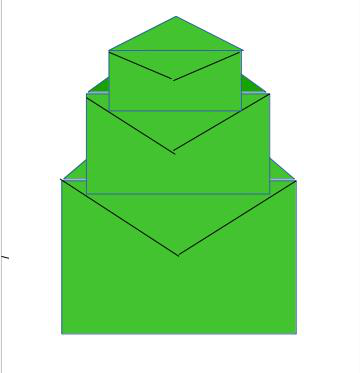
Given **N envelopes, as ****{W, H}** pair, where **W as the width and **H as the height. One envelope can fit into another if and only if both the width and height of one envelope is smaller than the width and height of the other envelope. Find the maximum number of envelopes that can be put inside another envelope and so on. Rotation of envelope is not allowed.
**Examples:
**Input: envelope[] = {{4, 3}, {5, 3}, {5, 6}, {1, 2}}
**Output: 3
**Explanation: The maximum number of envelopes that can be put into another envelope
is 3. ({1, 2}, {4, 3}, {5, 6})**Input: envelope[] = {{3, 6}, {5, 4}, {4, 8}, {6, 9}, {10, 7}, {12, 12}}
**Output: 4
****Explanation:**The maximum number of envelopes that can be put into another envelope is 4. ({3, 6}, {4, 8}, {6, 9}, {12, 12})
Table of Content
Naive Approach - O(N²) Time and O(N) Space
The idea is to treat this problem like the Longest Increasing Subsequence (LIS) problem. First, sort envelopes by increasing width. If widths are equal, sort by decreasing height. Then, for each envelope, check how many smaller envelopes can fit inside it.
**Steps:
- Sort the array in non-decreasing order of width and if width is same, then consider height.
- Initialize a dp[] array, where dp[i] stores the maximum number of envelopes that can be nested with envelope[i] as the largest envelope.
- For each envelope[i], loop through all envelopes before it. If the width and height of a previous envelope are both smaller, update dp[i] = max(dp[i], dp[j] + 1).
- The maximum value in dp[] gives the maximum number of envelopes that can be nested. C++ `
//Driver Code Starts using namespace std;
// Function that returns the maximum // number of envelopes that can be // inserted into another envelopes //Driver Code Ends
int maxenvelopes(vector<vector>& envelopes) { // Number of envelopes int n = envelopes.size();
if (n == 0)
    return 0;

// Sort the envelopes in
// non-decreasing order
sort(envelopes.begin(), envelopes.end(),
     [](vector<int>& a, vector<int>& b) {
         if(a[0] != b[0]) return a[0] < b[0];
         return a[1] < b[1];
     });

// Initialize dp[] array
vector<int> dp(n, 1);

// To store the result
int max_envelope = 1;

// Loop through the array
for(int i = 1; i < n; ++i)
{
    // Find envelopes count for
    // each envelope
    for(int j = 0; j < i; ++j)
    {
        if(envelopes[i][0] > envelopes[j][0] &&
           envelopes[i][1] > envelopes[j][1])
        {
            dp[i] = max(dp[i], dp[j] + 1);
        }
    }
    max_envelope = max(max_envelope, dp[i]);
}

return max_envelope;
}
//Driver Code Starts int main() { // Given the envelopes vector<vector> envelopes = {{4,3},{5,3},{5,6},{1,2}};
// Function call
cout << maxenvelopes(envelopes);
return 0;
} //Driver Code Ends
Java
//Driver Code Starts import java.util.Arrays; // Function that returns the maximum // number of envelopes that can be // inserted into another envelopes class GFG {
//Driver Code Ends
static int maxenvelopes(int[][] envelopes)
{
    // Number of envelopes
    int n = envelopes.length;

    if (n == 0)
        return 0;

    // Sort the envelopes in
    // non-decreasing order
    Arrays.sort(envelopes, (a, b) -> {
        if (a[0] != b[0])
            return a[0] - b[0];
        return a[1] - b[1];
    });

    // Initialize dp[] array
    int[] dp = new int[n];
    Arrays.fill(dp, 1);

    // To store the result
    int max_envelope = 1;

    // Loop through the array
    for (int i = 1; i < n; ++i) {
        // Find envelopes count for
        // each envelope
        for (int j = 0; j < i; ++j) {
            if (envelopes[i][0] > envelopes[j][0]
                && envelopes[i][1] > envelopes[j][1]) {
                dp[i] = Math.max(dp[i], dp[j] + 1);
            }
        }
        max_envelope = Math.max(max_envelope, dp[i]);
    }

    return max_envelope;
}
//Driver Code Starts
public static void main(String[] args)
{
    // Given the envelopes
    int[][] envelopes
        = { { 4, 3 }, { 5, 3 }, { 5, 6 }, { 1, 2 } };

    // Function call
    System.out.println(maxenvelopes(envelopes));
}
} //Driver Code Ends
Python
#Driver Code Starts
Function that returns the maximum
number of envelopes that can be
inserted into another envelopes
#Driver Code Ends
def maxenvelopes(envelopes): # Number of envelopes n = len(envelopes)
if n == 0:
    return 0

# Sort the envelopes in
# non-decreasing order
envelopes.sort(key=lambda x: (x[0], x[1]))

# Initialize dp[] array
dp = [1] * n

# To store the result
max_envelope = 1

# Loop through the array
for i in range(1, n):
    # Find envelopes count for
    # each envelope
    for j in range(i):
        if envelopes[i][0] > envelopes[j][0] and \
           envelopes[i][1] > envelopes[j][1]:
            dp[i] = max(dp[i], dp[j] + 1)
    max_envelope = max(max_envelope, dp[i])

return max_envelope
#Driver Code Starts if name == "main": # Given the envelopes envelopes = [[4,3],[5,3],[5,6],[1,2]]
# Function call
print(maxenvelopes(envelopes))
#Driver Code Ends
C#
//Driver Code Starts using System; using System.Collections.Generic;
// Function that returns the maximum // number of envelopes that can be // inserted into another envelopes class GFG {
//Driver Code Ends
static int maxenvelopes(int[,] envelopes) {
    // Number of envelopes
    int n = envelopes.GetLength(0);

    if(n == 0) return 0;

    // Convert 2D array to list for sorting
    List<int[]> envList = new List<int[]>();
    for(int i = 0; i < n; i++)
        envList.Add(new int[]{envelopes[i,0], envelopes[i,1]});

    // Sort the envelopes in non-decreasing order
    envList.Sort((a,b) => {
        if(a[0] != b[0]) return a[0] - b[0];
        return a[1] - b[1];
    });

    // Initialize dp[] array
    int[] dp = new int[n];
    for(int i = 0; i < n; i++) dp[i] = 1;

    // To store the result
    int max_envelope = 1;

    // Loop through the array
    for(int i = 1; i < n; i++) {
        // Find envelopes count for each envelope
        for(int j = 0; j < i; j++) {
            if(envList[i][0] > envList[j][0] &&
               envList[i][1] > envList[j][1]) {
                dp[i] = Math.Max(dp[i], dp[j]+1);
            }
        }
        max_envelope = Math.Max(max_envelope, dp[i]);
    }

    return max_envelope;
}
//Driver Code Starts static void Main() { // Given the envelopes int[,] envelopes = new int[,] { {4,3},{5,3},{5,6},{1,2} };
    // Function call
    Console.WriteLine(maxenvelopes(envelopes));
}
} //Driver Code Ends
JavaScript
//Driver Code Starts // Function that returns the maximum // number of envelopes that can be // inserted into another envelopes //Driver Code Ends
function maxenvelopes(envelopes) { // Number of envelopes let n = envelopes.length;
if (n === 0)
    return 0;

// Sort the envelopes in
// non-decreasing order
envelopes.sort((a, b) => {
    if (a[0] !== b[0])
        return a[0] - b[0];
    return a[1] - b[1];
});

// Initialize dp[] array
let dp = new Array(n).fill(1);

// To store the result
let max_envelope = 1;

// Loop through the array
for (let i = 1; i < n; i++) {
    // Find envelopes count for
    // each envelope
    for (let j = 0; j < i; j++) {
        if (envelopes[i][0] > envelopes[j][0]
            && envelopes[i][1] > envelopes[j][1]) {
            dp[i] = Math.max(dp[i], dp[j] + 1);
        }
    }
    max_envelope = Math.max(max_envelope, dp[i]);
}

return max_envelope;
}
//Driver Code Starts
const envelopes = [ [ 4, 3 ], [ 5, 3 ], [ 5, 6 ], [ 1, 2 ] ];
// Function call console.log(maxenvelopes(envelopes)); //Driver Code Ends
`
Efficient Approach - O(N log N) Time and O(N) Space
To optimize the naive approach the idea is to use the concept of Binary Searchand Longest Increasing Subsequence. First, sort envelopes by increasing width. If widths are equal, sort by decreasing height. Then, the problem reduces to finding the longest increasing sequence of heights
C++ `
using namespace std;
// Function that returns the maximum // number of envelopes that can be // inserted into another envelopes int maxEnvelopes(vector<vector> &envelopes) { // Number of envelopes int N = envelopes.size();
if (N == 0)
    return N;

// Sort the envelopes in increasing
// order of width and decreasing order
// of height is width is same
sort(envelopes.begin(), envelopes.end(),
     [](vector<int> &a, vector<int> &b) { return a[0] < b[0] or (a[0] == b[0] and a[1] > b[1]); });

// To store the longest increasing
// sequence of height
vector<int> dp;

// Finding LIS of the heights
// of the envelopes
for (int i = 0; i < N; ++i)
{
    auto iter = lower_bound(dp.begin(), dp.end(), envelopes[i][1]);

    if (iter == dp.end())
        dp.push_back(envelopes[i][1]);
    else if (envelopes[i][1] < *iter)
        *iter = envelopes[i][1];
}
return dp.size();
}
int main() { // Given the envelopes vector<vector> envelopes = {{4, 3}, {5, 3}, {5, 6}, {1, 2}};
// Function Call
cout << maxEnvelopes(envelopes);
return 0;
}
Java
//Driver Code Starts import java.util.Arrays; import java.util.ArrayList; import java.util.Collections; import java.util.Comparator;
class GFG {
// Function that returns the maximum
// number of envelopes that can be
// inserted into another envelopes
//Driver Code Ends
static int maxEnvelopes(int[][] envelopes) {

    // Number of envelopes
    int N = envelopes.length;
    if (N == 0)
        return 0;

    // Sort the envelopes in increasing
    // order of width and decreasing order
    // of height if width is same
    Arrays.sort(envelopes, new Comparator<int[]>() {
        @Override
        public int compare(int[] a, int[] b) {
            return a[0] == b[0] ? b[1] - a[1] : a[0] - b[0];
        }
    });

    // To store the longest increasing
    // sequence of height
    ArrayList<Integer> dp = new ArrayList<>();

    // Finding LIS of the heights
    // of the envelopes
    for (int i = 0; i < N; i++) {
        int idx = Collections.binarySearch(dp, envelopes[i][1]);
        if (idx < 0)
            idx = -idx - 1;

        if (idx == dp.size())
            dp.add(envelopes[i][1]);
        else
            dp.set(idx, envelopes[i][1]);
    }

    return dp.size();
}
//Driver Code Starts public static void main(String[] args) {
    // Given the envelopes
    int[][] envelopes = { {4, 3}, {5, 3}, {5, 6}, {1, 2} };

    // Function Call
    System.out.println(maxEnvelopes(envelopes));
}
}
// Output: 3 //Driver Code Ends
Python
#Driver Code Starts from bisect import bisect_left
Function that returns the maximum
number of envelopes that can be
inserted into another envelope
#Driver Code Ends
def max_envelopes(envelopes): # Number of envelopes n = len(envelopes) if n == 0: return 0
# Sort envelopes by increasing width
# and decreasing height if widths are same
envelopes.sort(key=lambda x: (x[0], -x[1]))

# To store the longest increasing sequence of heights
dp = []

# Finding LIS of the heights of the envelopes
for _, height in envelopes:
    idx = bisect_left(dp, height)
    if idx == len(dp):
        dp.append(height)
    else:
        dp[idx] = height

return len(dp)
#Driver Code Starts
if name == "main": # Given the envelopes envelopes = [[4, 3], [5, 3], [5, 6], [1, 2]]
# Function Call
print(max_envelopes(envelopes))
#Driver Code Ends
C#
//Driver Code Starts using System; using System.Collections.Generic;
class GFG { // Function that returns the maximum // number of envelopes that can be // inserted into another envelopes //Driver Code Ends
static int maxEnvelopes(int[][] envelopes)
{
    // Number of envelopes
    int n = envelopes.Length;

    if (n == 0)
        return 0;

    // Sort the envelopes in increasing
    // order of width and decreasing order
    // of height if width is same
    Array.Sort(envelopes, (a, b) = > {
        if (a[0] != b[0])
            return a[0] - b[0];
        return b[1] - a[1];
    });

    // To store the longest increasing sequence of
    // height
    List<int> dp = new List<int>();

    // Finding LIS of the heights of the envelopes
    for (int i = 0; i < n; i++) {
        int height = envelopes[i][1];
        int idx = dp.BinarySearch(height);

        if (idx < 0)
            idx = ~idx;

        if (idx == dp.Count)
            dp.Add(height);
        else
            dp[idx] = height;
    }

    return dp.Count;
}
//Driver Code Starts static void Main(string[] args) { // Given the envelopes int[][] envelopes = new int[4][]; envelopes[0] = new int[] { 4, 3 }; envelopes[1] = new int[] { 5, 3 }; envelopes[2] = new int[] { 5, 6 }; envelopes[3] = new int[] { 1, 2 };
    // Function Call
    Console.WriteLine(maxEnvelopes(envelopes));
}
} //Driver Code Ends
JavaScript
//Driver Code Starts // Function that returns the maximum // number of envelopes that can be // inserted into another envelopes //Driver Code Ends
function maxEnvelopes(envelopes) { // Number of envelopes let N = envelopes.length;
if (N === 0) return N;
// Sort the envelopes in increasing // order of width and decreasing order // of height is width is same envelopes.sort((a, b) => { if (a[0] === b[0]) { return b[1] - a[1]; } else { return a[0] - b[0]; } });
// To store the longest increasing // sequence of height let dp = [];
// Finding LIS of the heights // of the envelopes for (let i = 0; i < N; i++) { let iter = dp.findIndex(x => x >= envelopes[i][1]); if (iter === -1) { dp.push(envelopes[i][1]); } else if (envelopes[i][1] < dp[iter]) { dp[iter] = envelopes[i][1]; } }
return dp.length; }
//Driver Code Starts // Driver Code let envelopes = [[4, 3], [5, 3], [5, 6], [1, 2]];
// Function Call console.log(maxEnvelopes(envelopes)); // this contributed by devendra //Driver Code Ends
`