Maximum Size Square SubMatrix with All 1s (original) (raw)
Given a binary matrix **mat[][] of size n × m, find out the **maximum length of a side of a **square sub-matrix with all **1s.
**Example:
**Input:
mat[][] = [
[0, 1, 1, 0, 1],
[1, 1, 0, 1, 0],
[0, 1, 1, 1, 0],
[1, 1, 1, 1, 0],
[1, 1, 1, 1, 1],
[0, 0, 0, 0, 0] ]**Output: 3
**Explanation: The maximum length of a side of the square sub-matrix is 3 where every element is 1.
**Input:
mat[][] = [[1, 1],
[1, 1]]**Output: 2
**Explanation: The maximum length of a side of the square sub-matrix is 2. The matrix itself is the maximum sized sub-matrix in this case.
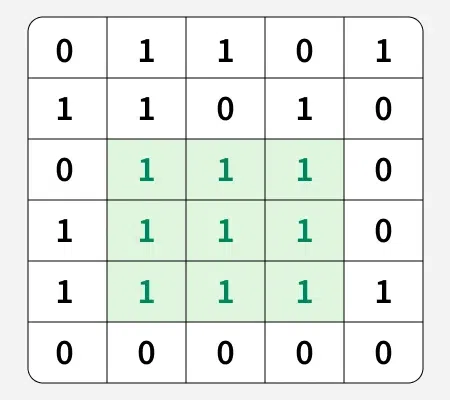
Table of Content
- [Naive Approach] - Using Recursion - O(3^(n+m)) Time and O(n+m) Space
- [Better Approach - 1] - Using Top-Down DP (Memoization) - O(n × m) Time and O(n × m) Space
- [Better Approach - 2] -Using Bottom-Up DP (Tabulation) – O(n × m) Time and O(n × m) Space
- [Expected Approach] - Using Space Optimized DP – O(n × m) Time and O(n) Space
[Naive Approach] - Using Recursion - O(3^(n+m)) Time and O(n+m) Space
The idea is to recursively determine the side length of the largest square sub-matrix with all 1s at each cell. For each cell, if its value is 0, we return 0 since it cannot contribute to a square. Otherwise, we calculate the possible side length of a square ending at this cell by finding the minimum square side lengths from the right, bottom, and bottom-right diagonal cells and adding 1 to this minimum. This value gives the largest possible square side length for that cell, and we update the maximum side length by comparing it with the result at each cell.
The recurrence equation will be as follows:
- **Side(i, j) = 1 + minimum(Side(i, j+1), Side(i+1, j), Side(i+1, j+1)) for cells i, j where **mat[i][j] = 1.
- Otherwise Side(i,j) = 0. C++ `
#include #include #include using namespace std;
//recursive function to find the square int maxSquareRecur(int i, int j, vector<vector> &mat, int &ans) {
// Return 0 for invalid cells
if (i<0 || i==mat.size() || j<0 || j==mat[0].size())
    return 0;

 // for the side square
int right = maxSquareRecur(i, j+1, mat, ans);
int down = maxSquareRecur(i+1, j, mat, ans);
int diagonal = maxSquareRecur(i+1, j+1, mat, ans);

// If mat[i][j]==0, then square cannot
// be formed.
if (mat[i][j]==0) return 0;

// Side of square will be
int val = 1+ min({right, down, diagonal});
ans = max(ans, val);

return val;
}
// for calculate the answer int maxSquare(vector<vector> &mat) {
int ans = 0;
maxSquareRecur(0,0,mat, ans);
return ans;
}
int main() { vector<vector> mat = {{0, 1, 1, 0, 1}, {1, 1, 0, 1, 0}, {0, 1, 1, 1, 0}, {1, 1, 1, 1, 0}, {1, 1, 1, 1, 1}, {0, 0, 0, 0, 0}}; cout << maxSquare(mat) << endl;
return 0;}
Java
public class GfG {
// recursive function to find the square
static int maxSquareRecur(int i, int j, int[][] mat, int[] ans) {

    // Return 0 for invalid cells
    if (i < 0 || i == mat.length || j < 0 || j == mat[0].length)
        return 0;

    // for the side square
    int right = maxSquareRecur(i, j + 1, mat, ans);
    int down = maxSquareRecur(i + 1, j, mat, ans);
    int diagonal = maxSquareRecur(i + 1, j + 1, mat, ans);

    // If mat[i][j]==0, then square cannot be formed.
    if (mat[i][j] == 0) return 0;

    // Side of square will be
    int val = 1 + Math.min(right, Math.min(down, diagonal));
    ans[0] = Math.max(ans[0], val);

    return val;
}

// for calculate the answer
static int maxSquare(int[][] mat) {
    int[] ans = new int[1];
    maxSquareRecur(0, 0, mat, ans);
    return ans[0];
}

public static void main(String[] args) {
    int[][] mat = {
        {0, 1, 1, 0, 1},
        {1, 1, 0, 1, 0},
        {0, 1, 1, 1, 0},
        {1, 1, 1, 1, 0},
        {1, 1, 1, 1, 1},
        {0, 0, 0, 0, 0}
    };

    System.out.println(maxSquare(mat));
}
}
Python
recursive function to find the square
def maxSquareRecur(i, j, mat, ans):
# Return 0 for invalid cells
if i < 0 or i == len(mat) or j < 0 or j == len(mat[0]):
    return 0

# for the side square
right = maxSquareRecur(i, j + 1, mat, ans)
down = maxSquareRecur(i + 1, j, mat, ans)
diagonal = maxSquareRecur(i + 1, j + 1, mat, ans)

# If mat[i][j]==0, then square cannot be formed.
if mat[i][j] == 0:
    return 0

# Side of square will be
val = 1 + min(right, down, diagonal)
ans[0] = max(ans[0], val)

return val
for calculate the answer
def maxSquare(mat): ans = [0] maxSquareRecur(0, 0, mat, ans) return ans[0]
if name=="main": mat = [ [0,1,1,0,1], [1,1,0,1,0], [0,1,1,1,0], [1,1,1,1,0], [1,1,1,1,1], [0,0,0,0,0] ]
print(maxSquare(mat))C#
using System;
class GfG { // recursive function to find the square static int MaxSquareRecur(int i, int j, int[,] mat, ref int ans) { int rows = mat.GetLength(0); int cols = mat.GetLength(1);
    // Return 0 for invalid cells
    if (i < 0 || i == rows || j < 0 || j == cols)
        return 0;

    // for the side square
    int right = MaxSquareRecur(i, j + 1, mat, ref ans);
    int down = MaxSquareRecur(i + 1, j, mat, ref ans);
    int diagonal = MaxSquareRecur(i + 1, j + 1, mat, ref ans);

    // If mat[i][j]==0, then square cannot be formed.
    if (mat[i, j] == 0) return 0;

    // Side of square will be
    int val = 1 + Math.Min(right, Math.Min(down, diagonal));
    ans = Math.Max(ans, val);

    return val;
}

// for calculate the answer
static int MaxSquare(int[,] mat)
{
    int ans = 0;
    MaxSquareRecur(0, 0, mat, ref ans);
    return ans;
}

static void Main()
{
    int[,] mat = {
        {0, 1, 1, 0, 1},
        {1, 1, 0, 1, 0},
        {0, 1, 1, 1, 0},
        {1, 1, 1, 1, 0},
        {1, 1, 1, 1, 1},
        {0, 0, 0, 0, 0}
    };

    Console.WriteLine(MaxSquare(mat));
}
}
JavaScript
// recursive function to find the square function maxSquareRecur(i, j, mat, ans) {
// Return 0 for invalid cells
if (i < 0 || i == mat.length || j < 0 || j == mat[0].length)
    return 0;

// for the side square
let right = maxSquareRecur(i, j + 1, mat, ans);
let down = maxSquareRecur(i + 1, j, mat, ans);
let diagonal = maxSquareRecur(i + 1, j + 1, mat, ans);

// If mat[i][j]==0, then square cannot be formed.
if (mat[i][j] === 0) return 0;

// Side of square will be
let val = 1 + Math.min(right, down, diagonal);
ans.value = Math.max(ans.value, val);

return val;
}
// for calculate the answer function maxSquare(mat) { let ans = { value: 0 }; maxSquareRecur(0, 0, mat, ans); return ans.value; }
// Driver code let mat = [ [0, 1, 1, 0, 1], [1, 1, 0, 1, 0], [0, 1, 1, 1, 0], [1, 1, 1, 1, 0], [1, 1, 1, 1, 1], [0, 0, 0, 0, 0] ];
console.log(maxSquare(mat));
`
[Better Approach - 1] - Using Top-Down DP ( Memoization) - O(n × m) Time and O(n × m) Space
_The recursive calls use sub-problems so if we get a sub-problem the first time, we can solve this problem by creating a 2-D array that can store a particular state. Now if we come across the same state again instead of calculating it again we can directly return its result stored in the table in constant time.
The recursive solution holds the following two properties of Dynamic Programming:
1. Optimal Substructure:
The side of square originating from i, j, i.e., maxSquare(i, j), depends on the optimal solutions of the sub-problems maxSquare(i, j+1) , maxSquare(i+1, j) and maxSquare(i+1, j+1). By finding the minimum value in these optimal substructures, we can efficiently calculate the side of square at (i,j).
2. Overlapping Sub-problems:
While applying a recursive approach in this problem, we notice that certain sub-problems are computed multiple times.
- There aretwo parameters, i and j that changes in the recursivesolution. So we create a 2D array of size n × m for memoization.
- We initialize thisarray as -1 to indicate nothing is computed initially.
- Now we modify our recursive solution to first check if the value is -1, then only make recursive calls. This way, we avoid re-computations of the same sub-problems. C++ `
#include #include #include using namespace std;
// recursive function to find the square int maxSquareRecur(int i, int j, vector<vector> &mat, int &ans, vector<vector> &memo) {
// Return 0 for invalid cells
if (i<0 || i==mat.size() || j<0 || j==mat[0].size())
    return 0;

// If value is memoized, return value.
if (memo[i][j]!=-1) return memo[i][j];
// for the side square int right = maxSquareRecur(i, j+1, mat, ans, memo); int down = maxSquareRecur(i+1, j, mat, ans, memo); int diagonal = maxSquareRecur(i+1, j+1, mat, ans, memo);
// If mat[i][j]==0, then square cannot
// be formed.
if (mat[i][j]==0) return memo[i][j] = 0;

// Side of square will be
int val = 1+min({right, down, diagonal});
ans = max(ans, val);

// Memoize the value and return it.
return memo[i][j] = val;
}
int maxSquare(vector<vector> &mat) { int n = mat.size(), m = mat[0].size(); int ans = 0;
// Create 2d array for memoization
vector<vector<int>> memo(n, vector<int>(m, -1));
maxSquareRecur(0,0,mat, ans,memo);
return ans;
}
int main() { vector<vector> mat = {{0, 1, 1, 0, 1}, {1, 1, 0, 1, 0}, {0, 1, 1, 1, 0}, {1, 1, 1, 1, 0}, {1, 1, 1, 1, 1}, {0, 0, 0, 0, 0}}; cout << maxSquare(mat) << endl;
return 0;}
Java
import java.util.Arrays;
class GfG {
// recursive function to find the square
static int maxSquareRecur(int i, int j, int[][] mat,
                          int[] ans, int[][] memo) {

    // Return 0 for invalid cells
    if (i < 0 || i == mat.length || j < 0
        || j == mat[0].length)
        return 0;

    // If value is memoized, return value.
    if (memo[i][j] != -1)
        return memo[i][j];

    // for the side square
    int right
        = maxSquareRecur(i, j + 1, mat, ans, memo);
    int down = maxSquareRecur(i + 1, j, mat, ans, memo);
    int diagonal
        = maxSquareRecur(i + 1, j + 1, mat, ans, memo);

    // If mat[i][j]==0, then square cannot
    // be formed.
    if (mat[i][j] == 0)
        return memo[i][j] = 0;

    // Side of square will be
    int val
        = 1 + Math.min(right, Math.min(down, diagonal));
    ans[0] = Math.max(ans[0], val);

    // Memoize the value and return it.
    return memo[i][j] = val;
}

static int maxSquare(int[][] mat) {
    int n = mat.length, m = mat[0].length;
    int[] ans = { 0 };

    // Create 2d array for memoization
    int[][] memo = new int[n][m];
    for (int[] row : memo)
        Arrays.fill(row, -1);

    maxSquareRecur(0, 0, mat, ans, memo);
    return ans[0];
}

public static void main(String[] args) {
    int[][] mat
        = { { 0, 1, 1, 0, 1 }, { 1, 1, 0, 1, 0 },
            { 0, 1, 1, 1, 0 }, { 1, 1, 1, 1, 0 },
            { 1, 1, 1, 1, 1 }, { 0, 0, 0, 0, 0 } };
    System.out.println(maxSquare(mat));
}
}
Python
recursive function to find the square
def maxSquareRecur(i, j, mat, ans, memo):
# Return 0 for invalid cells
if i < 0 or i == len(mat) or j < 0 or j == len(mat[0]):
    return 0

# If value is memoized, return value.
if memo[i][j] != -1:
    return memo[i][j]

# for the side square
right = maxSquareRecur(i, j + 1, mat, ans, memo)
down = maxSquareRecur(i + 1, j, mat, ans, memo)
diagonal = maxSquareRecur(i + 1, j + 1, mat, ans, memo)

# If mat[i][j]==0, then square cannot
# be formed.
if mat[i][j] == 0:
    memo[i][j] = 0
    return 0

# Side of square will be
val = 1 + min(right, down, diagonal)
ans[0] = max(ans[0], val)

# Memoize the value and return it.
memo[i][j] = val
return val
def maxSquare(mat): n, m = len(mat), len(mat[0]) ans = [0]
# Create 2d array for memoization
memo = [[-1 for _ in range(m)] for _ in range(n)]
maxSquareRecur(0, 0, mat, ans, memo)
return ans[0]
if name == "main": mat = [ [0, 1, 1, 0, 1], [1, 1, 0, 1, 0], [0, 1, 1, 1, 0], [1, 1, 1, 1, 0], [1, 1, 1, 1, 1], [0, 0, 0, 0, 0] ] print(maxSquare(mat))
C#
using System;
class GfG {
// recursive function to find the square
static int maxSquareRecur(int i, int j, int[, ] mat,
                          int[] ans, int[, ] memo) {

    // Return 0 for invalid cells
    if (i < 0 || i == mat.GetLength(0) || j < 0
        || j == mat.GetLength(1))
        return 0;

    // If value is memoized, return value.
    if (memo[i, j] != -1)
        return memo[i, j];

    // for the side square
    int right
        = maxSquareRecur(i, j + 1, mat, ans, memo);
    int down = maxSquareRecur(i + 1, j, mat, ans, memo);
    int diagonal
        = maxSquareRecur(i + 1, j + 1, mat, ans, memo);

    // If mat[i][j]==0, then square cannot
    // be formed.
    if (mat[i, j] == 0)
        return memo[i, j] = 0;

    // Side of square will be
    int val
        = 1 + Math.Min(right, Math.Min(down, diagonal));
    ans[0] = Math.Max(ans[0], val);

    // Memoize the value and return it.
    return memo[i, j] = val;
}

static int maxSquare(int[, ] mat) {

    int n = mat.GetLength(0), m = mat.GetLength(1);
    int[] ans = { 0 };

    // Create 2d array for memoization
    int[, ] memo = new int[n, m];
    for (int i = 0; i < n; i++)
        for (int j = 0; j < m; j++)
            memo[i, j] = -1;

    maxSquareRecur(0, 0, mat, ans, memo);
    return ans[0];
}

static void Main() {

    int[, ] mat
        = { { 0, 1, 1, 0, 1 }, { 1, 1, 0, 1, 0 },
            { 0, 1, 1, 1, 0 }, { 1, 1, 1, 1, 0 },
            { 1, 1, 1, 1, 1 }, { 0, 0, 0, 0, 0 } };
    Console.WriteLine(maxSquare(mat));
}
}
JavaScript
// recursive function to find the square function maxSquareRecur(i, j, mat, ans, memo) {
// Return 0 for invalid cells
if (i < 0 || i === mat.length || j < 0
    || j === mat[0].length)
    return 0;

// If value is memoized, return value.
if (memo[i][j] !== -1)
    return memo[i][j];

// for the side square
let right = maxSquareRecur(i, j + 1, mat, ans, memo);
let down = maxSquareRecur(i + 1, j, mat, ans, memo);
let diagonal
    = maxSquareRecur(i + 1, j + 1, mat, ans, memo);

// If mat[i][j]==0, then square cannot
// be formed.
if (mat[i][j] === 0)
    return memo[i][j] = 0;

// Side of square will be
let val = 1 + Math.min(right, down, diagonal);
ans[0] = Math.max(ans[0], val);

// Memoize the value and return it.
memo[i][j] = val;
return val;
}
function maxSquare(mat) { let n = mat.length, m = mat[0].length; let ans = [ 0 ];
// Create 2d array for memoization
let memo
    = Array.from({length : n}, () => Array(m).fill(-1));
maxSquareRecur(0, 0, mat, ans, memo);
return ans[0];
}
let mat = [ [ 0, 1, 1, 0, 1 ], [ 1, 1, 0, 1, 0 ], [ 0, 1, 1, 1, 0 ], [ 1, 1, 1, 1, 0 ], [ 1, 1, 1, 1, 1 ], [ 0, 0, 0, 0, 0 ] ]; console.log(maxSquare(mat));
`
[Better Approach - 2] -Using Bottom-Up DP (Tabulation) – O(n × m) Time and O(n × m) Space
The approach is similar to the previous one, just instead of breaking down the problem recursively, we iteratively build up the solution by calculating in bottom-up manner. _The idea is to create a 2_-D _array. Then fill the values using dp[i][j] = 1 + min(dp[i+1][j], dp[i][j+1], dp[i+1][j+1]) for cells having value equal to 1. Otherwise, set dp[i][j] = 0.
C++ `
#include #include #include using namespace std;
int maxSquare(vector<vector> &mat) { int n = mat.size(), m = mat[0].size(); int ans = 0;
// Create 2d array for tabulation
vector<vector<int>> dp(n+1, vector<int>(m+1, 0));

// Fill the dp
for (int i=n-1; i>=0; i--) {
    for (int j=m-1; j>=0; j--) {

        // If square cannot be formed
        if (mat[i][j] == 0) {
            dp[i][j] = 0;
            continue;
        }

        // check all 3 sides
        dp[i][j] = 1 + min({dp[i][j+1],
        dp[i+1][j], dp[i+1][j+1]});

        ans = max(ans, dp[i][j]);
    }
}

return ans;
}
int main() { vector<vector> mat = {{0, 1, 1, 0, 1}, {1, 1, 0, 1, 0}, {0, 1, 1, 1, 0}, {1, 1, 1, 1, 0}, {1, 1, 1, 1, 1}, {0, 0, 0, 0, 0}}; cout << maxSquare(mat) << endl;
return 0;}
Java
public class GfG {
static int maxSquare(int[][] mat) {
    int n = mat.length, m = mat[0].length;
    int ans = 0;

    // Create 2d array for tabulation
    int[][] dp = new int[n + 1][m + 1];

    // Fill the dp
    for (int i = n - 1; i >= 0; i--) {
        for (int j = m - 1; j >= 0; j--) {

            // If square cannot be formed
            if (mat[i][j] == 0) {
                dp[i][j] = 0;
                continue;
            }

            // check all 3 sides
            dp[i][j] = 1 + Math.min(dp[i][j + 1],
                            Math.min(dp[i + 1][j], dp[i + 1][j + 1]));

            ans = Math.max(ans, dp[i][j]);
        }
    }

    return ans;
}

public static void main(String[] args) {
    int[][] mat = {
        {0, 1, 1, 0, 1},
        {1, 1, 0, 1, 0},
        {0, 1, 1, 1, 0},
        {1, 1, 1, 1, 0},
        {1, 1, 1, 1, 1},
        {0, 0, 0, 0, 0}
    };

    System.out.println(maxSquare(mat));
}
}
Python
def maxSquare(mat): n = len(mat) m = len(mat[0]) ans = 0
# Create 2d array for tabulation
dp = [[0]*(m+1) for _ in range(n+1)]

# Fill the dp
for i in range(n-1, -1, -1):
    for j in range(m-1, -1, -1):

        # If square cannot be formed
        if mat[i][j] == 0:
            dp[i][j] = 0
            continue

        # check all 3 sides
        dp[i][j] = 1 + min(dp[i][j+1], dp[i+1][j], dp[i+1][j+1])

        ans = max(ans, dp[i][j])

return ans
mat = [ [0, 1, 1, 0, 1], [1, 1, 0, 1, 0], [0, 1, 1, 1, 0], [1, 1, 1, 1, 0], [1, 1, 1, 1, 1], [0, 0, 0, 0, 0] ]
print(maxSquare(mat))
C#
using System;
class GfG { static int MaxSquare(int[,] mat) { int n = mat.GetLength(0); int m = mat.GetLength(1); int ans = 0;
    // Create 2d array for tabulation
    int[,] dp = new int[n + 1, m + 1];

    // Fill the dp
    for (int i = n - 1; i >= 0; i--)
    {
        for (int j = m - 1; j >= 0; j--)
        {
            // If square cannot be formed
            if (mat[i, j] == 0)
            {
                dp[i, j] = 0;
                continue;
            }

            // check all 3 sides
            dp[i, j] = 1 + Math.Min(dp[i, j + 1],
                            Math.Min(dp[i + 1, j], dp[i + 1, j + 1]));

            ans = Math.Max(ans, dp[i, j]);
        }
    }

    return ans;
}

static void Main()
{
    int[,] mat = {
        {0, 1, 1, 0, 1},
        {1, 1, 0, 1, 0},
        {0, 1, 1, 1, 0},
        {1, 1, 1, 1, 0},
        {1, 1, 1, 1, 1},
        {0, 0, 0, 0, 0}
    };

    Console.WriteLine(MaxSquare(mat));
}
}
JavaScript
function maxSquare(mat) { let n = mat.length, m = mat[0].length; let ans = 0;
// Create 2d array for tabulation
let dp = Array.from({ length: n + 1 }, () => Array(m + 1).fill(0));

// Fill the dp
for (let i = n - 1; i >= 0; i--) {
    for (let j = m - 1; j >= 0; j--) {

        // If square cannot be formed
        if (mat[i][j] === 0) {
            dp[i][j] = 0;
            continue;
        }

        // check all 3 sides
        dp[i][j] = 1 + Math.min(dp[i][j + 1],
                        dp[i + 1][j], dp[i + 1][j + 1]);

        ans = Math.max(ans, dp[i][j]);
    }
}

return ans;
}
// Driver code let mat = [ [0, 1, 1, 0, 1], [1, 1, 0, 1, 0], [0, 1, 1, 1, 0], [1, 1, 1, 1, 0], [1, 1, 1, 1, 1], [0, 0, 0, 0, 0] ];
console.log(maxSquare(mat));
`
[Expected Approach] - Using Space Optimized DP – O(n × m) Time and O(n) Space
The idea is store the values for the next column only. We can observe that for a given cell (i,j), its value is only dependent on the two cells of the next column and the bottom cell of current column.
C++ `
#include #include #include using namespace std;
int maxSquare(vector<vector> &mat) { int n = mat.size(), m = mat[0].size(); int ans = 0;
// dp to store the result
vector<int> dp(n + 1, 0);

int diagonal = 0;

// Traverse column by column
for (int j = m - 1; j >= 0; j--) {
    for (int i = n - 1; i >= 0; i--) {

        int tmp = dp[i];

        // If square cannot be formed
        if (mat[i][j] == 0) {
            dp[i] = 0;
        }
        else {
            dp[i] = 1 + min({dp[i], diagonal, dp[i + 1]});
        }

        diagonal = tmp;

        ans = max(ans, dp[i]);
    }
}

return ans;
}
int main() { vector<vector> mat = {{0, 1, 1, 0, 1}, {1, 1, 0, 1, 0}, {0, 1, 1, 1, 0}, {1, 1, 1, 1, 0}, {1, 1, 1, 1, 1}, {0, 0, 0, 0, 0}}; cout << maxSquare(mat) << endl;
return 0;}
Java
public class GfG {
static int maxSquare(int[][] mat) {
    int n = mat.length, m = mat[0].length;
    int ans = 0;

    // dp to store the result
    int[] dp = new int[n + 1];

    int diagonal = 0;

    // Traverse column by column
    for (int j = m - 1; j >= 0; j--) {
        diagonal = 0;
        for (int i = n - 1; i >= 0; i--) {

            int tmp = dp[i];

            // If square cannot be formed
            if (mat[i][j] == 0) {
                dp[i] = 0;
            }
            else {
                dp[i] = 1 + Math.min(dp[i],
                            Math.min(diagonal, dp[i + 1]));
            }

            diagonal = tmp;

            ans = Math.max(ans, dp[i]);
        }
    }

    return ans;
}

public static void main(String[] args) {
    int[][] mat = {
        {0, 1, 1, 0, 1},
        {1, 1, 0, 1, 0},
        {0, 1, 1, 1, 0},
        {1, 1, 1, 1, 0},
        {1, 1, 1, 1, 1},
        {0, 0, 0, 0, 0}
    };

    System.out.println(maxSquare(mat));
}
}
Python
def maxSquare(mat): n = len(mat) m = len(mat[0]) ans = 0
# dp to store the result
dp = [0] * (n + 1)

diagonal = 0

# Traverse column by column
for j in range(m - 1, -1, -1):
    diagonal = 0
    for i in range(n - 1, -1, -1):

        tmp = dp[i]

        # If square cannot be formed
        if mat[i][j] == 0:
            dp[i] = 0
        else:
            dp[i] = 1 + min(dp[i], diagonal, dp[i + 1])

        diagonal = tmp

        ans = max(ans, dp[i])

return ans
if name == "main": mat = [ [0, 1, 1, 0, 1], [1, 1, 0, 1, 0], [0, 1, 1, 1, 0], [1, 1, 1, 1, 0], [1, 1, 1, 1, 1], [0, 0, 0, 0, 0] ]
print(maxSquare(mat))C#
using System;
class GfG { static int MaxSquare(int[,] mat) { int n = mat.GetLength(0); int m = mat.GetLength(1); int ans = 0;
    // dp to store the result
    int[] dp = new int[n + 1];

    int diagonal = 0;

    // Traverse column by column
    for (int j = m - 1; j >= 0; j--)
    {
        diagonal = 0;
        for (int i = n - 1; i >= 0; i--)
        {
            int tmp = dp[i];

            // If square cannot be formed
            if (mat[i, j] == 0)
            {
                dp[i] = 0;
            }
            else
            {
                dp[i] = 1 + Math.Min(dp[i],
                            Math.Min(diagonal, dp[i + 1]));
            }

            diagonal = tmp;

            ans = Math.Max(ans, dp[i]);
        }
    }

    return ans;
}

static void Main()
{
    int[,] mat = {
        {0, 1, 1, 0, 1},
        {1, 1, 0, 1, 0},
        {0, 1, 1, 1, 0},
        {1, 1, 1, 1, 0},
        {1, 1, 1, 1, 1},
        {0, 0, 0, 0, 0}
    };

    Console.WriteLine(MaxSquare(mat));
}
}
JavaScript
function maxSquare(mat) { let n = mat.length, m = mat[0].length; let ans = 0;
// dp to store the result
let dp = new Array(n + 1).fill(0);

let diagonal = 0;

// Traverse column by column
for (let j = m - 1; j >= 0; j--) {
    diagonal = 0;
    for (let i = n - 1; i >= 0; i--) {

        let tmp = dp[i];

        // If square cannot be formed
        if (mat[i][j] === 0) {
            dp[i] = 0;
        }
        else {
            dp[i] = 1 + Math.min(dp[i], diagonal, dp[i + 1]);
        }

        diagonal = tmp;

        ans = Math.max(ans, dp[i]);
    }
}

return ans;
}
// Driver code let mat = [ [0, 1, 1, 0, 1], [1, 1, 0, 1, 0], [0, 1, 1, 1, 0], [1, 1, 1, 1, 0], [1, 1, 1, 1, 1], [0, 0, 0, 0, 0] ];
console.log(maxSquare(mat));
`