Maximum sum rectangle in a 2D matrix (original) (raw)
Given a 2D matrix **mat[][]**of integers, find the **maximum sum among all possible submatrices.
**Example:
**Input: mat[][] = [[1, 2, -1, -4, -20],
[-8, -3, 4, 2, 1],
[3, 8, 10, 1, 3],
[-4, -1, 1, 7, -6]]
**Output: 29
**Explanation: The matrix is as follows and the green rectangle denotes the maximum sum rectangle which is equal to 29.
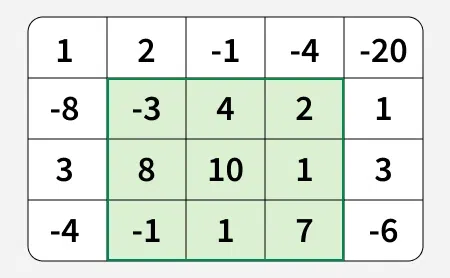
This problem is mainly an extension of theMaximum Subarray Sum.
Table of Content
- [Naive approach] - Iterating Over All Possible Submatrices - O((n*m)^3) time and O(1) space
- [Better Approach] - Using Prefix Sum - O((n*m)^2) time and O(n*m) space
- [Expected Approach] - Using Kadane’s Algorithm - O(n*m^2) time and O(n) space
[Naive approach] - Iterating Over All Possible Submatrices - O((n*m)3) time and O(1) space
We explore all possible rectangles in the given 2D array, by using four variables: two to define the left and right boundaries and two more to define the top and bottom boundaries and calculate their sums, and keep track of the maximum sum found.
C++ `
//Driver Code Starts #include #include #include using namespace std;
//Driver Code Ends
int maxRectSum(vector<vector> &mat) {
int n = mat.size();
int m = mat[0].size();
int maxSum = INT_MIN;

for (int up = 0; up < n; up++) {
    for (int left = 0; left < m; left++) {
        for (int down = up; down < n; down++) {
            for (int right = left; right < m; right++) {

                // Find the sum of submatrix(up, right, down, left)
                int sum = 0;
                for (int i = up; i <= down; i++) {
                    for (int j = left; j <= right; j++) {
                        sum += mat[i][j];
                    }
                }

                // Update maxSum if sum > maxSum.
                if (sum > maxSum) {
                    maxSum = sum;
                }
            }
        }
    }
}

return maxSum;
}
//Driver Code Starts
int main() { vector<vector> mat = {{1, 2, -1, -4, -20}, {-8, -3, 4, 2, 1}, {3, 8, 10, 1, 3}, {-4, -1, 1, 7, -6}};
cout << maxRectSum(mat) << endl;
return 0;
} //Driver Code Ends
Java
class GfG {
static int maxRectSum(int[][] mat) {
    int n = mat.length;
    int m = mat[0].length;
    int maxSum = Integer.MIN_VALUE;

    for (int up = 0; up < n; up++) {
        for (int left = 0; left < m; left++) {
            for (int down = up; down < n; down++) {
                for (int right = left; right < m; right++) {

                    // Find the sum of
                    // submatrix(up, right, down, left)
                    int sum = 0;
                    for (int i = up;
                         i <= down; i++) {
                        for (int j = left;
                             j <= right; j++) {
                            sum += mat[i][j];
                        }
                    }

                    // Update maxSum if sum > maxSum.
                    if (sum > maxSum) {
                        maxSum = sum;
                    }
                }
            }
        }
    }

    return maxSum;
}
public static void main(String[] args) {//Driver Code Starts int[][] mat = { { 1, 2, -1, -4, -20 }, { -8, -3, 4, 2, 1 }, { 3, 8, 10, 1, 3 }, { -4, -1, 1, 7, -6 } };
    System.out.println(maxRectSum(mat));
}
} //Driver Code Ends
Python
def maxRectSum(mat): n = len(mat) m = len(mat[0]) maxSum = float('-inf')
for up in range(n):
    for left in range(m):
        for down in range(up, n):
            for right in range(left, m):

                # Calculate the sum of submatrix
                # (up, left, down, right)
                subMatrixSum = 0
                for i in range(up, down + 1):
                    for j in range(left, right + 1):
                        subMatrixSum += mat[i][j]

                # Update maxSum if a larger sum is found
                maxSum = max(maxSum, subMatrixSum)

return maxSum
if name == "main":
mat = [
    [1, 2, -1, -4, -20],
    [-8, -3, 4, 2, 1],
    [3, 8, 10, 1, 3],
    [-4, -1, 1, 7, -6]
]

print(maxRectSum(mat))
C#
//Driver Code Starts using System; //Driver Code Ends
class GfG { static int maxRectSum(int[][] mat) { int n = mat.Length; int m = mat[0].Length; int maxSum = int.MinValue;
    for (int up = 0; up < n; up++) {
        for (int left = 0; left < m; left++) {
            for (int down = up; down < n; down++) {
                for (int right = left; right < m; right++) {

                    // Calculate the sum of submatrix
                    // (up, left, down, right)
                    int subMatrixSum = 0;
                    for (int i = up; i <= down; i++) {
                        for (int j = left; j <= right; j++) {
                            subMatrixSum += mat[i][j];
                        }
                    }

                    // Update maxSum if a larger sum is found
                    maxSum = Math.Max(maxSum, subMatrixSum);
                }
            }
        }
    }

    return maxSum;
}
//Driver Code Starts
static void Main(string[] args) {
    int[][] mat = {
        new int[] { 1, 2, -1, -4, -20 },
        new int[] { -8, -3, 4, 2, 1 },
        new int[] { 3, 8, 10, 1, 3 },
        new int[] { -4, -1, 1, 7, -6 }
    };

    Console.WriteLine(maxRectSum(mat));
}
} //Driver Code Ends
JavaScript
function maxRectSum(mat) { const n = mat.length; const m = mat[0].length; let maxSum = -Infinity;
for (let up = 0; up < n; up++) {
    for (let left = 0; left < m; left++) {
        for (let down = up; down < n; down++) {
            for (let right = left; right < m; right++) {

                // Calculate the sum of submatrix
                // (up, left, down, right)
                let subMatrixSum = 0;
                for (let i = up; i <= down; i++) {
                    for (let j = left; j <= right; j++) {
                        subMatrixSum += mat[i][j];
                    }
                }

                // Update maxSum if a larger sum is
                // found
                maxSum = Math.max(maxSum, subMatrixSum);
            }
        }
    }
}

return maxSum;
}
//Driver Code Starts // Driver Code const mat = [ [ 1, 2, -1, -4, -20 ], [ -8, -3, 4, 2, 1 ], [ 3, 8, 10, 1, 3 ], [ -4, -1, 1, 7, -6 ] ];
console.log(maxRectSum(mat)); //Driver Code Ends
`
[Better Approach] - Using Prefix Sum - O((n*m)2) time and O(n*m) space
In this approach, we used prefix sum matrix to efficiently compute the sum of any submatrix. We first precompute the prefix sum such that pref[i][j] stores the sum of all elements in the submatrix from the top-left corner (0, 0) to the cell (i, j). This preprocessing allows us to calculate the sum of any arbitrary submatrix in constant time using the inclusion-exclusion principle, thereby eliminating redundant computations and significantly improving performance.
Step by Step Approach:
- Initialize a 2D prefix sum matrix
pref[][]of the same size as the input matrix. - Precompute the prefix sum for each cell : pref[i][j] = matrix[i][j] + pref[i−1][j] + pref[i][j−1] − pref[i−1][j−1] (Handle edges separately to avoid index out-of-bound errors.)
- Iterate over all possible top-left corners
(up, left)and bottom-right corners(down, right)to define submatrices. - For each such submatrix, compute the sum using the prefix sum matrix in constant time: _sum = pref[down][right] − pref[up - 1][right] − pref[down][left−1] + pref[up-1][left - 1]
- Track the maximum sum obtained across all submatrices. C++ `
//Driver Code Starts #include #include #include using namespace std;
//Driver Code Ends
int findSum(int up, int left, int down, int right, vector<vector> &pref) {
// Start with the sum of the entire submatrix
// from (0, 0) to (down, right)
int sum = pref[down][right];

  // Subtract the area to the left of
  // the submatrix, if it exists
if (left - 1 >= 0) {
    sum -= pref[down][left - 1];
}

  // Subtract the area above
  // the submatrix, if it exists
if (up - 1 >= 0) {
    sum -= pref[up - 1][right];
}

// Add back the overlapping area
// that was subtracted twice
if (up - 1 >= 0 && left - 1 >= 0) {
    sum += pref[up - 1][left - 1];
}

return sum;
}
// function to find the maximum // sum rectangle in a 2D matrix int maxRectSum(vector<vector> &mat) { int n = mat.size(); int m = mat[0].size();
// Initialize the prefix sum matrix
vector<vector<int>> pref(n, vector<int>(m, 0));

// Row-wise sum
for (int i = 0; i < n; i++) {
    for (int j = 0; j < m; j++) {
        pref[i][j] = mat[i][j];
        if (j - 1 >= 0) {
            pref[i][j] += pref[i][j - 1];
        }
    }
}

// Column-wise sum
for (int j = 0; j < m; j++) {
    for (int i = 0; i < n; i++) {
        if (i - 1 >= 0) {
            pref[i][j] += pref[i - 1][j];
        }
    }
}

int maxSum = INT_MIN;

for (int up = 0; up < n; up++) {
    for (int left = 0; left < m; left++) {
        for (int down = up; down < n; down++) {
            for (int right = left; right < m; right++) {

                // Find the sum of submatrix(up, right, down, left)
                int sum = findSum(up, left, down, right, pref);

                // Update maxSum if sum > maxSum.
                if (sum > maxSum) {
                    maxSum = sum;
                }
            }
        }
    }
}

return maxSum;
}
//Driver Code Starts
int main() { vector<vector> mat = {{1, 2, -1, -4, -20}, {-8, -3, 4, 2, 1}, {3, 8, 10, 1, 3}, {-4, -1, 1, 7, -6}}; cout << maxRectSum(mat) << endl; } //Driver Code Ends
Java
class GfG {
static int findSum(int up, int left, int down, int right,
                  int[][] pref) {
    //  Start with the sum of the entire submatrix
    // from (0, 0) to (down, right)
    int sum = pref[down][right];

      // Subtract the area to the left of
      // the submatrix, if it exists
    if (left - 1 >= 0) {
        sum -= pref[down][left - 1];
    }

      // Subtract the area above
      // the submatrix, if it exists
    if (up - 1 >= 0) {
        sum -= pref[up - 1][right];
    }

    // Add back the overlapping area
    // that was subtracted twice
    if (up - 1 >= 0 && left - 1 >= 0) {
        sum += pref[up - 1][left - 1];
    }

    return sum;
}

// function to find the maximum
// sum rectangle in a 2D matrix
public static int maxRectSum(int[][] mat) {
    int n = mat.length;
    int m = mat[0].length;

    // Initialize the prefix sum matrix
    int[][] pref = new int[n][m];

    // Row-wise sum
    for (int i = 0; i < n; i++) {
        for (int j = 0; j < m; j++) {
            pref[i][j] = mat[i][j];
            if (j - 1 >= 0) {
                pref[i][j] += pref[i][j - 1];
            }
        }
    }

    // Column-wise sum
    for (int j = 0; j < m; j++) {
        for (int i = 0; i < n; i++) {
            if (i - 1 >= 0) {
                pref[i][j] += pref[i - 1][j];
            }
        }
    }

    // Find the maximum sum rectangle
    int maxSum = Integer.MIN_VALUE;

    for (int up = 0; up < n; up++) {
        for (int left = 0; left < m; left++) {
            for (int down = up; down < n; down++) {
                for (int right = left; right < m;
                                         right++) {
                    // Find the sum of the submatrix
                    // (up, left) to
                    // (down, right)
                    int sum = findSum( up, left, down,
                                          right, pref);

                    // Update maxSum if sum > maxSum
                    if (sum > maxSum) {
                        maxSum = sum;
                    }
                }
            }
        }
    }

    return maxSum;
}
//Driver Code Starts public static void main(String[] args) { int[][] mat = { { 1, 2, -1, -4, -20 }, { -8, -3, 4, 2, 1 }, { 3, 8, 10, 1, 3 }, { -4, -1, 1, 7, -6 } };
    System.out.println(maxRectSum(mat));
}
} //Driver Code Ends
Python
def findSum(up, left, down, right, pref): # Start with the sum of the entire submatrix # from (0, 0) to (down, right) totalSum = pref[down][right]
# Subtract the area to the left of
# the submatrix, if it exists
if left - 1 >= 0:
    totalSum -= pref[down][left - 1]

# Subtract the area above
# the submatrix, if it exists
if up - 1 >= 0:
    totalSum -= pref[up - 1][right]

# Add back the overlapping area
# that was subtracted twice
if up - 1 >= 0 and left - 1 >= 0:
    totalSum += pref[up - 1][left - 1]

return totalSum
Function to find the maximum
sum rectangle in a 2D matrix
def maxRectSum(mat): n = len(mat) m = len(mat[0])
# Initialize the prefix sum matrix
pref = [[0] * m for _ in range(n)]

# Row-wise sum
for i in range(n):
    for j in range(m):
        pref[i][j] = mat[i][j]
        if j - 1 >= 0:
            pref[i][j] += pref[i][j - 1]

# Column-wise sum
for j in range(m):
    for i in range(n):
        if i - 1 >= 0:
            pref[i][j] += pref[i - 1][j]

# Find the maximum sum rectangle
maxSum = float('-inf')

for up in range(n):
    for left in range(m):
        for down in range(up, n):
            for right in range(left, m):
                totalSum = findSum(up, left, down, right, pref)
                maxSum = max(maxSum, totalSum)

return maxSum
if name == "main": mat = [ [1, 2, -1, -4, -20], [-8, -3, 4, 2, 1], [3, 8, 10, 1, 3], [-4, -1, 1, 7, -6] ]
print(maxRectSum(mat))C#
//Driver Code Starts using System;
//Driver Code Ends
class GfG { static int findSum(int up, int left, int down, int right, int[,] pref) { // Start with the sum of the entire submatrix // from (0,0) to (down,right) int sum = pref[down, right];
    // Subtract the area to the left of
    // the submatrix, if it exists
    if (left - 1 >= 0)
        sum -= pref[down, left - 1];

    // Subtract the area above
    // the submatrix, if it exists
    if (up - 1 >= 0)
        sum -= pref[up - 1, right];

    // Add back the overlapping area
    // that was subtracted twice
    if (up - 1 >= 0 && left - 1 >= 0)
        sum += pref[up - 1, left - 1];

    return sum;
}

static int maxRectSum(int[,] mat) {
    int n = mat.GetLength(0);
    int m = mat.GetLength(1);

    // Initialize the prefix sum matrix
    int[,] pref = new int[n, m];

    // Compute row-wise prefix sum
    for (int i = 0; i < n; i++) {
        for (int j = 0; j < m; j++) {
            pref[i, j] = mat[i, j];
            if (j - 1 >= 0)
                pref[i, j] += pref[i, j - 1];
        }
    }

    // Compute column-wise prefix sum
    for (int j = 0; j < m; j++) {
        for (int i = 0; i < n; i++) {
            if (i - 1 >= 0)
                pref[i, j] += pref[i - 1, j];
        }
    }

    int maxSum = int.MinValue;

    // Check all possible submatrices
    for (int up = 0; up < n; up++) {
        for (int left = 0; left < m; left++) {
            for (int down = up; down < n; down++) {
                for (int right = left; right < m; right++) {
                    int totalSum = findSum(up, left, down, right, pref);
                    if (totalSum > maxSum)
                        maxSum = totalSum;
                }
            }
        }
    }

    return maxSum;
}
//Driver Code Starts
static void Main(string[] args) {
    int[,] mat = new int[,]
    {
        { 1, 2, -1, -4, -20 },
        { -8, -3, 4, 2, 1 },
        { 3, 8, 10, 1, 3 },
        { -4, -1, 1, 7, -6 }
    };

    Console.WriteLine(maxRectSum(mat));
}
} //Driver Code Ends
JavaScript
function findSum(up, left, down, right, pref) {
// Start with the sum of the entire submatrix
// from (0, 0) to (down, right)
let sum = pref[down][right];

  // Subtract the area to the left of
// the submatrix, if it exists
if (left - 1 >= 0) {
    sum -= pref[down][left - 1];
}

  // Subtract the area above
// the submatrix, if it exists
if (up - 1 >= 0) {
    sum -= pref[up - 1][right];
}

// Add back the overlapping area that was subtracted twice
if (up - 1 >= 0 && left - 1 >= 0) {
    sum += pref[up - 1][left - 1];
}

return sum;
}
// function to find the maximum sum // rectangle in a 2D matrix function maxRectSum(mat) { const n = mat.length; const m = mat[0].length;
// Create and initialize prefix sum matrix
const pref = Array.from({ length: n }, () => Array(m).fill(0));

// Row-wise prefix sum
for (let i = 0; i < n; i++) {
    for (let j = 0; j < m; j++) {
        pref[i][j] = mat[i][j];
        if (j - 1 >= 0) {
            pref[i][j] += pref[i][j - 1];
        }
    }
}

// Column-wise prefix sum
for (let j = 0; j < m; j++) {
    for (let i = 0; i < n; i++) {
        if (i - 1 >= 0) {
            pref[i][j] += pref[i - 1][j];
        }
    }
}

let maxSum = -Infinity;

// Try all submatrices
for (let up = 0; up < n; up++) {
    for (let left = 0; left < m; left++) {
        for (let down = up; down < n; down++) {
            for (let right = left; right < m; right++) {
                let sum = findSum(up, left, down, right, pref);
                if (sum > maxSum) {
                    maxSum = sum;
                }
            }
        }
    }
}
return maxSum;}
//Driver Code Starts // Driver code const mat = [ [ 1, 2, -1, -4, -20 ], [ -8, -3, 4, 2, 1 ], [ 3, 8, 10, 1, 3 ], [ -4, -1, 1, 7, -6 ] ];
console.log(maxRectSum(mat)); //Driver Code Ends
`
[Expected Approach] - Using Kadane’s Algorithm - O(n*m2) time and O(n) space
Instead of checking every possible submatrix, we fix two column boundaries: left and right. For each pair of columns, we compress the 2D matrix into a 1D array, where each element represents the sum of rows between the current left and right columns. This 1D array (temp[]) represents the column-wise sum for a fixed column window.
Now, we can apply Kadane’s algorithm on this temp[] array to find the maximum subarray sum, which corresponds to a rectangular submatrix with the maximum sum between columns left and right.
C++ `
//Driver Code Starts #include #include #include
using namespace std;
//Driver Code Ends
int kadane(vector& temp) { int rows = temp.size(); int currSum = 0; int maxSum = INT_MIN;
for (int i = 0; i < rows; i++) {
    currSum += temp[i];

    // Update maxSum if the current sum is greater
    if (maxSum < currSum) {
        maxSum = currSum;
    }

    // If the current sum becomes negative, reset it to 0
    if (currSum < 0) {
        currSum = 0;
    }
}

return maxSum;
}
// Function to find the maximum // sum rectangle in a 2D matrix int maxRectSum(vector<vector> &mat) { int rows = mat.size(); int cols = mat[0].size();
int maxSum = INT_MIN;

// Initialize a temporary array to store row-wise
  // sums between left and right boundaries
vector<int> temp(rows);

// Check for all possible left and right boundaries
for (int left = 0; left < cols; left++) {

    // Reset the temporary array for each new left boundary
    for (int i = 0; i < rows; i++)
        temp[i] = 0;

    for (int right = left; right < cols; right++) {

        // Update the temporary array with the current
          // column's values
        for (int row = 0; row < rows; row++) {
            temp[row] += mat[row][right];
        }

        // Find the maximum sum of the subarray for the
          // current column boundaries
        int sum = kadane(temp);

        // Update the maximum sum found so far
        maxSum = max(maxSum, sum);
    }
}

return maxSum;
}
//Driver Code Starts
int main() { vector<vector> mat = {{1, 2, -1, -4, -20}, {-8, -3, 4, 2, 1}, {3, 8, 10, 1, 3}, {-4, -1, 1, 7, -6}};
int res = maxRectSum(mat);
cout << res << endl;

return 0;
}
//Driver Code Ends
Java
class GfG {
static int kadane(int[] temp) {
    int rows = temp.length;
    int currSum = 0;
    int maxSum = Integer.MIN_VALUE;

    for (int i = 0; i < rows; i++) {
        currSum += temp[i];

        // Update maxSum if the current sum is greater
        if (maxSum < currSum) {
            maxSum = currSum;
        }

        // If the current sum becomes negative, reset it
        // to 0
        if (currSum < 0) {
            currSum = 0;
        }
    }

    return maxSum;
}

// Function to find the maximum
// sum rectangle in a 2D matrix
static int maxRectSum(int[][] mat) {
    int rows = mat.length;
    int cols = mat[0].length;

    int maxSum = Integer.MIN_VALUE;

    // Initialize a temporary array to store row-wise
    // sums between left and right boundaries
    int[] temp = new int[rows];

    // Check for all possible left and right boundaries
    for (int left = 0; left < cols; left++) {

        // Reset the temporary array for each new left
        // boundary
        for (int i = 0; i < rows; i++) {
            temp[i] = 0;
        }

        for (int right = left; right < cols; right++) {

            // Update the temporary array with the
            // current column's values
            for (int row = 0; row < rows; row++) {
                temp[row] += mat[row][right];
            }

            // Find the maximum sum of the subarray for
            // the current column boundaries
            int sum = kadane(temp);

            // Update the maximum sum found so far
            maxSum = Math.max(maxSum, sum);
        }
    }

    return maxSum;
}
//Driver Code Starts public static void main(String[] args) { int[][] mat = { { 1, 2, -1, -4, -20 }, { -8, -3, 4, 2, 1 }, { 3, 8, 10, 1, 3 }, { -4, -1, 1, 7, -6 } };
    int res = maxRectSum(mat);
    System.out.println(res);
}
} //Driver Code Ends
Python
def kadane(temp): rows = len(temp)
currSum = 0
maxSum = float('-inf')

for i in range(rows):
    currSum += temp[i]

    # Update maxSum if the current sum is greater
    if maxSum < currSum:
        maxSum = currSum

    # If the current sum becomes negative, reset it to 0
    if currSum < 0:
        currSum = 0

return maxSum
def maxRectSum(mat): rows = len(mat) cols = len(mat[0])
maxSum = float('-inf')

# Initialize a temporary array to store row-wise
# sums between left and right boundaries
temp = [0] * rows

# Check for all possible left and right boundaries
for left in range(cols):
    # Reset the temporary array for each new left
    # boundary
    temp = [0] * rows

    for right in range(left, cols):
        # Update the temporary array with the current
        # column's values
        for row in range(rows):
            temp[row] += mat[row][right]

        # Find the maximum sum of the subarray for the
        # current column boundaries
        sumValue = kadane(temp)

        # Update the maximum sum found so far
        maxSum = max(maxSum, sumValue)

return maxSum
if name == "main":
mat = [
    [1, 2, -1, -4, -20],
    [-8, -3, 4, 2, 1],
    [3, 8, 10, 1, 3],
    [-4, -1, 1, 7, -6]
]

res = maxRectSum(mat)
print(res)
C#
//Driver Code Starts using System;
//Driver Code Ends
class GfG {
static int kadane(int[] temp) {
    int rows = temp.Length;
    int currSum = 0;
    int maxSum = int.MinValue;

    for (int i = 0; i < rows; i++) {
        currSum += temp[i];

        // Update maxSum if the current sum is greater
        if (maxSum < currSum) {
            maxSum = currSum;
        }

        // If the current sum becomes negative, reset it
        // to 0
        if (currSum < 0) {
            currSum = 0;
        }
    }

    return maxSum;
}

// Function to find the maximum
// sum of submatrix
static int maxRectSum(int[, ] mat) {
    int rows = mat.GetLength(0);
    int cols = mat.GetLength(1);

    int maxSum = int.MinValue;

    // Initialize a temporary array to store row-wise
    // sums between left and right boundaries
    int[] temp = new int[rows];

    // Check for all possible left and right boundaries
    for (int left = 0; left < cols; left++) {

        // Reset the temporary array for each new left
        // boundary
        Array.Clear(temp, 0, rows);

        for (int right = left; right < cols; right++) {

            // Update the temporary array with the
            // current column's values
            for (int row = 0; row < rows; row++) {
                temp[row] += mat[row, right];
            }

            // Find the maximum sum of the subarray for
            // the current column boundaries
            int sumValue = kadane(temp);

            // Update the maximum sum found so far
            maxSum = Math.Max(maxSum, sumValue);
        }
    }

    return maxSum;
}
//Driver Code Starts
static void Main() {

    int[, ] mat = { { 1, 2, -1, -4, -20 },
                    { -8, -3, 4, 2, 1 },
                    { 3, 8, 10, 1, 3 },
                    { -4, -1, 1, 7, -6 } };

    int res = maxRectSum(mat);
    Console.WriteLine(res);
}
} //Driver Code Ends
JavaScript
function kadane(temp) { let rows = temp.length; let currSum = 0; let maxSum = -Infinity;
for (let i = 0; i < rows; i++) {
    currSum += temp[i];

    // Update maxSum if the current sum is greater
    if (maxSum < currSum) {
        maxSum = currSum;
    }

    // If the current sum becomes negative, reset it to
    // 0
    if (currSum < 0) {
        currSum = 0;
    }
}

return maxSum;
}
// Function to find the maximum sum of submatrix function maxRectSum(mat) { const rows = mat.length; const cols = mat[0].length;
let maxSum = -Infinity;

// Initialize a temporary array to store row-wise sums
// between left and right boundaries
let temp = new Array(rows).fill(0);

// Check for all possible left and right boundaries
for (let left = 0; left < cols; left++) {

    // Reset the temporary array for each new left
    // boundary
    temp.fill(0);

    for (let right = left; right < cols; right++) {

        // Update the temporary array with the current
        // column's values
        for (let row = 0; row < rows; row++) {
            temp[row] += mat[row][right];
        }

        // Find the maximum sum of the subarray for the
        // current column boundaries
        let sumValue = kadane(temp, rows);

        // Update the maximum sum found so far
        maxSum = Math.max(maxSum, sumValue);
    }
}

return maxSum;
}
//Driver Code Starts // Driver Code const mat = [ [ 1, 2, -1, -4, -20 ], [ -8, -3, 4, 2, 1 ], [ 3, 8, 10, 1, 3 ], [ -4, -1, 1, 7, -6 ] ];
const res = maxRectSum(mat); console.log(res);
//Driver Code Ends
`