Merge two sorted linked lists (original) (raw)
Last Updated : 30 Aug, 2025
Given the **heads of two sorted linked lists, merge them into a single sorted linked list and return the head of the merged list.
**Examples:
**Input:
**Output: 2 -> 3 -> 5 -> 10 -> 15 -> 20 -> 40
**Explanation: Merging two sorted lists [5, 10, 15, 40] and [2, 3, 20] in order gives 2 -> 3 -> 5 -> 10 -> 15 -> 20 -> 40.
**Input:
**Output: 1 -> 1 -> 2 -> 4
**Explanation: Merging [1 ,1] and [2, 4] in order gives 1 -> 1 -> 2 -> 4.
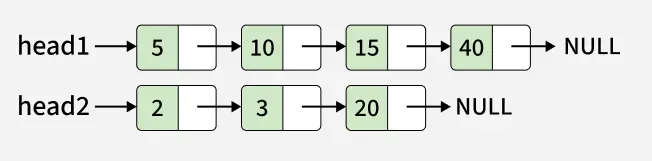

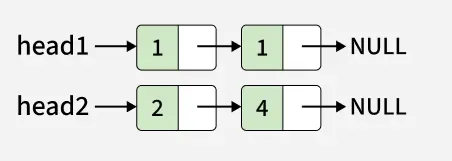


Table of Content
- [Naive Approach] By Using Array - O((n+m) × log(n+m)) Time and O(n+m) Space
- [Better Approach] Using Recursive Merge - O(n+m) Time and O(n+m) Space
- [Efficient Approach] Using Iterative Merge - O(n+m) Time and O(1) Space
[Naive Approach] By Using Array - O((n+m) × log(n+m)) Time and O(n+m) Space
The idea is to use an array to store all the node data from both linked lists, sort the array, and then construct the resultant sorted linked list from the array elements.
C++ `
#include #include #include using namespace std;
class Node { public: int data; Node *next;
Node(int x) {
    data = x;
    next = nullptr;
}
};
Node *sortedMerge(Node *head1, Node *head2) { vector arr;
// pushing the values of the first linked list
while (head1 != nullptr) {
    arr.push_back(head1->data);
    head1 = head1->next;
}

// pushing the values of the second linked list
while (head2 != nullptr) {
    arr.push_back(head2->data);
    head2 = head2->next;
}

// sorting the vector
sort(arr.begin(), arr.end());

// creating a new list with sorted values
Node *dummy = new Node(-1);
Node *curr = dummy;

for (int i = 0; i < arr.size(); i++) {
    curr->next = new Node(arr[i]);
    curr = curr->next;
}

return dummy->next;
}
void printList(Node *curr) { while (curr != nullptr) { cout << curr->data; if (curr->next != nullptr) cout << " -> "; curr = curr->next; } cout << endl; }
int main() {
Node *head1 = new Node(5);
head1->next = new Node(10);
head1->next->next = new Node(15);
head1->next->next->next = new Node(40);

Node *head2 = new Node(2);
head2->next = new Node(3);
head2->next->next = new Node(20);

Node *res = sortedMerge(head1, head2);

printList(res);

return 0;
}
Java
import java.util.ArrayList; import java.util.Collections;
class Node { int data; Node next;
Node(int x)
{
    data = x;
    next = null;
}
}
class GfG {
static Node sortedMerge(Node head1,
                                   Node head2) {
    ArrayList<Integer> arr = new ArrayList<>();

    // pushing the values of the first linked list
    while (head1 != null) {
        arr.add(head1.data);
        head1 = head1.next;
    }

    // pushing the values of the second linked list
    while (head2 != null) {
        arr.add(head2.data);
        head2 = head2.next;
    }

    // sorting the list
    Collections.sort(arr);

    // creating a new list with sorted values
    Node dummy = new Node(-1);
    Node curr = dummy;

    for (int i = 0; i < arr.size(); i++) {
        curr.next = new Node(arr.get(i));
        curr = curr.next;
    }

    return dummy.next;
}

static void printList(Node curr) {
    while (curr != null) {
        System.out.print(curr.data);
        if (curr.next != null) {
            System.out.print(" -> ");
        }
        curr = curr.next;
    }
    System.out.println();
}

public static void main(String[] args) {

    Node head1 = new Node(5);
    head1.next = new Node(10);
    head1.next.next = new Node(15);
    head1.next.next.next = new Node(40);

    Node head2 = new Node(2);
    head2.next = new Node(3);
    head2.next.next = new Node(20);

    Node res = sortedMerge(head1, head2);
    printList(res);
}
}
Python
class Node: def init(self, x): self.data = x self.next = None
def sortedMerge(head1, head2): arr = []
# pushing the values of the first linked list
while head1 is not None:
    arr.append(head1.data)
    head1 = head1.next

# pushing the values of the second linked list
while head2 is not None:
    arr.append(head2.data)
    head2 = head2.next

# sorting the list
arr.sort()

# creating a new list with sorted values
dummy = Node(-1)
curr = dummy

for value in arr:
    curr.next = Node(value)
    curr = curr.next

return dummy.next
def printList(node): while node is not None: print(f"{node.data}", end="") if node.next is not None: print(" -> ", end="") node = node.next print()
if name == "main":
head1 = Node(5)
head1.next = Node(10)
head1.next.next = Node(15)
head1.next.next.next = Node(40)

head2 = Node(2)
head2.next = Node(3)
head2.next.next = Node(20)

res = sortedMerge(head1, head2)

printList(res)
C#
using System; using System.Collections.Generic;
class Node { public int data; public Node next;
public Node(int x) {
    data = x;
    next = null;
}
}
class GfG {
static Node sortedMerge(Node head1,
                                   Node head2) {
    List<int> arr = new List<int>();

    // pushing the values of the first linked list
    while (head1 != null) {
        arr.Add(head1.data);
        head1 = head1.next;
    }

    // pushing the values of the second linked list
    while (head2 != null) {
        arr.Add(head2.data);
        head2 = head2.next;
    }

    // sorting the list
    arr.Sort();

    // creating a new list with sorted values
    Node dummy = new Node(-1);
    Node curr = dummy;

    foreach(int value in arr) {
        curr.next = new Node(value);
        curr = curr.next;
    }

    return dummy.next;
}

static void printList(Node curr) {
    while (curr != null) {
        Console.Write(curr.data);
        if (curr.next != null) {
            Console.Write(" -> ");
        }
        curr = curr.next;
    }
    Console.WriteLine();
}

static void Main(string[] args) {

    Node head1 = new Node(5);
    head1.next = new Node(10);
    head1.next.next = new Node(15);
    head1.next.next.next = new Node(40);

    Node head2 = new Node(2);
    head2.next = new Node(3);
    head2.next.next = new Node(20);

    Node res = sortedMerge(head1, head2);

    printList(res);
}
}
JavaScript
class Node { constructor(x) { this.data = x; this.next = null; } }
function sortedMerge(head1, head2) { let arr = [];
// pushing the values of the first linked list
while (head1 !== null) {
    arr.push(head1.data);
    head1 = head1.next;
}

// pushing the values of the second linked list
while (head2 !== null) {
    arr.push(head2.data);
    head2 = head2.next;
}

// sorting the array
arr.sort((x, y) => x - y);

// creating a new list with sorted values
let dummy = new Node(-1);
let curr = dummy;

for (let value of arr) {
    curr.next = new Node(value);
    curr = curr.next;
}

return dummy.next;
}
function printList(node) { while (node !== null) { process.stdout.write(node.data.toString()); if (node.next !== null) { process.stdout.write(" -> "); } node = node.next; } }
let head1 = new Node(5); head1.next = new Node(10); head1.next.next = new Node(15); head1.next.next.next = new Node(40);
let head2 = new Node(2); head2.next = new Node(3); head2.next.next = new Node(20);
let res = sortedMerge(head1, head2); printList(res);
`
Output
2 -> 3 -> 5 -> 10 -> 15 -> 20 -> 40
[Better Approach] Using Recursive Merge - O(n+m) Time and O(n+m) Space
The idea is to pick the smaller head node at each step and let recursion merge the remaining parts. if one list is empty, return the other; otherwise the smaller node becomes the next node in the merged list and its next is the recursive merge of the rest.
**Algorithm:
- If head1 is null, return head2.
- If head2 is null, return head1.
- Compare head1.data and head2.data.
- If head1.data <= head2.data:
=> set head = head1
=> set head.next = merge(head1.next, head2)
Else:
=> set head = head2
=> set head.next = merge(head1, head2.next) - Return head. C++ `
#include using namespace std;
class Node { public: int data; Node* next;
Node(int x) {
    data = x;
    next = nullptr;
}
};
Node* sortedMerge(Node* head1, Node* head2) {
// base cases
if (head1 == nullptr)
    return head2;
if (head2 == nullptr)
    return head1;

// recursive merging based on smaller value
if (head1->data <= head2->data) {
    head1->next = sortedMerge(head1->next, head2);
    return head1;
} else {
    head2->next = sortedMerge(head1, head2->next);
    return head2;
}
}
void printList(Node* curr) { while (curr != nullptr) { cout << curr->data; if (curr->next != nullptr) cout << " -> "; curr = curr->next; } cout << endl; }
int main() { Node* head1 = new Node(5); head1->next = new Node(10); head1->next->next = new Node(15); head1->next->next->next = new Node(40);
Node* head2 = new Node(2);
head2->next = new Node(3);
head2->next->next = new Node(20);

Node* res = sortedMerge(head1, head2);
printList(res);

return 0;
}
C
#include <stdio.h> #include <stdlib.h>
struct Node { int data; struct Node *next; };
struct Node *sortedMerge(struct Node *head1, struct Node *head2) {
// base cases
if (head1 == NULL)
    return head2;
if (head2 == NULL)
    return head1;

// recursive merging based on smaller value
if (head1->data <= head2->data) {
    head1->next = sortedMerge(head1->next, head2);
    return head1;
}
else {
    head2->next = sortedMerge(head1, head2->next);
    return head2;
}
}
void printList(struct Node *curr) { while (curr != NULL) { printf("%d", curr->data); if (curr->next != NULL) { printf(" -> "); } curr = curr->next; } printf("\n"); }
struct Node *createNode(int data) { struct Node *newNode = (struct Node *)malloc(sizeof(struct Node)); newNode->data = data; newNode->next = NULL; return newNode; }
int main() {
struct Node *head1 = createNode(5);
head1->next = createNode(10);
head1->next->next = createNode(15);
head1->next->next->next = createNode(40);

struct Node *head2 = createNode(2);
head2->next = createNode(3);
head2->next->next = createNode(20);

struct Node *res = sortedMerge(head1, head2);

printList(res);

return 0;
}
Java
class Node { int data; Node next;
Node(int x) {
    data = x;
    next = null;
}
}
class GfG {
static Node sortedMerge(Node head1, Node head2) {

    // base cases
    if (head1 == null)
        return head2;
    if (head2 == null)
        return head1;

    // recursive merging based on smaller value
    if (head1.data <= head2.data) {
        head1.next = sortedMerge(head1.next, head2);
        return head1;
    }
    else {
        head2.next = sortedMerge(head1, head2.next);
        return head2;
    }
}

static void printList(Node curr) {
    while (curr != null) {
        System.out.print(curr.data);
        if (curr.next != null)
            System.out.print(" -> ");
        curr = curr.next;
    }
    System.out.println();
}

public static void main(String[] args) {

    Node head1 = new Node(5);
    head1.next = new Node(10);
    head1.next.next = new Node(15);
    head1.next.next.next = new Node(40);

    Node head2 = new Node(2);
    head2.next = new Node(3);
    head2.next.next = new Node(20);

    Node res = sortedMerge(head1, head2);
    printList(res);
}
}
Python
class Node: def init(self, x): self.data = x self.next = None
def sortedMerge(head1, head2):
# base cases
if head1 is None:
    return head2
if head2 is None:
    return head1

# recursive merging based on smaller value
if head1.data <= head2.data:
    head1.next = sortedMerge(head1.next, head2)
    return head1
else:
    head2.next = sortedMerge(head1, head2.next)
    return head2
def printList(node): while node is not None: print(f"{node.data}", end="") if node.next is not None: print(" -> ", end="") node = node.next print()
if name == "main":
head1 = Node(5)
head1.next = Node(10)
head1.next.next = Node(15)
head1.next.next.next = Node(40)

head2 = Node(2)
head2.next = Node(3)
head2.next.next = Node(20)

res = sortedMerge(head1, head2)
printList(res)
C#
using System;
class Node { public int data; public Node next;
public Node(int x) {
    data = x;
    next = null;
}
}
class GfG {
static Node sortedMerge(Node head1,
                                   Node head2) {

    // base cases
    if (head1 == null)
        return head2;
    if (head2 == null)
        return head1;

    // recursive merging based on smaller value
    if (head1.data <= head2.data) {
        head1.next = sortedMerge(head1.next, head2);
        return head1;
    }
    else {
        head2.next = sortedMerge(head1, head2.next);
        return head2;
    }
}

static void printList(Node curr) {
    while (curr != null) {
        Console.Write(curr.data);
        if (curr.next != null)
            Console.Write(" -> ");
        curr = curr.next;
    }
    Console.WriteLine();
}

static void Main(string[] args) {

    Node head1 = new Node(5);
    head1.next = new Node(10);
    head1.next.next = new Node(15);
    head1.next.next.next = new Node(40);

    Node head2 = new Node(2);
    head2.next = new Node(3);
    head2.next.next = new Node(20);

    Node res = sortedMerge(head1, head2);

    printList(res);
}
}
JavaScript
class Node { constructor(x) { this.data = x; this.next = null; } }
function sortedMerge(head1, head2) {
// base cases
if (head1 === null)
    return head2;
if (head2 === null)
    return head1;

// recursive merging based on smaller value
if (head1.data <= head2.data) {
    head1.next = sortedMerge(head1.next, head2);
    return head1;
}
else {
    head2.next = sortedMerge(head1, head2.next);
    return head2;
}
}
function printList(node) { while (node !== null) { process.stdout.write(node.data.toString()); if (node.next !== null) { process.stdout.write(" -> "); } node = node.next; } }
// Driver Code let head1 = new Node(5); head1.next = new Node(10); head1.next.next = new Node(15); head1.next.next.next = new Node(40);
let head2 = new Node(2); head2.next = new Node(3); head2.next.next = new Node(20); let res = sortedMerge(head1, head2); printList(res);
`
Output
2 -> 3 -> 5 -> 10 -> 15 -> 20 -> 40
[Efficient Approach] Using Iterative Merge - O(n+m) Time and O(1) Space
The idea is to iteratively merge two sorted linked lists using a dummy node to simplify the process. A current pointer tracks the last node of the merged list. We compare the nodes from both lists and append the smaller node to the merged list. Once one list is fully traversed, the remaining nodes from the other list are appended. The merged list is returned starting from the node after the dummy node.
**Working:
C++ `
#include using namespace std;
class Node { public: int data; Node* next;
Node(int x) {
    data = x;
    next = nullptr;
}
};
Node* sortedMerge(Node* head1, Node* head2) {
// create a dummy node to simplify
// the merging process
Node* dummy = new Node(-1);
Node* curr = dummy;

// iterate through both linked lists
while (head1 != nullptr && head2 != nullptr) {

    // add the smaller node to the merged list
    if (head1->data <= head2->data) {
        curr->next = head1;
        head1 = head1->next;
    } else {
        curr->next = head2;
        head2 = head2->next;
    }
    curr = curr->next;
}

// if any list is left, append it to
// the merged list
if (head1 != nullptr) {
    curr->next = head1;
} else {
    curr->next = head2;
}

// return the merged list starting
// from the next of dummy node
return dummy->next;
}
void printList(Node* head) {
while (head != nullptr) {
    cout << head->data;
    if (head->next != nullptr)
        cout << " -> ";
    head = head->next;
}
cout << endl;
}
int main() {
Node* head1 = new Node(5);
head1->next = new Node(10);
head1->next->next = new Node(15);
head1->next->next->next = new Node(40);

Node* head2 = new Node(2);
head2->next = new Node(3);
head2->next->next = new Node(20);

Node* res = sortedMerge(head1, head2);
printList(res);

return 0;
}
C
#include <stdio.h> #include <stdlib.h>
struct Node { int data; struct Node* next; };
struct Node* createNode(int data);
struct Node* sortedMerge(struct Node* head1, struct Node* head2) {
// create a dummy node to simplify
// the merging process
struct Node* dummy = createNode(-1);
struct Node* curr = dummy;

// iterate through both linked lists
while (head1 != NULL && head2 != NULL) {

    // add the smaller node to the merged list
    if (head1->data <= head2->data) {
        curr->next = head1;
        head1 = head1->next;
    } else {
        curr->next = head2;
        head2 = head2->next;
    }
    curr = curr->next;
}

// if any list is left, append it to
// the merged list
if (head1 != NULL) {
    curr->next = head1;
} else {
    curr->next = head2;
}

// return the merged list starting
// from the next of dummy node
return dummy->next;
}
void printList(struct Node* head) { while (head != NULL) { printf("%d", head->data); if (head->next != NULL) { printf(" -> "); } head = head->next; } printf("\n"); }
struct Node* createNode(int data) { struct Node* newNode = (struct Node*)malloc(sizeof(struct Node)); newNode->data = data; newNode->next = NULL; return newNode; }
int main() {
struct Node* head1 = createNode(5);
head1->next = createNode(10);
head1->next->next = createNode(15);
head1->next->next->next = createNode(40);

struct Node* head2 = createNode(2);
head2->next = createNode(3);
head2->next->next = createNode(20);

struct Node* res = sortedMerge(head1, head2);

printList(res);

return 0;
}
Java
class Node { int data; Node next;
Node(int x) {
    data = x;
    next = null;
}
}
class GfG {
static Node sortedMerge(Node head1,
                                   Node head2) {

    // create a dummy node to simplify
    // the merging process
    Node dummy = new Node(-1);
    Node curr = dummy;

    // iterate through both linked lists
    while (head1 != null && head2 != null) {

        // add the smaller node to the merged list
        if (head1.data <= head2.data) {
            curr.next = head1;
            head1 = head1.next;
        } else {
            curr.next = head2;
            head2 = head2.next;
        }
        curr = curr.next;
    }

    // if any list is left, append it to
    // the merged list
    if (head1 != null) {
        curr.next = head1;
    } else {
        curr.next = head2;
    }

    // return the merged list starting from
    // the next of dummy node
    return dummy.next;
}

static void printList(Node head) {
    while (head != null) {
        System.out.print(head.data);
        if (head.next != null)
            System.out.print(" -> ");
        head = head.next;
    }
    System.out.println();
}

public static void main(String[] args) {

    Node head1 = new Node(5);
    head1.next = new Node(10);
    head1.next.next = new Node(15);
    head1.next.next.next = new Node(40);

    Node head2 = new Node(2);
    head2.next = new Node(3);
    head2.next.next = new Node(20);

    Node res = sortedMerge(head1, head2);
    printList(res);
}
}
Python
class Node: def init(self, x): self.data = x self.next = None
def sortedMerge(head1, head2):
# create a dummy node to simplify
# the merging process
dummy = Node(-1)
curr = dummy

# iterate through both linked lists
while head1 is not None and head2 is not None:

    # add the smaller node to the merged list
    if head1.data <= head2.data:
        curr.next = head1
        head1 = head1.next
    else:
        curr.next = head2
        head2 = head2.next
    curr = curr.next

# if any list is left, append it to the merged list
if head1 is not None:
    curr.next = head1
else:
    curr.next = head2

# return the merged list starting from
# the next of dummy node
return dummy.next
def printList(head): while head is not None: if head.next is not None: print(head.data, end=" -> ") else: print(head.data) head = head.next
if name == "main":
head1 = Node(5)
head1.next = Node(10)
head1.next.next = Node(15)
head1.next.next.next = Node(40)

head2 = Node(2)
head2.next = Node(3)
head2.next.next = Node(20)

res = sortedMerge(head1, head2)

printList(res)
C#
using System;
class Node { public int data; public Node next;
public Node(int x) {
    data = x;
    next = null;
}
}
class GfG {
static Node sortedMerge(Node head1, Node head2) {

    // create a dummy node to simplify the
    // merging process
    Node dummy = new Node(-1);
    Node curr = dummy;

    // iterate through both linked lists
    while (head1 != null && head2 != null) {

        // add the smaller node to the merged list
        if (head1.data <= head2.data) {
            curr.next = head1;
            head1 = head1.next;
        } else {
            curr.next = head2;
            head2 = head2.next;
        }
        curr = curr.next;
    }

    // if any list is left, append it to the
    // merged list
    if (head1 != null) {
        curr.next = head1;
    } else {
        curr.next = head2;
    }

    // return the merged list starting from
    // the next of dummy node
    return dummy.next;
}

static void printList(Node head) {
    while (head != null) {
        Console.Write(head.data);
        if (head.next != null)
            Console.Write(" -> ");
        head = head.next;
    }
    Console.WriteLine();
}

static void Main(string[] args) {

    Node head1 = new Node(5);
    head1.next = new Node(10);
    head1.next.next = new Node(15);
    head1.next.next.next = new Node(40);

    Node head2 = new Node(2);
    head2.next = new Node(3);
    head2.next.next = new Node(20);

    Node res = sortedMerge(head1, head2);
    printList(res);
}
}
JavaScript
class Node { constructor(x) { this.data = x; this.next = null; } }
function sortedMerge(head1, head2) {
// create a dummy node to simplify the merging process
let dummy = new Node(-1);
let curr = dummy;

// iterate through both linked lists
while (head1 !== null && head2 !== null) {

    // add the smaller node to the merged list
    if (head1.data <= head2.data) {
        curr.next = head1;
        head1 = head1.next;
    }
    else {
        curr.next = head2;
        head2 = head2.next;
    }
    curr = curr.next;
}

// if any list is left, append it
// to the merged list
if (head1 !== null) {
    curr.next = head1;
}
else {
    curr.next = head2;
}

// return the merged list starting from
// the next of dummy node
return dummy.next;
}
function printList(head) { let result = ""; while (head !== null) { result += head.data; if (head.next !== null) { result += " -> "; } head = head.next; } console.log(result); }
// Driver code let head1 = new Node(5); head1.next = new Node(10); head1.next.next = new Node(15); head1.next.next.next = new Node(40);
let head2 = new Node(2); head2.next = new Node(3); head2.next.next = new Node(20);
let res = sortedMerge(head1, head2); printList(res);
`
Output
2 -> 3 -> 5 -> 10 -> 15 -> 20 -> 40