Minimax Algorithm in Game Theory | Set 1 (Introduction) (original) (raw)
Last Updated : 27 May, 2026
Minimax is a backtracking-based algorithm used in game theory and AI to determine the optimal move in competitive games by evaluating all possible future outcomes, assuming both players act optimally.
- Works in two-player, turn-based, zero-sum games
- Builds a decision process based on game states and outcomes
- Widely used in strategic games like Tic-Tac-Toe and Chess
**Key Concepts
- **Maximizer: Player who tries to maximize the final score or outcome
- **Minimizer: Player who tries to minimize the final score or opponent’s advantage
- **Game State: Representation of the current configuration of the game
- **Utility Value: Numerical score assigned to terminal states to represent win, loss, or draw outcomes
- **Game Tree: Tree structure representing all possible moves and resulting states
- **Heuristic Evaluation: Function used to estimate the value of non-terminal states when full exploration is not possible
Working
- Constructs a game tree where nodes represent game states and edges represent possible moves
- Expands all possible future moves up to terminal states or a depth limit
- Assigns utility values to leaf nodes using game outcomes or heuristic evaluation
- Propagates values upward: maximizer selects maximum value, minimizer selects minimum value
- Final decision is made at the root node based on optimal play assumption by both players
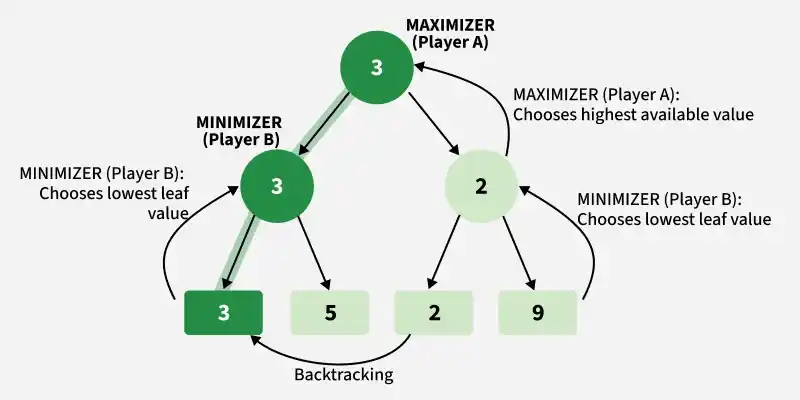
Working of Minimax Algorithm
Implementation
Implementing the Minimax algorithm using a simple game tree where leaf nodes represent final scores, and the algorithm finds the optimal value assuming both players play optimally.
**Step 1: Importing Required Module
Using the math module to compute the depth of the game tree.
Python `
import math
`
**Step 2: Defining Minimax Function
This function recursively evaluates the game tree and returns the optimal value based on maximizing and minimizing turns.
Python `
def minimax(curDepth, nodeIndex, maxTurn, scores, targetDepth):
if curDepth == targetDepth:
    return scores[nodeIndex]

if maxTurn:
    return max(
        minimax(curDepth + 1, nodeIndex * 2, False, scores, targetDepth),
        minimax(curDepth + 1, nodeIndex * 2 + 1, False, scores, targetDepth)
    )
else:
    return min(
        minimax(curDepth + 1, nodeIndex * 2, True, scores, targetDepth),
        minimax(curDepth + 1, nodeIndex * 2 + 1, True, scores, targetDepth)
    )
`
**Step 3: Defining game states
We define leaf node values representing final game outcomes.
Python `
scores = [3, 5, 2, 9, 12, 5, 23, 23]
`
**Step 4: Computing the tree depth
Calculating the depth of the binary game tree using logarithm.
Python `
treeDepth = int(math.log(len(scores), 2))
`
**Step 5: Run the Minimax algorithm
We start evaluation from the root node assuming the maximizer plays first.
Python `
print("The optimal value is:", minimax(0, 0, True, scores, treeDepth))
`
**Output:
The optimal value is: 12
**Advantages
- Guarantees optimal move selection under perfect play assumption
- Works well for deterministic, turn-based, zero-sum games
- Serves as the base for advanced techniques like Alpha-Beta Pruning
- Suitable for problems with limited search space
**Limitations
- Exponential time complexity makes it inefficient for large game trees
- Explores all possible moves regardless of usefulness
- Not scalable for complex games without optimization
- Requires high computational resources for deeper searches